Category of income
Boxes a to g for section 951A category, foreign branch, passive, general, section 901(j), income re-sourced by treaty and lump-sum distributions. One box is checked on each form. Line h names the country of residence.
1116
Foreign Tax Credit (Individual, Estate, or Trust)
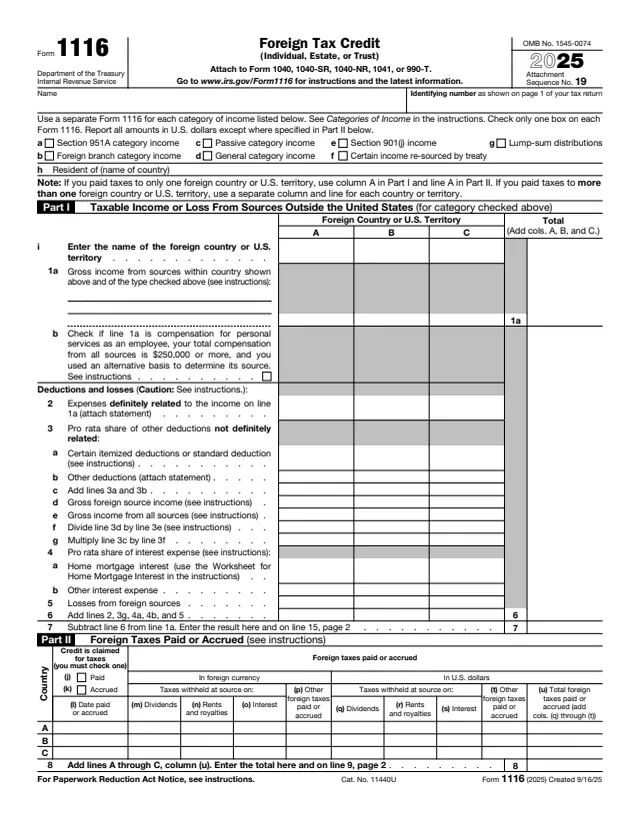
Form 1116, Foreign Tax Credit (Individual, Estate, or Trust), figures the credit for income taxes paid or accrued to a foreign country or U.S. territory. The IRS About page says it is filed to claim the foreign tax credit by an individual, estate or trust that paid or accrued certain foreign taxes to a foreign country or U.S. possession. This page covers the 2025 form.
The form is attached to Form 1040, 1040-SR, 1040-NR, 1041 or 990-T. A separate Form 1116 is used for each category of income, such as passive or general category income. Part I figures taxable income from sources outside the United States, Part II lists the foreign taxes, Part III figures the credit and its limit, and Part IV sums the credits from every category.
The instructions describe an election that lets some filers claim the credit without the form. You can fill out Form 1116 free in your browser on this page and download it without an account.
Boxes a to g for section 951A category, foreign branch, passive, general, section 901(j), income re-sourced by treaty and lump-sum distributions. One box is checked on each form. Line h names the country of residence.
Columns A to C for each country or territory: gross foreign income on line 1a, expenses, pro rata deductions, interest expense and foreign losses, and the result on line 7.
A Paid or Accrued box, the date, and taxes withheld on dividends, rents and royalties, interest and other taxes, in foreign currency and in U.S. dollars, totaled on line 8.
Lines 9 to 24: foreign taxes plus carryovers, reductions, net foreign source taxable income, the limitation fraction on line 19 and the smaller of line 14 or line 23 on line 24.
Lines 25 to 31 list the credit for each category, line 34 reduces it for international boycott operations, and line 35 is the foreign tax credit.
The About page says Schedule B (Form 1116) reconciles foreign tax carryovers and Schedule C (Form 1116) identifies current year foreign tax redeterminations.
Check one category box. The form says to use a separate Form 1116 for each category of income and to report amounts in U.S. dollars except where Part II says otherwise.
Use a separate column for each foreign country or U.S. territory. The instructions say to attach additional sheets in the same format for more than three. Subtract line 6 from line 1a on line 7.
Check Paid or Accrued and enter the taxes. For passive income tax reported in U.S. dollars on Form 1099-DIV or 1099-INT, the instructions say to enter "1099 taxes" in column (l) and complete columns (q) to (u).
Enter any carryover from Schedule B (Form 1116), line 3, column (xiv) on line 10 and attach Schedule B. Work lines 15 to 23, then enter the smaller of line 14 or line 23 on line 24.
The What's New section says lines 25 to 32 are now completed even when filing only one Form 1116. With several forms, Part IV goes on the one with the largest line 24 and the others are attached.
The instructions say that if amounts are converted from foreign currency, a detailed explanation of how the conversion rate was figured is attached.
You get the real form, filled in a browser tab, with nothing standing between you and the finished PDF.
The form says to attach it to Form 1040, 1040-SR, 1040-NR, 1041 or 990-T. It is Attachment Sequence No. 19.
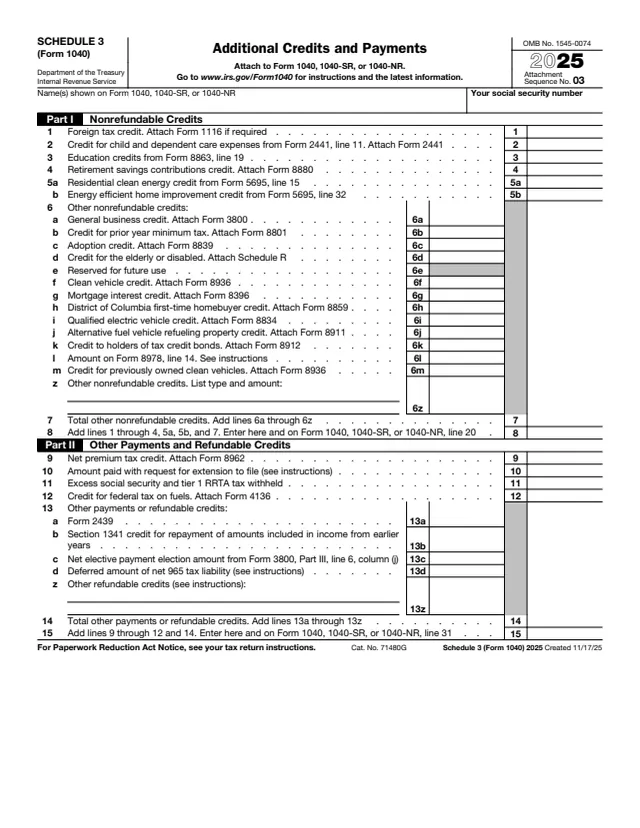
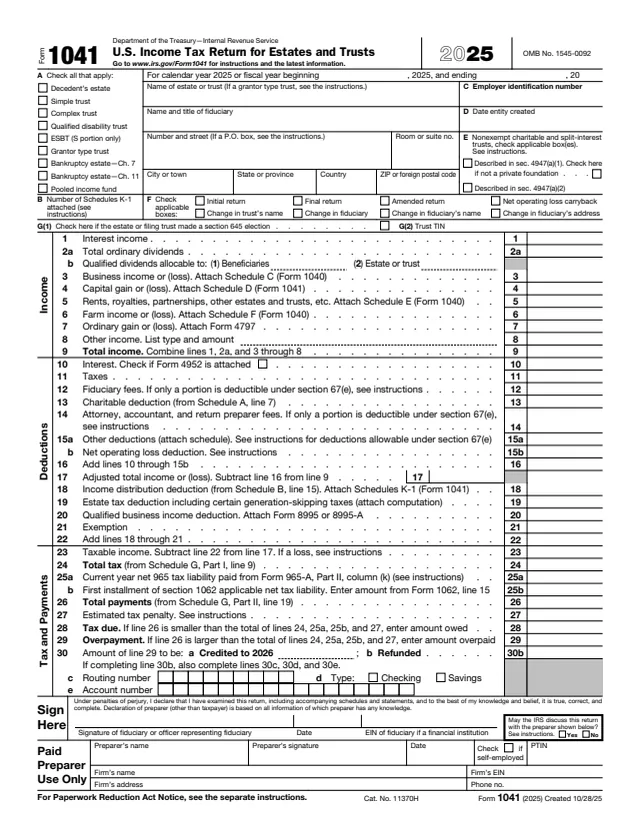
Line 35 goes on Schedule 3 (Form 1040), line 1; Form 1041, Schedule G, line 2a; or Form 990-T, Part III, line 1a.
The instructions say foreign income taxes can be deducted instead, on Schedule A (Form 1040) for Form 1040 or 1040-SR filers. Generally, taking the credit for any eligible foreign taxes rules out deducting any part of that year's foreign taxes.
If foreign taxes are refunded or change later, the instructions describe filing an amended return such as Form 1040-X and Schedule C (Form 1116) with the current-year return.
The instructions list taxes that are not creditable, such as taxes not legally owed, certain taxes paid to sanctioned countries, and interest or penalties.
The instructions point to Pub. 514. From overseas, call 267-941-1000 (not toll free), or write to Internal Revenue Service, International Accounts, Philadelphia, PA 19255-0725.
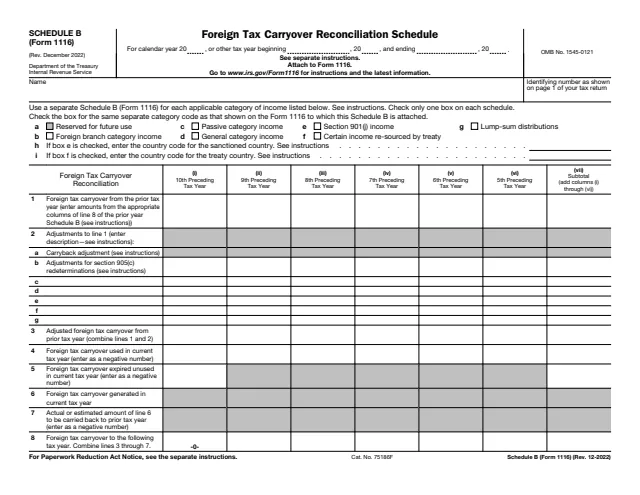
1116 Sch. B
222 fields, 2 pages
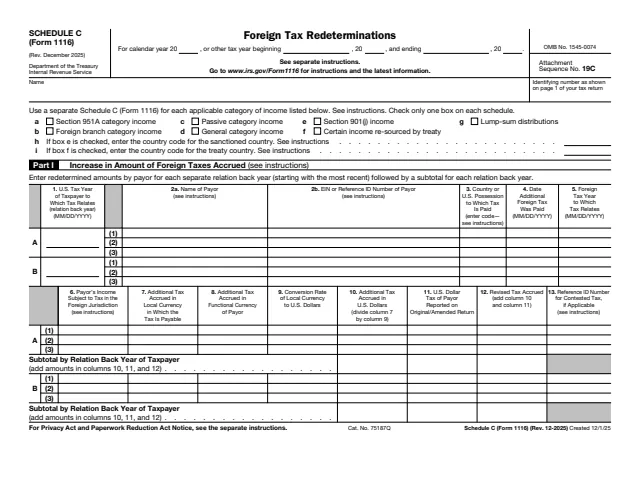
1116 Sch. C
256 fields, 3 pages
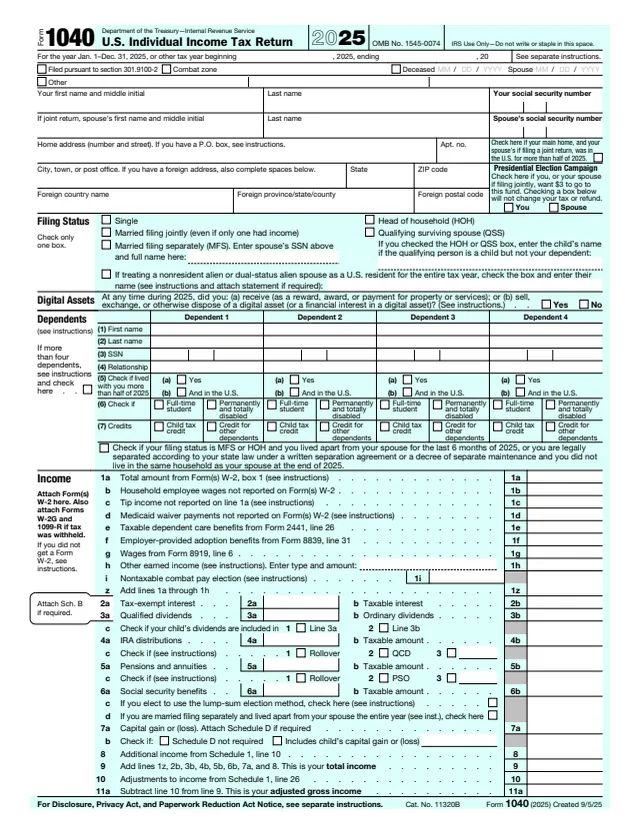
1040
199 fields, 2 pages
1040
37 fields, 1 page
1041
173 fields, 3 pages
8833
41 fields, 5 pages
The taxpayer claiming the credit completes the form and attaches it to their own return, which goes to the IRS. The instructions say to file it when the election to skip the form does not apply.
No tool matches that search.
The instructions say an individual, estate or trust that paid or accrued certain foreign taxes to a foreign country or U.S. territory files it to claim the foreign tax credit, unless the election to skip the form applies.
The instructions describe an election when all foreign income is passive, reported on a qualified payee statement, and creditable foreign taxes are not more than $300 ($600 if married filing jointly). Estates and trusts cannot use it.
The form says to use a separate Form 1116 for each category of income, such as passive category or general category income, and to check only one box on each.
The instructions say Part IV, lines 25 to 32, is now completed even with only one Form 1116. They also explain removing the new deduction reported on Schedule 1-A (Form 1040), line 37, when figuring the limit.
The form says to enter line 35 on Schedule 3 (Form 1040), line 1; Form 1041, Schedule G, line 2a; or Form 990-T, Part III, line 1a.
The instructions say not to use Form 1116 for them. Form 8689, Allocation of Individual Income Tax to the U.S. Virgin Islands, is used instead.