Header
The name of the partnership and its employer identification number (EIN).
1065 Sch. B-1
Information on Partners Owning 50% or More of the Partnership
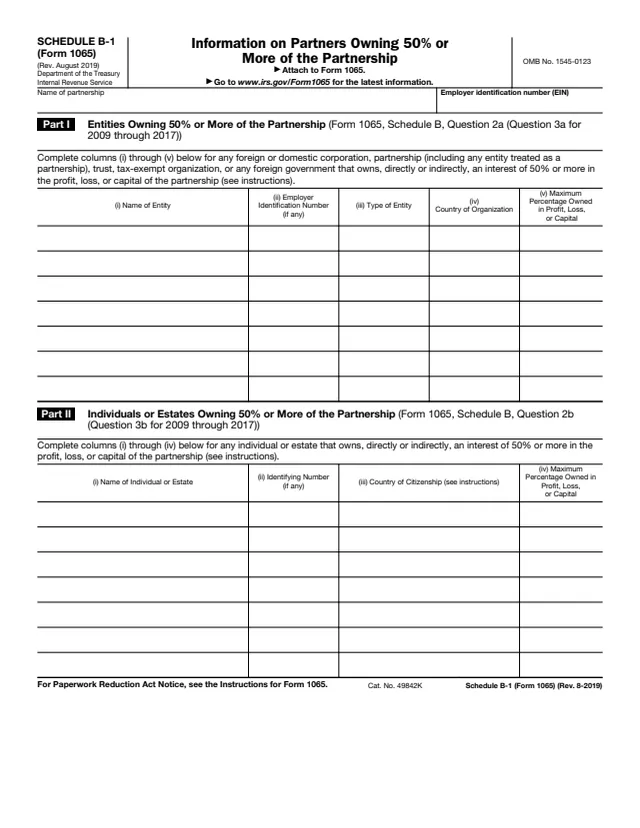
Schedule B-1 (Form 1065), Information on Partners Owning 50% or More of the Partnership, is a one-page schedule a partnership attaches to Form 1065, U.S. Return of Partnership Income. The IRS About page says partnerships use it to provide information applicable to certain entities, individuals, and estates that own, directly or indirectly, an interest of 50% or more in the profit, loss, or capital of the partnership.
The instructions on page 2 say it is filed by all partnerships that answer Yes to question 2a or question 2b on Form 1065, Schedule B (question 3a or 3b for 2009 through 2017). Part I lists entity owners and Part II lists individuals and estates, each with the maximum percentage they own.
The current revision is August 2019. You can fill out Schedule B-1 free in your browser on this page and download it without an account.
The name of the partnership and its employer identification number (EIN).
Columns (i) to (v): name of entity, EIN (if any), type of entity, country of organization, and maximum percentage owned in profit, loss, or capital.
Columns (i) to (iv): name of individual or estate, identifying number (if any), country of citizenship, and maximum percentage owned in profit, loss, or capital.
Purpose of the form, who must file, and specific instructions for Parts I and II.
Example 1 shows indirect ownership through another partnership. Example 2 shows when family attribution does not apply.
Complete Part I if the partnership answered Yes to question 2a and Part II if it answered Yes to question 2b. Ownership is measured at the end of the tax year.
Enter each entity's name, EIN, type (corporation, partnership, trust, tax-exempt organization or foreign government), country of organization and maximum percentage owned. For a tax-exempt organization, enter tax-exempt organization in column (iii).
List the parent corporation rather than subsidiary members of a consolidated group, and the entity owner rather than a disregarded entity. If the disregarded entity's owner is an individual, list that person in Part II.
Enter each individual's or estate's name, social security or employer identification number, country of citizenship and maximum percentage owned. For an estate, the country of citizenship is that of the decedent.
In Example 1, Corporation A owns 15% of Partnership C directly and 35% indirectly through Partnership B, so C lists Corporation A at 50% and Partnership B at 70%.
In Example 2, A owns 50% of Partnership X and A's daughter B owns no interest. The partnership lists A at 50% in Part II and does not list B.
You get the real form, filled in a browser tab, with nothing standing between you and the finished PDF.
The schedule says to attach it to Form 1065, the partnership's return.
The instructions say all partnerships that answer Yes to question 2a or 2b on Form 1065, Schedule B, file it.
For 2009 through 2017 returns, the matching Schedule B questions are 3a and 3b instead of 2a and 2b.
The form points to www.irs.gov/Form1065 for the latest information, and to the Instructions for Form 1065 for the Paperwork Reduction Act Notice.
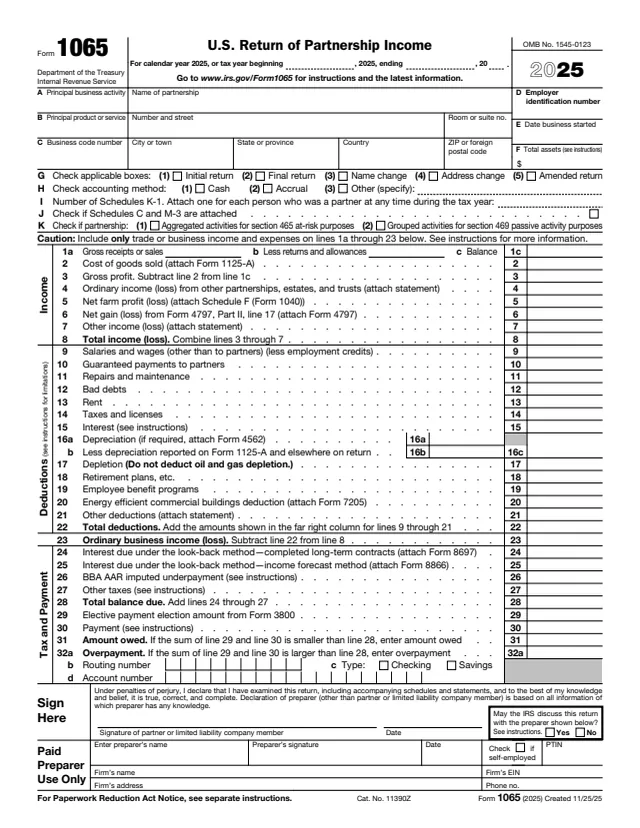
1065
440 fields, 6 pages
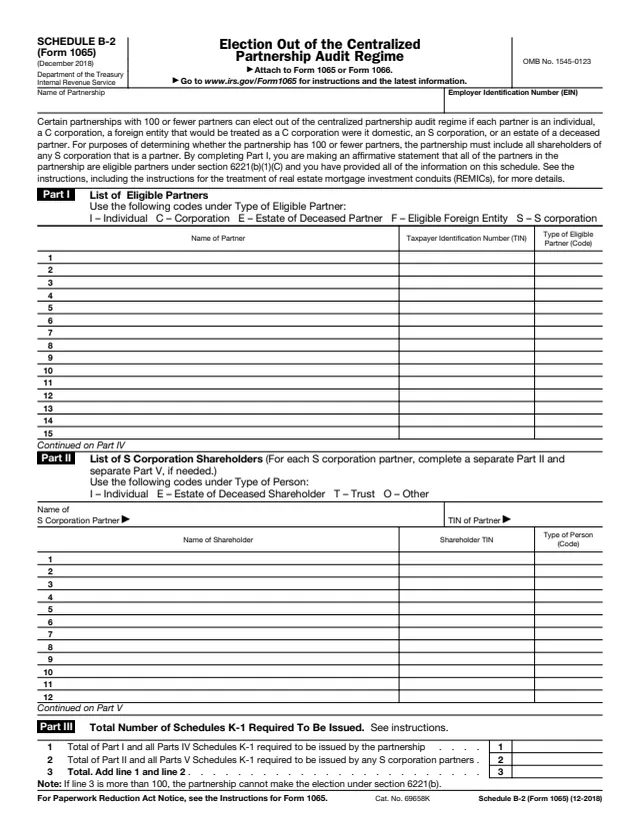
1065 Sch. B-2
613 fields, 5 pages
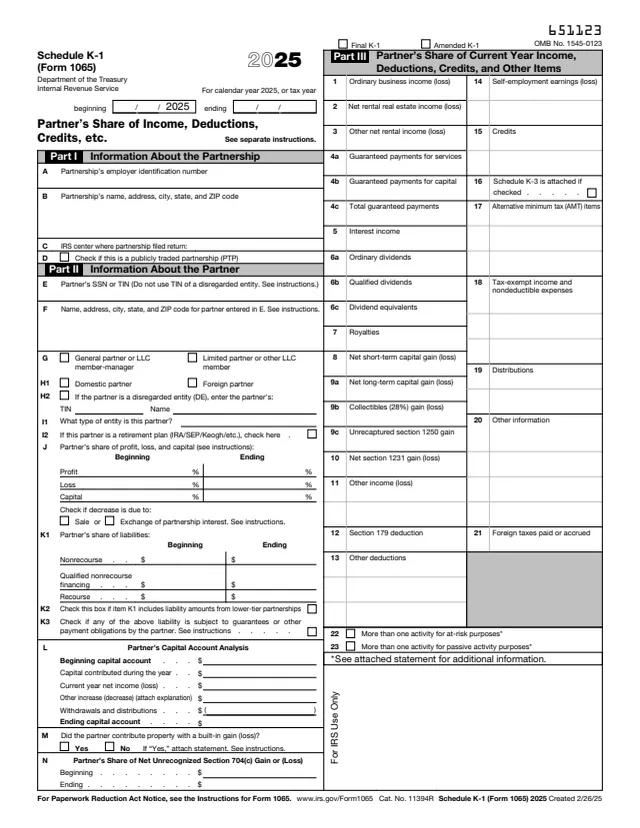
1065
111 fields, 1 page
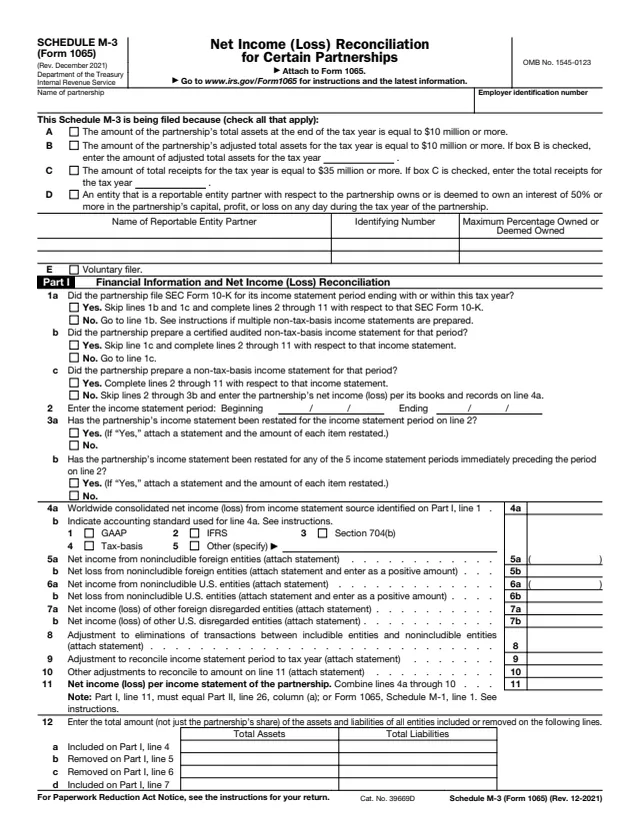
1065 Sch. M-3
316 fields, 3 pages
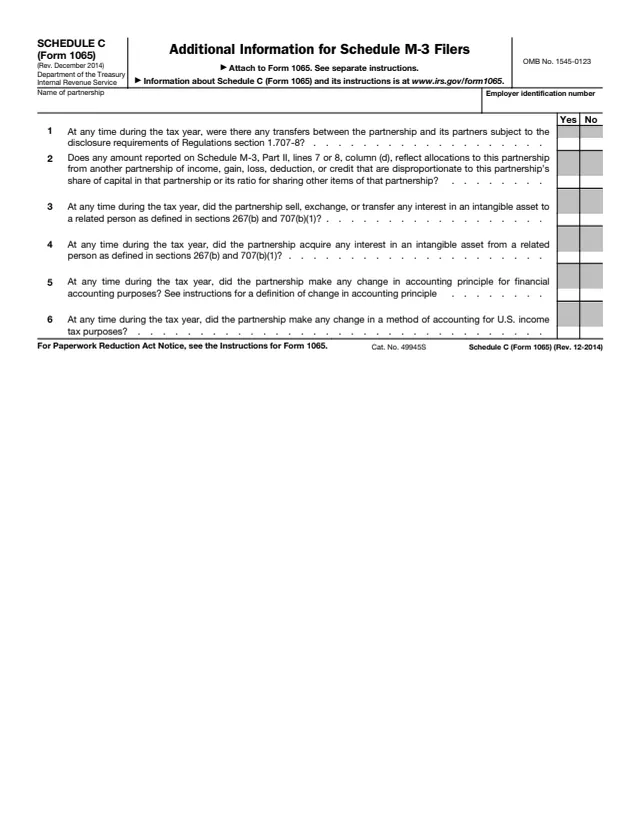
1065
14 fields, 1 page
The partnership completes Schedule B-1 and attaches it to its Form 1065, which goes to the IRS. The partnership identifies the owners in Parts I and II.
No tool matches that search.
The instructions say it is filed by all partnerships that answer Yes to question 2a or question 2b on Form 1065, Schedule B, and attached to Form 1065.
The instructions say partnerships file it with Form 1065. A partner owning 50% or more is listed on it by the partnership.
Yes. The schedule asks about interests owned directly or indirectly. In Example 1, a 15% direct interest plus 35% held through another partnership adds up to 50%.
The maximum percentage the owner holds, directly or indirectly, in the profit, loss, or capital of the partnership.
The instructions say to enter the citizenship of the decedent.
The partnership lists the entity owner of the disregarded entity rather than the disregarded entity itself. If that owner is an individual, the individual goes in Part II.