Rules and payment information
Pages 1 to 4 explain the package, the general rule and its exception, special rules, what's new for 2026, payment due dates and ways to pay.
1040-ES
Estimated Tax Worksheet-For Nonresident Alien Individuals
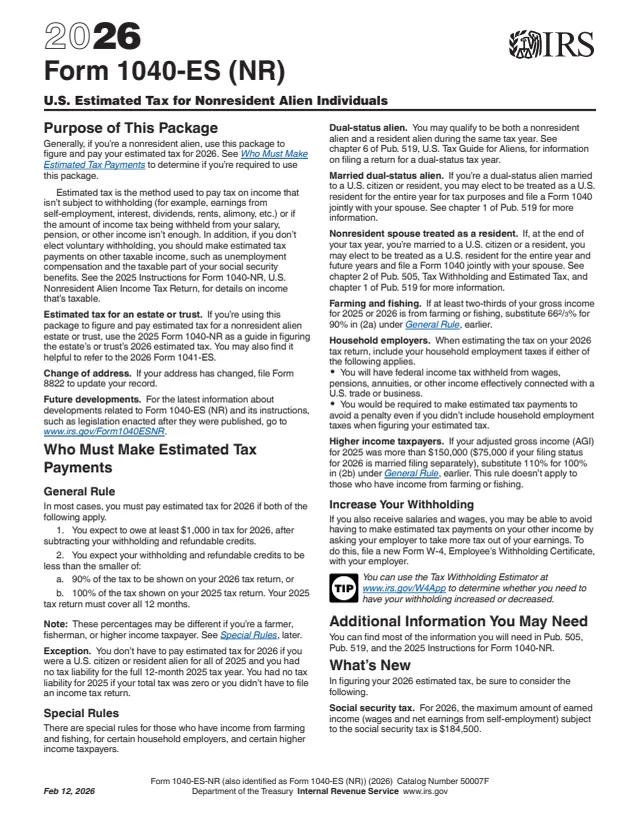
2026 Form 1040-ES (NR) is the IRS package of U.S. Estimated Tax for Nonresident Alien Individuals. The form says that, generally, a nonresident alien uses this package to figure and pay estimated tax for 2026. Estimated tax is the method used to pay tax on income that isn't subject to withholding, such as self-employment earnings, interest, dividends and rents, or when the tax withheld isn't enough.
The package holds the rules on who makes estimated tax payments, the 2026 Tax Rate Schedules, a Self-Employment Tax and Deduction Worksheet, the 2026 Estimated Tax Worksheet for Nonresident Alien Individuals, a Record of Estimated Tax Payments and four payment vouchers. The worksheets and the record are marked Keep for Your Records. A voucher is mailed only with a payment by check or money order. The package can also be used for a nonresident alien estate or trust.
You can fill out Form 1040-ES (NR) free in your browser on this page and download it without an account.
Pages 1 to 4 explain the package, the general rule and its exception, special rules, what's new for 2026, payment due dates and ways to pay.
Schedules X (Single), Y (Married filing separately), Z (Qualifying surviving spouse) and W (Estate or Trust), for figuring 2026 estimated taxes only.
Figures the self-employment tax for worksheet line 9 and the deduction to subtract from expected AGI on line 1, using a social security maximum of $184,500.
Lines 1 to 18: expected effectively connected income and tax, income not effectively connected with a U.S. trade or business, credits, withholding and the required payment.
A table for each payment's due date, amount due, date paid, check or confirmation number, amount paid and any 2025 overpayment credit applied.
One voucher per due date with the identifying number, name, address, foreign address fields and the amount paid by check or money order.
The form says to include only income and allowable deductions effectively connected with a U.S. trade or business. Self-employed filers subtract the deduction figured on the self-employment worksheet.
Enter estimated deductions, figure tax on line 3 with the 2026 Tax Rate Schedules, add other taxes and self-employment tax, and subtract credits. Line 11 is the estimated tax on effectively connected income.
Enter expected income not effectively connected with a U.S. trade or business on line 12 and multiply it by 30%, or use Schedule NEC (Form 1040-NR) for a lower treaty rate. Line 14c is the total 2026 estimated tax.
Line 15c is the smaller of 90% of line 14c or the prior-year amount on line 15b. Subtract withholding. The worksheet says to stop if line 17a is zero or less, or line 17b is less than $1,000.
With a first payment due April 15, 2026, each installment is 1/4 of line 17a. Without wages subject to U.S. withholding, the first payment is due June 15, 2026 and is 1/2 of line 15c, then 1/4 for each of the next two.
Only when paying by check or money order: enter the SSN or ITIN (EIN for an estate or trust), name, address and the amount, and make the check payable to United States Treasury.
You get the real form, filled in a browser tab, with nothing standing between you and the finished PDF.
Apr. 15, 2026, Jun. 15, 2026, Sep. 15, 2026 and Jan. 15, 2027. The form says the January payment isn't needed if the 2026 Form 1040-NR is filed by February 1, 2027 with the entire balance due paid.
All of it by June 15, 2026, or in three installments: 1/2 by June 15, 2026, 1/4 by September 15, 2026 and 1/4 by January 15, 2027.
Internal Revenue Service, P.O. Box 1303, Charlotte, NC 28201-1303 USA. Write 2026 Form 1040-ES (NR) and the identifying number on the check or money order, and do not staple it to the voucher.
The form asks for electronic payment and lists the IRS Online Account, IRS Direct Pay, debit or credit card or digital wallet, EFW, EFTPS and the IRS2Go app. Payments are in U.S. dollars; digital assets are not accepted.
The form says the IRS doesn't send notices reminding filers to make their estimated tax payments.
A penalty may apply for not paying enough estimated tax or not paying on time, even with an overpayment on the return. The form points to the Instructions for Form 2210 for waivers.
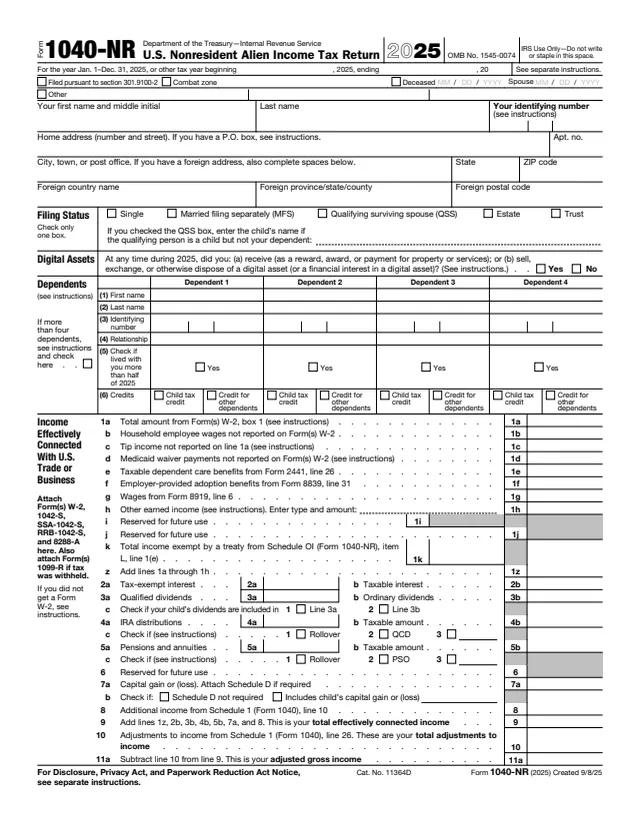
1040-NR
171 fields, 2 pages
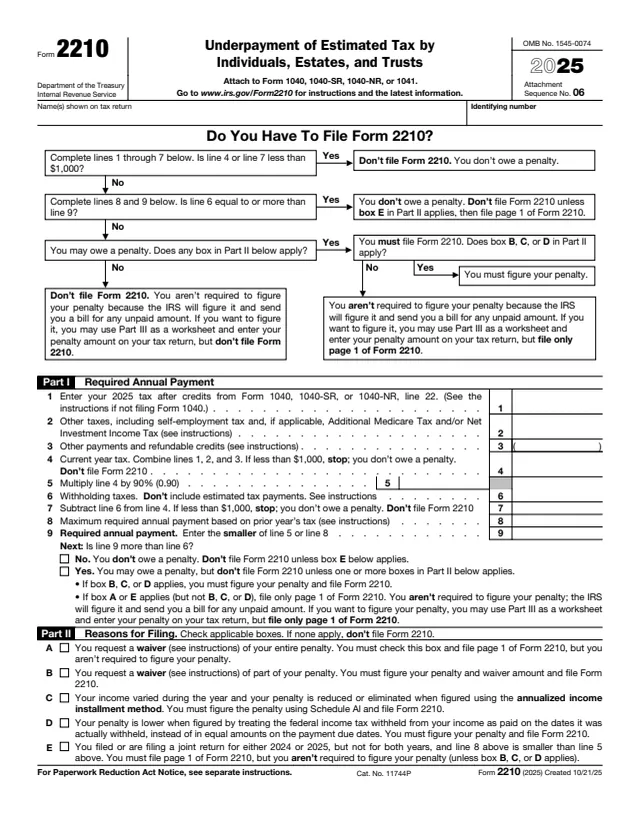
2210
199 fields, 3 pages
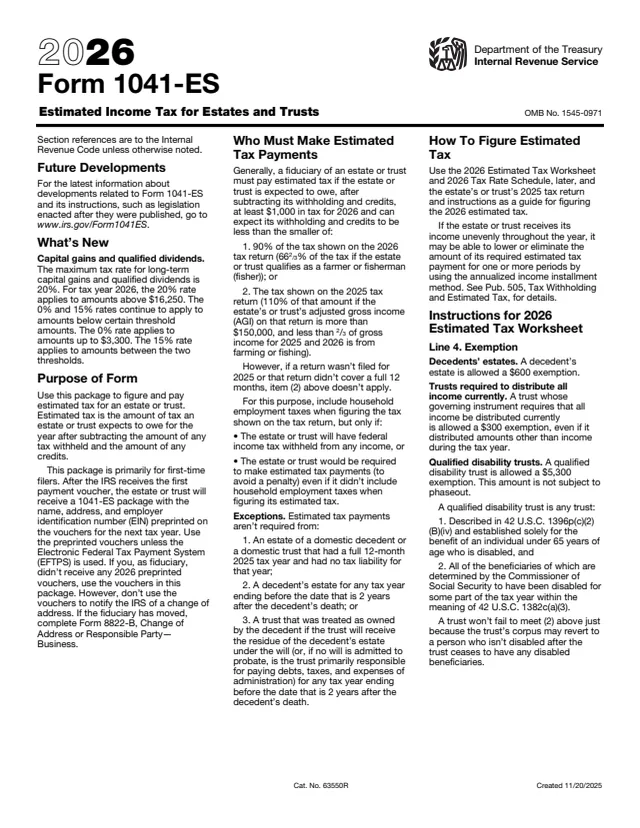
1041-ES
116 fields, 7 pages
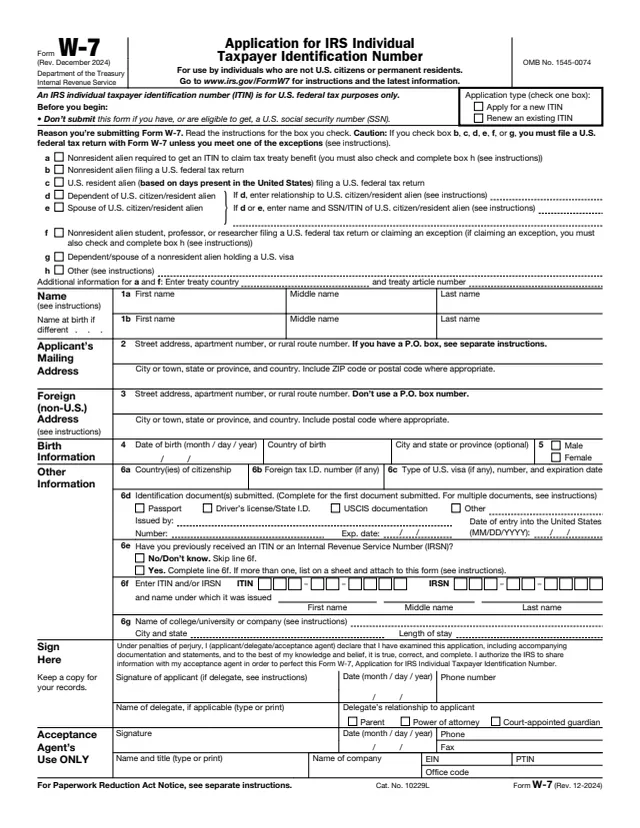
W-7
69 fields, 1 page
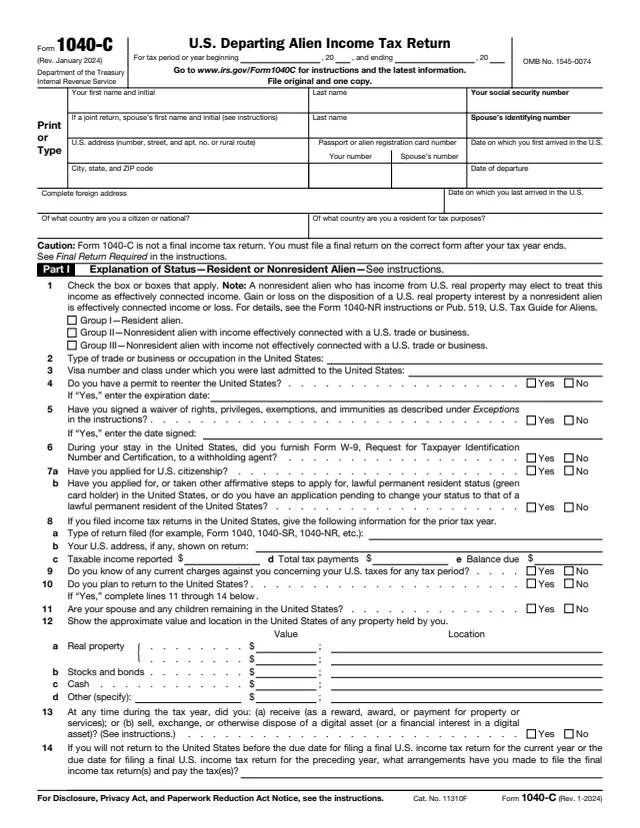
1040-C
307 fields, 4 pages
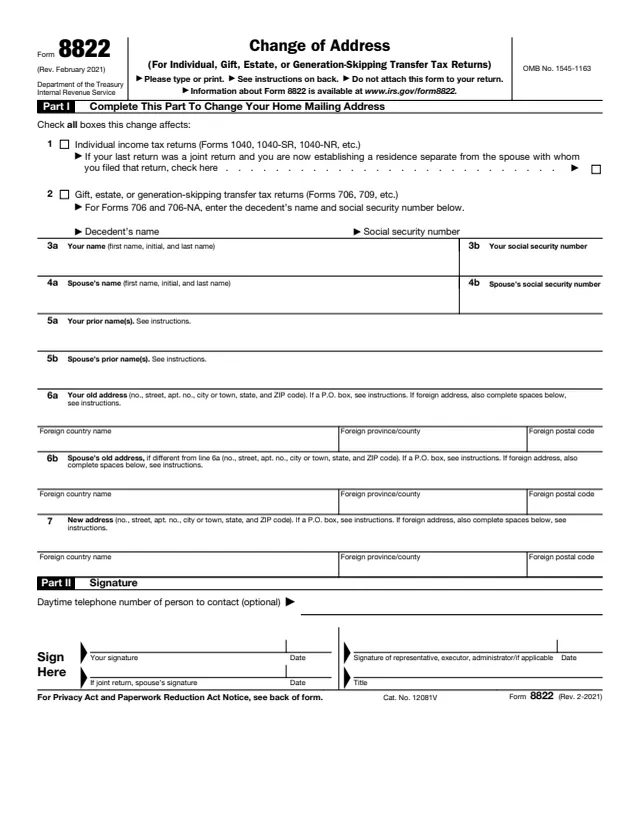
8822
25 fields, 2 pages
The package is for nonresident alien individuals, and for nonresident alien estates and trusts, that make U.S. estimated tax payments. Payments and vouchers go to the IRS.
No tool matches that search.
The form says that, generally, a nonresident alien uses this package to figure and pay estimated tax for 2026. It can also be used for a nonresident alien estate or trust.
No. The worksheet and the Record of Estimated Tax Payments are marked Keep for Your Records. Only a payment voucher is mailed, and only with a check or money order.
The form says yes: copy an unused voucher, fill it in and mail it with the payment.
Worksheet line 13 multiplies that income by 30%, or uses Schedule NEC (Form 1040-NR) if any of it is subject to a lower tax treaty rate.
The form says joint estimated tax payments can't be made if either spouse is a nonresident alien, unless they elected to be treated as a resident alien for tax purposes.
The voucher instructions say to enter an ITIN wherever an SSN is requested. Form W-7 is used to apply for an ITIN.