Heading
Tax period, names, Social Security numbers, U.S. and foreign addresses, passport or alien registration card numbers, dates of first arrival, last arrival and departure, citizenship and tax residence.
1040-C
U.S. Departing Alien Income Tax Return
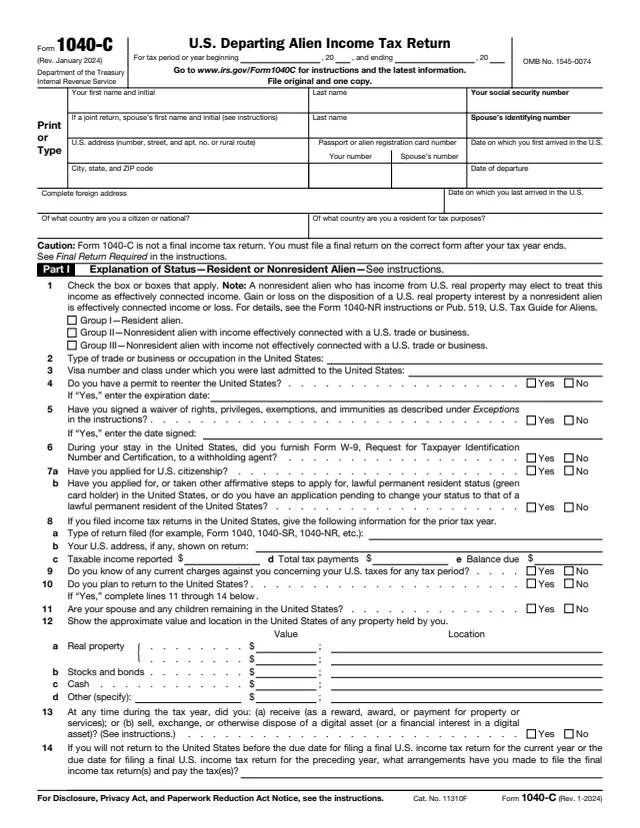
Form 1040-C, U.S. Departing Alien Income Tax Return, is filed by aliens who intend to leave the United States or any of its possessions. The IRS says they file it to report income received or expected to be received for the entire tax year, and to pay the expected tax liability on that income if they are required to do so.
Filing Form 1040-C, or the shorter Form 2063, is how a departing alien gets a certificate of compliance, also called a sailing or departure permit. An agent of the IRS Field Assistance Area Director signs the certificate at the bottom of page 2. The instructions say the certificate is not a final determination of tax liability.
The form itself warns that Form 1040-C is not a final income tax return: a final return on the correct form is still filed after the tax year ends, and tax paid with Form 1040-C counts as a credit on it. Form 1040-C is a continuous-use form, with the tax year entered at the top. You can fill it out free in your browser on this page and download the result without an account.
Tax period, names, Social Security numbers, U.S. and foreign addresses, passport or alien registration card numbers, dates of first arrival, last arrival and departure, citizenship and tax residence.
Lines 1 to 14: Group I, II or III, occupation, visa, reentry permit, waiver, Form W-9, citizenship or green card applications, prior returns, plans to return, U.S. property, digital assets and arrangements for final returns.
Line 15 lists each dependent's name, Social Security number, relationship and whether they qualify for the child tax credit or the credit for other dependents.
Lines 16 to 23 for Groups I and II, lines 24 and 25 for Group III at 30% (0.30), then total tax, payments, the amount owed and the amount overpaid on lines 26 to 32.
Signatures, occupations, Identity Protection PINs, the paid preparer section, and the certificate of compliance completed by the IRS Field Assistance Area Director.
Schedule A, income; Schedule B, gains and losses of nonresident aliens from property not effectively connected; Schedule C, itemized deductions; Schedule D, tax computation for Groups I and II.
Enter the tax period at the top and your identifying details. On line 1, check each group that applies. If you plan to return, complete lines 11 through 14. The instructions say line 13 on digital assets is answered Yes or No, never left blank.
List each payer, the type of income and any U.S. tax paid or withheld at source. Put the amount in column (d) for resident alien income, (e) for effectively connected income or (f) for income not effectively connected.
Nonresident aliens report sales of property not effectively connected on Schedule B, with the net gain going to Schedule A, line 3. Schedule C lists itemized deductions allowed for the group that applies.
Groups I and II figure tax on lines 16 through 23 using Schedule D. Group III multiplies line 24 by 30% (0.30) on line 25, or attaches a statement with the treaty article if a lower treaty rate applies.
Enter tax withheld, estimated tax payments and other payments on lines 27 through 30. The form says any overpayment on line 32 is refunded only when you file your final return for the tax year.
The instructions say Form 1040-C is not a valid return unless signed. On a joint return both spouses sign. An agent may sign only with IRS approval, and a paid preparer signs and enters a PTIN.
You get the real form, filled in a browser tab, with nothing standing between you and the finished PDF.
File with your local IRS Taxpayer Assistance Center (TAC) before you leave. The instructions say all TAC offices operate by appointment, made by calling 844-545-5640 between 7 a.m. and 7 p.m. local time.
The instructions say to get the permit at least 2 weeks before you plan to leave, and that you cannot apply earlier than 30 days before your planned departure date.
The form says to file the original and one copy. The instructions list papers to bring, such as your passport with green card or visa, returns for the past 2 years, employer statements and proof of your departure date.
Unless a bond is furnished or the IRS is satisfied the departure does not jeopardize collection, the tax shown and any past-due taxes are paid at filing in certified funds (cashier's check, certified bank or postal money order, or cash).
After the tax year ends, the instructions point to Form 1040 (or 1040-SR) for a U.S. citizen or resident alien on the last day of the year, or Form 1040-NR otherwise, with dual-status rules for some filers.
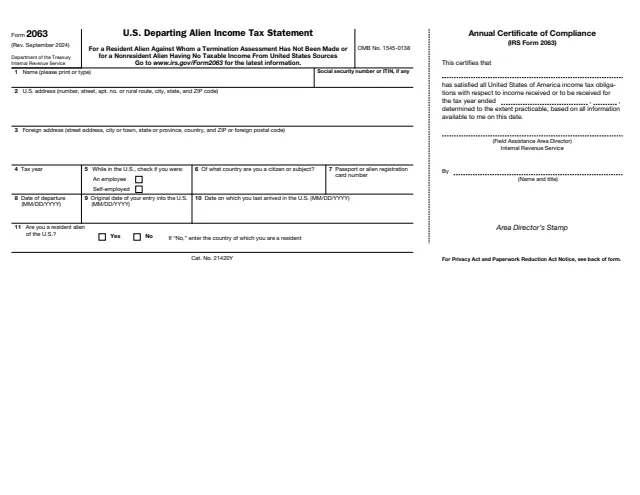
2063
30 fields, 2 pages
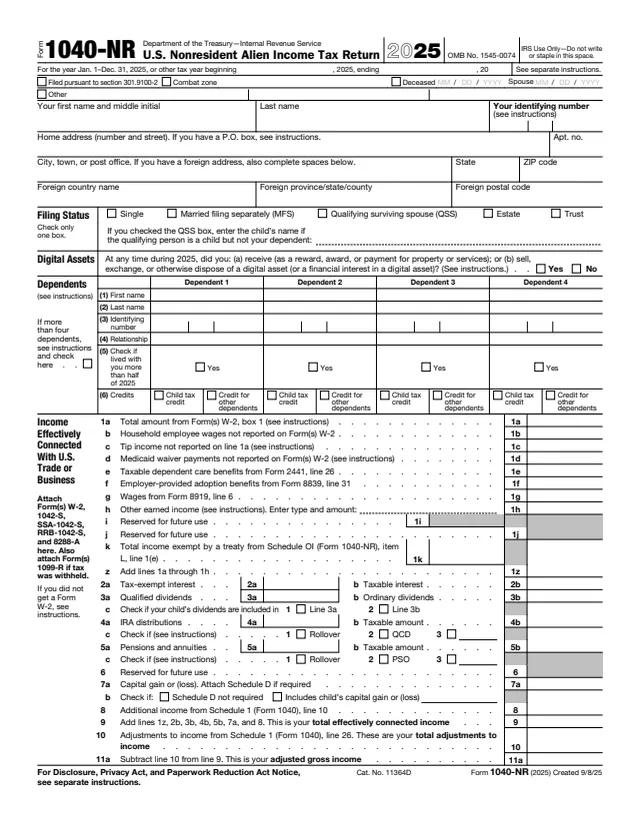
1040-NR
171 fields, 2 pages
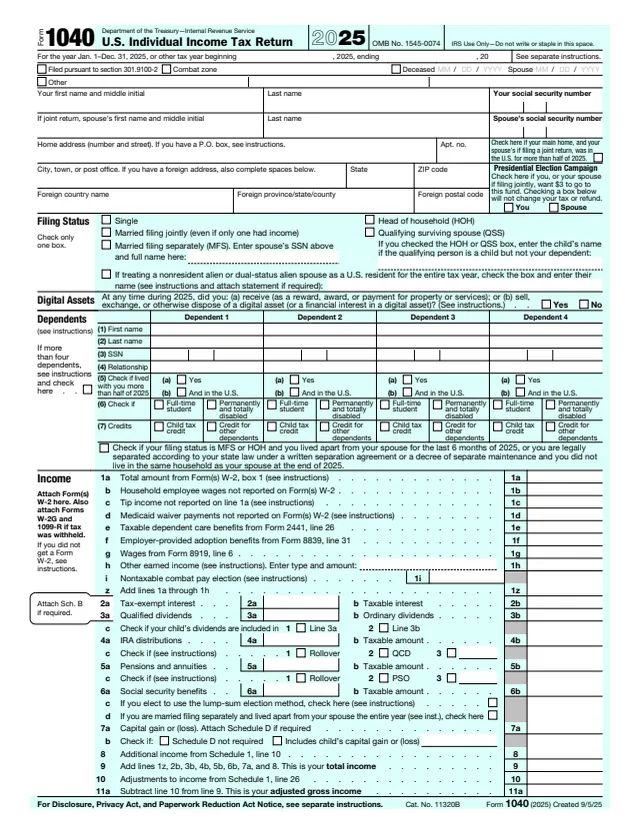
1040
199 fields, 2 pages
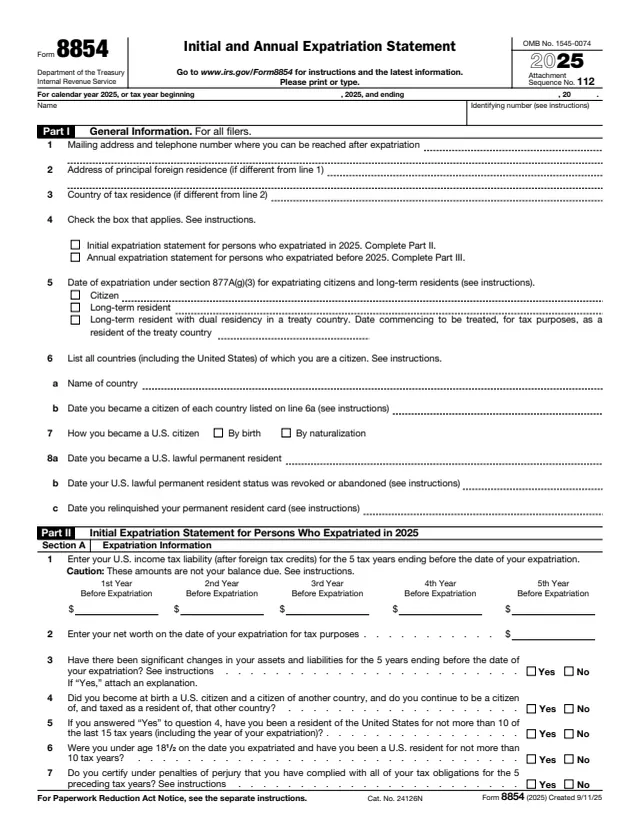
8854
208 fields, 5 pages
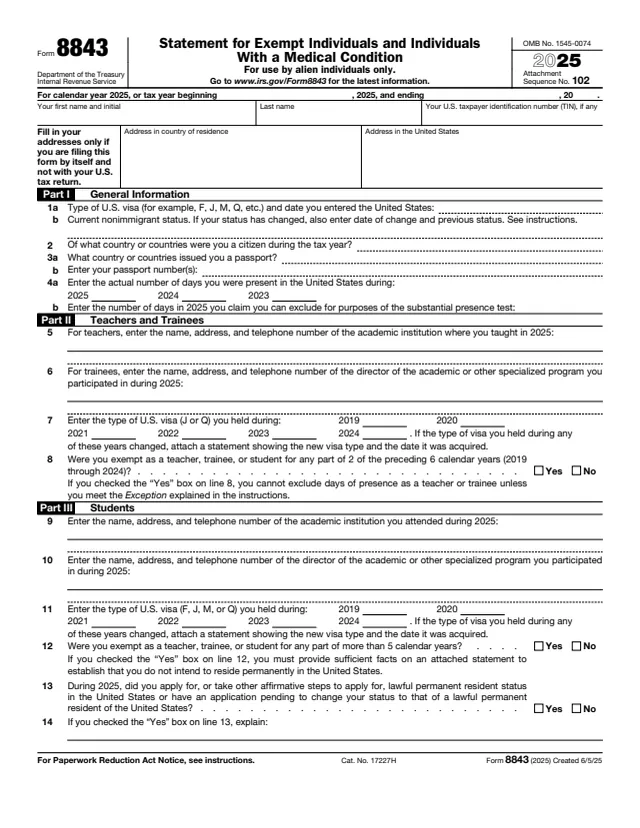
8843
48 fields, 4 pages
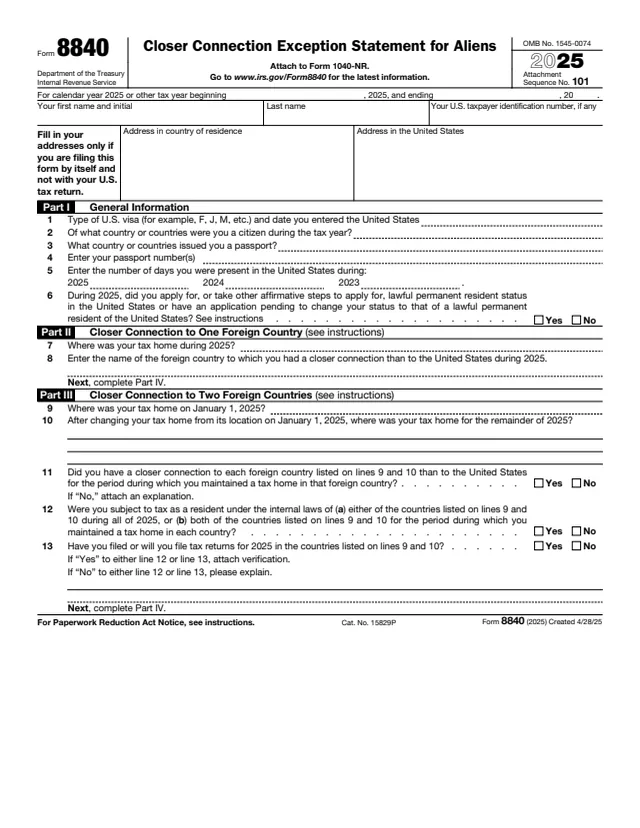
8840
62 fields, 4 pages
The departing alien fills out and signs the form and files it in person at an IRS Taxpayer Assistance Center. The IRS completes the certificate of compliance section.
No tool matches that search.
No. The form says it is not a final income tax return. A final return on the correct form is filed after the tax year ends, and tax paid with Form 1040-C counts as a credit against it.
Form 2063 is a short form with no tax computation. The instructions say aliens who do not qualify for Form 2063 file Form 1040-C, which reports income and figures the tax.
The instructions say at least 2 weeks before you plan to leave, and not earlier than 30 days before your planned departure date.
No. The instructions say the IRS cannot provide a refund at the time of departure. A refund comes from filing Form 1040 or Form 1040-NR at the end of the tax year.
Students, trainees and exchange visitors on F-1, F-2, H-3, H-4, J-1, J-2 or Q visas, and M-1 or M-2 students, are excepted only if their U.S. income is limited to the types the instructions list.
A certificate on Form 1040-C generally applies to all departures during the current tax year, but the instructions say it can be revoked on a later departure if leaving would hinder collecting the tax.