Opening statement
The employee's name, typed or printed, and the definitions of employment and separation.
OF109
Separation Statement
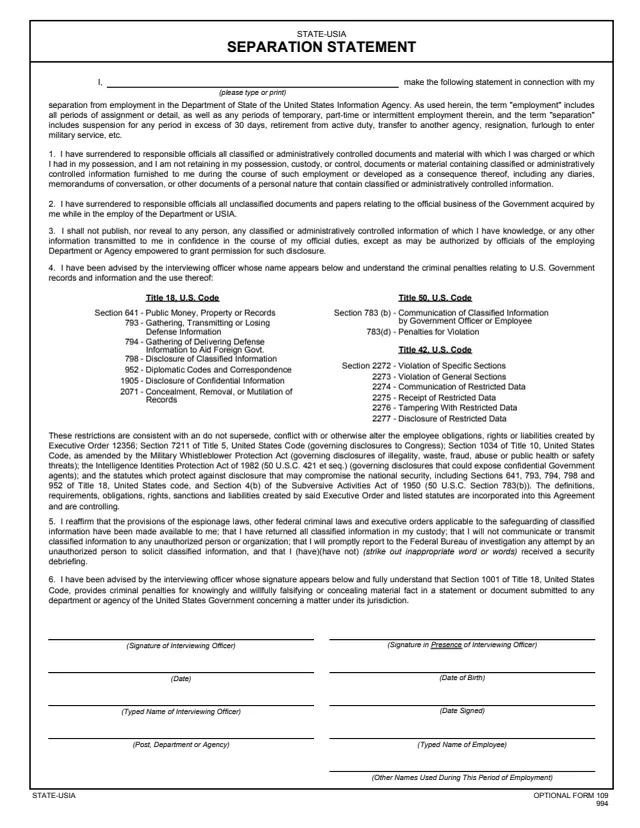
Optional Form 109 (OF 109), Separation Statement, is a one-page statement marked STATE-USIA at the top and bottom. An employee makes it in connection with separation from employment, and its text refers to the Department of State and the United States Information Agency (USIA). The footer prints OPTIONAL FORM 109 and 994, and GSA's page gives a current revision date of 09/1994. GSA hosts a copy in its forms library.
The form says employment includes all periods of assignment or detail and any temporary, part-time or intermittent employment, and separation includes suspension for any period in excess of 30 days, retirement from active duty, transfer to another agency, resignation and furlough to enter military service. In six numbered paragraphs the employee states that documents were surrendered, that classified information will not be revealed, and that the interviewing officer explained the criminal penalties listed.
You can fill it out free in your browser on this page and download the result without an account.
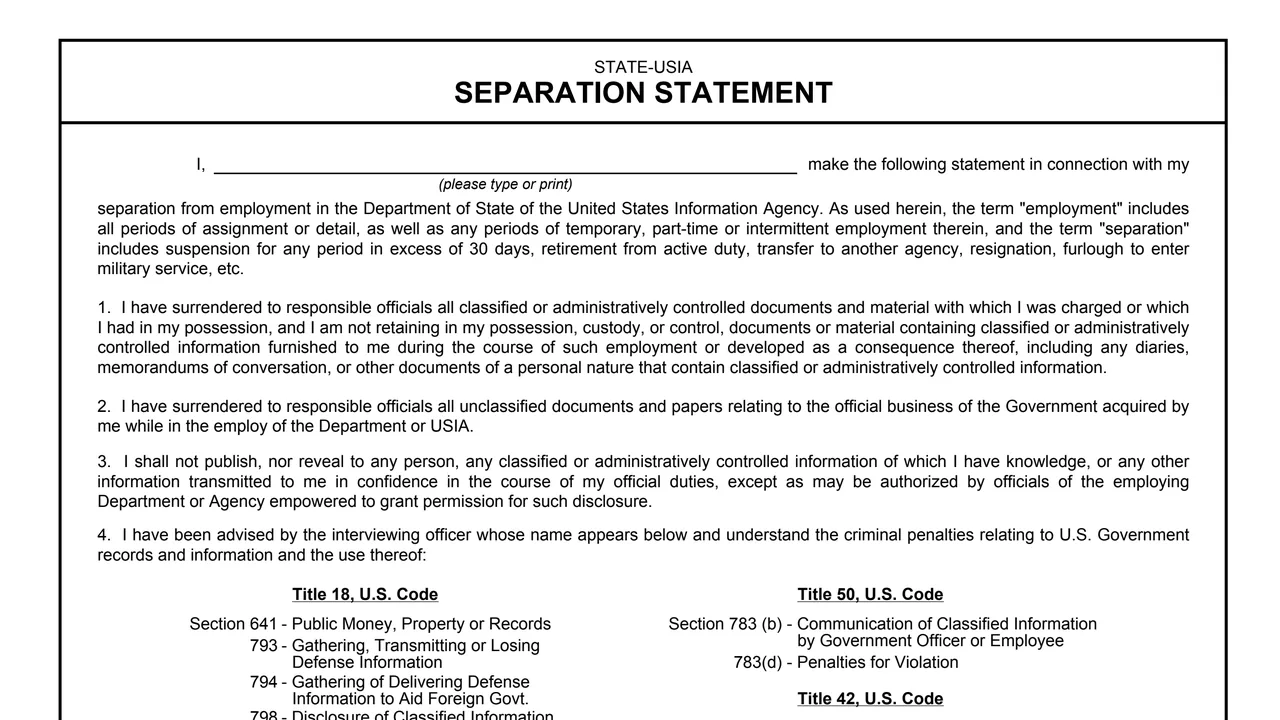
The employee's name, typed or printed, and the definitions of employment and separation.
Classified or administratively controlled documents and material, including diaries and memorandums of conversation that contain such information, and unclassified documents relating to official business.
A statement that classified or administratively controlled information, or information received in confidence, will not be published or revealed except as authorized by officials of the employing Department or Agency.
Sections of Title 18, Title 50 and Title 42 of the U.S. Code, and a statement that these restrictions do not supersede, conflict with or otherwise alter rights created by Executive Order 12356 and the other laws it lists.
The employee reaffirms that the espionage laws were made available and classified information was returned, and strikes out have or have not to show whether a security debriefing was received.
Notice of the criminal penalties in Section 1001 of Title 18, United States Code, then the signature blocks for the interviewing officer and the employee.
Type or print the employee's name in the opening line, as the form asks.
Each paragraph is a statement about documents, disclosure or penalties. Paragraphs 4 and 6 say the interviewing officer advised the employee of the penalties.
In paragraph 5, the form says to strike out have or have not to show whether a security debriefing was received.
The employee signs on the line marked Signature in Presence of Interviewing Officer and adds date of birth, date signed, typed name and other names used.
The interviewing officer signs and dates the form and adds a typed name and post, department or agency.
These steps follow the form's printed blocks.
You get the real form, filled in a browser tab, with nothing standing between you and the finished PDF.
The form prints no address or routing. It is signed in the presence of the interviewing officer, who adds a post, department or agency.
Title 18, U.S. Code Sections 641, 793, 794, 798, 952, 1905 and 2071, Title 50, U.S. Code Section 783 (b) and 783(d), and Title 42, U.S. Code Sections 2272 to 2277.
Paragraph 5 says attempts by an unauthorized person to solicit classified information will be promptly reported to the Federal Bureau of Investigation.
Paragraph 6 says Section 1001 of Title 18, United States Code, provides criminal penalties for knowingly and willfully falsifying or concealing material fact in a statement to any department or agency.
The footer prints OPTIONAL FORM 109 and 994. GSA's page gives a current revision date of 09/1994.
The form names two people: the separating employee and an interviewing officer.
No tool matches that search.
The form is marked STATE-USIA at the top and bottom, and its text refers to the Department of State and the United States Information Agency. GSA hosts a copy in its forms library.
The employee makes the statement in connection with separation from employment. The form says separation includes suspension for any period in excess of 30 days, retirement from active duty, transfer to another agency, resignation and furlough to enter military service.
The employee signs in the presence of the interviewing officer, and the interviewing officer signs too, with a typed name and post, department or agency.
The employee states that all classified or administratively controlled documents and material, and all unclassified documents relating to official business, were surrendered to responsible officials.
The form says its restrictions do not supersede, conflict with or otherwise alter rights created by Executive Order 12356, Section 7211 of Title 5, United States Code (governing disclosures to Congress), the Military Whistleblower Protection Act and the other laws it lists.
Paragraph 5 asks the employee to strike out have or have not to show whether a security debriefing was received.