Sections 1 to 10: identity and citizenship
Full name, date and place of birth, Social Security number, other names used, height, weight, hair and eye color, contact details, U.S. passport, citizenship, and any dual citizenship or foreign passport.
SF86
Questionnaire for National Security Positions
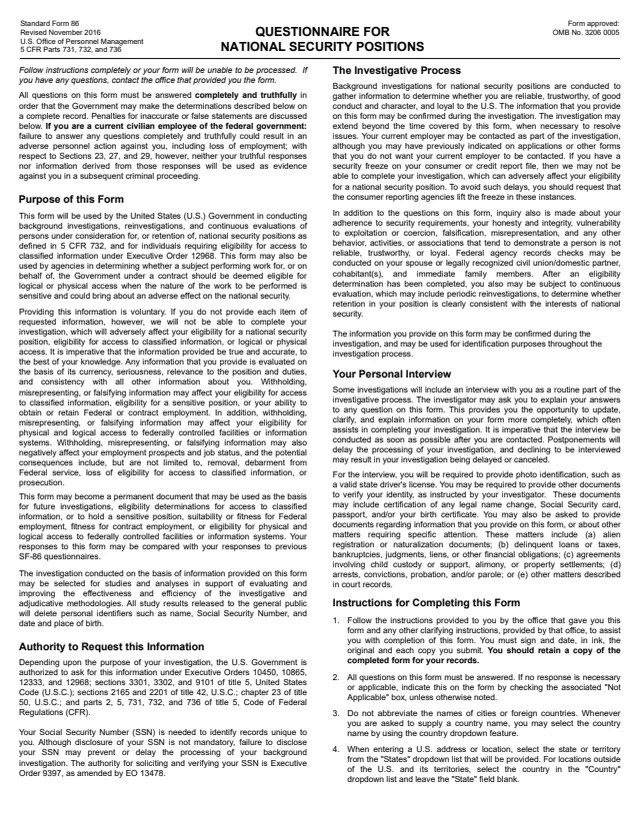
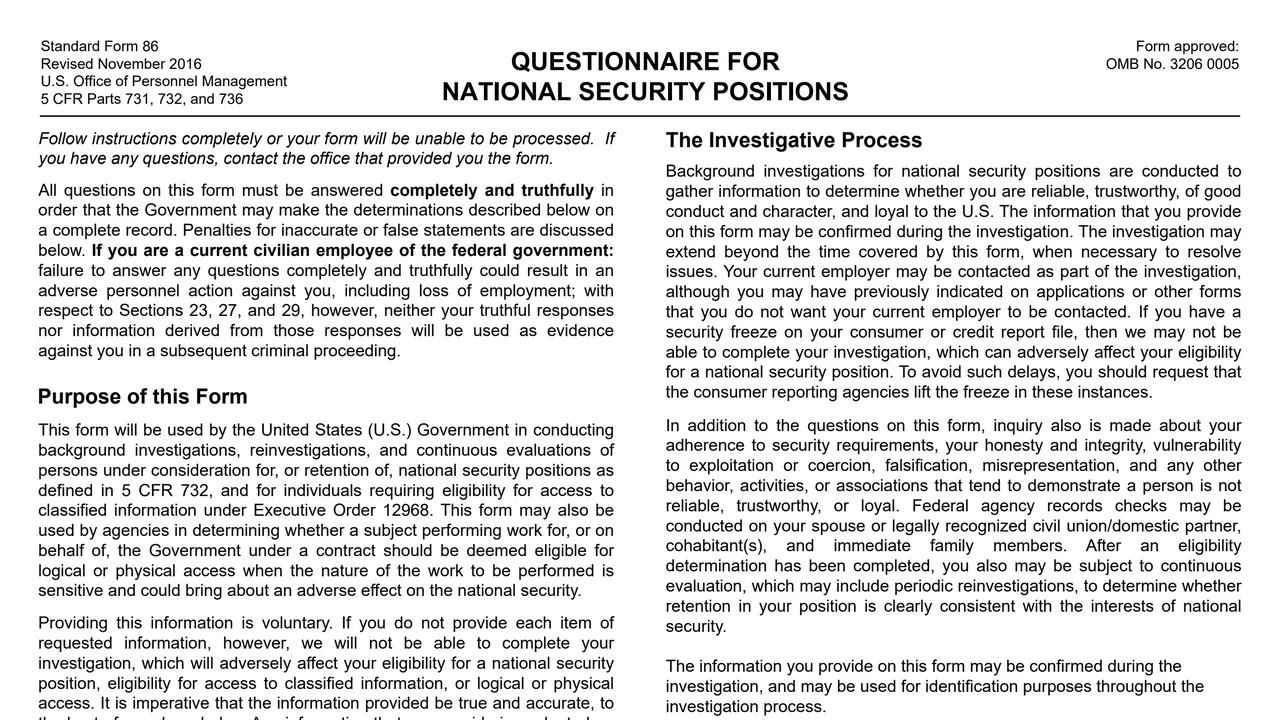
Standard Form 86 (SF 86) is the Questionnaire for National Security Positions. It is printed as a U.S. Office of Personnel Management (OPM) form, Revised November 2016, under 5 CFR Parts 731, 732 and 736, with OMB No. 3206-0005. GSA's forms library hosts a copy.
The form says the U.S. Government uses it for background investigations, reinvestigations and continuous evaluations of people under consideration for, or retention of, national security positions, and of people who need eligibility for access to classified information. Agencies may also use it for contract workers whose sensitive work needs logical or physical access.
SF 86 has Sections 1 to 29, followed by a certification and three authorizations. Many questions look back 7 or 10 years, and some ask whether something has EVER happened. The form says to follow the instructions of the office that gave it to you. You can fill it out free in your browser on this page and download the result without an account.
Full name, date and place of birth, Social Security number, other names used, height, weight, hair and eye color, contact details, U.S. passport, citizenship, and any dual citizenship or foreign passport.
Where you lived and went to school, and your employment, going back 10 years, plus former federal service, your employment record, Selective Service, military history and three people who know you well.
Your marital or relationship status, details about a current or former spouse or partner, any cohabitant, and each type of relative, living or deceased.
Close and continuing contact with foreign nationals, foreign financial interests, foreign business and government contacts, and travel outside the U.S. in the last 7 years.
Questions on psychological and emotional health, police record, illegal use of drugs and drug activity, and use of alcohol, each with its own time period.
Earlier investigations and clearances, financial record, use of information technology systems, non-criminal court actions in the last 10 years, and association record.
The 29 numbered sections fall into these groups.
The first question asks you to confirm, yes or no, that you read the instructions and understand the penalties for withholding, misrepresenting or falsifying information.
The form says all questions must be answered. Where one does not apply, check its Not Applicable box. Write dates as Month/Day/Year or Month/Year and mark APPROX. or EST for an estimate.
Use the Continuation Space at the end, or blank sheets with your name and SSN at the top. Identify the item number before each answer.
Sign and date in ink the certification, the authorization for release of information, the Fair Credit Reporting authorization and, if you answered Yes to Section 21, the medical release.
Follow the instructions of the office that gave you the form. The form says to sign and date the original and each copy you submit and to keep a copy for your records.
Some investigations include an interview. The form says the interview requires photo identification, such as a valid state driver's license, and you may be asked for documents such as a passport or birth certificate.
You get the real form, filled in a browser tab, with nothing standing between you and the finished PDF.
The PDF gives no filing address. It says to follow the instructions of the office that gave you the form and to contact that office with any questions.
OPM estimates the public burden at an average of 150 minutes per response, including time to review the instructions and gather the data.
The general release and the credit authorization stay in effect while you occupy a national security sensitive position or need eligibility for access to classified information. The medical release is valid for one year or until your affiliation with the Federal Government ends, whichever is sooner.
The form says a security freeze on your consumer or credit report file can keep the investigation from being completed, and asks you to respond to requests to release the freeze.
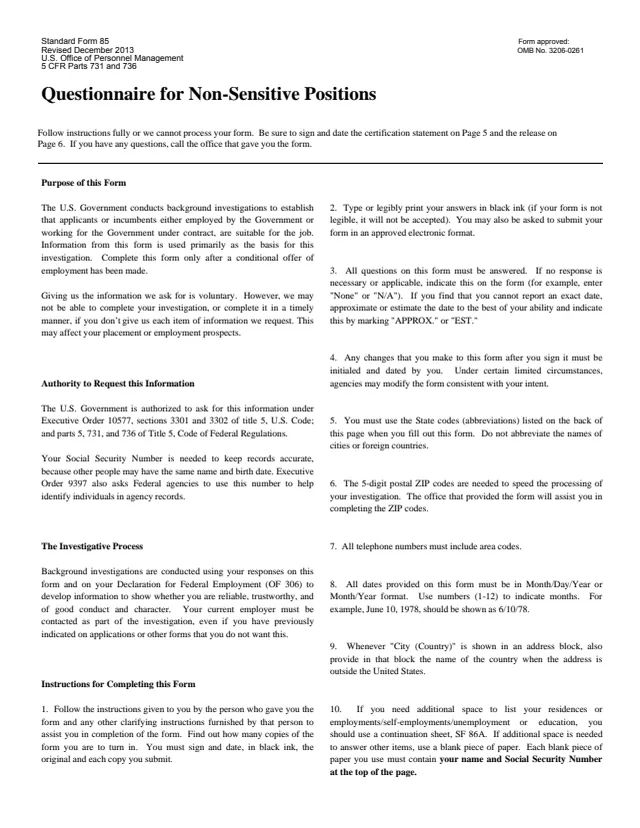
Collection and disclosure are governed by the Privacy Act. The form lists OPM's routine uses and says the office that gave you the form will provide a copy of its routine uses.
The Purpose section of the form lists these uses. The form says to follow the instructions of the office that gave it to you.
No tool matches that search.
The form is printed as a U.S. Office of Personnel Management form, OMB No. 3206-0005, Revised November 2016. GSA hosts a copy in its forms library.
It depends on the section. Where you lived, where you went to school and your employment go back 10 years, many other questions cover the last 7 years, and some ask whether something has EVER happened.
The form says to check the associated Not Applicable box, unless otherwise noted.
No. The release says it does not require you to provide passwords, log into a private account or take any action that would disclose non-publicly available social media information.
Section 21 asks about psychological and emotional health. The form says mental health treatment and counseling, in and of itself, is not a reason to revoke or deny eligibility.
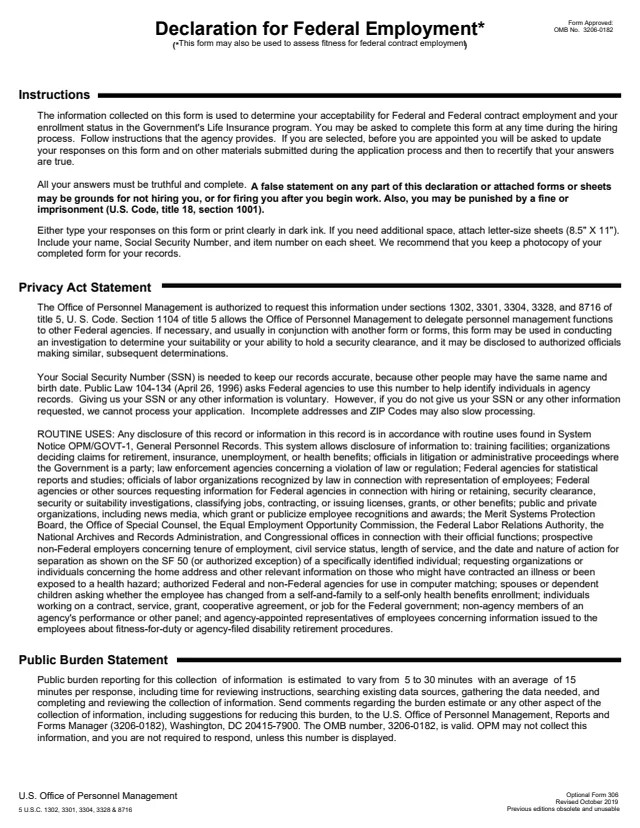
The form says that under 18 U.S.C. 1001, knowingly falsifying or concealing a material fact is a felony which may result in fines and/or up to five years imprisonment.
OPM estimates an average of 150 minutes per response, including time to review the instructions and gather the information.