SF180

Request Pertaining to Military Records

Agency
GSA
Revision
Rev. 06/2026
Fillable fields
72
Pages
3
Official source
GSA form page
Checked
October 20, 2026
Fill SF180 online
Page 1 of form SF180

Standard Form 180 (SF 180): Request Pertaining to Military Records

Standard Form 180 (SF 180), Request Pertaining to Military Records, is used to request information from military records, such as a DD Form 214 or equivalent, the Official Military Personnel File (OMPF), and medical and dental records. The form is prescribed by the National Archives and Records Administration (NARA) under 36 CFR 1233.18(d). GSA hosts a copy in its forms library, and the form says it is also available on the NARA website.

The form says requests can also be submitted online using eVetRecs at archives.gov. A paper SF 180 goes to the records office listed on page 2 of the form, which depends on the branch of service and on when the member was discharged, retired or died. The form says not to send completed forms to the NARA address in its burden statement.

NARA estimates about five minutes per request. You can fill it out free in your browser on this page and download the result without an account.

Top of page 1 of Standard Form 180 (SF 180): Request Pertaining to Military Records, as printed by GSA

What's on SF 180

Section I, items 1 to 5: locating the record

Name used during service, Social Security number, date and place of birth, and all active, reserve and National Guard service with branch, dates entered and released, officer or enlisted, service number and DoD ID / EDIPI number.
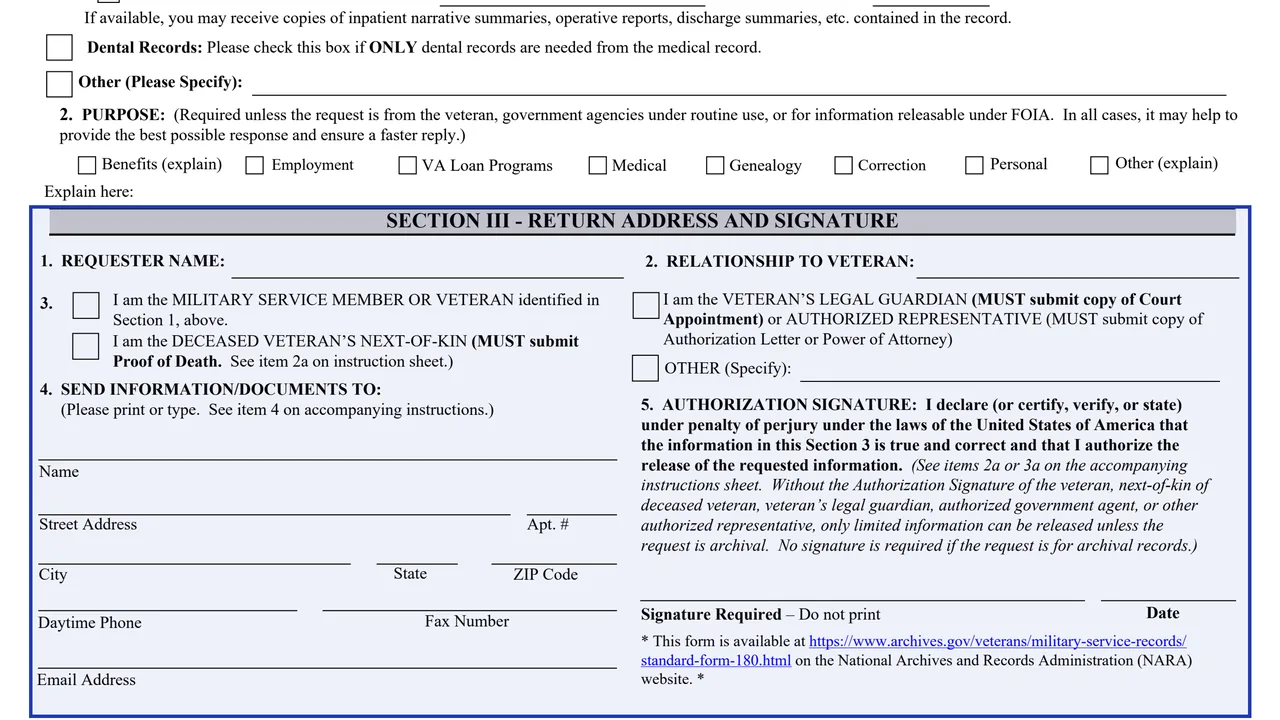
Section I, items 6 to 9

Last duty station, whether the person is deceased and the date of death, whether they retired from military service, and whether they filed a VA claim, with the VA claim or file number if known.

Section II: records requested

Boxes for a DD Form 214 or equivalent, the Official Military Personnel File, medical records, dental records only, or other. Inpatient records need the facility and the year last treated.

Deleted or undeleted DD Form 214

An undeleted copy is sent unless you check the box for a deleted copy. A deleted copy blacks out items such as the authority and reason for separation, the reenlistment eligibility code and the separation code.

Section II, item 2: purpose

Benefits, employment, VA loan programs, medical, genealogy, correction, personal or other. The form says a purpose is required unless the request is from the veteran, a government agency under routine use, or for information releasable under FOIA.

Section III: return address and signature

Requester name, relationship to the veteran, which kind of requester you are, the address to send the records to, and a signature under penalty of perjury that authorizes the release.

How to request records with SF 180

  1. 1

    Fill in what you know

    The instructions ask you to answer each item. If you do not have and cannot get the information for an item, write NA for not available. The form says incomplete information may delay the response.

  2. 2

    Choose the records and the purpose

    Check the documents you want in Section II, say whether you want a deleted DD Form 214 or inpatient records, and pick a purpose.

  3. 3

    Attach any proof the form asks for

    Next of kin attach proof of death, such as a death certificate or an obituary. A legal guardian attaches the court appointment, and an authorized representative an authorization letter or power of attorney.

  4. 4

    Sign and date Section III

    The form marks the signature as required and says not to print it. It also says no signature is required if the request is for archival records.

  5. 5

    Find the address on page 2

    Page 2 has a chart by branch and by discharge, retirement or death date. Each row gives a code number for the personnel record and the medical record that matches an address at the bottom of the page.

  6. 6

    Mail it or use eVetRecs

    Send the form to the matching address. The form also says requests can be submitted online with eVetRecs at archives.gov/veterans/military-service-records.

Why fill Form SF180 on indox

You get the real form, filled in a browser tab, with nothing standing between you and the finished PDF.

  • Fill the form right in your browser, no software to install
  • Free to fill and free to download, with no account
  • The official blank straight from the GSA, not a copy someone retyped
  • Works on a phone, tablet or computer

Where to send it, fees and record age

Where to send it

To the office whose code matches the branch and date in the page 2 chart, such as the National Personnel Records Center in St. Louis (code 14), a service department records office, or the Department of Veterans Affairs (code 11).

Fees

The form says there is no charge for most services to service members or next of kin of deceased veterans, and a nominal fee for certain services. Archival records are offered as copies for a fee. If a fee applies, you receive an invoice.

Records 62 or more years old

Personnel records of members discharged, retired or died in service 62 or more years ago are archival records at NARA. Service completed before World War I uses National Archives Trust Fund (NATF) forms instead.

Medical records to a third party

The instructions say a veteran or dependent who wants medical records sent to a third party fills out a DD Form 2870.

Edition and OMB number

The form shows OMB No. 3095-0029, expiring 05/31/2027, and says the previous edition is unusable.

Who uses SF 180?

  • Veterans and service members

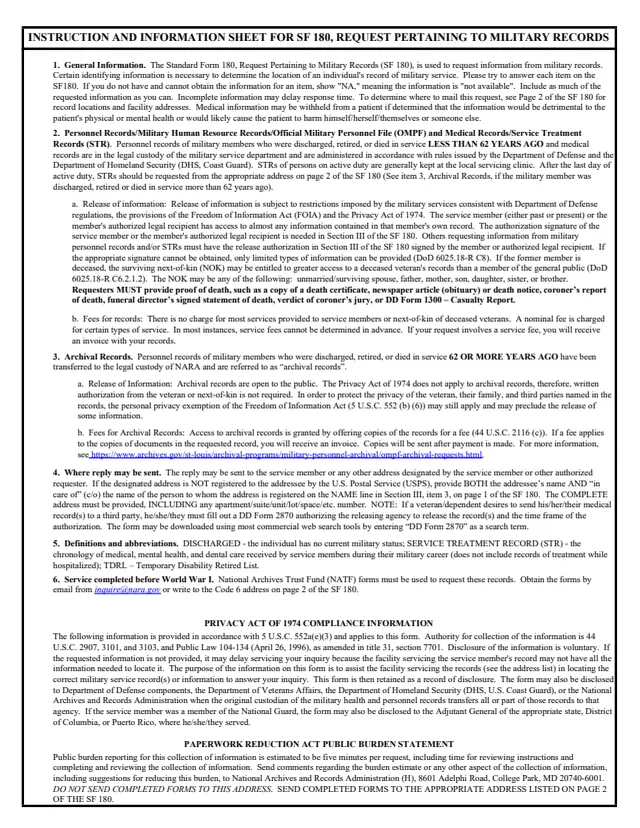
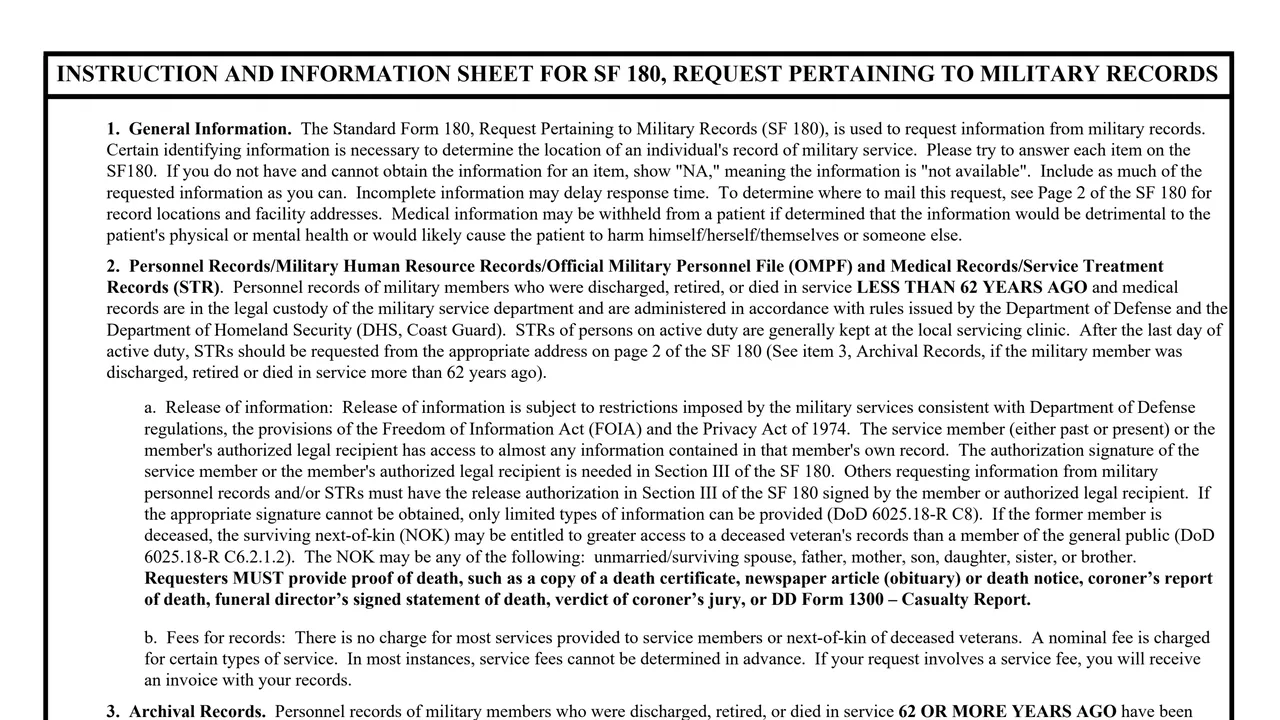
    The form says a past or present service member has access to almost any information in their own record. The member signs the authorization in Section III.

  • Next of kin of a deceased veteran

    The form lists the unmarried or surviving spouse, father, mother, son, daughter, sister or brother, and says next of kin may get greater access than the general public. It asks them for proof of death.

  • Guardians and representatives

    Section III asks a veteran's legal guardian for a copy of the court appointment, and an authorized representative for a copy of the authorization letter or power of attorney.

  • Other requesters

    Anyone else needs the release authorization in Section III signed by the member or an authorized legal recipient. Without it, the form says only limited types of information can be provided.

  • Archival record requests

    Personnel records of members discharged, retired or died in service 62 or more years ago are archival records held by NARA. The form says they are open to the public and need no signature.

The instruction sheet describes who can see what in a military record and whose signature the request needs.

Official sources and the blank

Do it all with indox

View all 94 tools

Questions about Form SF180

Can I request military records without the paper SF 180?

The form says requests can be submitted online using eVetRecs at archives.gov/veterans/military-service-records. It also says recent veterans may be able to request a DD Form 214 through milConnect.

Where do I mail SF 180?

Page 2 of the form has a chart by branch of service and by the date the member was discharged, retired or died. Each row gives a code number that matches an address at the bottom of the page. The form says not to send it to the NARA address in its burden statement.

Does it cost anything to request military records?

The form says there is no charge for most services to service members or next of kin of deceased veterans, and a nominal fee for certain services. Copies of archival records are offered for a fee. If a fee applies, you receive an invoice.

Who can request a deceased veteran's records?

The form says next of kin may get greater access than the general public, and lists the unmarried or surviving spouse, father, mother, son, daughter, sister or brother. It asks for proof of death, such as a death certificate, an obituary or a DD Form 1300 Casualty Report.

What is a deleted DD Form 214?

A copy with some items blacked out, such as the authority and reason for separation, the reenlistment eligibility code and the separation code, and for separations after June 30, 1979, the character of separation and dates of time lost. The form says an undeleted copy is sent unless you ask for a deleted one.

What if I don't know some of the information?

The instructions say to write NA, meaning not available, for any item you do not have and cannot get, and to include as much information as you can. Incomplete information may delay the response.

Are records 62 or more years old handled differently?

Yes. The form calls them archival records, held by NARA. They are open to the public, written authorization is not required, and copies are offered for a fee. Some information may still be withheld under the personal privacy exemption of FOIA.