Reason for the statement
Five check boxes, check one: the two clearance and position changes, an Emergency Preparedness clearance, an absence of 60 calendar days or more, or termination of employment with GSA.
GSA3162
Security Termination Statement
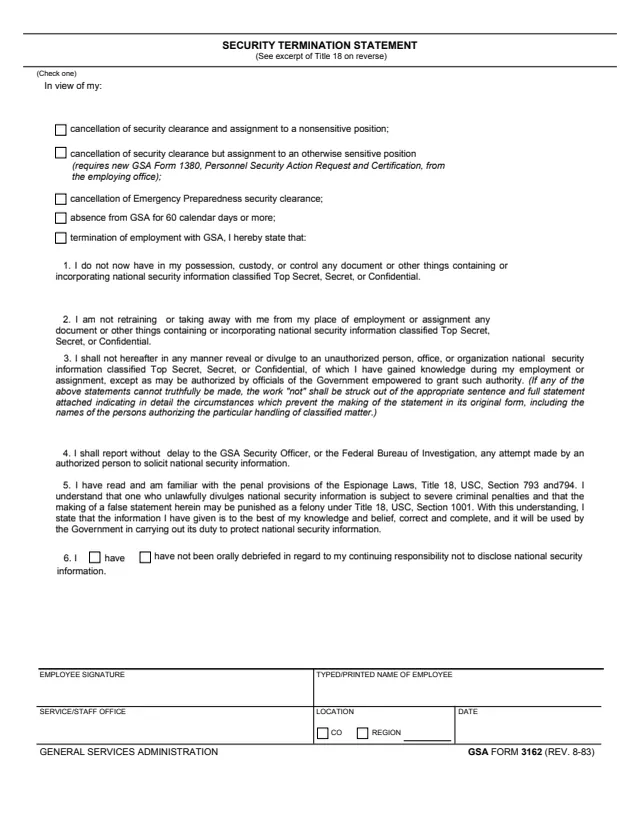
GSA Form 3162, Security Termination Statement, is a General Services Administration form, REV. 8-83 in its footer. GSA hosts it in its forms library.
The employee checks one reason for the statement: cancellation of a security clearance with assignment to a nonsensitive position, cancellation of a clearance with assignment to an otherwise sensitive position, cancellation of an Emergency Preparedness security clearance, absence from GSA for 60 calendar days or more, or termination of employment with GSA. Six numbered statements follow, about classified material, not revealing national security information, reporting attempts to solicit it, the Espionage Laws and an oral debriefing.
The employee signs, prints a name and enters the service or staff office, location and date. The back of the form prints an excerpt of the Espionage Act and Section 1001 of Title 18, United States Code. You can fill it out free in your browser on this page and download the result without an account.
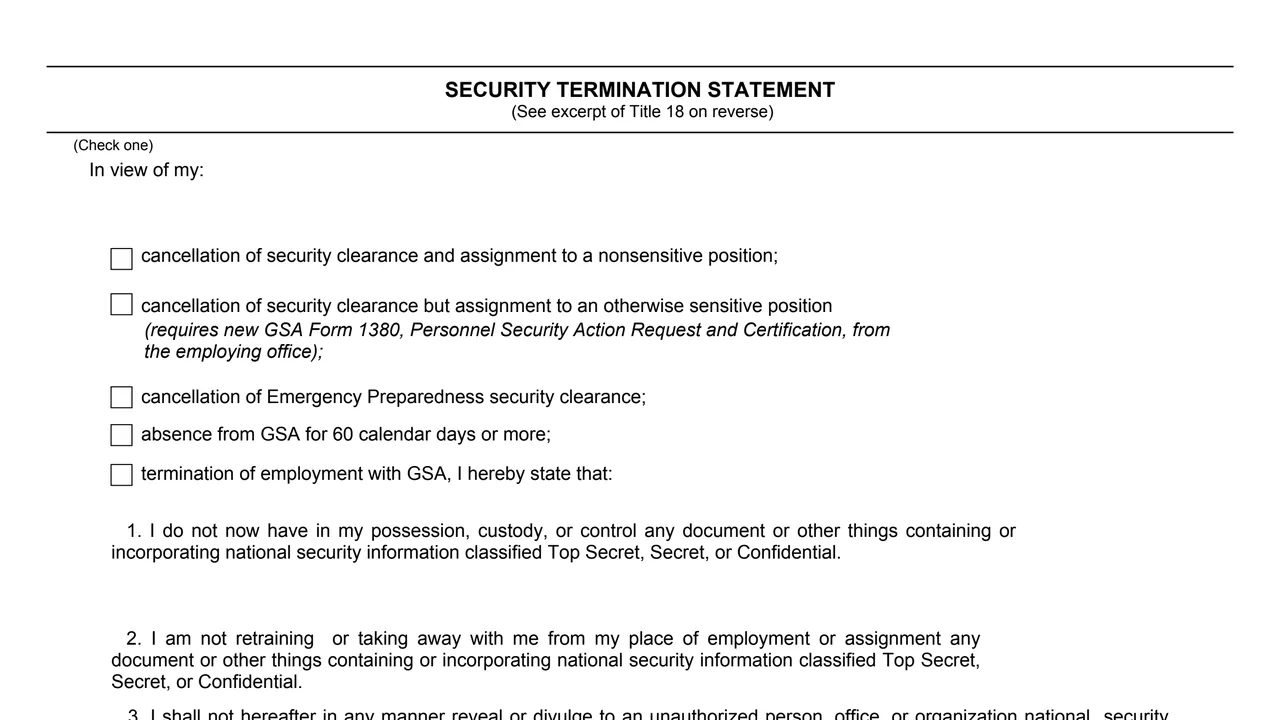
Five check boxes, check one: the two clearance and position changes, an Emergency Preparedness clearance, an absence of 60 calendar days or more, or termination of employment with GSA.
No document or other thing with national security information classified Top Secret, Secret, or Confidential is in the employee's possession, custody, or control or being taken away, and such information will not be revealed to an unauthorized person, office, or organization except as authorized by officials of the Government empowered to grant such authority.
Statement 4 says the employee shall report without delay to the GSA Security Officer, or the Federal Bureau of Investigation, any attempt to solicit national security information. Statement 5 cites the Espionage Laws, Title 18, USC, Section 793 and 794, and Title 18, USC, Section 1001.
Two boxes, have or have not, for whether the employee has been orally debriefed on the continuing responsibility not to disclose national security information.
Employee signature, typed or printed name of employee, service or staff office, location with CO and Region boxes, and date.
The back prints Sections 793 and 794 from the Espionage Act and Section 1001, Statements or entries generally, from Title 18, United States Code.
Mark the one box that matches the situation. The second box notes that a new GSA Form 1380 comes from the employing office.
Statements 1 to 5 cover classified material, disclosure, reporting and the penalty provisions. The heading says to see the excerpt of Title 18 on the reverse.
The form says that if any statement cannot truthfully be made, the word "not" is struck out of the sentence and a full statement is attached giving the circumstances, including the names of the persons authorizing the particular handling of classified matter.
Check have or have not to show whether the employee has been orally debriefed on the continuing responsibility not to disclose national security information.
The employee signs, types or prints a name, and enters the service or staff office, the location with CO or Region, and the date.
You get the real form, filled in a browser tab, with nothing standing between you and the finished PDF.
The form prints no address and does not name an office that receives it. For the second reason box, it says a new GSA Form 1380 comes from the employing office.
Statement 4 names the GSA Security Officer or the Federal Bureau of Investigation for reporting any attempt to solicit national security information.
The excerpt prints a fine of not more than $10,000 or imprisonment of not more than ten years, or both, in Section 793, death or imprisonment for any term of years or for life in Section 794, and a fine of not more than $10,000 or imprisonment of not more than five years, or both, in Section 1001.
The downloaded PDF prints no Privacy Act notice, OMB number or burden estimate.
The form opens with a check-one list of reasons, and the employee signs it. Each item below is one of those reasons.
No tool matches that search.
The footer prints GENERAL SERVICES ADMINISTRATION and GSA FORM 3162 (REV. 8-83). GSA hosts it in its forms library.
The form lists five reasons, check one: cancellation of a security clearance with a nonsensitive or an otherwise sensitive assignment, cancellation of an Emergency Preparedness security clearance, absence from GSA for 60 calendar days or more, or termination of employment with GSA.
The form says the word "not" is struck out of the appropriate sentence and a full statement is attached giving the circumstances in detail, including the names of the persons authorizing the particular handling of classified matter.
Statement 4 says to report without delay to the GSA Security Officer, or the Federal Bureau of Investigation.
Statement 5 cites the Espionage Laws, Title 18, USC, Section 793 and 794, and says a false statement may be punished as a felony under Title 18, USC, Section 1001. The back prints an excerpt of those sections.
It has two boxes, have or have not, for whether the employee has been orally debriefed in regard to the continuing responsibility not to disclose national security information.