Case caption
The names of Debtor 1 and Debtor 2 (spouse, if filing), the bankruptcy court district, the case number if known, and a box for an amended filing.
B 104
For Individual Chapter 11 Cases: The List of Creditors Who Have the 20 Largest Unsecured Claims Against You Who Are Not Insiders
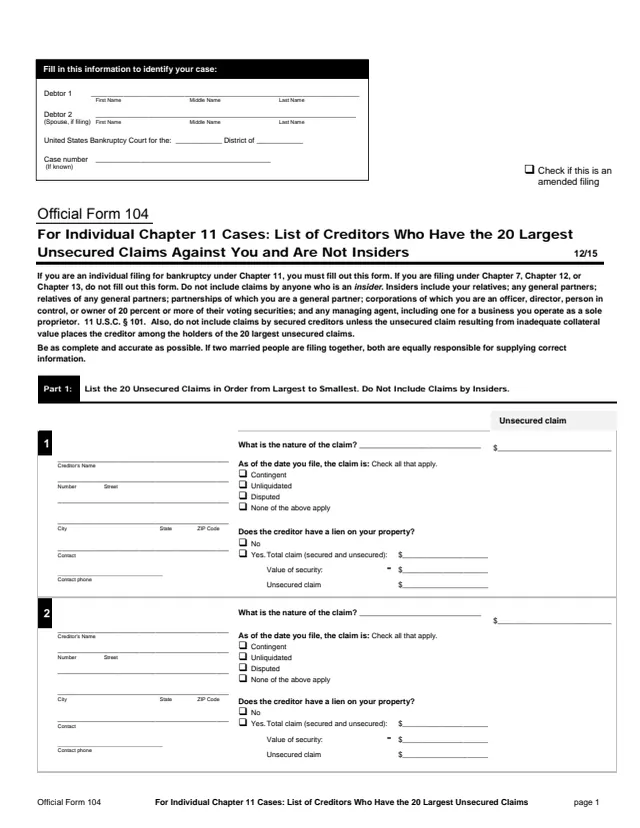
Form B 104, printed as Official Form 104, is For Individual Chapter 11 Cases: List of Creditors Who Have the 20 Largest Unsecured Claims Against You and Are Not Insiders. It is an Official Bankruptcy Form from the U.S. Courts, listed under Individual Debtors and effective on December 1, 2015. The U.S. Courts page says it is derived from Official Form 4, and that Official Bankruptcy Forms are approved by the Judicial Conference and must be used under Bankruptcy Rule 9009.
The form says an individual filing for bankruptcy under Chapter 11 fills it out, and that people filing under Chapter 7, Chapter 12 or Chapter 13 do not. It has a numbered section for each of 20 unsecured claims, listed from largest to smallest, and leaves out insiders and secured creditors, unless the unsecured part of a secured claim is among the 20 largest. The committee note says the form was renumbered to set it apart from the version used in chapter 11 cases filed by non-individuals, such as corporations and partnerships.
This page explains the form in plain words and is not legal advice. You can fill it out free in your browser on this page and download the result without an account.
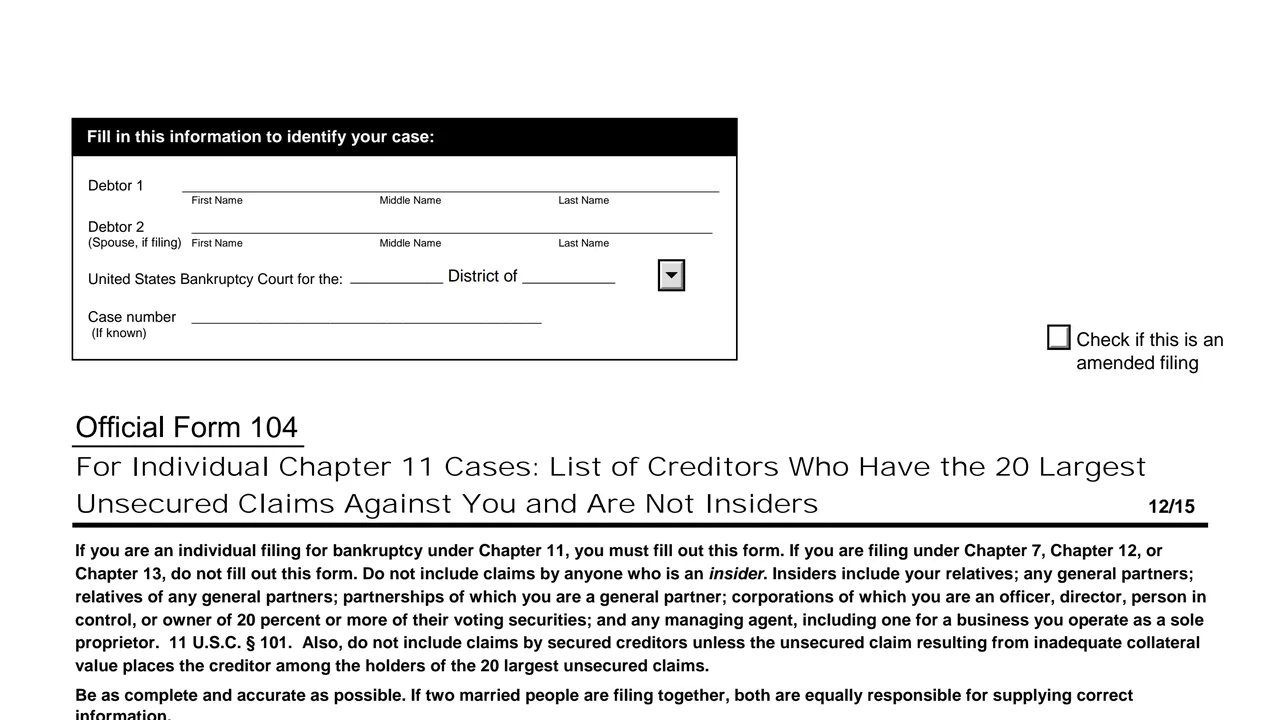
The names of Debtor 1 and Debtor 2 (spouse, if filing), the bankruptcy court district, the case number if known, and a box for an amended filing.
The form lists relatives, general partners and their relatives, partnerships where you are a general partner, corporations where you are an officer, director, person in control or owner of 20 percent or more of the voting securities, and any managing agent (11 U.S.C. § 101).
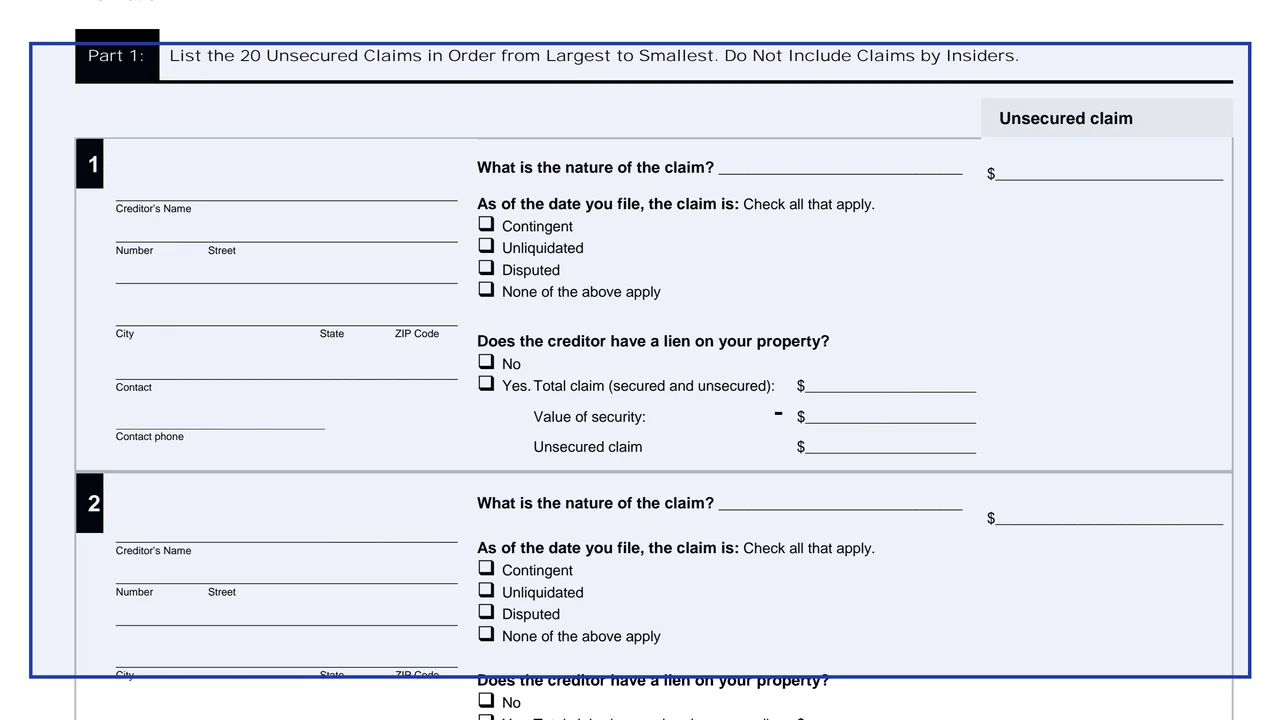
Twenty numbered sections, from largest to smallest. Each asks for the creditor's name, address, contact and contact phone, the nature of the claim, and the unsecured claim amount.
For each claim, boxes show whether, as of the date you file, it is contingent, unliquidated, disputed, or none of these. The instructions say a claim can have one, more than one, or none of them.
If the creditor has a lien on your property, the section asks for the total claim (secured and unsecured), subtracts the value of security, and shows the unsecured claim.
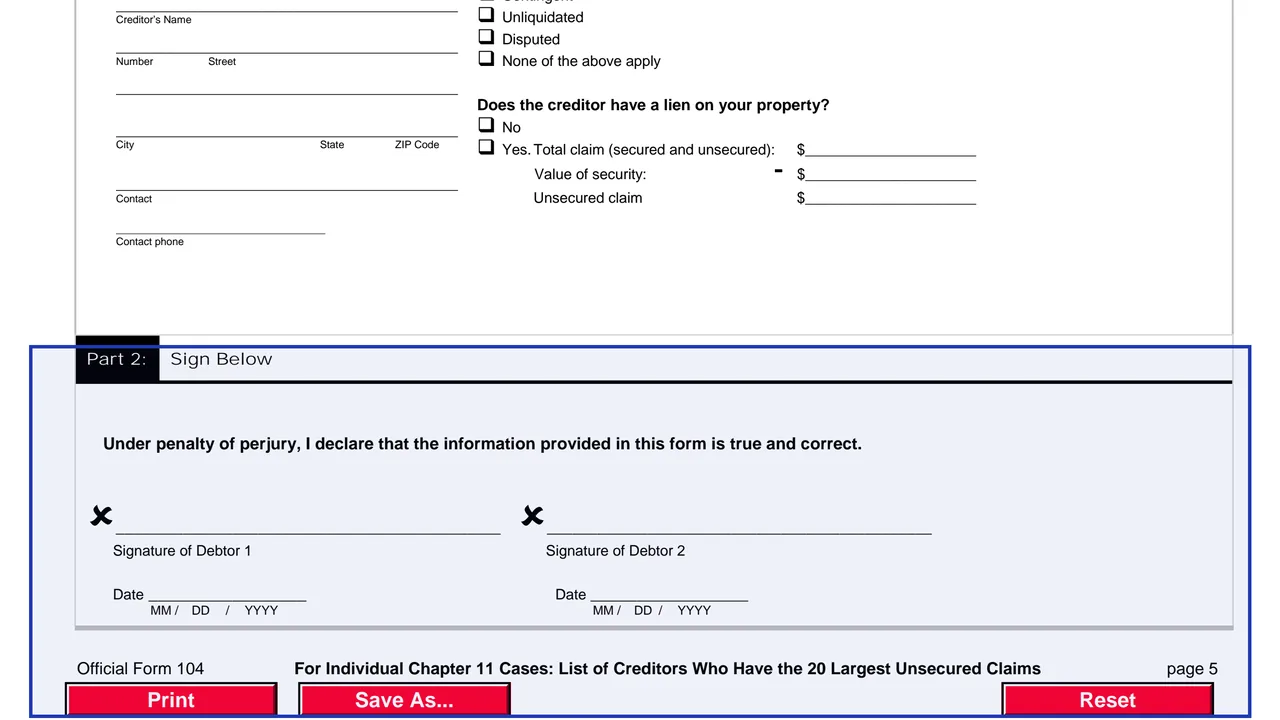
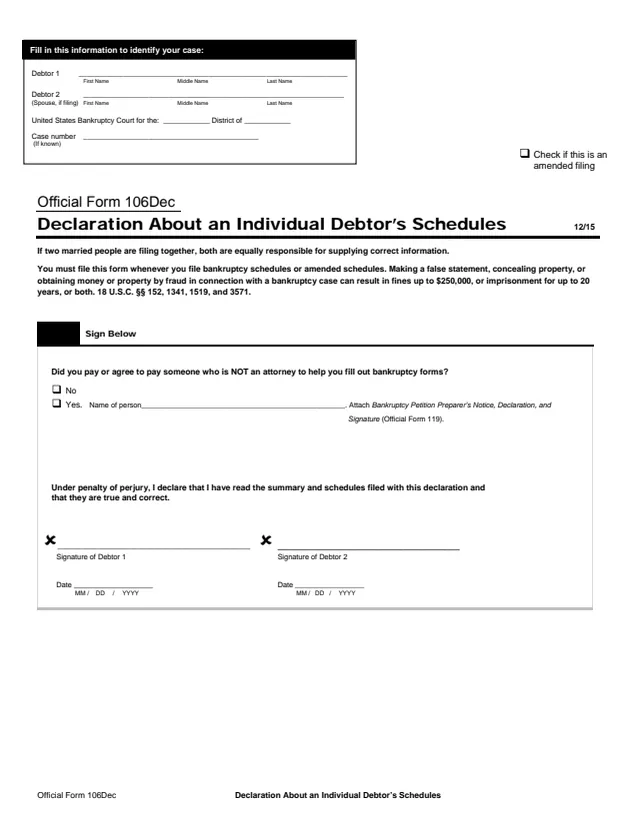
Each debtor declares under penalty of perjury that the information provided in the form is true and correct, then signs and dates it.
Enter the name of Debtor 1 and, in a joint case, Debtor 2, the district, the case number if known, and check the box if this is an amended filing.
The form says not to include claims by anyone who is an insider, and gives examples such as relatives and corporations in which you own 20 percent or more of the voting securities.
For a creditor with a lien, subtract the value of security from the total claim. The instructions give an example: owing $30,000 on a car worth $20,000 leaves a $10,000 unsecured claim.
Fill one numbered section per claim, from largest to smallest. The instructions say claims that are uncertain when you file, or become due only after you file, are included too.
Fill in the nature of the claim, such as the instructions' examples of trade debts, bank loans, professional services and government contracts, and check contingent, unliquidated, disputed or none of the above.
Each debtor signs and dates Part 2 under penalty of perjury.
You get the real form, filled in a browser tab, with nothing standing between you and the finished PDF.
With the United States Bankruptcy Court for the district named in the caption. The instructions say it is filed when the chapter 11 case is filed with the court.
The form does not print a fee for this list.
The instructions say every creditor listed on this form is also listed on Schedule D (Official Form 106D) or Schedule E/F (Official Form 106E/F).
The instructions booklet says not to list a minor child's full name, only the child's initials and the full name and address of the child's parent or guardian (11 U.S.C. § 112; Bankruptcy Rule 1007(m) and 9037). The committee note says this direction moved from the form to the booklet.
The instructions booklet says making a false statement, concealing property, or obtaining money or property by fraud in connection with a bankruptcy case can result in fines up to $250,000, or imprisonment for up to 20 years, or both.
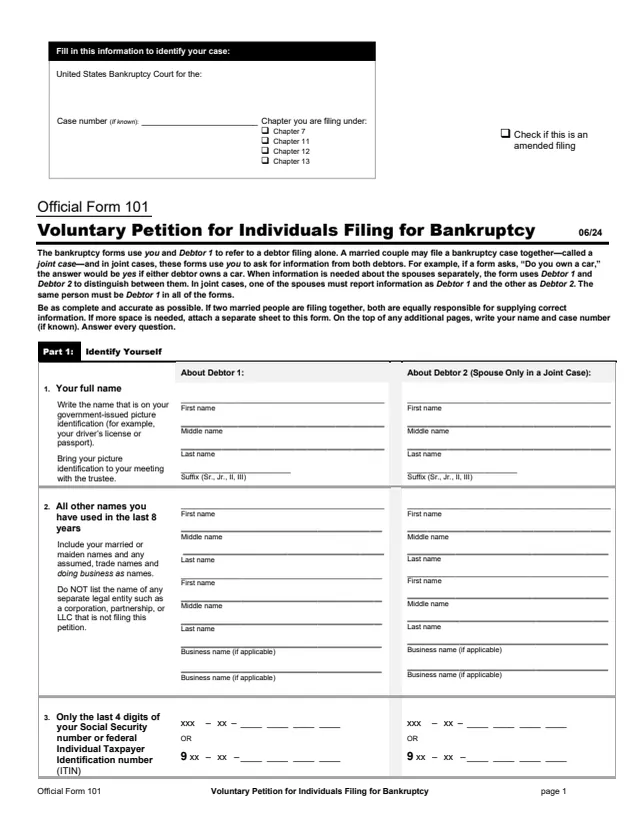
B 101
159 fields, 9 pages
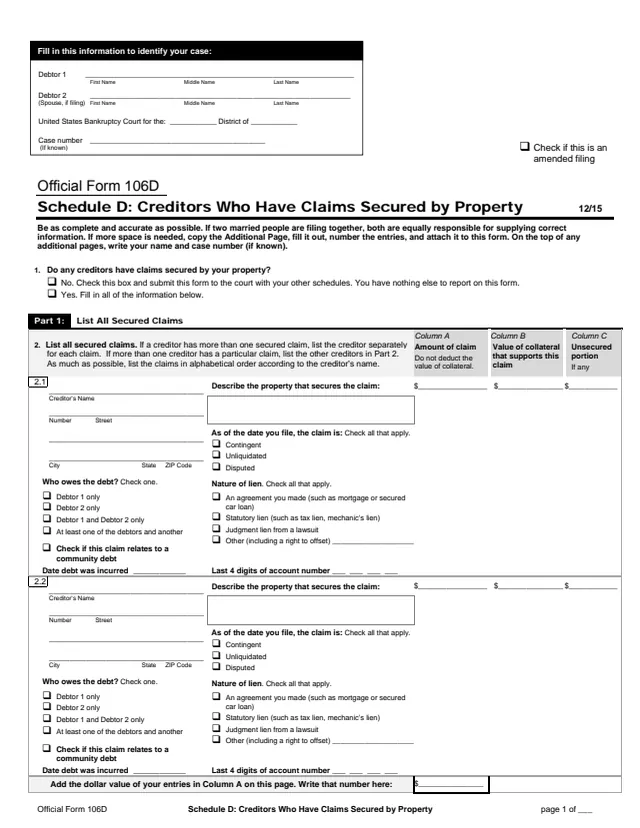
B 106D
186 fields, 3 pages
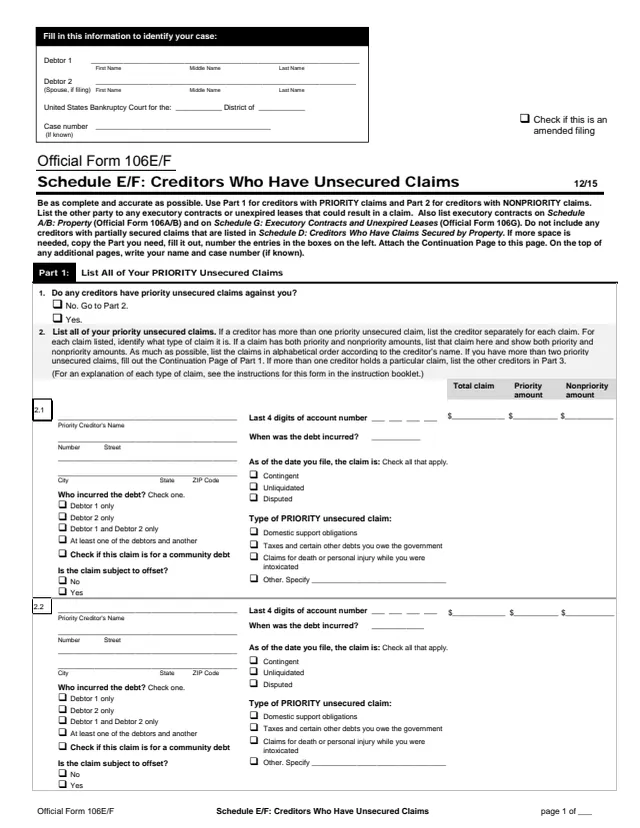
B 106E/F
323 fields, 6 pages
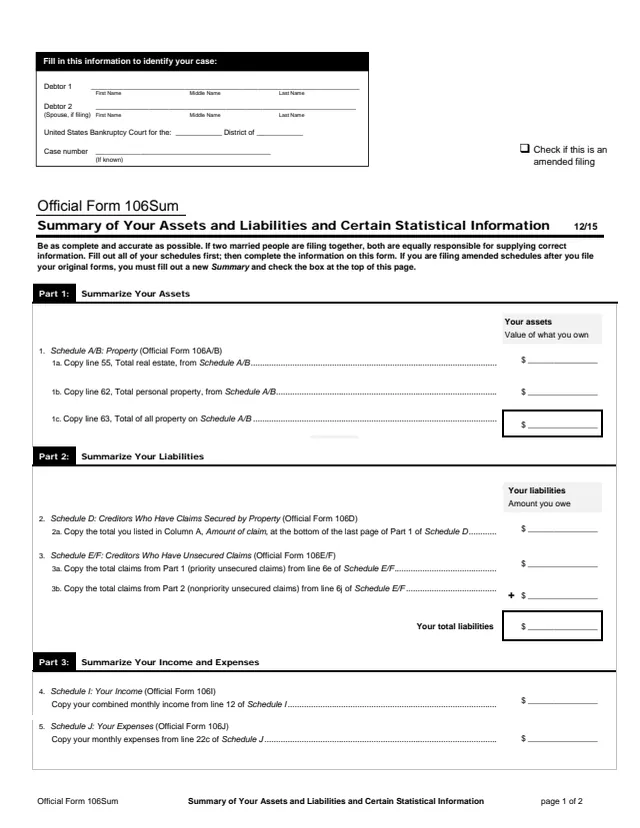
B 106 Summary
28 fields, 2 pages
B 106 Declaration
15 fields, 1 page
The debtor fills out and signs the form. It is for individual Chapter 11 cases only.
No tool matches that search.
The form says an individual filing for bankruptcy under Chapter 11 fills it out, and that people filing under Chapter 7, Chapter 12 or Chapter 13 do not.
The form lists relatives, general partners, relatives of general partners, partnerships of which you are a general partner, corporations of which you are an officer, director, person in control, or owner of 20 percent or more of their voting securities, and any managing agent, including one for a business you operate as a sole proprietor.
Only in one case. The form says not to include claims by secured creditors unless the unsecured claim resulting from inadequate collateral value places the creditor among the holders of the 20 largest unsecured claims.
The instructions say a claim is contingent if it is owed only if a particular event occurs after filing, such as a cosigned loan, unliquidated if the amount cannot be readily determined, such as unset car accident damages, and disputed if you do not agree that you owe the debt.
The instructions booklet says to fill in only the child's initials and the full name and address of the child's parent or guardian, for example A.B., a minor child (John Doe, parent, 123 Main St., City, State).
No. This page explains the form in plain words and is not legal advice. The instructions booklet notes that it is extremely difficult to succeed in a chapter 11, 12, or 13 case without an attorney.