Instructions (page 1)
Ten numbered instructions: who may use the form, typing or neat writing, telling the truth and signing, answering every question, the fee, one court per petition, where to send it, including all grounds, and capital cases.
AO 241
Petition for Writ of Habeas Corpus Under 28 U.S.C. § 2254
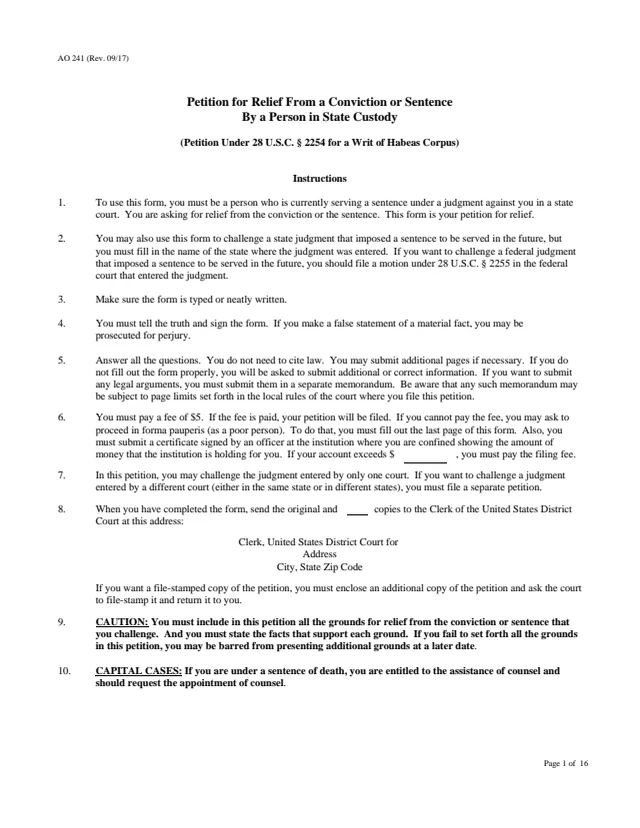
AO 241, Petition for Writ of Habeas Corpus Under 28 U.S.C. § 2254, is the U.S. Courts form titled Petition for Relief From a Conviction or Sentence By a Person in State Custody. It is filed with the Clerk of a United States District Court. The U.S. Courts page lists it under Civil Forms, effective on September 1, 2017, and the form is dated Rev. 09/17.
The 16-page form starts with ten instructions. It then asks about the state conviction and sentence, appeals, other state petitions and motions, up to four grounds for relief with the facts for each, earlier federal filings, pending cases, attorneys, future sentences and the timeliness of the petition under 28 U.S.C. § 2244(d). It ends with the relief requested and a declaration under penalty of perjury.
This page explains the form in plain words and is not legal advice. It cannot say whether the form fits a case. You can fill it out free in your browser on this page and download the result without an account.
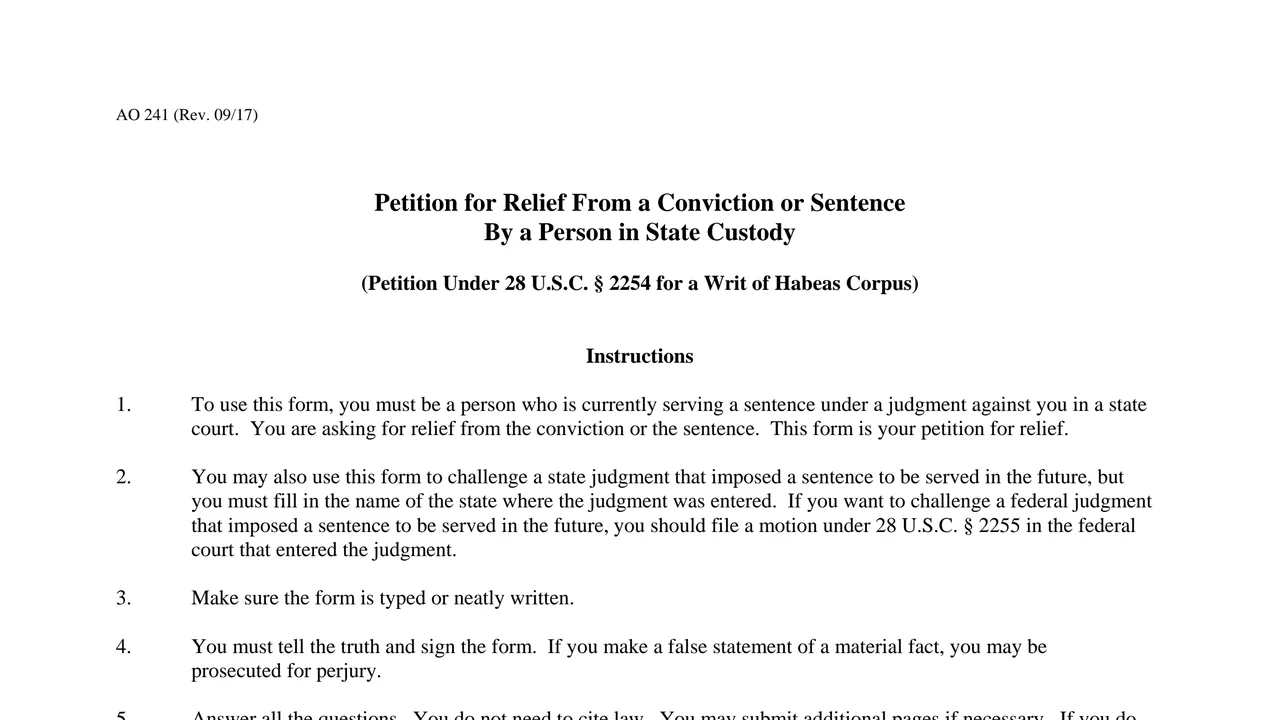
Ten numbered instructions: who may use the form, typing or neat writing, telling the truth and signing, answering every question, the fee, one court per petition, where to send it, including all grounds, and capital cases.
The district, the name under which the petitioner was convicted, docket or case number, place of confinement, prisoner number, the petitioner and respondent (the authorized person having custody of petitioner), and the Attorney General of the State.
The court that entered the judgment, dates of judgment and sentencing, length of sentence, counts and crimes, the plea, the kind of trial, testimony, and any appeal, further state review or petition for certiorari in the United States Supreme Court.
Other petitions, applications or motions about the judgment in any state court, with up to three described: court, docket number, filing date, nature, grounds, hearing, result and any appeal to the highest state court.
Each ground on which the petitioner claims to be held in violation of the Constitution, laws or treaties of the United States, with supporting facts, exhaustion of state remedies, direct appeal, post-conviction proceedings and other remedies.
Presentation of grounds to state courts, earlier federal filings, pending cases, attorneys at each stage, future sentences, timeliness under 28 U.S.C. § 2244(d) with an excerpt of that section, the relief requested, and the declaration and signatures.
The form asks for typed or neatly written answers to all the questions. It says citing law is not needed, extra pages may be added, and any legal arguments go in a separate memorandum that may be subject to page limits in the local rules.
Enter the district, the name under which you were convicted, the place of confinement, the prisoner number, the respondent and the state of the Attorney General.
Questions 1 to 11 ask about the judgment, the plea, the trial, any appeal and other state filings. Many lines are marked if you know.
Question 12 asks for every ground and the facts supporting each. Each ground says do not argue or cite law, just state the specific facts. Pages are attached for more than four grounds.
Questions 13 to 18 cover state and federal filings, attorneys, future sentences and timeliness. Question 18 asks a petitioner whose judgment became final over one year ago to explain why the one-year statute of limitations in 28 U.S.C. § 2244(d) does not bar the petition.
Write the relief requested, then sign the declaration under penalty of perjury that the petition is true and correct and give the date it was placed in the prison mailing system and the date signed.
You get the real form, filled in a browser tab, with nothing standing between you and the finished PDF.
Instruction 8 says to send the original and a number of copies to the Clerk of the United States District Court at an address. The number of copies and the address are blank on the downloaded form. For a file-stamped copy, it says to enclose an additional copy and ask the court to file-stamp it and return it.
Instruction 6 says the fee is $5 and that if the fee is paid, the petition will be filed.
Instruction 6 says a person who cannot pay may ask to proceed in forma pauperis (as a poor person) by filling out the last page of the form and submitting a certificate signed by an officer at the institution showing the money it holds for them. The account amount is blank on the downloaded form, and the 16-page PDF ends with the signature page.
Instruction 7 says a petition may challenge the judgment entered by only one court, and a judgment entered by a different court, in the same state or in different states, needs a separate petition.
The form quotes 28 U.S.C. § 2244(d): a one-year period of limitation applies, running from the latest of four listed dates, and time during which a properly filed application for State post-conviction or other collateral review is pending is not counted.
Instruction 4 says a false statement of a material fact may be prosecuted as perjury.
AO 243
150 fields, 13 pages
AO 242
212 fields, 9 pages
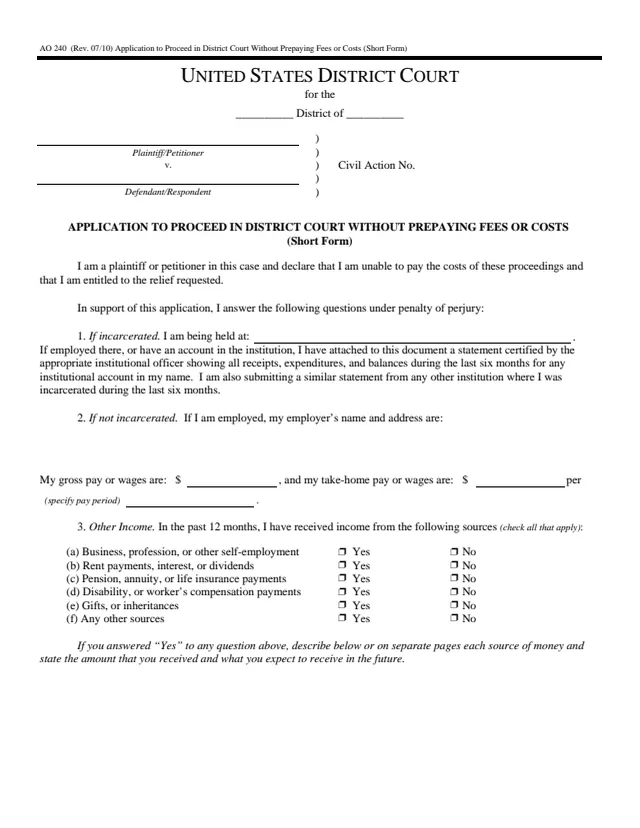
AO 240
28 fields, 2 pages
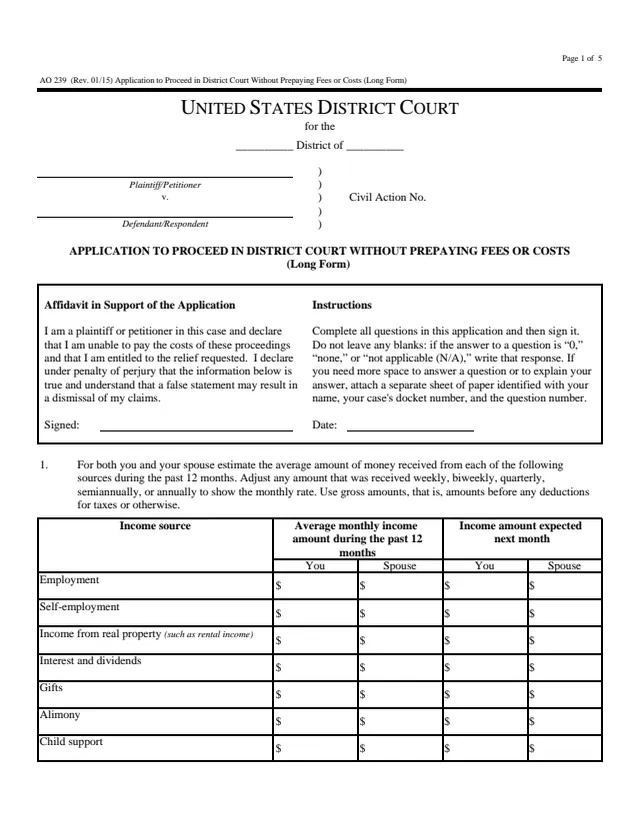
AO 239
191 fields, 5 pages
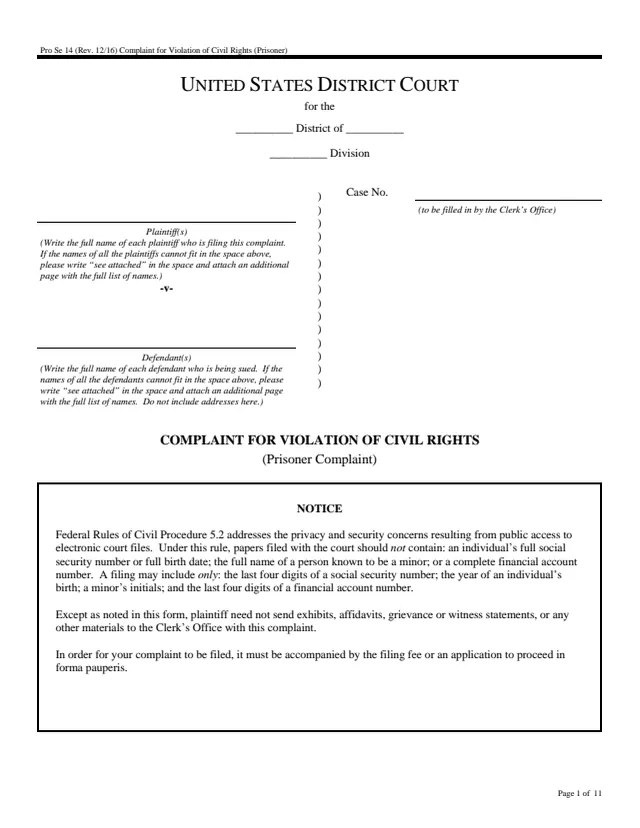
Pro Se 14
125 fields, 11 pages
The form's instructions describe who it is written for and who signs it.
No tool matches that search.
This page cannot say. Instruction 1 says the form is for a person currently serving a sentence under a state court judgment, and instruction 2 says a person challenging a federal judgment that imposed a sentence to be served in the future should file a motion under 28 U.S.C. § 2255 in the federal court that entered the judgment.
Instruction 6 says the fee is $5. It says a person who cannot pay may ask to proceed in forma pauperis (as a poor person), with a certificate signed by an officer at the institution where they are confined.
No. Instruction 7 says a petition may challenge the judgment entered by only one court, and a judgment from a different court needs a separate petition.
Instruction 5 says you do not need to cite law. Any legal arguments go in a separate memorandum, which the form says may be subject to page limits set in the local rules of the court.
The cautions in instruction 9 and question 12 say that if a petitioner fails to set forth all the grounds in the petition, they may be barred from presenting additional grounds at a later date. Question 12 also says a petitioner ordinarily first exhausts available state-court remedies on each ground.
If the judgment of conviction became final over one year ago, question 18 asks why the one-year statute of limitations in 28 U.S.C. § 2244(d) does not bar the petition. The form prints an excerpt of that section.
Instruction 8 says to enclose an additional copy of the petition and ask the court to file-stamp it and return it.
The petitioner signs the declaration under penalty of perjury, and there is a line for the attorney, if any. If someone else signs, the form asks for their relationship to the petitioner and why the petitioner is not signing.