Caption and notice
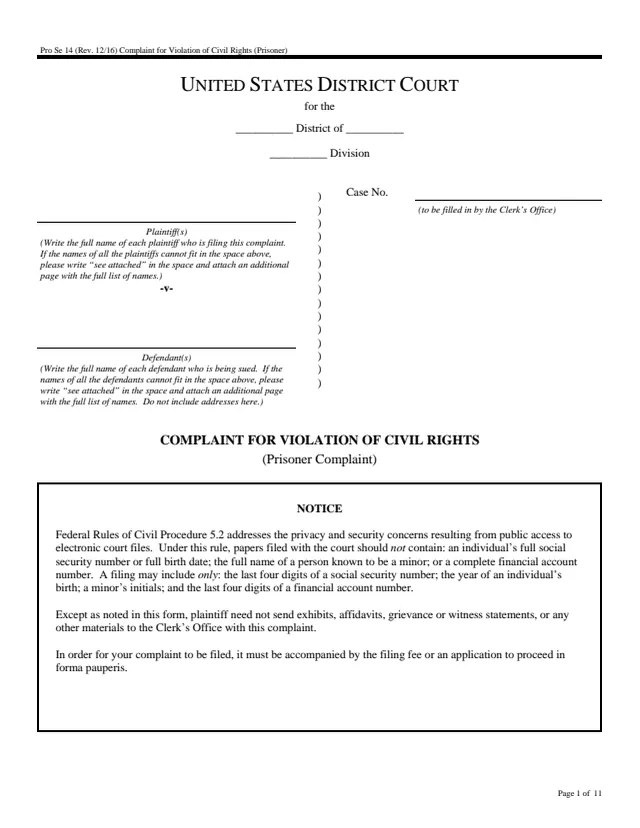
The district and division, the full names of the plaintiffs and defendants without addresses, and a case number left for the Clerk's Office. Page 1 has a notice on privacy, exhibits and the filing fee.
Pro Se 14
Complaint for Violation of Civil Rights (Prisoner)
Pro Se 14, Complaint for Violation of Civil Rights (Prisoner), is a pleading form from the U.S. Courts for a case in a United States district court. It is one of the Civil Pro Se Forms, which the U.S. Courts page says are limited to types of cases often filed in federal courts by people who represent themselves or who may not have much experience in federal courts.
The 11-page form is titled a Prisoner Complaint. It asks for the parties, whether the suit is against federal officials (a Bivens claim), state or local officials (a § 1983 claim) or both, prisoner status, the facts, injuries, relief, exhaustion of administrative remedies, previous lawsuits, and a signed certification under Federal Rule of Civil Procedure 11.
The U.S. Courts offers it as a PDF and a Word file, effective on December 1, 2016. This page explains the form in plain words and is not legal advice. You can fill it out free in your browser on this page and download the result without an account.
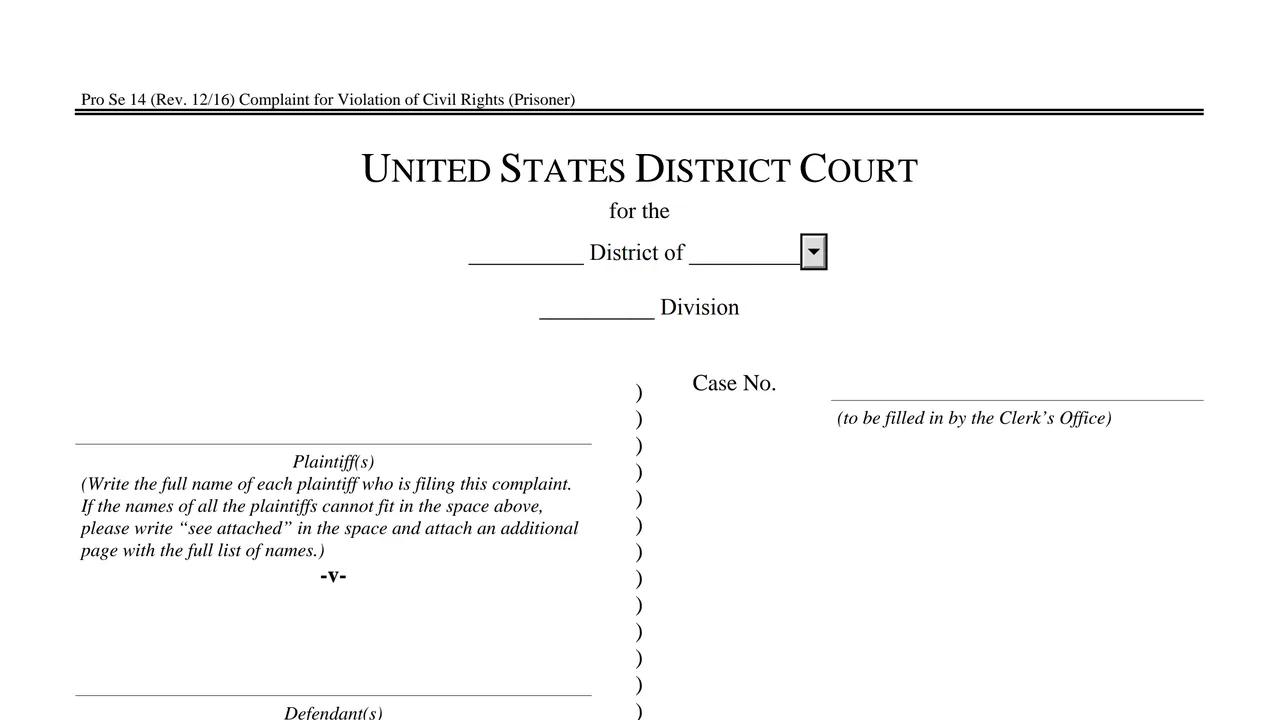
The district and division, the full names of the plaintiffs and defendants without addresses, and a case number left for the Clerk's Office. Page 1 has a notice on privacy, exhibits and the filing fee.
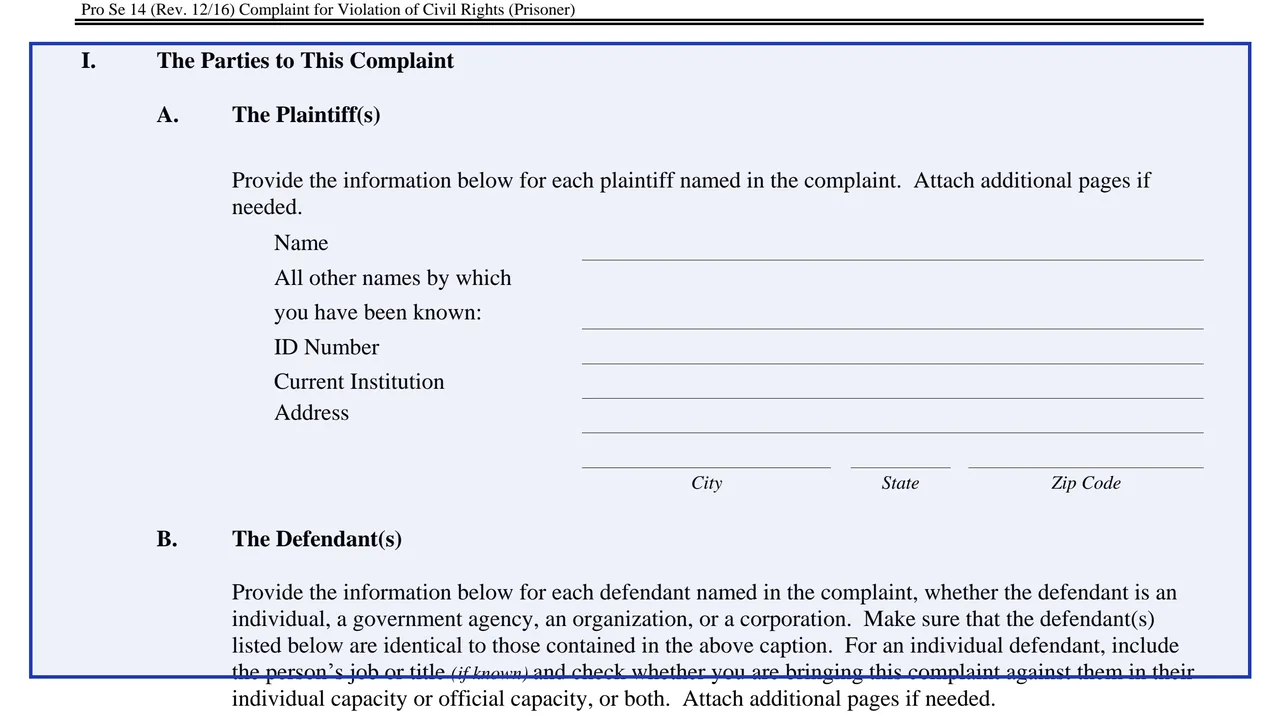
For each plaintiff: name, other names used, ID number, current institution and address. For up to four defendants: name, job or title, shield number, employer, address and capacity.
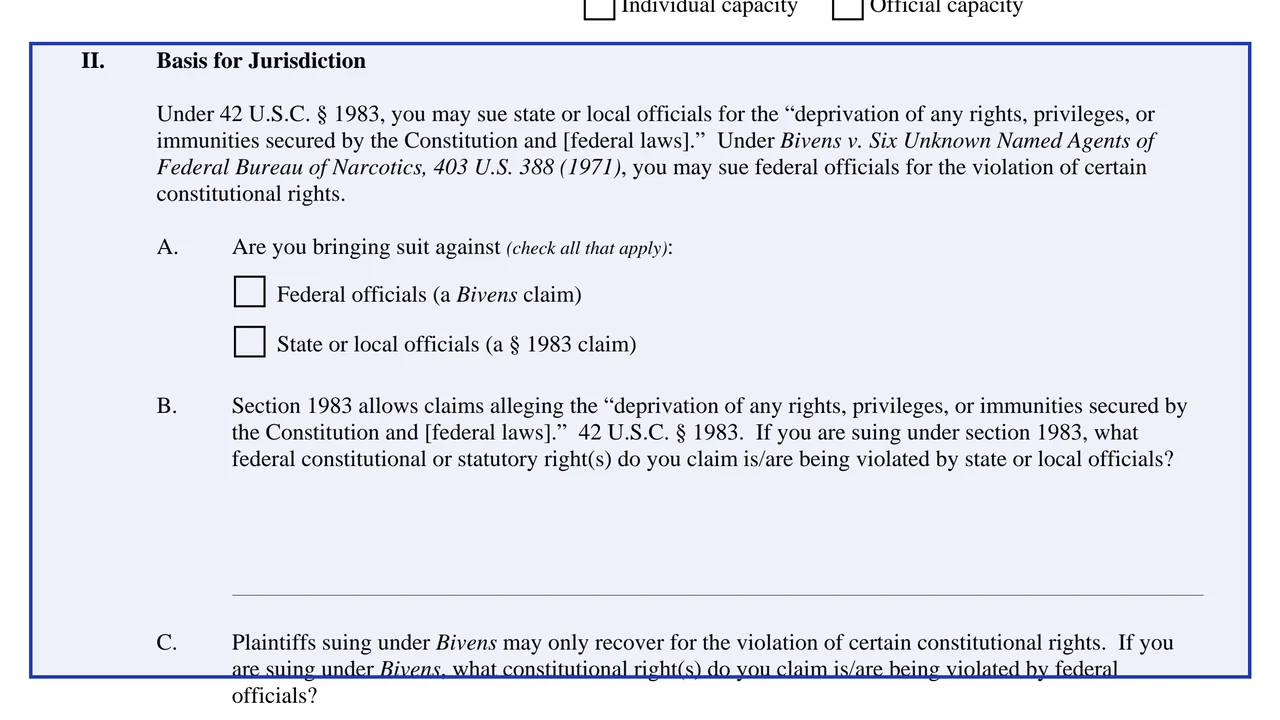
Whether federal officials (Bivens), state or local officials (42 U.S.C. § 1983) or both are sued, the rights claimed to be violated, and how each defendant acted under color of state, local or federal law.
Prisoner status, the facts with where, when and how each defendant was involved and no case or statute citations, any injuries and medical treatment, and the relief asked for with amounts of any damages.
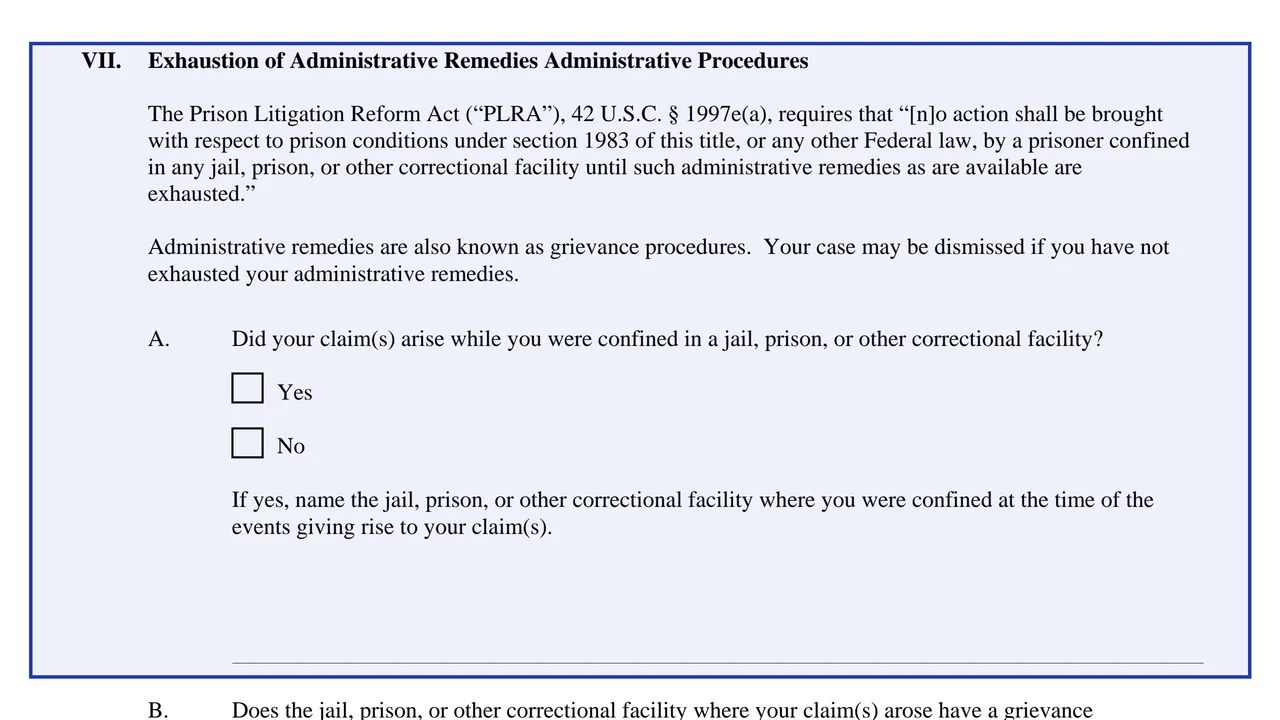
Questions about the facility's grievance procedure, any grievance filed, its result and appeals. The form quotes the Prison Litigation Reform Act, 42 U.S.C. § 1997e(a), and says a case may be dismissed if administrative remedies were not exhausted.
Whether a case was dismissed under the "three strikes rule" of 28 U.S.C. § 1915(g), other lawsuits on the same facts or on prison conditions, then the Rule 11 certification and signatures.
Page 1 cites Federal Rule of Civil Procedure 5.2: a filing may include only the last four digits of a Social Security number, the year of birth, a minor's initials and the last four digits of a financial account number.
Write each defendant's full name in the caption without addresses, then list the same defendants in Section I.B and check individual capacity, official capacity or both.
Section II asks which officials are sued and, for each type, the rights claimed and how each defendant acted under color of state, local or federal law.
Section IV asks for the facts, dates, times and locations and how each defendant was personally involved, with no cases or statutes cited. Several claims are numbered in separate paragraphs.
Sections VII and VIII ask about grievances and their results, any "three strikes" dismissal, and earlier lawsuits, using the same 7 questions for each lawsuit. Grievance documents may be attached as exhibits.
Sign under the Rule 11 certification. A plaintiff without an attorney adds a prison identification number and prison address and agrees to keep the address current with the Clerk's Office.
You get the real form, filled in a browser tab, with nothing standing between you and the finished PDF.
The form is captioned for a United States District Court, district and division. The page says to consult the rules and caselaw that govern in the court where the pleading is filed.
The form says that for the complaint to be filed, it must be accompanied by the filing fee or an application to proceed in forma pauperis. It does not print the fee amount.
The form quotes 42 U.S.C. § 1997e(a) on exhausting available administrative remedies before an action about prison conditions, and says administrative remedies are also known as grievance procedures.
The form quotes 28 U.S.C. § 1915(g), which it says bars a prisoner with three or more earlier dismissals on the listed grounds from suing or appealing without paying the filing fee, unless under imminent danger of serious physical injury.
Except as noted in the form, it says the plaintiff need not send exhibits, affidavits, grievance or witness statements, or other materials to the Clerk's Office with the complaint.
The page says that if you are not a lawyer and are suing or have been sued, it is best to have or consult a lawyer if possible.
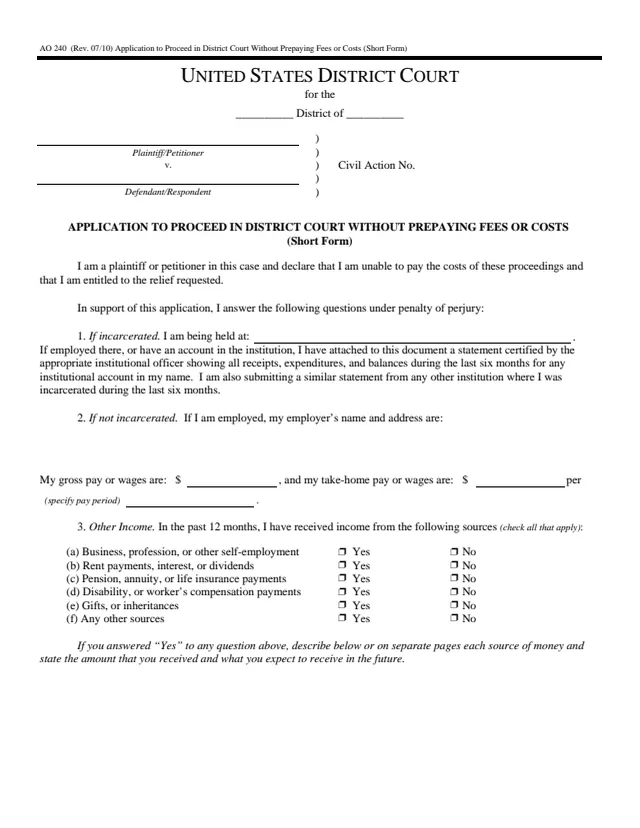
AO 240
28 fields, 2 pages
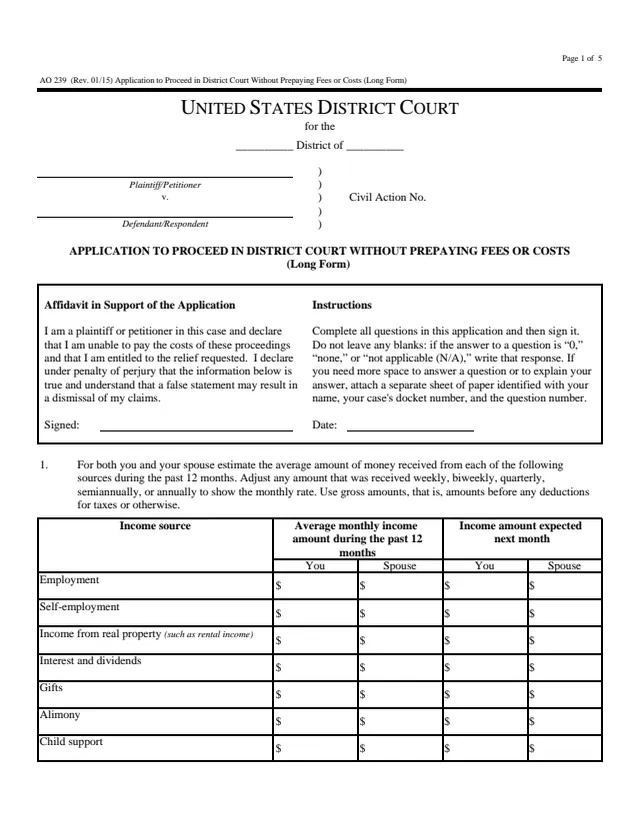
AO 239
191 fields, 5 pages
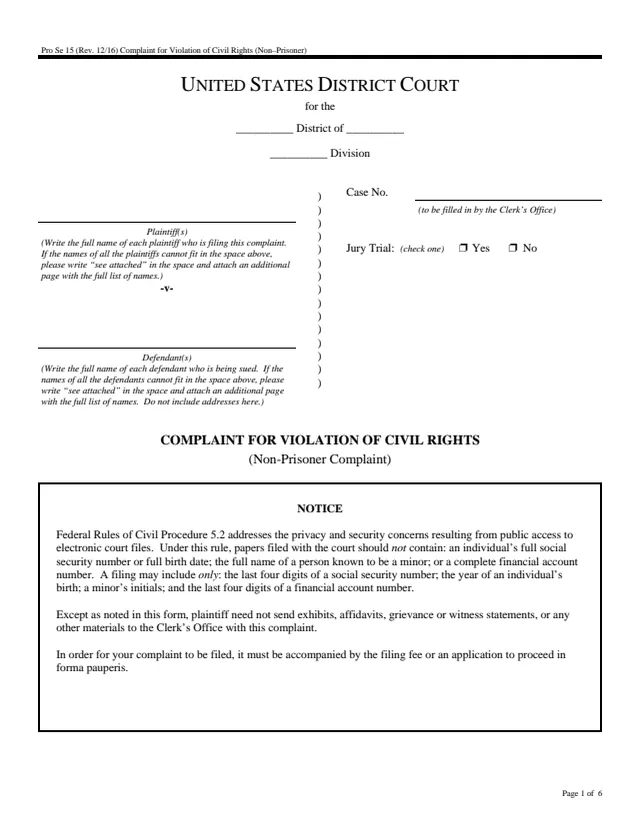
Pro Se 15
82 fields, 6 pages
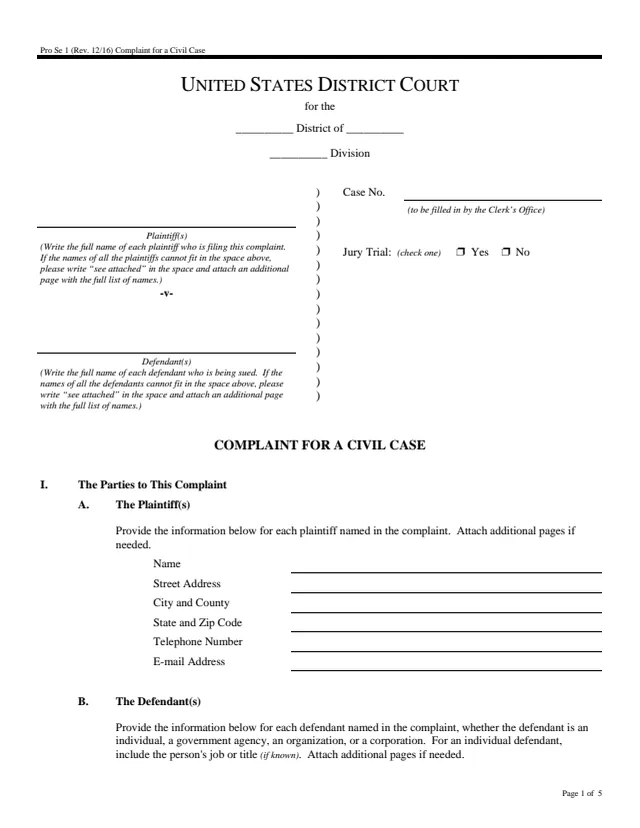
Pro Se 1
76 fields, 5 pages
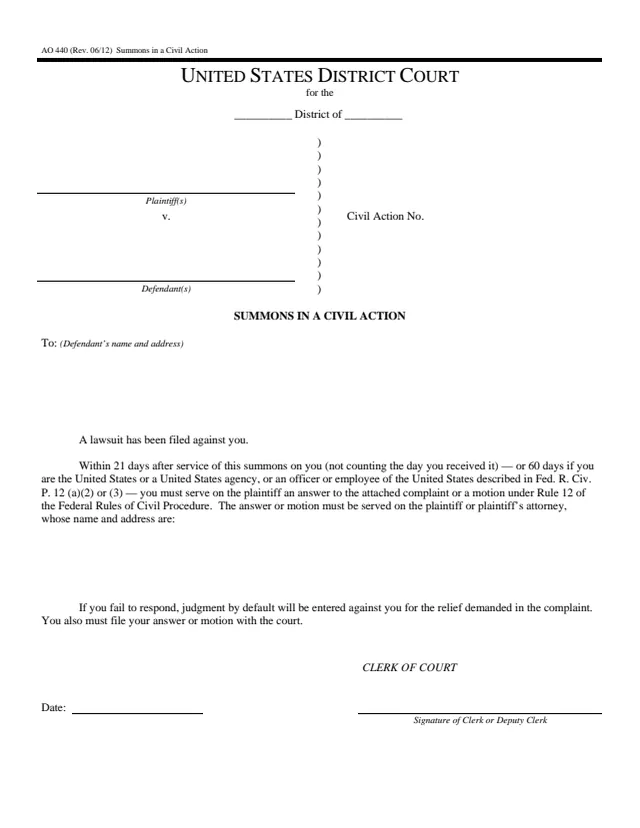
AO 440
34 fields, 2 pages
The page describes the Civil Pro Se Forms as examples for people who represent themselves or have little experience in federal courts, and says to use the form that fits your case. The form names these parties.
No tool matches that search.
No. The U.S. Courts page says no form provides legal advice or substitutes for having or consulting a lawyer, and that following a form does not guarantee a pleading is legally or factually correct or sufficient.
The form says that under 42 U.S.C. § 1983 a person may sue state or local officials, and under Bivens v. Six Unknown Named Agents of Federal Bureau of Narcotics, 403 U.S. 388 (1971), federal officials for the violation of certain constitutional rights. Section II.A has a box for each.
The form quotes 28 U.S.C. § 1915(g) and asks whether, to the best of your knowledge, a case of yours was dismissed under it. If yes, it asks which court and when, and for a copy of the order if possible.
Section VII quotes the Prison Litigation Reform Act, 42 U.S.C. § 1997e(a), and says a case may be dismissed if administrative remedies were not exhausted. It asks about the grievance procedure, any grievance filed and any appeal.
The form says that, except as noted in it, the plaintiff need not send exhibits, affidavits, grievance or witness statements, or other materials. Section VII notes that documents about exhaustion of administrative remedies may be attached as exhibits.
The notice on page 1 cites Federal Rule of Civil Procedure 5.2: no full Social Security number or full birth date, no full name of a person known to be a minor, and no complete financial account number.
The U.S. Courts forms include Pro Se 15, Complaint for Violation of Civil Rights (Non-Prisoner). This page cannot say which form fits a case.