Case caption
The district court and district, the plaintiff or petitioner, the defendant or respondent, and the civil action number.
AO 240
Application to Proceed in District Court Without Prepaying Fees or Costs (Short Form)
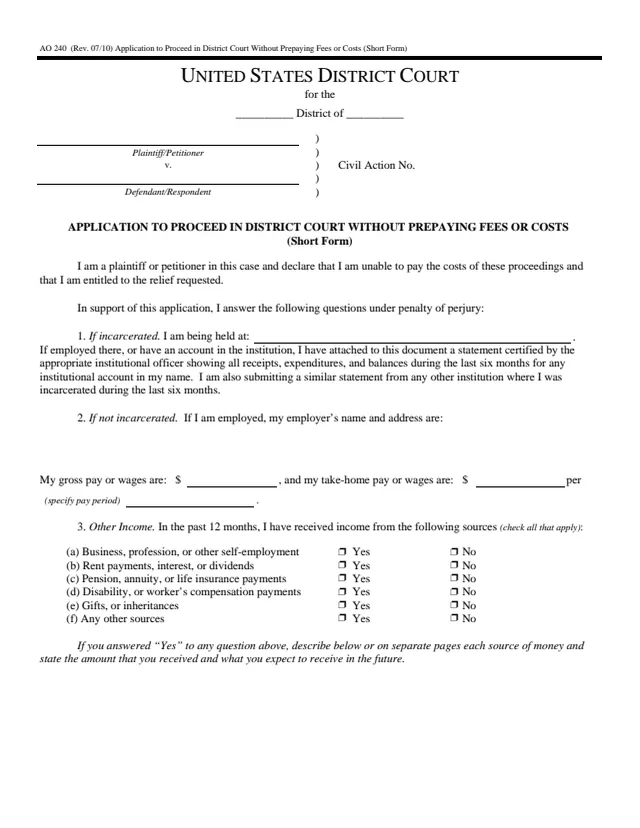
Form AO 240 is the Short Form of the Application to Proceed in District Court Without Prepaying Fees or Costs, published by the U.S. Courts. It opens with a declaration by a plaintiff or petitioner in a United States district court case that they are unable to pay the costs of the proceedings and are entitled to the relief requested. The answers that follow are given under penalty of perjury.
The form asks where the applicant is held if incarcerated, their job and pay, other income in the past 12 months, cash and bank balances, property, regular monthly expenses, dependents and debts. The U.S. Courts lists it under Fee Waiver Application Forms, effective on July 1, 2010, and the printed form is marked Rev. 07/10.
You can fill it out free in your browser on this page and download the result without an account.
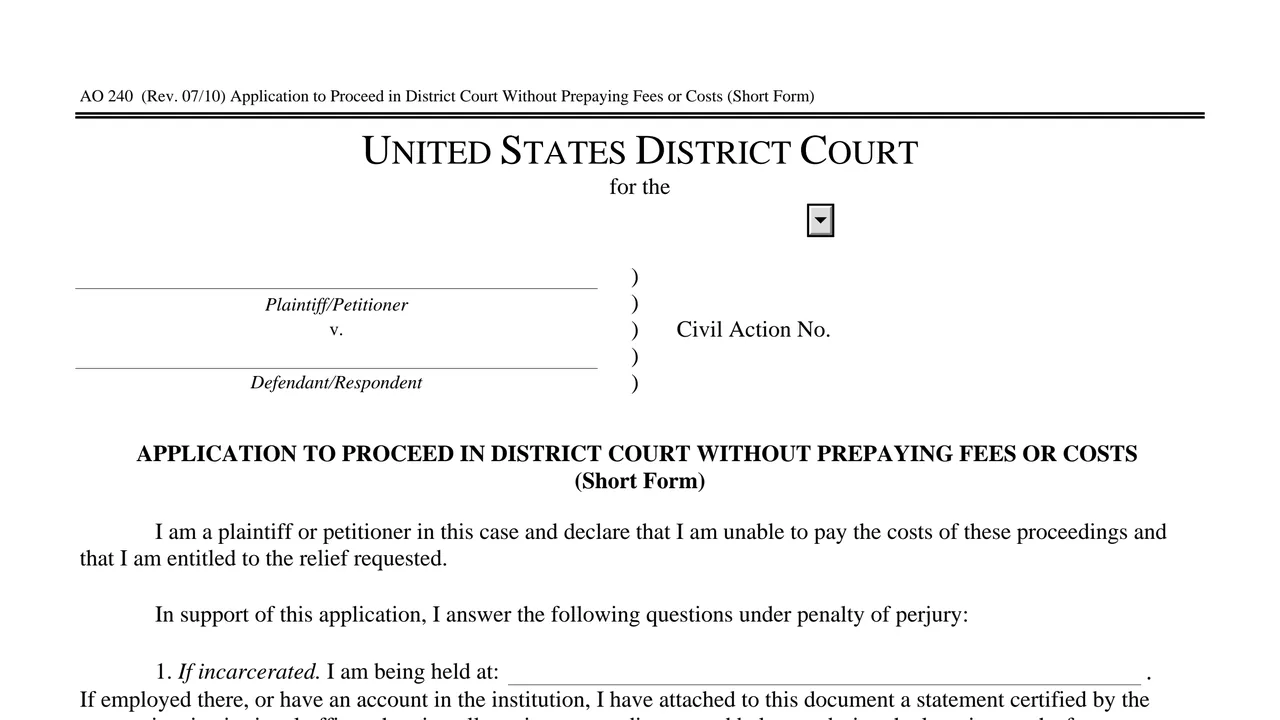
The district court and district, the plaintiff or petitioner, the defendant or respondent, and the civil action number.
Where the applicant is held, if incarcerated, or the employer's name and address, gross pay, take-home pay and pay period, if not.
Yes or no for six sources in the past 12 months: self-employment; rent, interest or dividends; pension, annuity or life insurance; disability or worker's compensation; gifts or inheritances; and any other source. Each yes is described with the amount received and the amount expected.
Cash and checking or savings balances, and any automobile, real estate, stock, bond, trust, jewelry, art work or other thing of value, including items held in someone else's name, with approximate values.
Regular monthly expenses such as housing, transportation, utilities and loan payments; each dependent's name, or initials if under 18, with the relationship and the support given; and debts with amounts and to whom they are owed.
A declaration under penalty of perjury that the information is true, noting that a false statement may result in a dismissal of the claims, then the date, signature and printed name.
Enter the district, the plaintiff or petitioner, the defendant or respondent and the civil action number.
Question 1 is for applicants who are incarcerated and question 2 for those who are not. An incarcerated applicant with a job or account at the institution attaches the certified six-month statements the form describes.
Check yes or no for each of the six income sources in question 3. For each yes, describe the source and the amounts below or on separate pages.
Give cash and bank balances, things of value with approximate values, monthly expenses, dependents and debts in questions 4 to 8.
Date the form, sign it and print your name. The answers are given under penalty of perjury.
You get the real form, filled in a browser tab, with nothing standing between you and the finished PDF.
The form is captioned for a United States District Court in a named district, in a case with a civil action number. The form and its U.S. Courts page do not give submission instructions.
The form asks to proceed without prepaying fees or costs. It does not list fee amounts; the court sets them.
Certified institutional account statements for applicants who are incarcerated, and separate pages for describing other income if needed.
The U.S. Courts page lists AO 240 as effective on July 1, 2010. The printed form is marked Rev. 07/10.
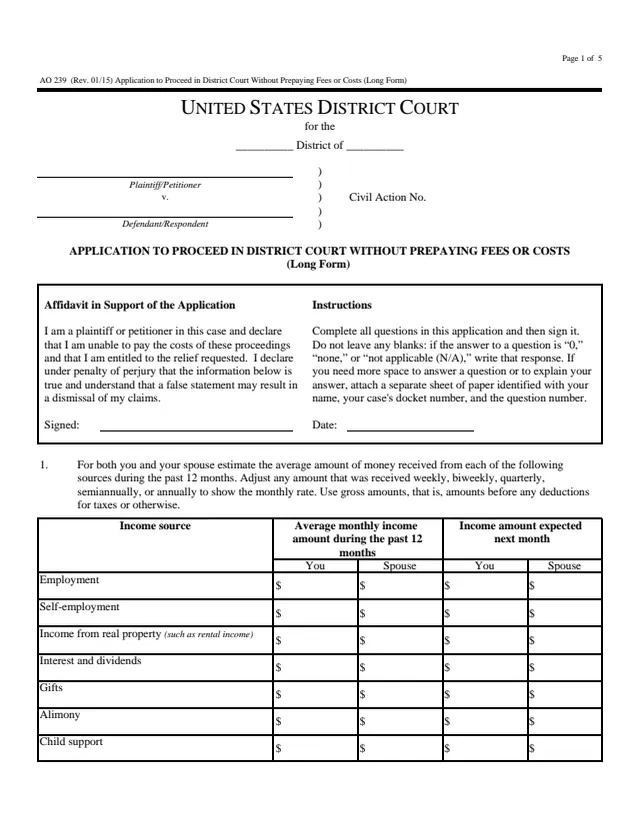
AO 239
191 fields, 5 pages
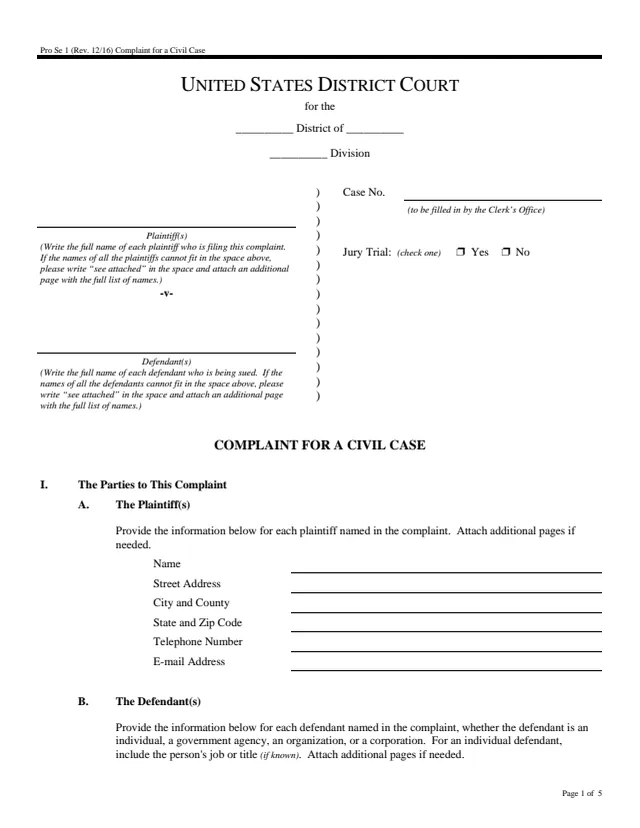
Pro Se 1
76 fields, 5 pages
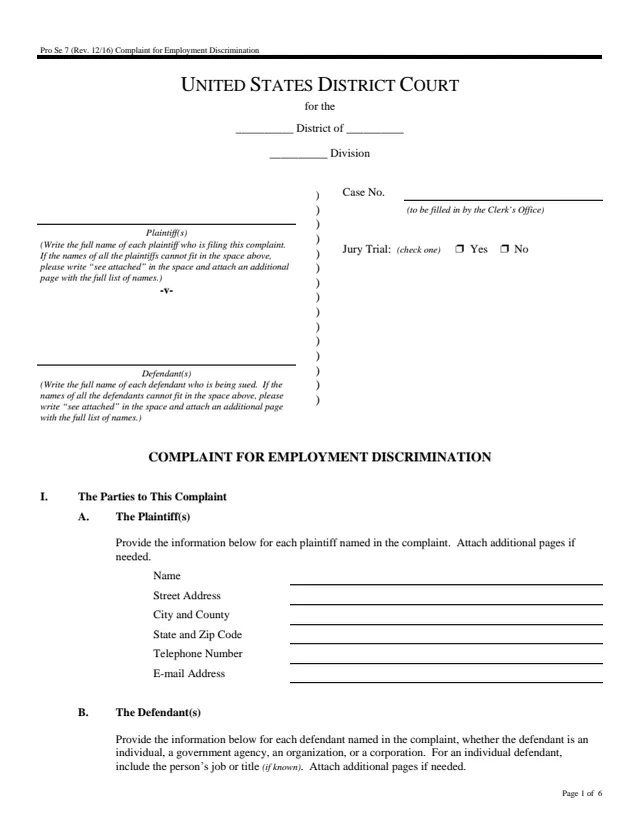
Pro Se 7
99 fields, 6 pages
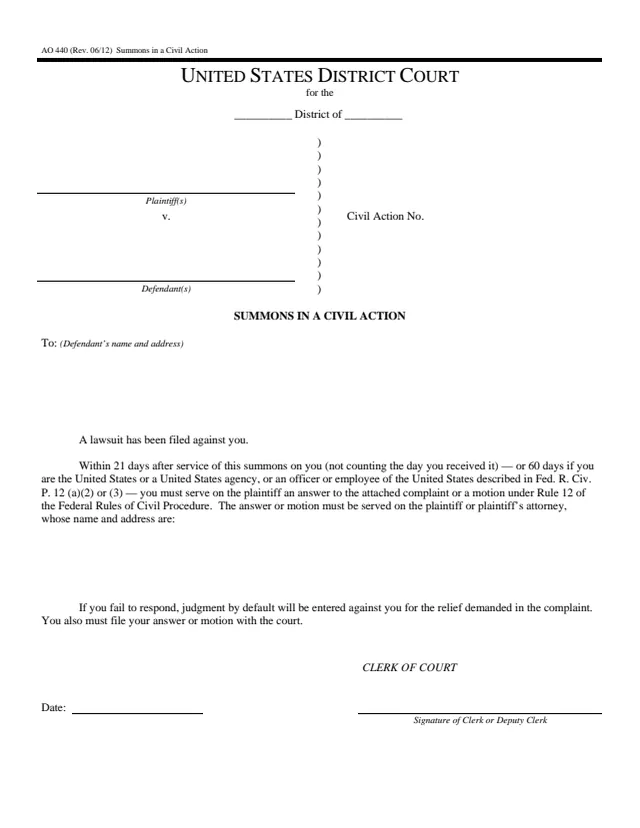
AO 440
34 fields, 2 pages
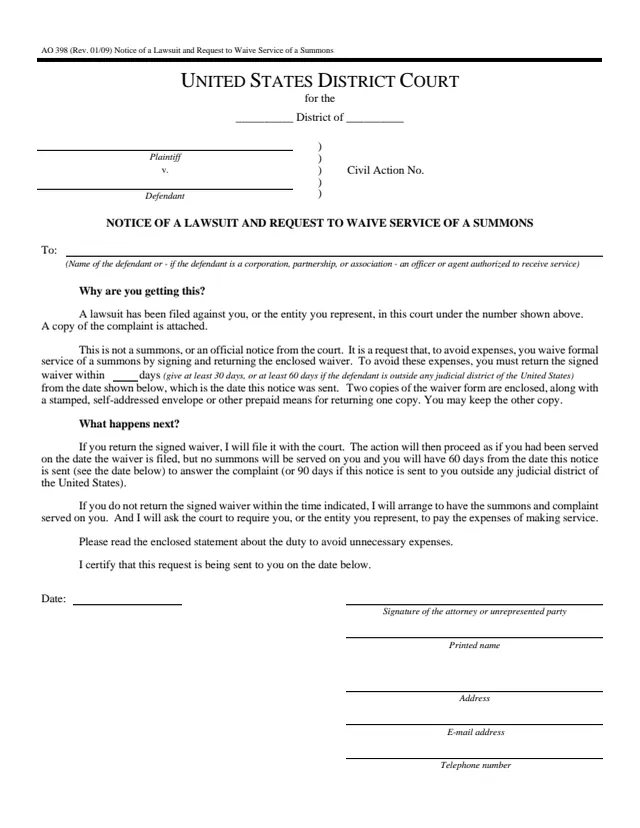
AO 398
15 fields, 1 page
The form is written for a plaintiff or petitioner in a federal district court case. Its first questions depend on whether the applicant is incarcerated.
No tool matches that search.
The U.S. Courts forms list has AO 240 as the Short Form and AO 239 as the Long Form of the Application to Proceed in District Court Without Prepaying Fees or Costs, both under Fee Waiver Application Forms. The AO 240 page does not say which one a court expects.
Yes. The form says the answers are given under penalty of perjury, and the declaration says a false statement may result in a dismissal of the claims.
If employed at the institution or holding an account there, the form says to attach a statement certified by the appropriate institutional officer showing all receipts, expenditures and balances for the last six months, plus a similar statement from any other institution where the applicant was held in that time.
Question 7 asks for the names of everyone who depends on the applicant for support, using initials only for anyone under 18, along with the relationship and how much the applicant contributes.
No. The form and its U.S. Courts page do not list fee amounts. The court sets its fees and costs.
Yes. Question 3 says to describe each other income source and amount below or on separate pages.