Caption
The district, the petitioner's name and the respondent, described on the form as the warden or authorized person having custody of the petitioner. The case number is supplied by the Clerk of Court.
AO 242
Petition for a Writ of Habeas Corpus Under 28 U.S.C. § 2241
AO 242, Petition for a Writ of Habeas Corpus Under 28 U.S.C. § 2241, is a U.S. Courts form a petitioner files with a United States District Court. The U.S. Courts lists it under Civil Forms, and the page says it is effective on September 1, 2017. The edition printed on the form is Rev. 09/17.
The 9-page form opens with a page of instructions. It then asks for personal information and the place of confinement, the decision or action being challenged, earlier appeals, grievances and administrative remedies, any earlier motion under 28 U.S.C. § 2255, immigration proceedings, other petitions, up to four grounds with supporting facts, and the relief requested. It ends with a declaration under penalty of perjury.
This page explains the form in plain words and is not legal advice. It does not say whether the form fits a particular case. You can fill it out free in your browser on this page and download the result without an account.
The district, the petitioner's name and the respondent, described on the form as the warden or authorized person having custody of the petitioner. The case number is supplied by the Clerk of Court.
Full name and other names used, the institution's name and address, an identification number, whether the person is held on federal, state or other orders, and whether the person is a pretrial detainee, serving a sentence, held on an immigration charge or other.
Choices include how a sentence is carried out, calculated or credited, pretrial detention, immigration detention, a detainer, the validity of a conviction or sentence as imposed, and disciplinary proceedings, with the agency or court, case number, decision and date.
First, second and third appeals, grievances or administrative remedies, any earlier § 2255 motion or § 2244(b)(3)(A) motion with an explanation of why the § 2255 remedy is inadequate or ineffective, immigration appeals, and any other petitions or motions.
Up to four grounds, each with brief supporting facts and whether it was presented in all available appeals, an explanation for grounds not presented, and a statement of exactly what the petitioner wants the court to do.
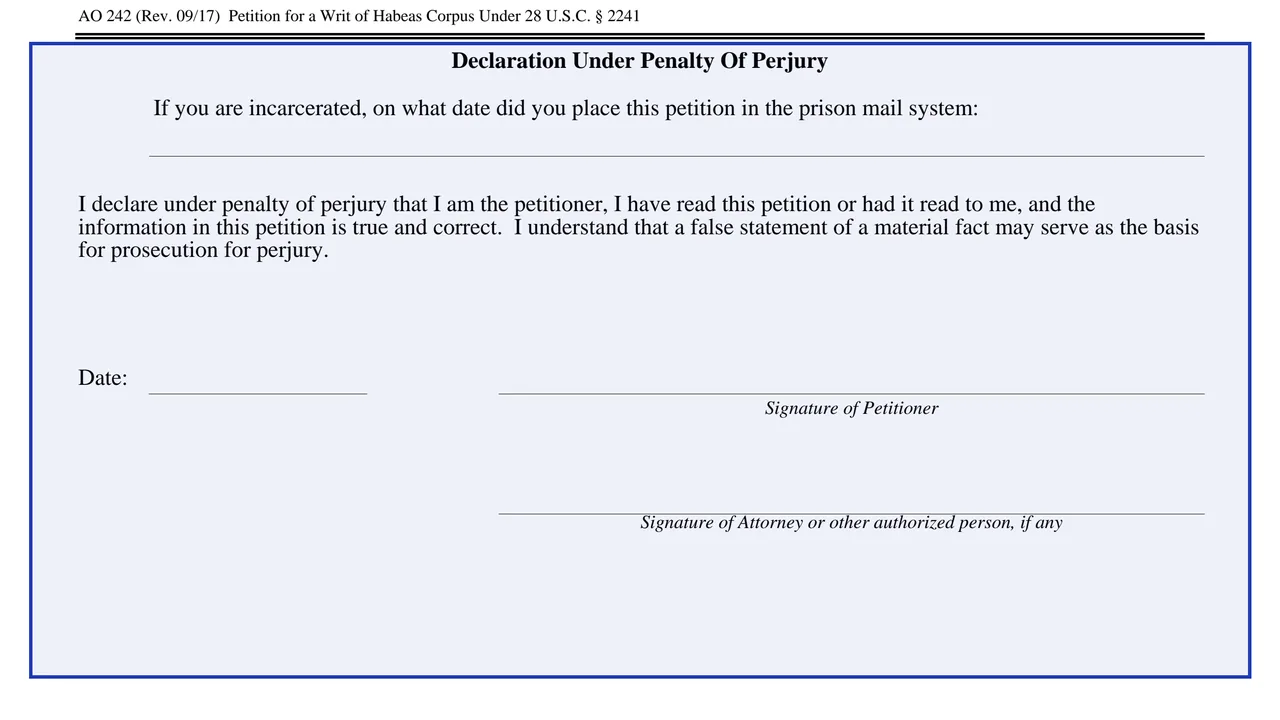
If incarcerated, the date the petition was placed in the prison mail system, then the declaration that the information is true and correct, the date and the petitioner's signature.
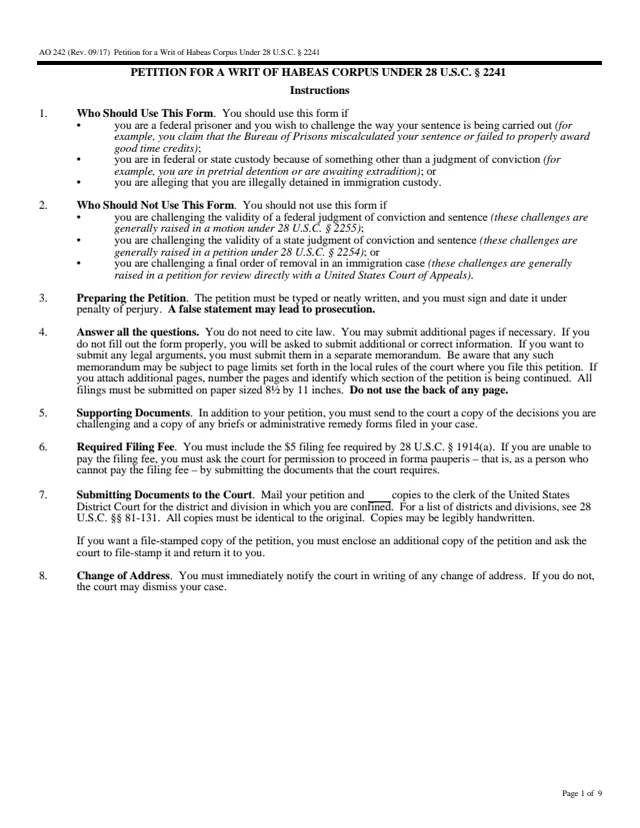
Page 1 says who should and should not use the form, how to prepare it, which documents go with it, the filing fee, where to mail it and what to do after a change of address.
The form asks for a typed or neatly written petition with all questions answered. Law need not be cited. Legal arguments go in a separate memorandum, which the form says may be subject to page limits in the local rules.
Extra pages are numbered and name the section of the petition they continue. The form says all filings are on paper sized 8½ by 11 inches, without using the back of any page.
The form asks for a copy of the decisions being challenged and a copy of any briefs or administrative remedy forms filed in the case to be sent with the petition.
The petitioner signs and dates the declaration on page 9. The form says a false statement may lead to prosecution.
You get the real form, filled in a browser tab, with nothing standing between you and the finished PDF.
The form says to mail the petition and copies to the clerk of the United States District Court for the district and division in which the petitioner is confined, and points to 28 U.S.C. §§ 81-131 for a list of districts and divisions.
The form says to include the $5 filing fee required by 28 U.S.C. § 1914(a). If the fee cannot be paid, it says to ask the court for permission to proceed in forma pauperis by submitting the documents the court requires.
The form leaves the number of copies blank. It says all copies are to be identical to the original and may be legibly handwritten, and that a file-stamped copy needs an additional copy and a request that the court file-stamp it and return it.
The form says to notify the court in writing immediately of any change of address, and that if this is not done, the court may dismiss the case.
The form says a petition that is not filled out properly will lead to a request to submit additional or correct information.
AO 243
150 fields, 13 pages
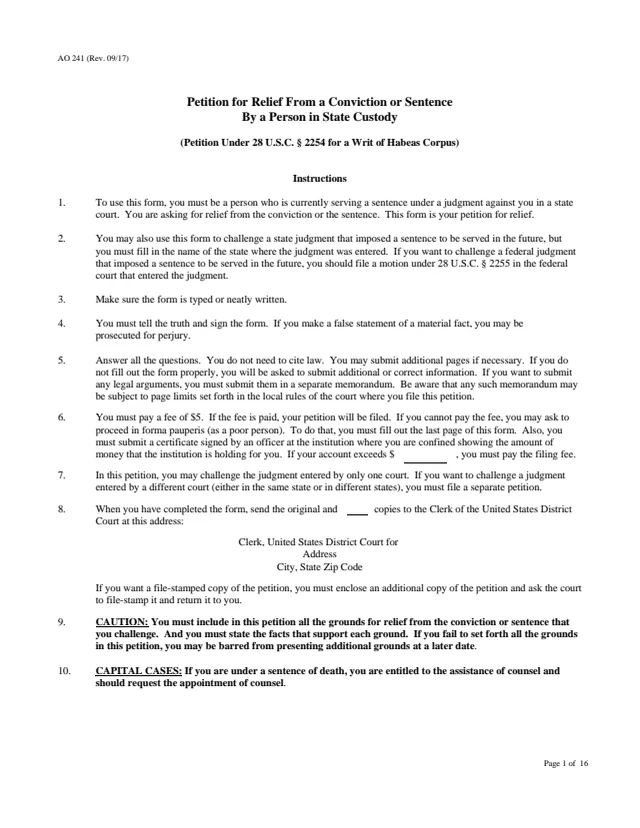
AO 241
385 fields, 16 pages
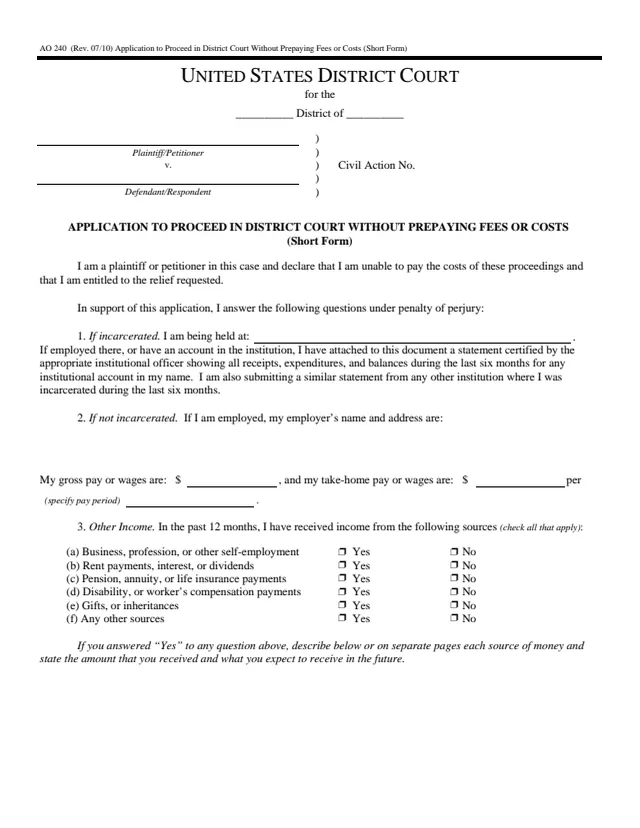
AO 240
28 fields, 2 pages
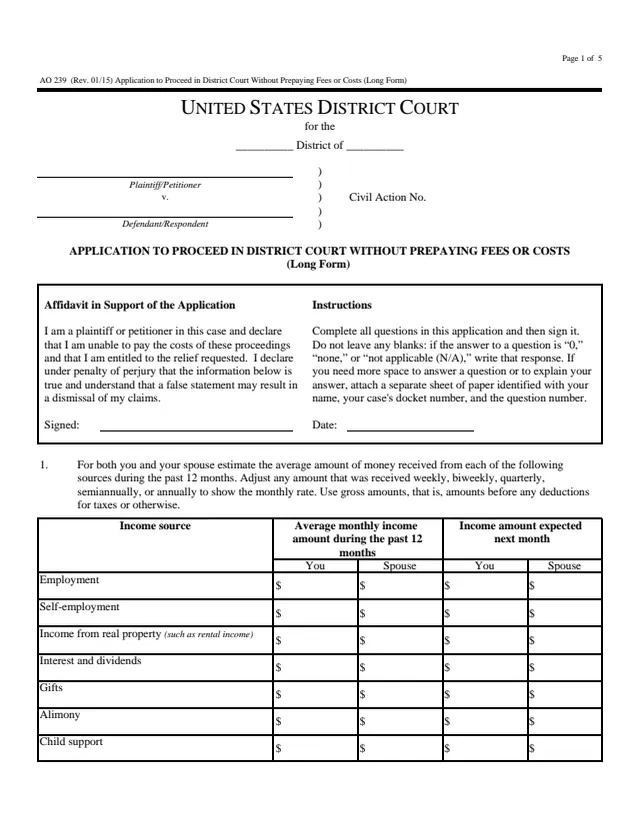
AO 239
191 fields, 5 pages
The petitioner fills out and signs the form. Its instructions list who it is written for and who it is not.
No tool matches that search.
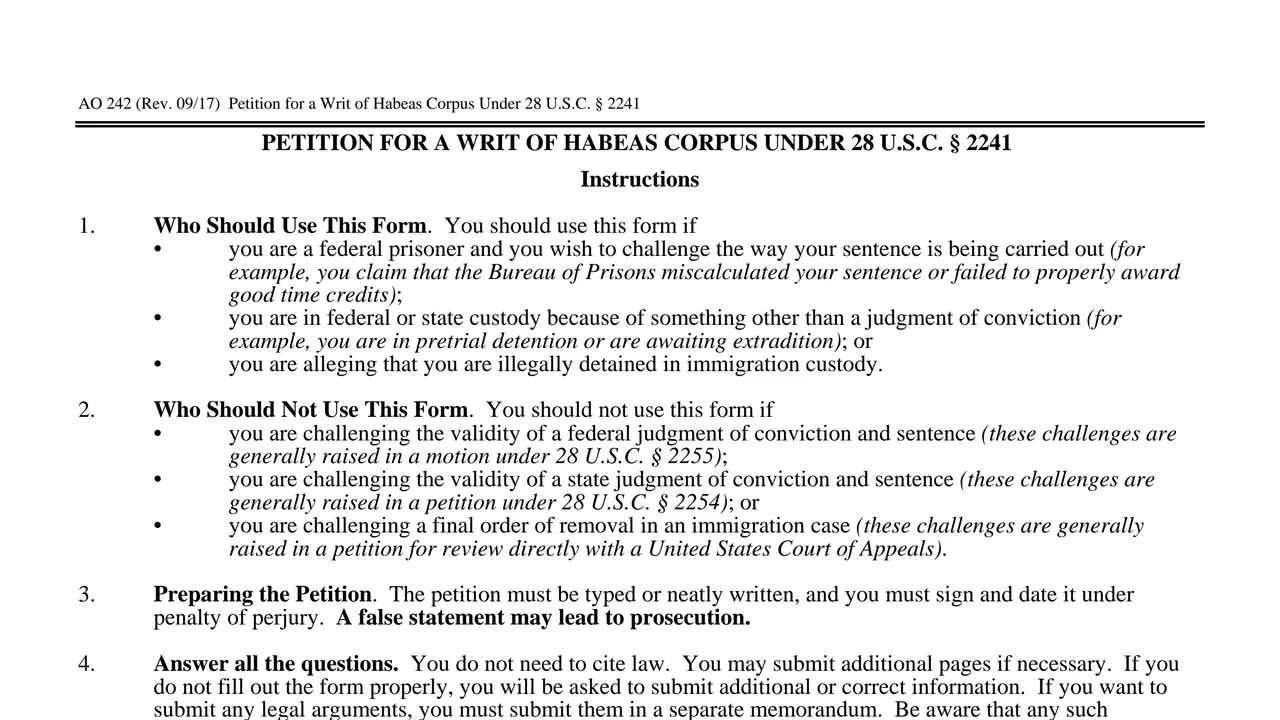
The instructions name federal prisoners challenging the way a sentence is being carried out, people in federal or state custody for something other than a judgment of conviction, such as pretrial detention or awaiting extradition, and people alleging they are illegally detained in immigration custody. This page does not say whether the form fits a particular case.
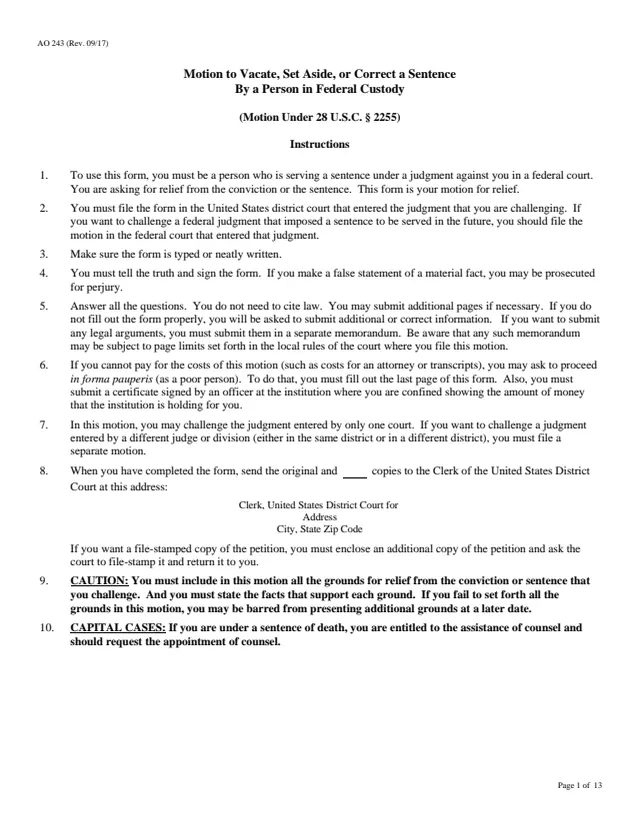
The instructions say challenges to the validity of a federal judgment of conviction and sentence are generally raised in a motion under 28 U.S.C. § 2255, and state ones in a petition under 28 U.S.C. § 2254. The U.S. Courts forms list includes AO 243 and AO 241 for those. Question 10 asks anyone challenging a conviction or sentence as imposed about earlier § 2255 motions.
The form says to include the $5 filing fee required by 28 U.S.C. § 1914(a), and to ask the court for permission to proceed in forma pauperis if the fee cannot be paid. The U.S. Courts forms list includes AO 240 and AO 239, applications to proceed without prepaying fees or costs.
No. The form says law need not be cited, supporting facts are to be brief without citing cases or law, and any legal arguments go in a separate memorandum.
The caption describes the respondent as the warden or authorized person having custody of the petitioner.
The caption says the case number is supplied by the Clerk of Court.