990

Liquidation, Termination, Dissolution, or Significant Disposition of Assests

Agency
IRS
Revision
2025
Fillable fields
173
Pages
5
Official source
IRS form page
Checked
October 21, 2026
Fill 990 online
Page 1 of form 990

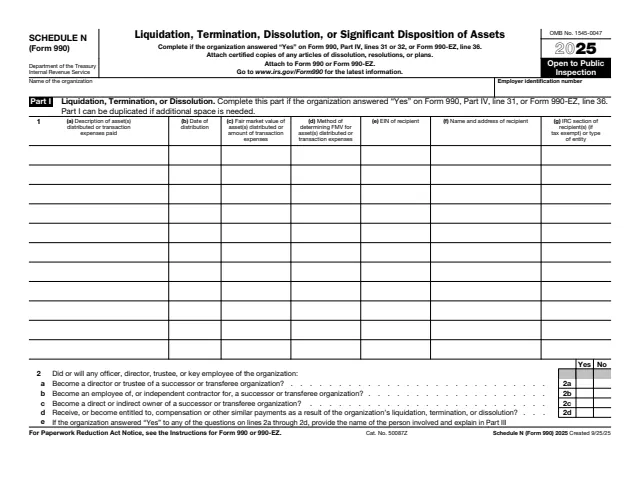
Schedule N (Form 990): Liquidation, Dissolution, or Significant Disposition of Assets

Schedule N (Form 990) is used by an organization that files Form 990 or Form 990-EZ to report going out of existence or disposing of more than 25% of its net assets through sale, exchange, or other disposition. The IRS About Form 990 page describes it as the schedule for information relating to going out of existence or disposing of more than 25 percent of net assets through a contraction, sale, exchange, or other disposition.

The 2025 schedule has three parts. Part I covers a liquidation, termination, or dissolution. Part II covers a sale, exchange, disposition, or other transfer of more than 25% of the organization's assets. Part III holds the supplemental narrative answers. The instructions for the schedule are printed on pages 4 and 5 of the same PDF. The schedule says to attach it to Form 990 or Form 990-EZ with certified copies of any articles of dissolution, resolutions, or plans, and it is marked Open to Public Inspection.

The filing organization completes it. You can fill out Schedule N (Form 990) free in your browser on this page and download it without an account.

What's on Schedule N (Form 990)

Part I, line 1: assets distributed

A table with seven columns: description of assets distributed or transaction expenses paid, date of distribution, fair market value or amount, method of determining FMV, EIN of recipient, name and address of recipient, and the recipient's IRC section or type of entity.
Part I, lines 2a to 2e: officers

Yes or No questions on whether any officer, director, trustee, or key employee did or will become a director, trustee, employee, contractor, or owner of a successor or transferee organization, or receive compensation because of the liquidation.

Part I, lines 3 to 6c: winding up

Whether assets were distributed under the governing instruments, whether a state attorney general or other official had to be and was notified, whether all liabilities were paid under state laws, and how tax-exempt bonds were discharged or defeased.

Part II: more than 25% of assets

The same seven-column asset table and the same officer questions on lines 2a to 2e, for a sale, exchange, disposition, or other transfer of more than 25% of the organization's assets.

Part III: Supplemental Information

Narrative answers required by Part I, lines 2e, 3, and 6c, and Part II, line 2e, plus any other explanations. The instructions say to identify the part and line each response supports.

How to fill out Schedule N (Form 990)

  1. 1

    Choose Part I or Part II

    The instructions say an organization that completely liquidated, terminated, or dissolved and ceased operations completes Part I, and one that made a significant disposition of net assets completes Part II. An organization that completes Part I doesn't complete Part II.

  2. 2

    Line 1, columns (a) to (d)

    Aggregate assets into categories that are sufficiently described, and list related transaction expenses of at least $10,000 separately, such as attorney or accountant fees. Brokerage fees go in the fair market value in column (c). Column (d) names the valuation method, such as appraisals, comparables, or book value.

  3. 3

    Line 1, columns (e) to (g)

    Enter the EIN, name, and address of each recipient, but not social security numbers of individual recipients. Membership organizations may group members by class. Column (g) holds the recipient's Code section, such as 501(c)(3), or a type of entity.

  4. 4

    Line 2

    Answer for each officer, director, trustee, or key employee listed in Form 990, Part VII, Section A. Compensation on line 2d includes a severance payment or a change in control payment. For any Yes, line 2e names the person and Part III explains the relationship and benefit.

  5. 5

    Lines 3 to 6

    Answer the governing instrument, state notice, liabilities and bond questions. Line 6c explains in Part III how bond liabilities were settled. If a defeasance was avoided by transferring assets, the instructions ask for the transferees, the CUSIP number of the bond issue, and the terms.

  6. 6

    Attach supporting documents

    The instructions say a claim to have liquidated, terminated, dissolved, or merged is supported by a certified copy of the articles of dissolution or merger. If none is available, board resolutions or board approved plans of liquidation or merger may be submitted.

Why fill Form 990 on indox

You get the real form, filled in a browser tab, with nothing standing between you and the finished PDF.

  • Fill the form right in your browser, no software to install
  • Free to fill and free to download, with no account
  • The official blank straight from the IRS, not a copy someone retyped
  • Works on a phone, tablet or computer

How it is filed and what to know

Attach to the return

The schedule says to attach it to Form 990 or Form 990-EZ, with certified copies of any articles of dissolution, resolutions, or plans.

Final return box

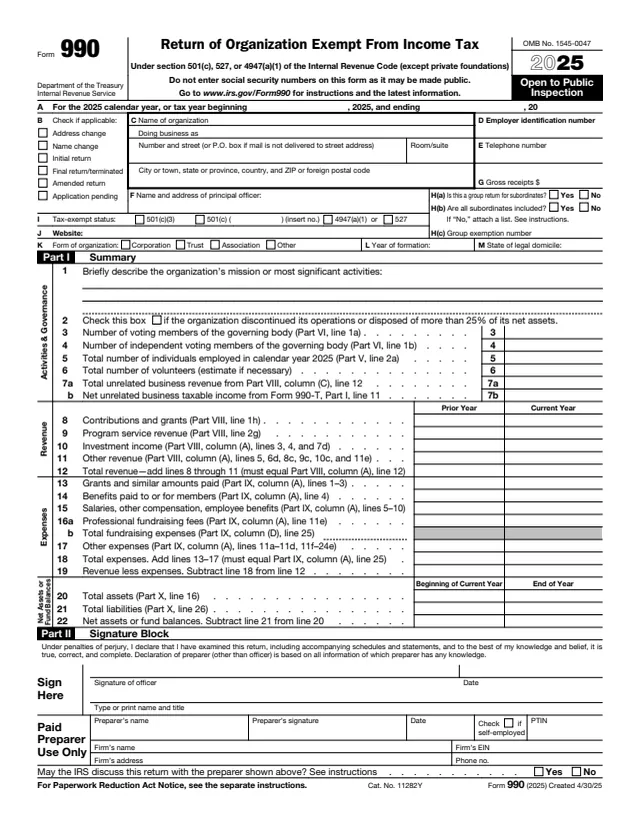
The Instructions for Form 990 say a final return checks the Final return/terminated box in item B of the heading and completes Schedule N (Form 990).

No separate letter

The instructions say an organization filing Schedule N shouldn't report its liquidation, termination, or dissolution in a letter to IRS Exempt Organizations, Determinations, which no longer issues letters confirming that exempt status was terminated.

Balance sheet at zero

If the organization distributed all of its assets during the tax year, the schedule notes that Form 990, Part X, column (B), line 16 (Total assets) and line 26 (Total liabilities) should equal -0-.

Open to public inspection

The schedule header is marked Open to Public Inspection. The instructions say not to enter social security numbers of individual recipients.

More rows

Parts I, II, and III can be duplicated if more space is needed.

Who files Schedule N (Form 990)?

  • Organizations that went out of existence

    The instructions say an organization that answered Yes on Form 990, Part IV, line 31, completes Part I. That includes one that dissolved, liquidated, terminated, or merged into a successor organization and has no plans to continue any activities.

  • Significant disposition of net assets

    An organization that answered Yes on Form 990, Part IV, line 32, completes Part II. The instructions describe this as disposing of more than 25% of the fair market value of its net assets during the tax year.

  • Form 990-EZ filers

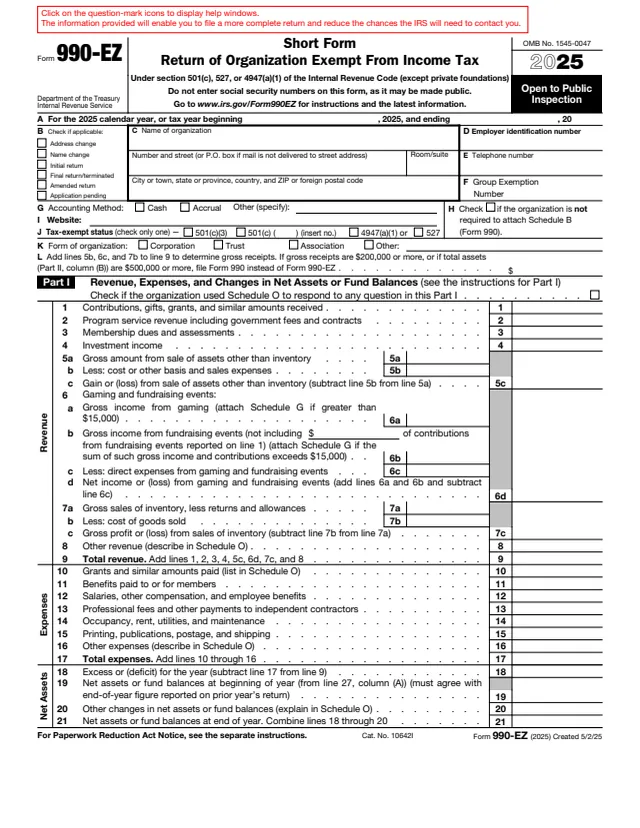
    An organization that answered Yes on Form 990-EZ, line 36, also attaches Schedule N. The instructions point to the Instructions for Form 990-EZ, line 36, for its Part II reporting requirements.

  • Organizations still winding up

    The instructions say an organization still winding up its affairs at the end of the tax year, but not yet completely liquidated, terminated, or dissolved, doesn't complete Part I, but may need to complete Part II.

  • Voluntary filers

    The instructions say an organization not required to file Form 990 or Form 990-EZ that chooses to do so files a complete return with all the information requested, including the required schedules.

The schedule says to complete it if the organization answered Yes on Form 990, Part IV, lines 31 or 32, or Form 990-EZ, line 36. It is filed with the organization's own return.

Official sources and the blank

Do it all with indox

View all 123 tools

Questions about Form 990

What counts as a significant disposition of net assets?

The instructions say a sale, exchange, disposition, or other transfer of more than 25% of the fair market value of the organization's net assets during the tax year, in one disposition or a series of related ones. Net assets means total assets less total liabilities.

What is not reported in Part II?

The instructions list changes in publicly traded securities in a passive investment portfolio, asset sales and grants in the ordinary course of exempt activities, a decrease in value from market fluctuation, and transfers to a disregarded entity of which the organization is the sole member.

Does an organization still winding up complete Part I?

No. The instructions say an organization that hadn't completely liquidated, terminated, or dissolved and ceased operations by the end of the tax year shouldn't complete Part I, but may need to complete Part II.

Can an organization complete both Part I and Part II?

The instructions say an organization that completes Part I doesn't complete Part II, and one that has terminated operations with no plans for future activities completes only Part I.

Should the organization also write a letter to the IRS?

The instructions say it shouldn't report the liquidation, termination, or dissolution in a letter to EO Determinations, which no longer issues letters confirming that exempt status was terminated.

Which transaction expenses are listed?

Payments of at least $10,000 to a professional or other third party for services in the transaction or in winding down, such as attorney or accountant fees, are listed separately. Brokerage fees are included in the fair market value in column (c).