Part 1: Tell us about your return
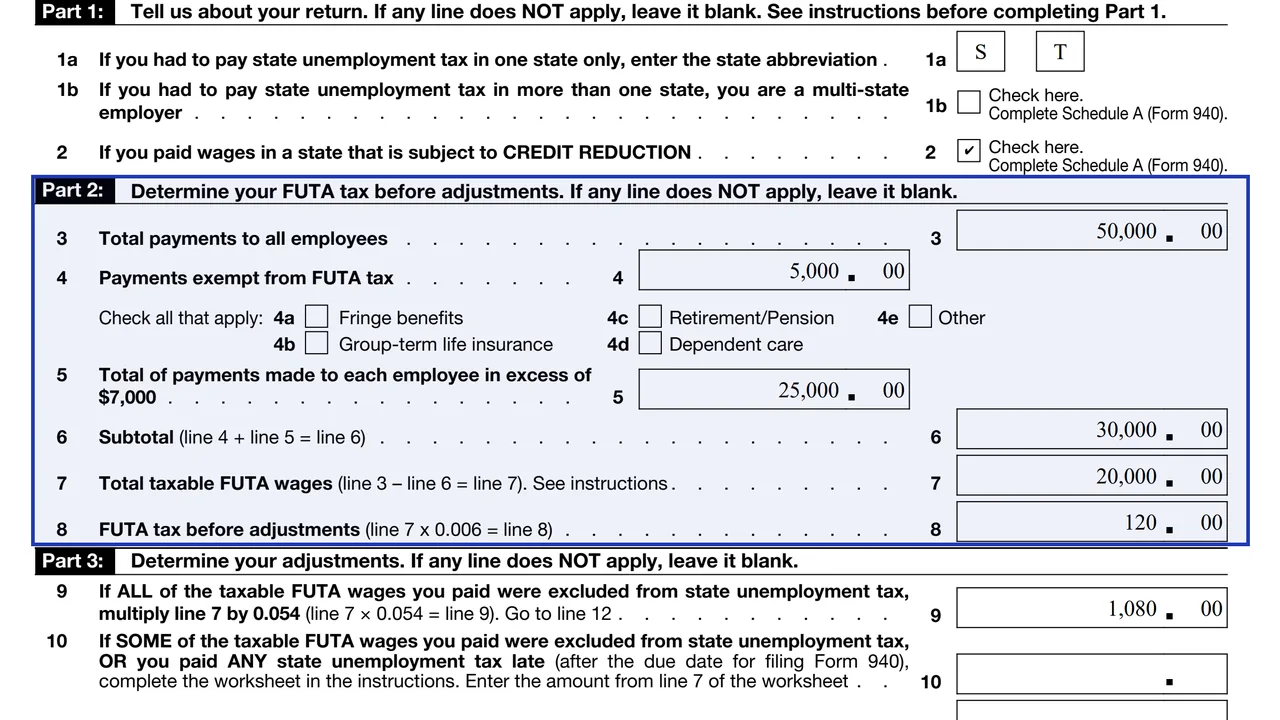
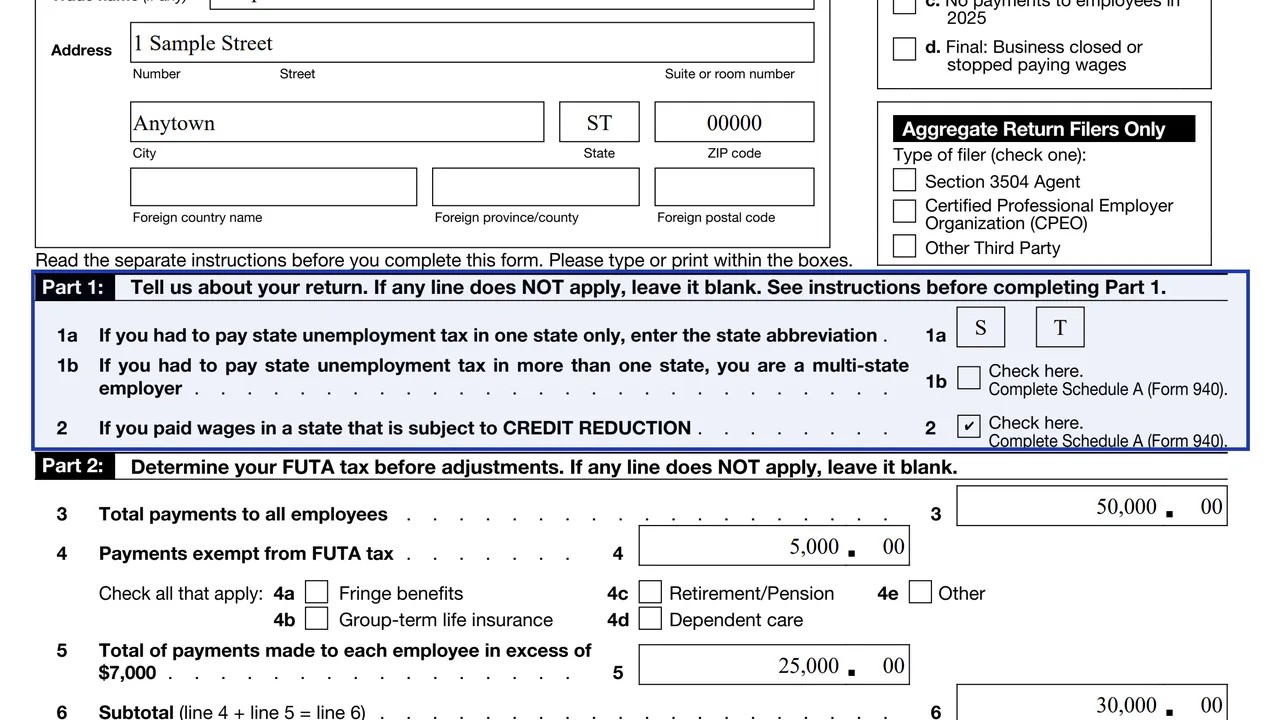
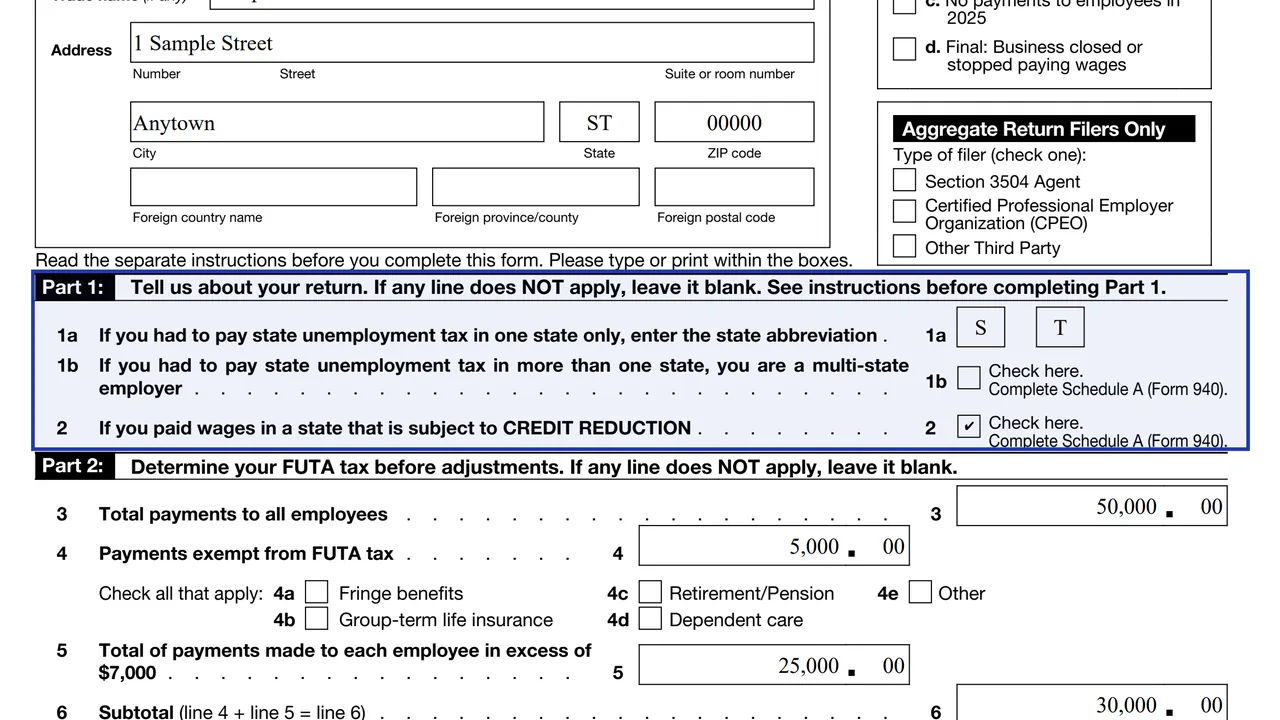
The state or states where you paid unemployment tax, and whether any wages were subject to a credit reduction state.
940
Employer's Annual Federal Unemployment (FUTA) Tax Return
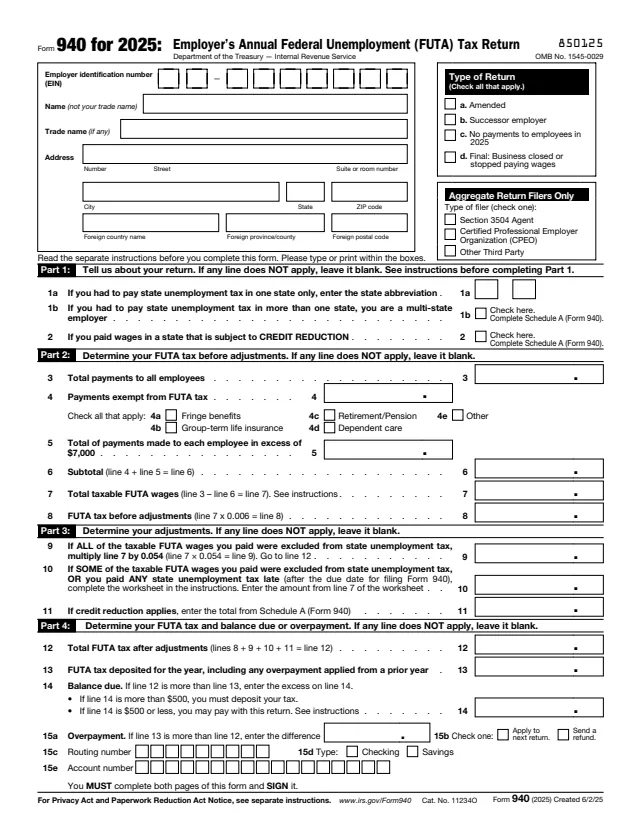
Form 940 is the yearly return employers use to report their Federal Unemployment Tax Act (FUTA) tax. FUTA tax helps fund unemployment compensation for workers who lose their jobs. Employers pay it, and they should not collect it from employees' wages.
This page is the 2025 form, for wages paid in calendar year 2025. Unlike Form 941, which reports withheld income tax and Social Security and Medicare taxes each quarter, Form 940 covers FUTA tax only and is filed once a year.
Most of the work is working out how much of each employee's pay is subject to the tax and how much credit you get for state unemployment tax you paid. Deposits during the year are due when the liability passes a threshold, and the return reconciles them.
The state or states where you paid unemployment tax, and whether any wages were subject to a credit reduction state.
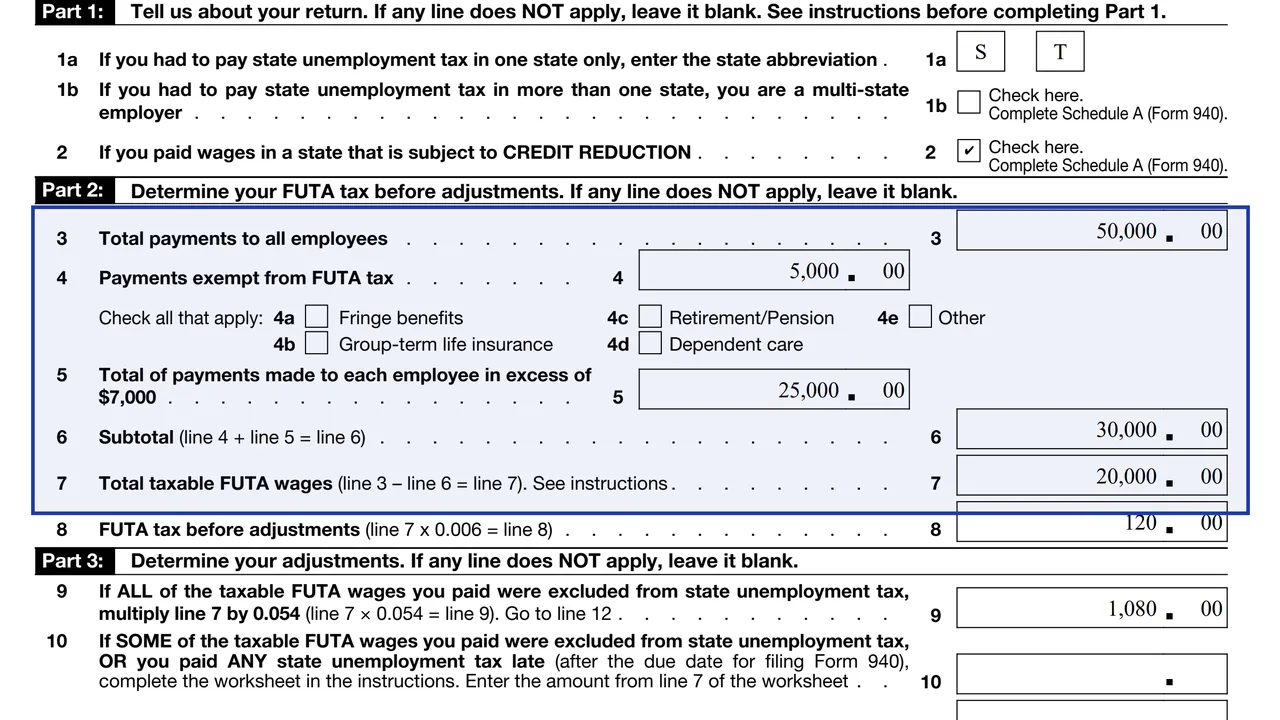
Lines 3 to 8: total payments, exempt payments, payments above the $7,000 wage base, and the tax figure.
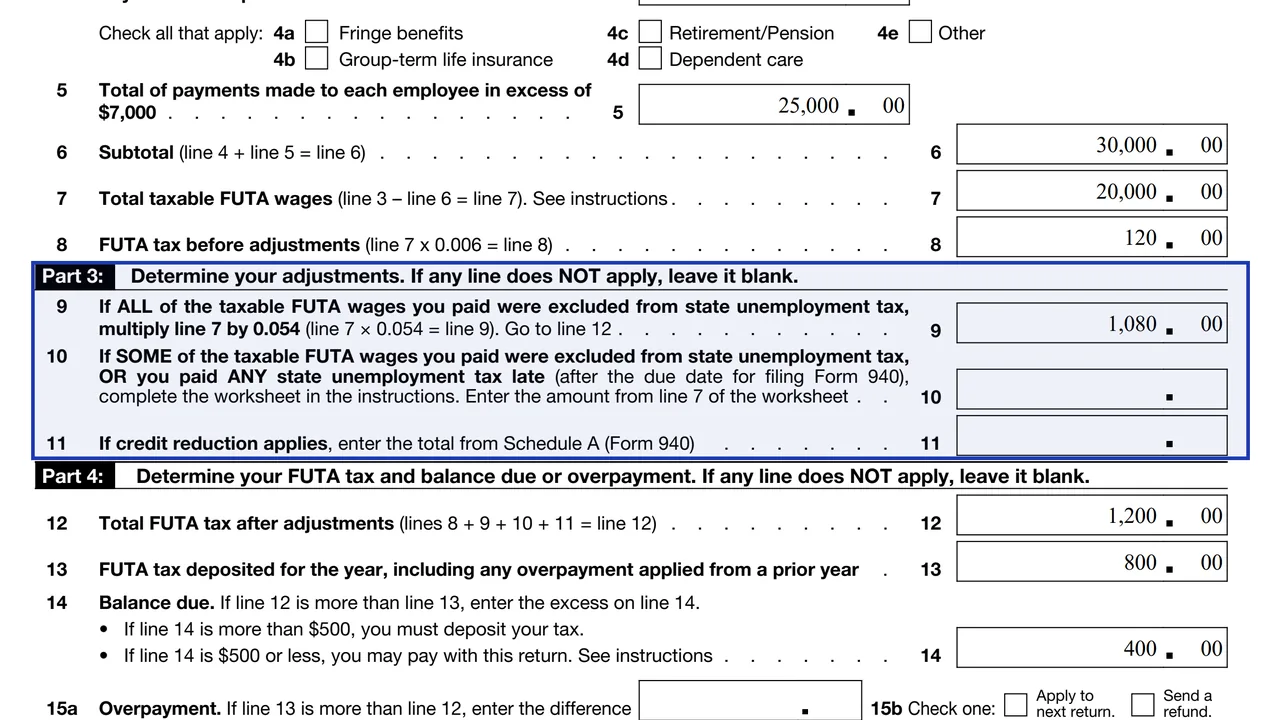
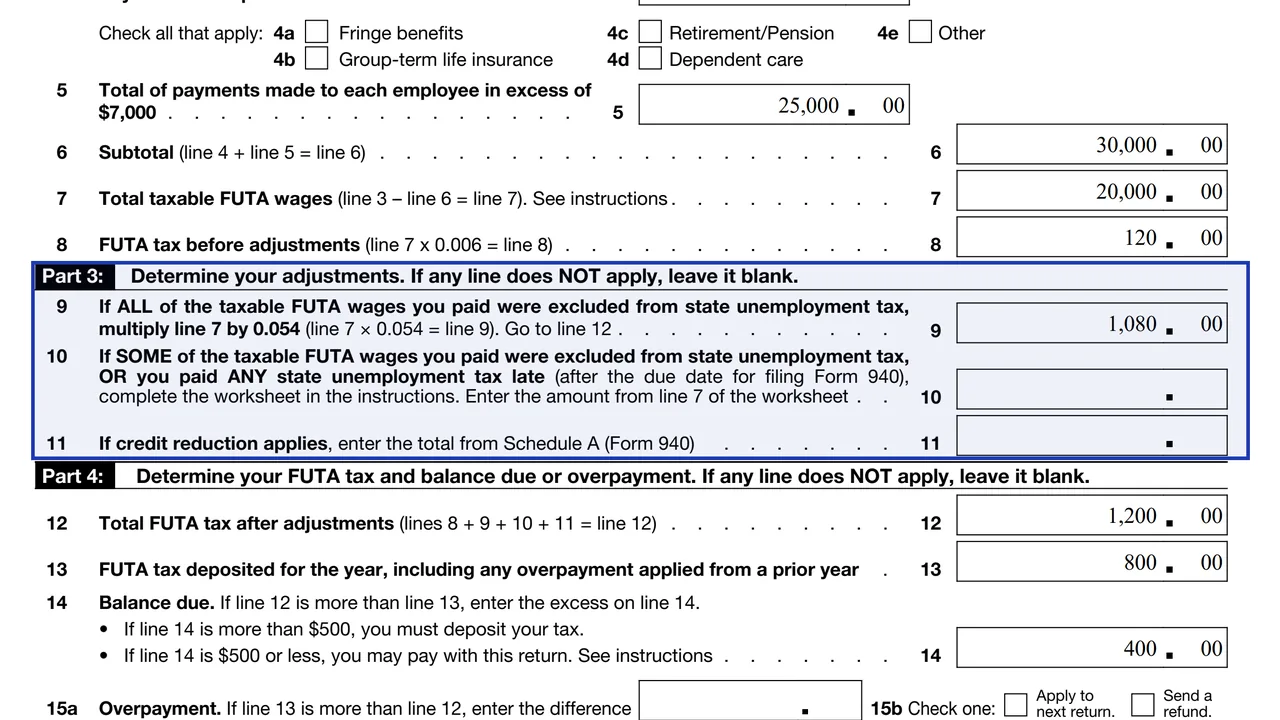
Lines 9 to 11, including the worksheet for state unemployment payments that were late or excluded.
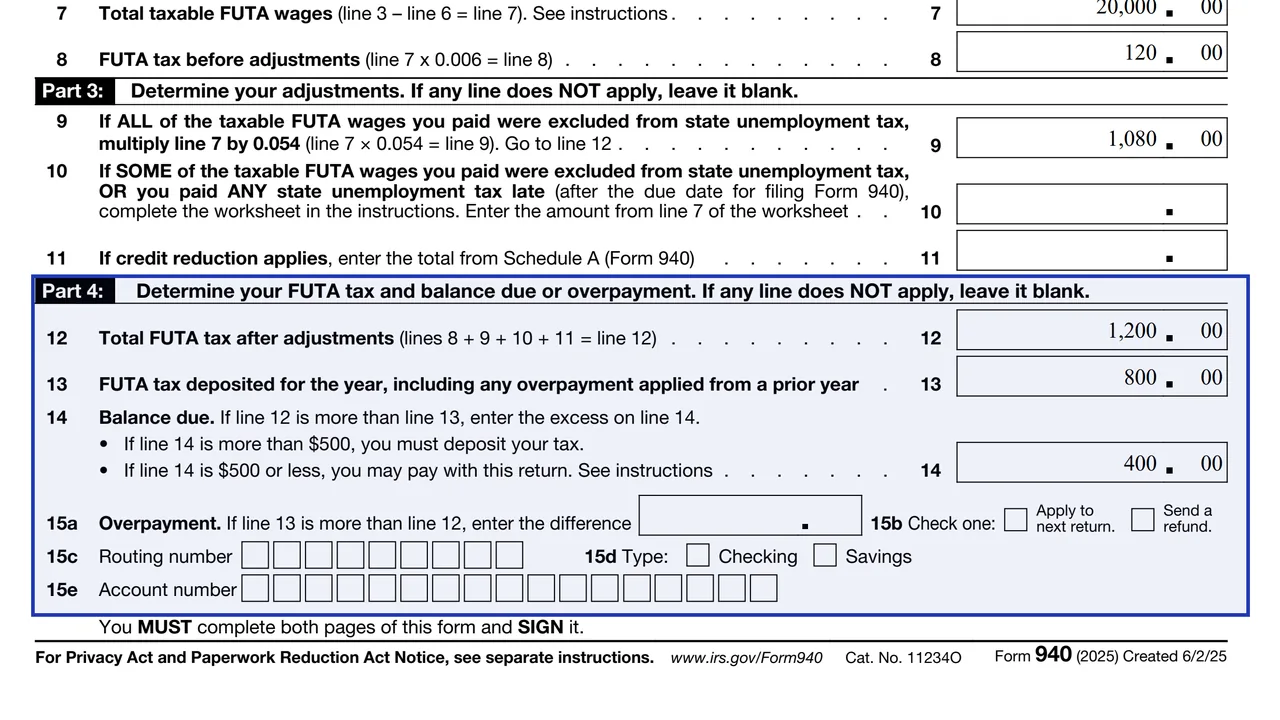
Lines 12 to 15: total FUTA tax after adjustments, deposits, and balance due or overpayment.
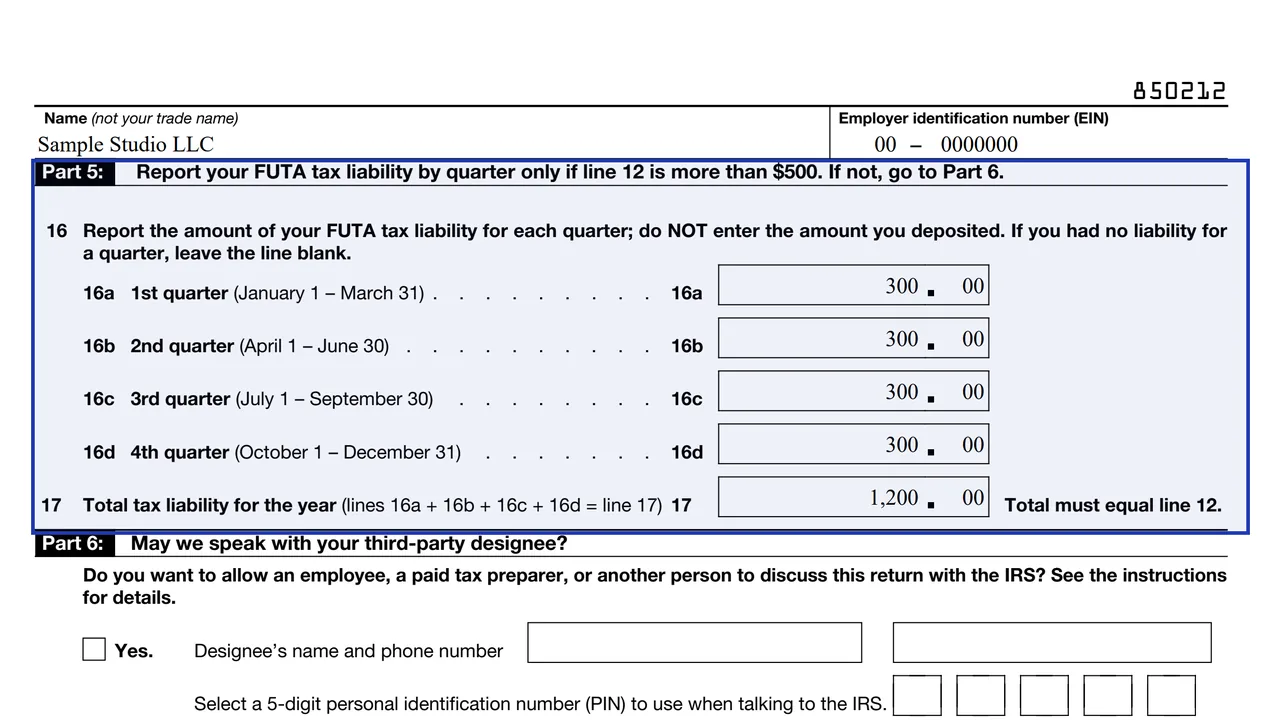
Lines 16 and 17. Required only if line 12 is more than $500.
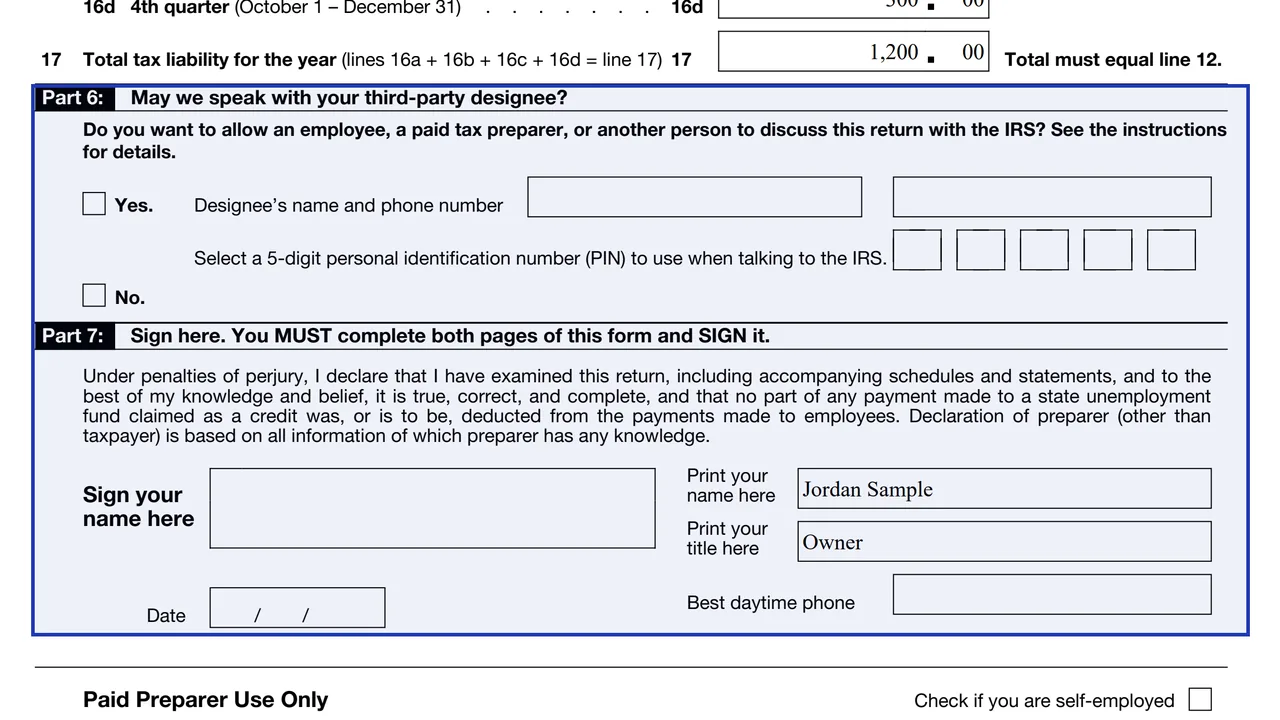
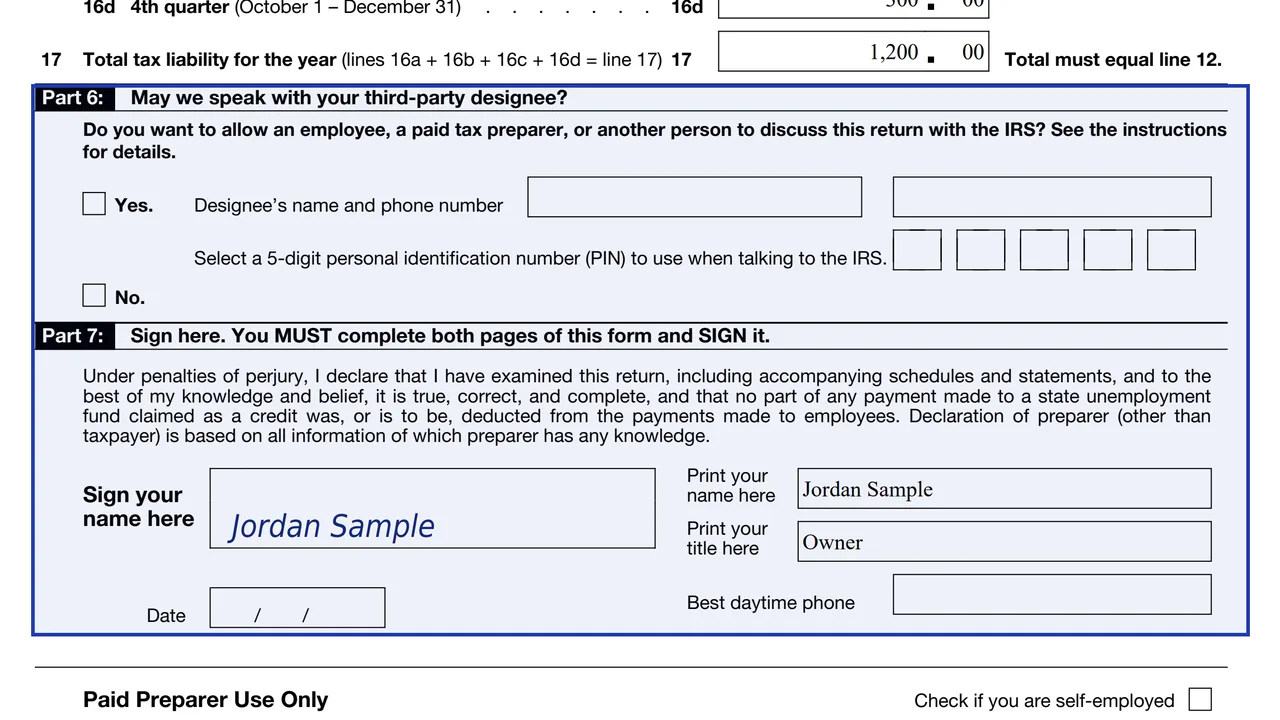
Authorize a third-party designee to talk to the IRS, and sign. Both pages must be completed and signed.
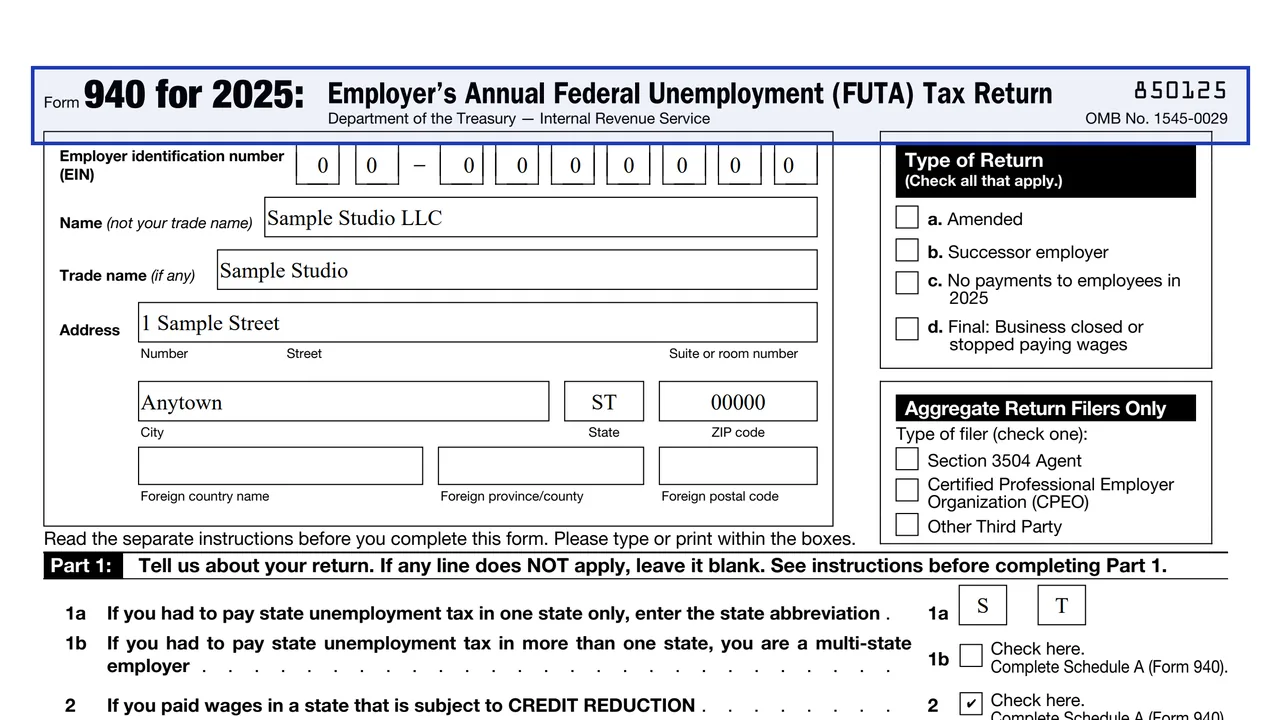
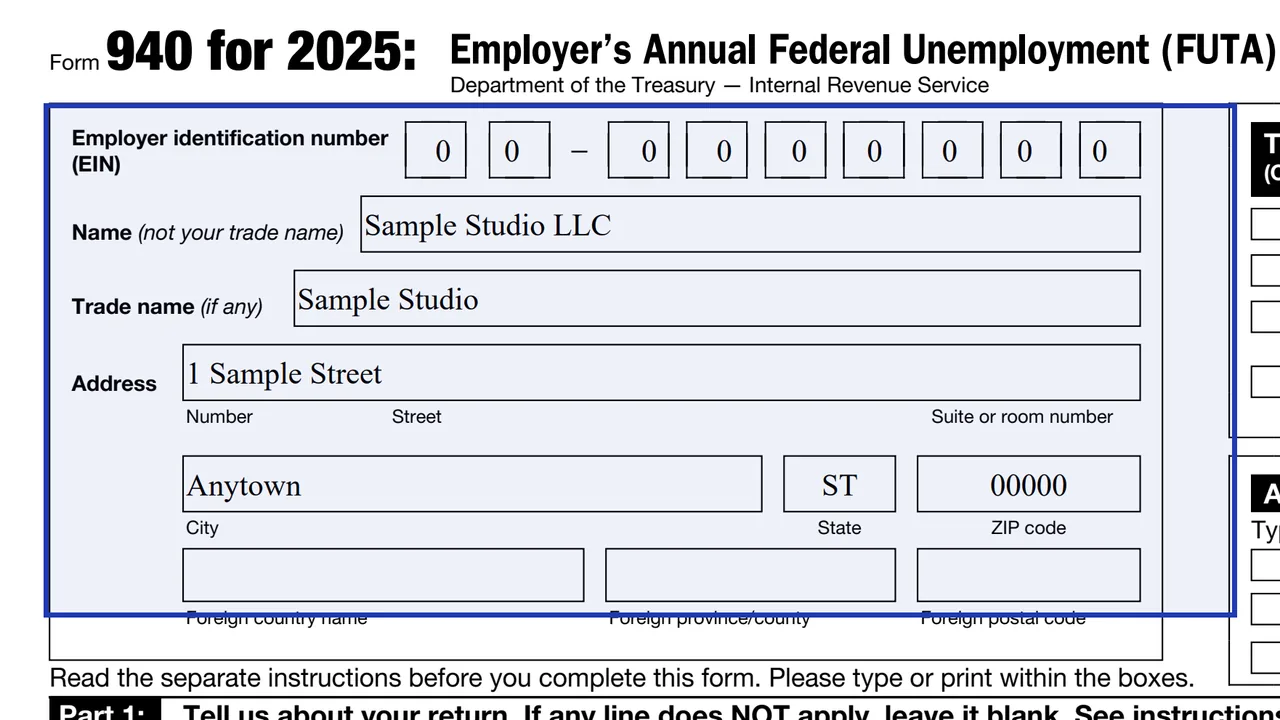
Enter your EIN, name, trade name and address at the top of page 1.
Enter the state where you paid state unemployment tax. Check the credit reduction box if any wages were subject to a credit reduction state's law, and complete Schedule A (Form 940).
Total what you paid all employees, subtract payments exempt from FUTA tax and the amount above $7,000 per employee, and compute the tax from the result.
Compute the credit for state unemployment tax paid on time. Use the line 10 worksheet if you paid late or if some payments were excluded.
Total the FUTA tax, subtract your deposits, and enter the balance due or overpayment. If line 14 is $500 or less, you can pay it with the return.
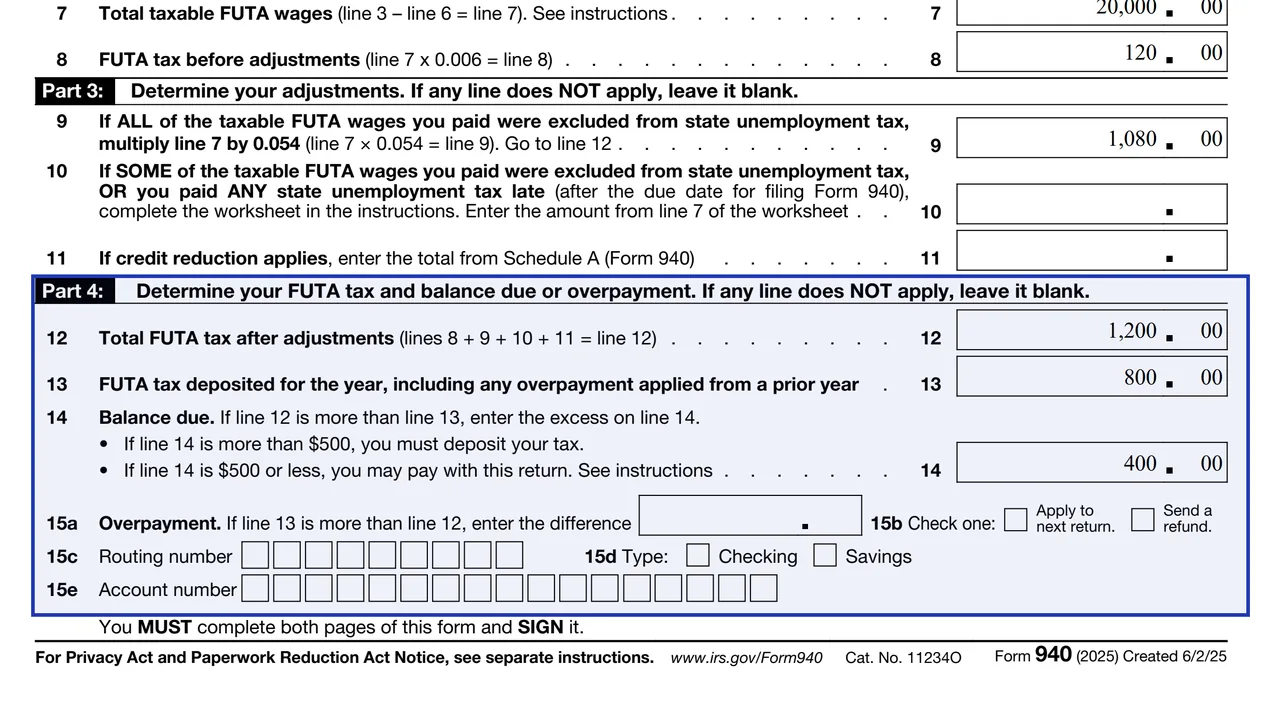
Complete the quarterly liability only if the total FUTA tax is above $500.
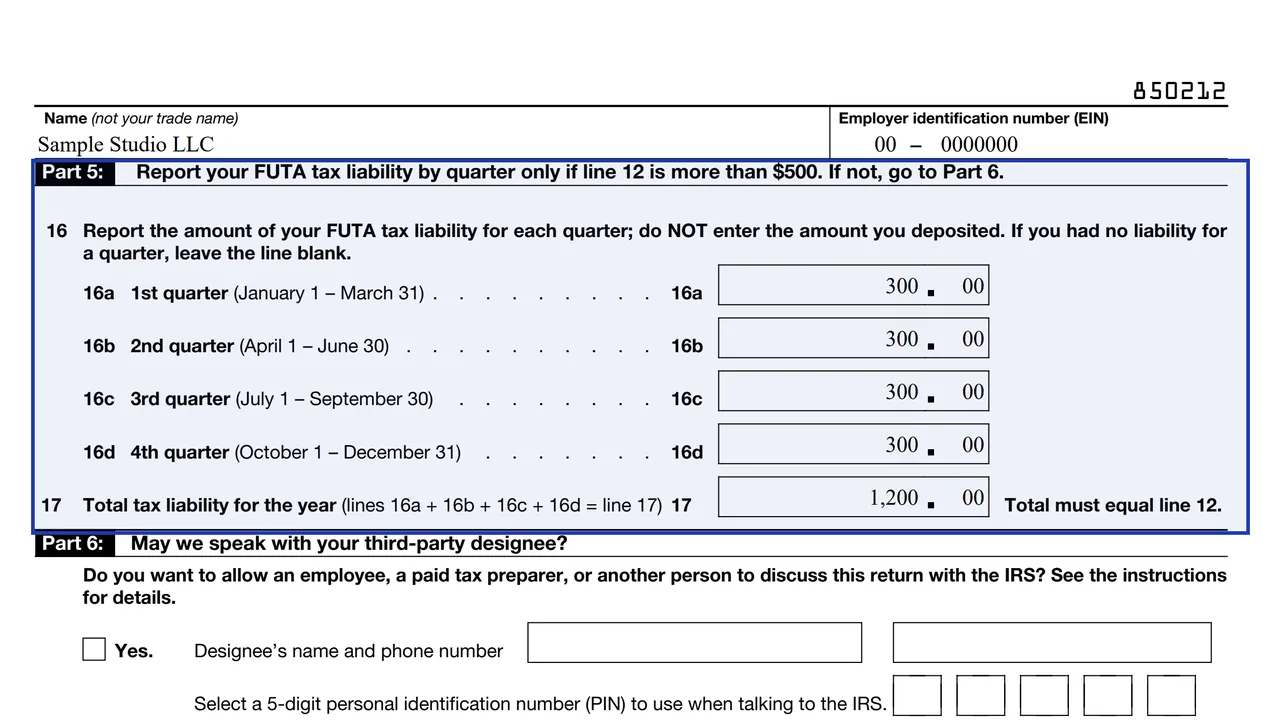
Name a designee if you want one, then sign and date. Paid preparers complete their own block.
You get the real form, filled in a browser tab, with nothing standing between you and the finished PDF.
February 2, 2026, or February 10, 2026 if you deposited all FUTA tax when due.
The FUTA rate is 6.0% on the first $7,000 paid to each employee in a calendar year. Most employers get a credit of up to 5.4%, so the effective rate is typically 0.6%.
If your FUTA tax is more than $500 for the year, you must deposit at least one quarterly payment, due by the last day of the month after the quarter ends. Liabilities of $500 or less carry forward until the total exceeds $500. Deposits are made by electronic funds transfer.
E-filing through Modernized e-File is encouraged. A paper return goes to an address that depends on your state and whether you include a payment. Amended returns can be filed electronically.
Late deposits, late returns and unpaid tax bring penalties and interest. Ask for penalty relief on Form 843, not on Form 940.
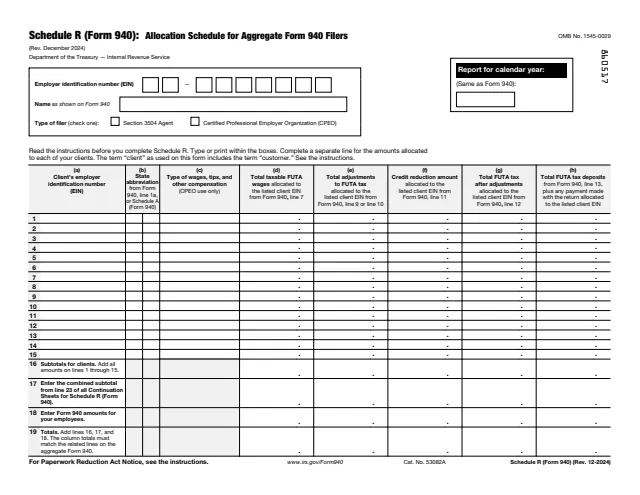
Collecting FUTA tax from employee wages, forgetting Schedule A for credit reduction states, and omitting Schedule R when it is required.
940 Sch. R
611 fields, 3 pages
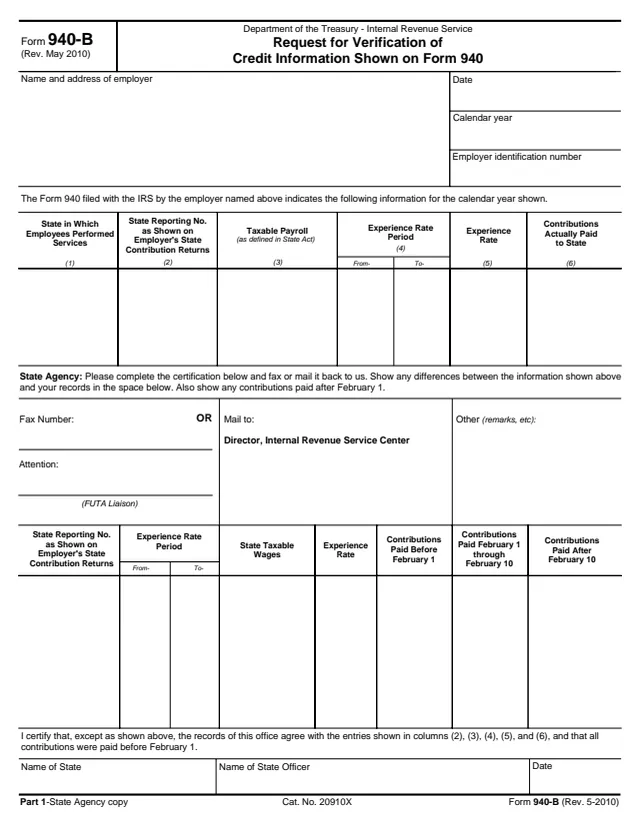
940-B
26 fields, 2 pages
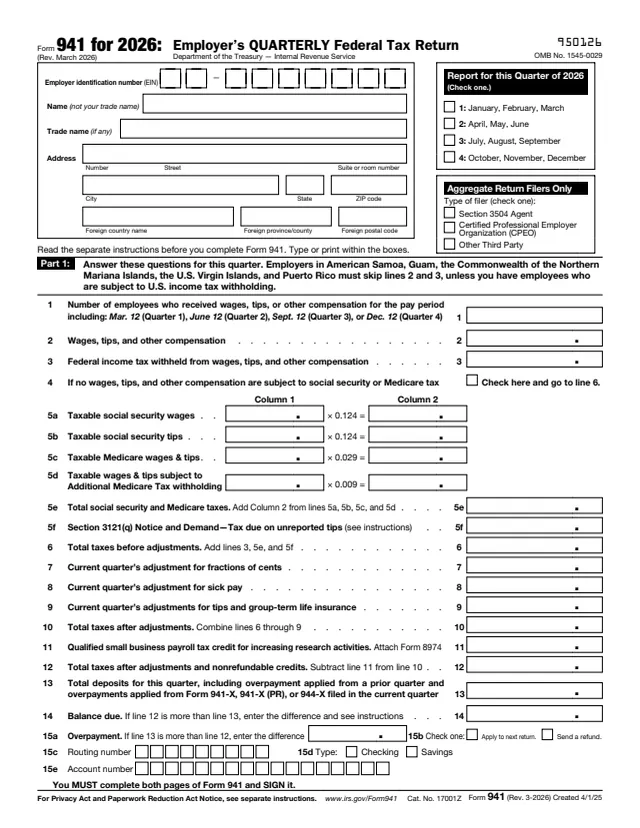
941
116 fields, 3 pages
W-2
568 fields, 11 pages
W-3
46 fields, 2 pages
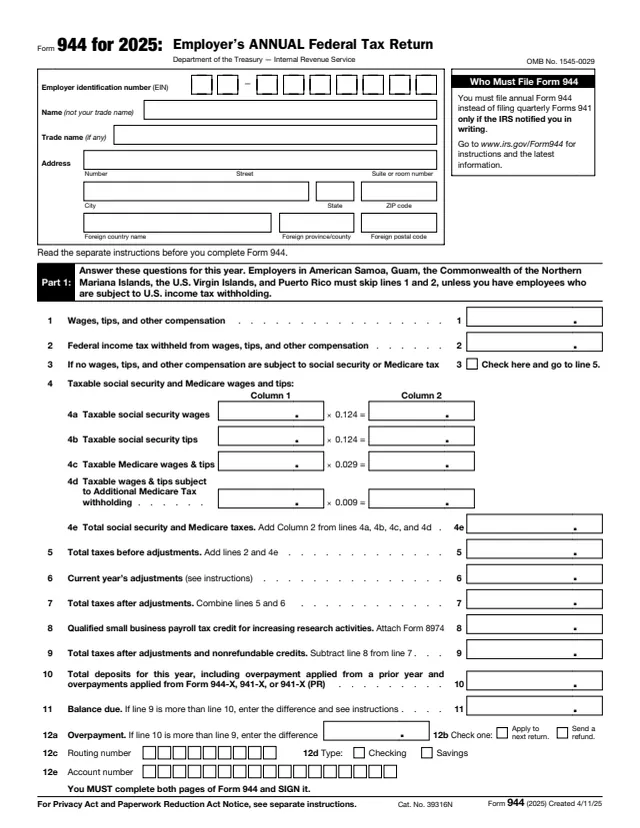
944
114 fields, 3 pages
The 2025 instructions give these tests.
No tool matches that search.
The employer pays it. The IRS says employers should not collect it from employees' wages.
The rate is 6.0% on the first $7,000 each employee earns in a year. With the usual credit of up to 5.4%, the effective rate is typically 0.6%.
If your FUTA tax is more than $500 for the year, yes, at least one quarterly deposit. Smaller amounts carry forward until they total more than $500.
A state whose unemployment law reduces the credit employers get, which can raise your FUTA tax. You use Schedule A (Form 940) to figure the reduction.
No. Form 941 is quarterly for withheld income tax and Social Security and Medicare. Form 940 is yearly and covers FUTA tax only.
Yes. The IRS encourages e-filing through Modernized e-File and allows some amended returns to be filed electronically.