Header
The calendar or tax year, the name of the partnership and its employer identification number.
8879-PE
E-file Authorization for Form 1065
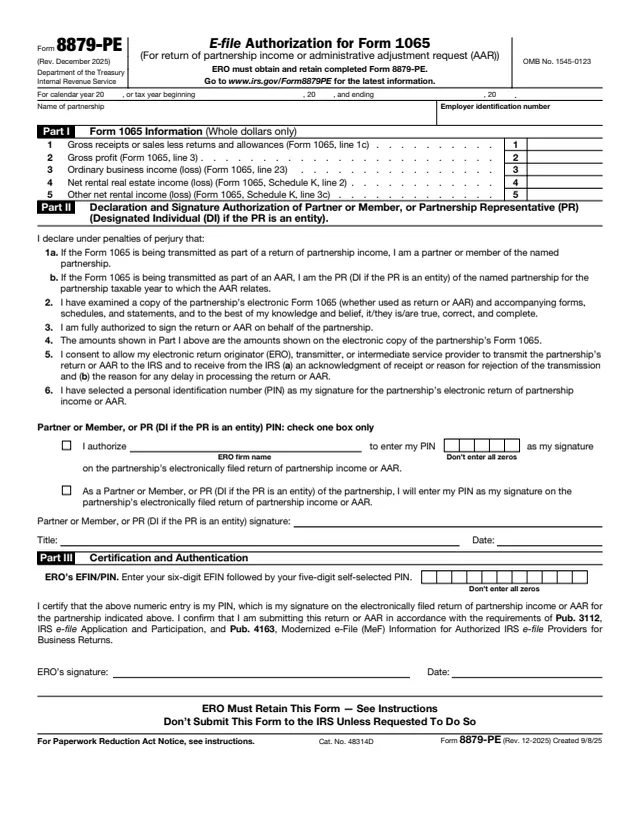
Form 8879-PE, E-file Authorization for Form 1065, is used by a partner or member, or a partnership representative (PR), together with an electronic return originator (ERO). The instructions say they use it when the signer wants to use a personal identification number (PIN) to electronically sign a partnership's electronic return of partnership income or administrative adjustment request (AAR). When the PR is an entity, its designated individual (DI) signs.
The ERO fills in the partnership's details and five amounts from Form 1065, the signer reviews the return and picks a PIN option, and the ERO certifies with its own EFIN and PIN. The form says "Don't Submit This Form to the IRS Unless Requested To Do So." The ERO keeps it.
A signer who doesn't use Form 8879-PE uses Form 8453-PE instead. You can fill out Form 8879-PE free in your browser on this page and download it without an account.
The calendar or tax year, the name of the partnership and its employer identification number.
Five amounts in whole dollars from Form 1065: gross receipts less returns, gross profit, ordinary business income, net rental real estate income and other net rental income.
Six statements under penalties of perjury about the signer's role, review of the return or AAR, authority to sign, the Part I amounts, consent to transmit and the selected PIN.
Two boxes: authorize the ERO firm to enter the PIN, or enter it in person. Then the signature, title and date.
The ERO's six-digit EFIN followed by a five-digit self-selected PIN, and the ERO's signature and date.
The ERO enters the partnership's name and EIN and completes Part I from the partnership's Form 1065. The instructions say zero may be entered when appropriate.
If authorized to enter the signer's PIN, the ERO enters its firm name on the Part II authorization line, not the name of the individual preparing the return.
The partner or member, or PR, verifies the accuracy of the partnership's return or AAR.
Check one box only in Part II. The instructions say the PIN is five digits other than all zeros.
Sign, date and enter a title in Part II, then return the form to the ERO by hand delivery, U.S. mail, private delivery service, email, Internet website, or fax.
The ERO enters its EFIN and PIN, signs and dates, and transmits the return or AAR only after receiving the signed form.
You get the real form, filled in a browser tab, with nothing standing between you and the finished PDF.
The form says don't submit it to the IRS unless requested to do so. The ERO keeps the completed form.
The instructions say 3 years from the return due date or IRS received date, whichever is later. It can be kept electronically under Rev. Proc. 97-22.
The instructions say the return or AAR shouldn't be transmitted to the IRS until the ERO receives the properly signed Form 8879-PE.
The ERO provides a copy of the signed form on request, and a corrected copy if changes are made to the return or AAR.
The instructions say Form 8879-PE changed from an annual revision to continuous use and will be updated as needed.
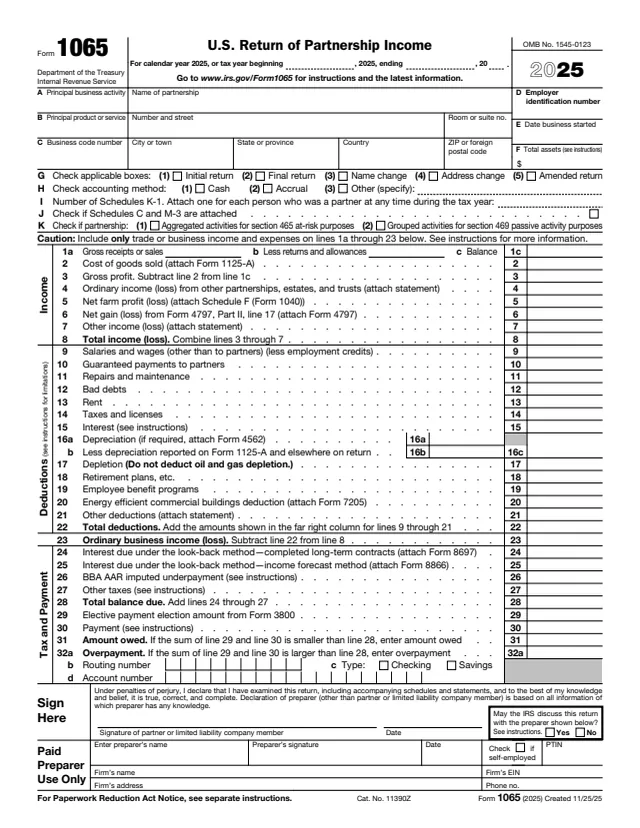
1065
440 fields, 6 pages
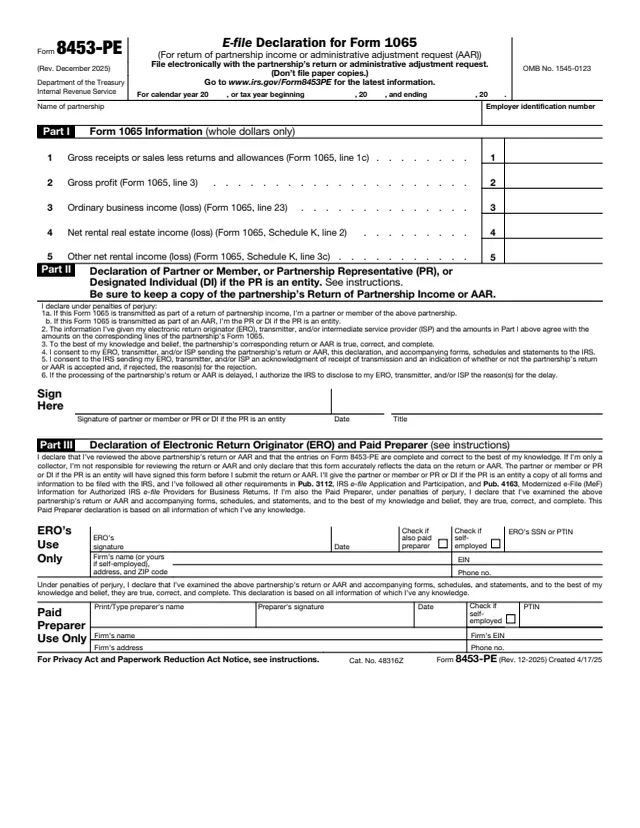
8453-PE
26 fields, 2 pages
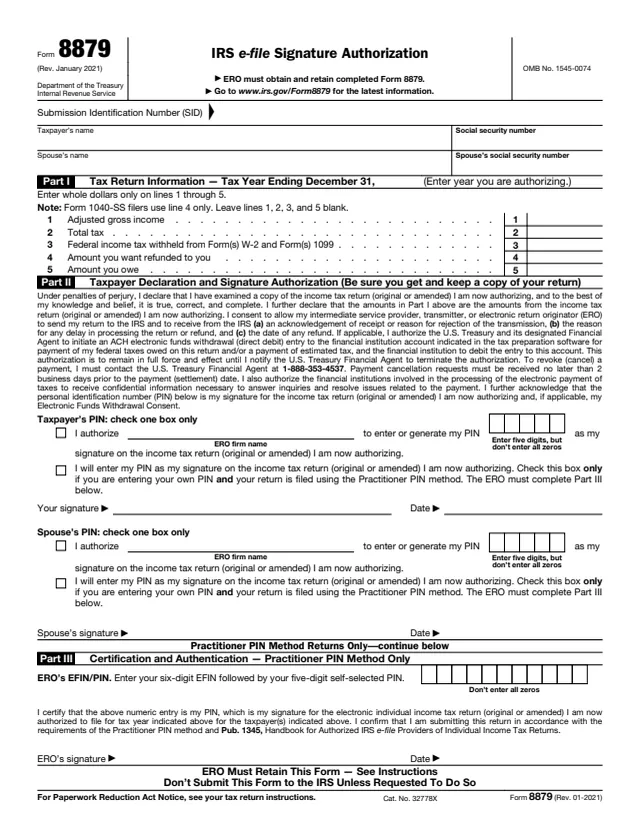
8879
20 fields, 2 pages
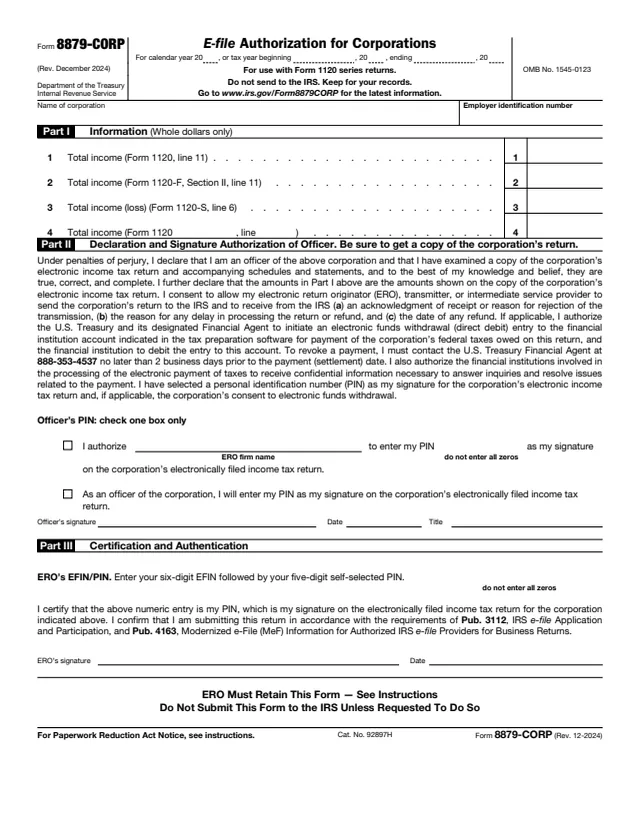
8879-CORP
19 fields, 2 pages
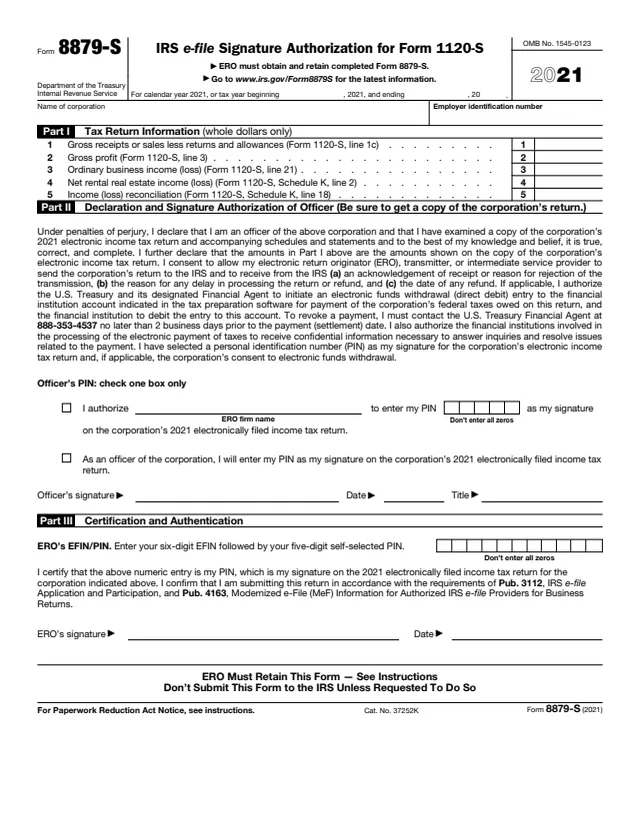
8879-S
16 fields, 2 pages
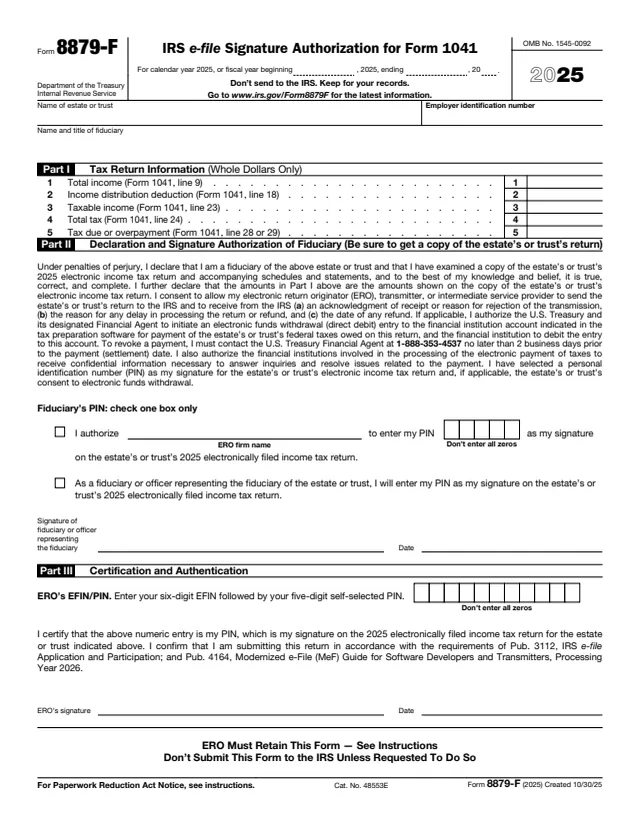
8879-F
16 fields, 2 pages
The form is completed by a partnership's signer and its electronic return originator (ERO). It is not filed with the IRS.
No tool matches that search.
The electronic return originator (ERO). The form says the ERO must obtain and retain the completed form.
No. The form says don't submit it to the IRS unless requested to do so.
A partner or member for a return of partnership income. For an AAR, the partnership representative signs, or the designated individual if the PR is an entity.
The instructions say a signer who doesn't use Form 8879-PE uses Form 8453-PE, E-file Declaration for Form 1065.
The signer's PIN is five digits other than all zeros. The ERO enters its six-digit EFIN followed by its five-digit self-selected PIN.
3 years from the return due date or IRS received date, whichever is later, according to the instructions.