Header and notes
The decedent's name and Social Security number, a note that section 2032A valuation also needs Schedule T (Form 706), a note on Schedule W for more space, and a note for estates filing only to elect portability.
706 Sch. E
Jointly Owned Property
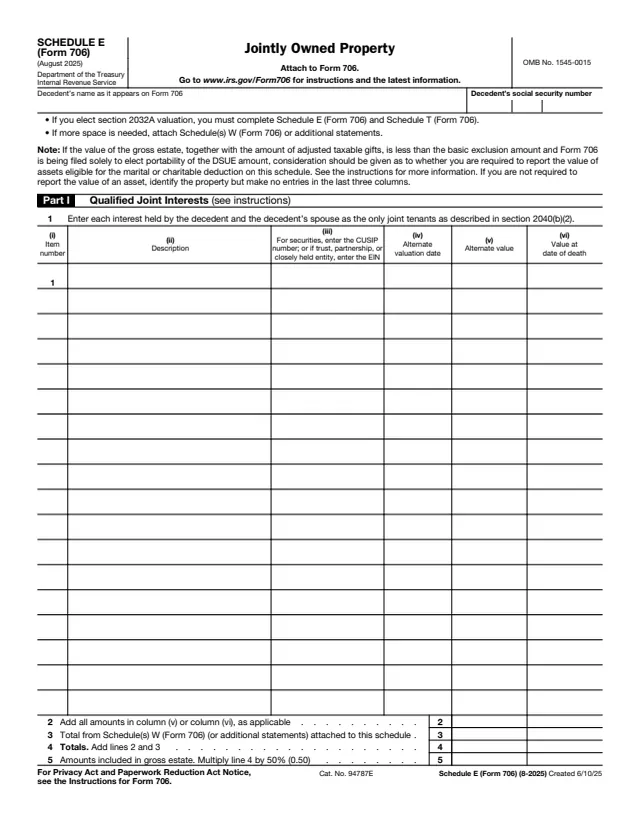
Schedule E (Form 706), Jointly Owned Property, is a two-page schedule attached to Form 706, the United States Estate (and Generation-Skipping Transfer) Tax Return. The IRS About page says that if the decedent owned any joint property at the time of death, and whether or not the decedent's interest is includable in the gross estate, this schedule is used to report the property.
The instructions say to enter all property of whatever kind or character, whether real estate, personal property or bank accounts, in which the decedent held an interest at death as a joint tenant with right to survivorship or as a tenant by the entirety. Part I covers qualified joint interests held with a spouse, and Part II covers all other joint interests.
The line 10 total is entered on Form 706, Part V, item 5. You can fill out Schedule E free in your browser on this page and download it without an account.
The decedent's name and Social Security number, a note that section 2032A valuation also needs Schedule T (Form 706), a note on Schedule W for more space, and a note for estates filing only to elect portability.
Qualified joint interests: item number, description, CUSIP number or EIN, alternate valuation date, alternate value and value at date of death.
The column total, the Schedule W total, and line 5, which multiplies line 4 by 50% (0.50) to give the amount included in the gross estate.
The name and address of each surviving co-tenant, labeled A, B and C, with any more listed on an attached statement.
All other joint interests, with the co-tenant letter, description, CUSIP number or EIN, percentage includible, includible alternate value and includible value at date of death.
The Part II totals, the Schedule W total, and line 10, which adds line 9 and Part I, line 5 and goes to Form 706, Part V, item 5.
Enter the decedent's name as it appears on Form 706 and the decedent's Social Security number.
Enter interests that meet the section 2040(b)(2) test in Part I. The instructions say all joint interests not entered in Part I go in Part II.
The instructions say to describe each item as required in the instructions for Schedules A, B, C and F for that type of property. Jointly held stocks and bonds use the Schedule B rules.
Enter the full value of the property in the alternate value and date of death columns. Line 5 then multiplies the total by 50% (0.50).
List each surviving co-tenant on line 6a and enter that letter for each item. Enter the percentage of the total value included in the gross estate. The instructions say proof of each interest is attached when less than the full value is included.
Add the Part II amounts on lines 7 to 9, then add line 9 and Part I, line 5 on line 10 and carry that total to Form 706, Part V, item 5.
You get the real form, filled in a browser tab, with nothing standing between you and the finished PDF.
Schedule E is not filed alone. The schedule says "Attach to Form 706."
The Form 706 instructions give the address Department of the Treasury, Internal Revenue Service, Kansas City, MO 64999. The About page also points to the IRS page on filing estate and gift tax returns for the latest address.
The instructions say Form 706 is filed within 9 months after the date of the decedent's death, and Form 4768 applies for an automatic 6-month extension of time to file.
Attach Schedule(s) W (Form 706) or additional statements. Their totals go on line 3 for Part I and line 8 for Part II.
The schedule notes that when Form 706 is filed solely to elect portability of the DSUE amount, an asset whose value need not be reported is identified with no entries in the last three columns.
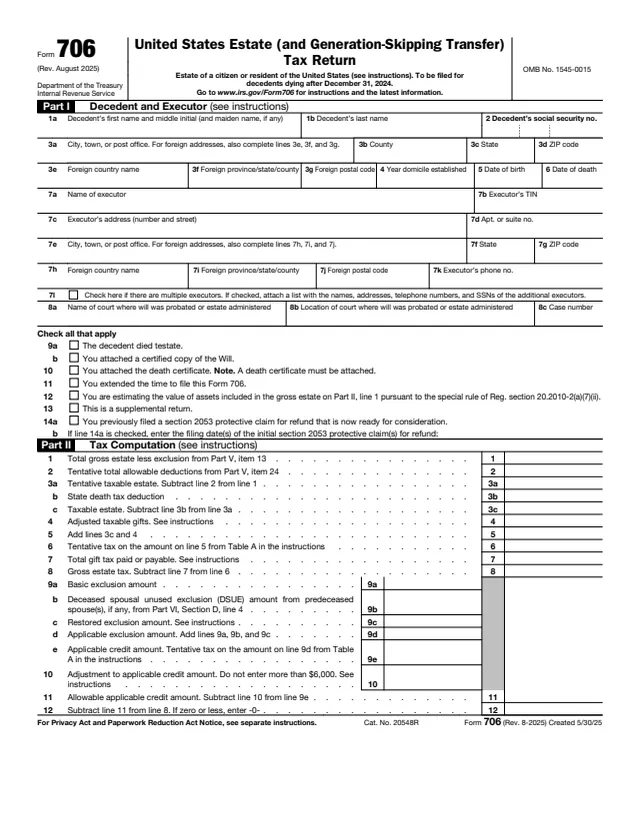
706
316 fields, 5 pages
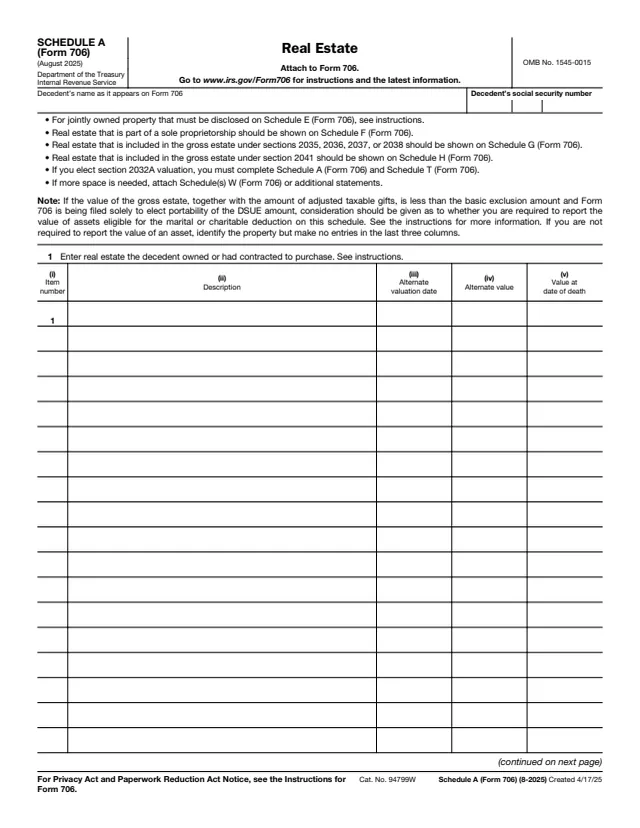
706 Sch. A
223 fields, 2 pages
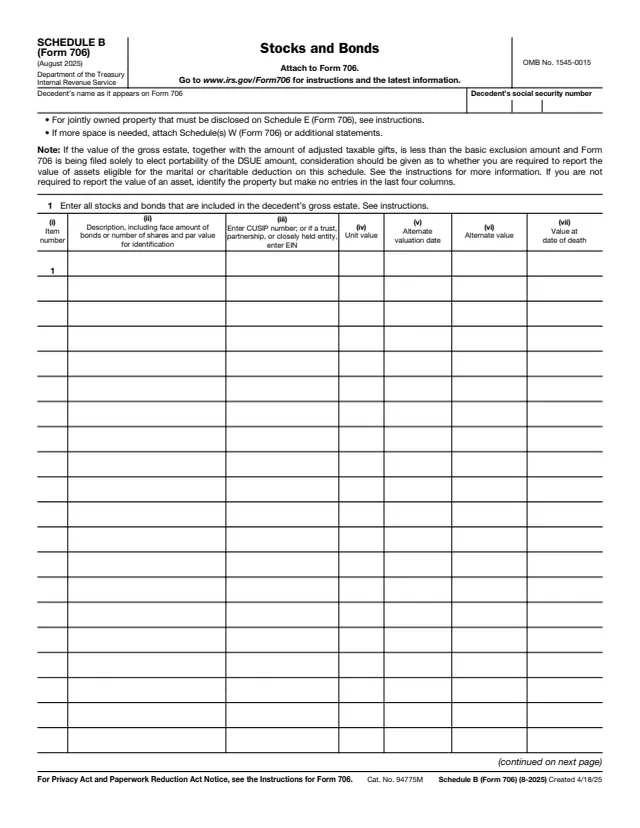
706 Sch. B
323 fields, 2 pages
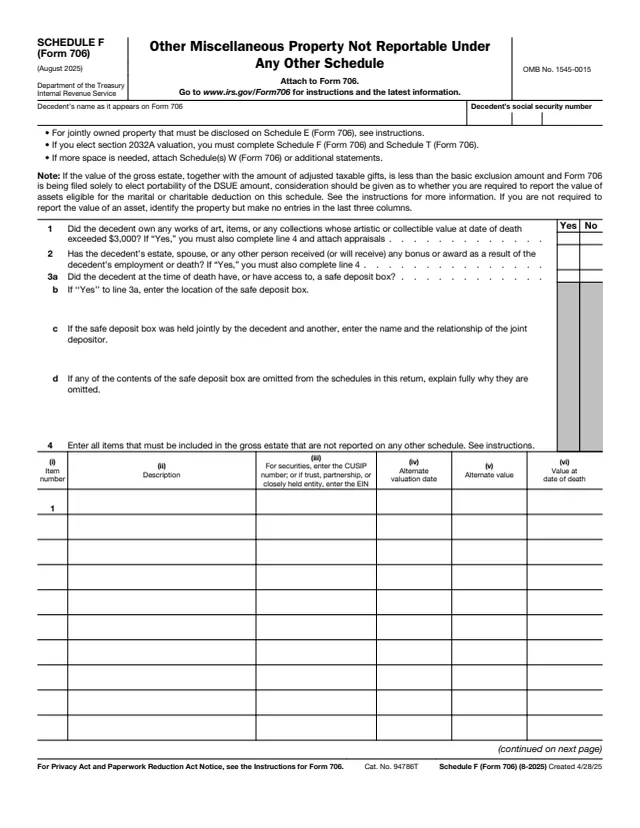
706 Sch. F
227 fields, 2 pages
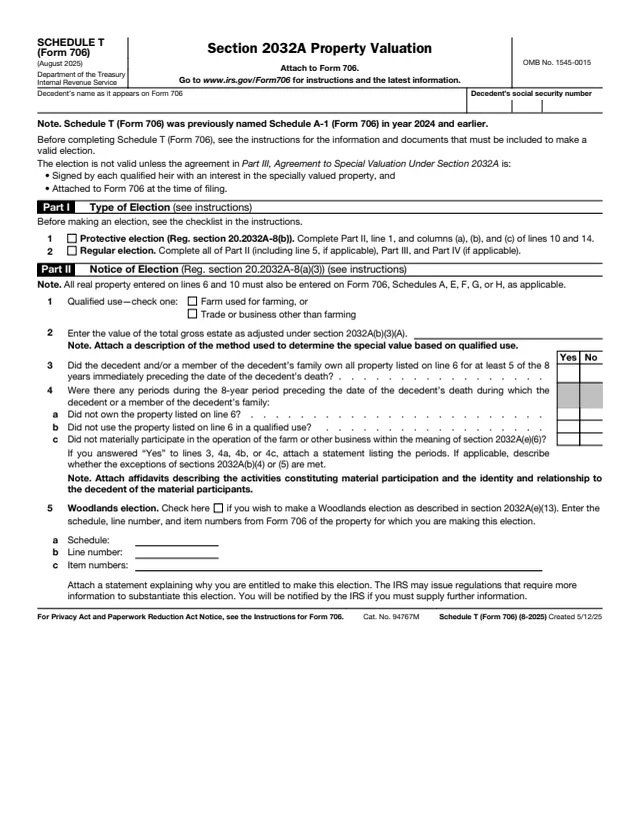
706 Sch. T
858 fields, 8 pages
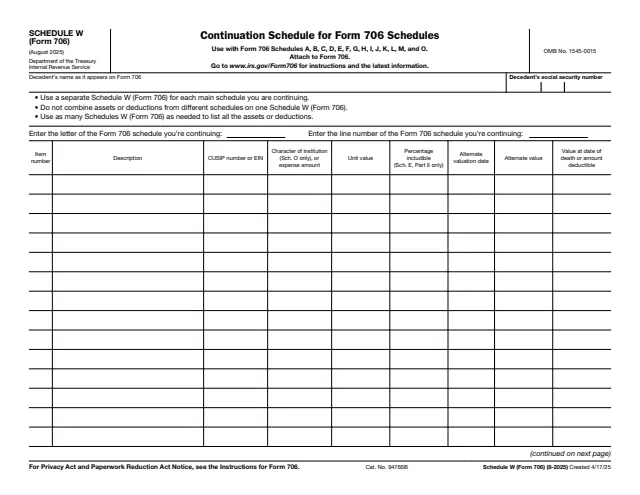
706 Sch. W
303 fields, 2 pages
The executor completes Schedule E as part of the estate's Form 706. The instructions say that when Form 706 is required, Schedule E is completed and filed with it if the decedent owned any joint property at the time of death.
No tool matches that search.
The instructions say that under section 2040(b)(2) it is an interest the decedent and surviving spouse held as tenants by the entirety, or as joint tenants with right of survivorship when they were the only joint tenants.
Line 5 of the schedule multiplies the Part I total by 50% (0.50) to give the amount included in the gross estate.
The instructions say generally yes, unless it can be shown that part of the property originally belonged to the other tenant or was acquired with consideration that originally belonged to the surviving joint tenant.
The instructions say that if the interests are not otherwise specified by law, include the full value divided by the number of joint tenants.
Yes. The About page says the schedule reports joint property whether or not the decedent's interest is includable in the gross estate.
The instructions say community property held by the decedent and spouse is reported on the appropriate Schedules A through I of Form 706, not on Schedule E.