Names, addresses and opening amount
Grantor, designated beneficiary (with address and date of birth), responsible individual and trustee, a box to check for an amendment, and the dollar amount the grantor assigns in cash.
5305-E
Coverdell Education Savings Trust Account
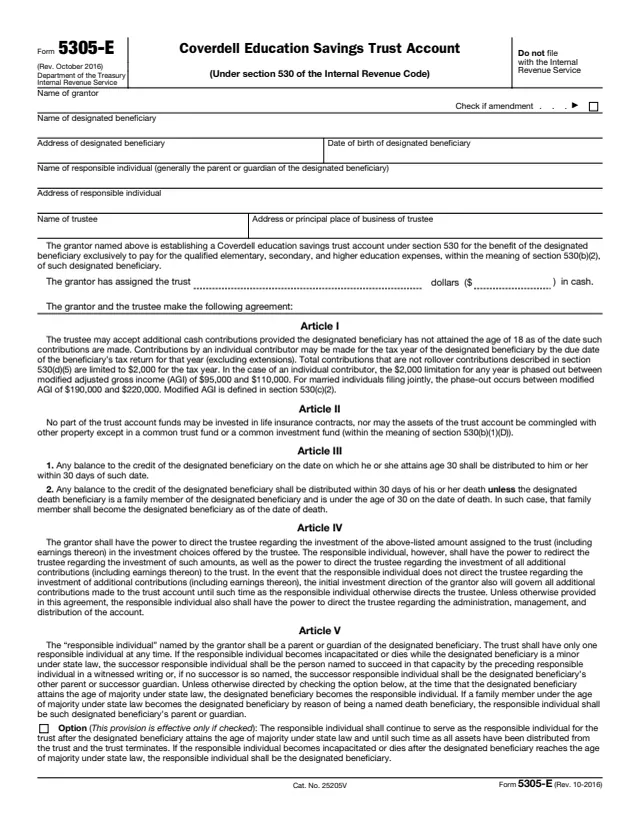
Form 5305-E is a model trust account agreement under section 530 of the Internal Revenue Code. The instructions on the form say it meets the requirements of section 530(b)(1) and has been pre-approved by the IRS, and that a Coverdell education savings account (ESA) is established after the form is fully executed by both the grantor and the trustee.
The form names the grantor, the designated beneficiary, the responsible individual and the trustee, records the cash amount the grantor assigns to the trust, and then sets out Articles I to X of the agreement. The form says the account is for paying the qualified elementary, secondary, and higher education expenses of the designated beneficiary.
The form says "Do not file with the Internal Revenue Service." The instructions say the grantor keeps the completed form in its records. If the model account is a custodial account, the form points to Form 5305-EA instead. You can fill it out free in your browser on this page and download the result without an account.
Grantor, designated beneficiary (with address and date of birth), responsible individual and trustee, a box to check for an amendment, and the dollar amount the grantor assigns in cash.
Contribution rules, including the $2,000 annual limit and its phase-out, a ban on life insurance and commingling, and distribution of the balance at age 30 or at death.
Who directs the trustee on investments, and the rules for the responsible individual and a successor, with an optional box for keeping the responsible individual after the age of majority.
Boxes for whether the responsible individual may or may not change the beneficiary to another member of the beneficiary's family described in section 529(e)(2).
Reporting duties of the grantor and the trustee, the rule that Articles I through III control, and how the agreement is amended.
Space for additional provisions, then signature and date lines for the grantor, the trustee and a witness.
Enter the grantor, the designated beneficiary with address and date of birth, the responsible individual and the trustee with its address or principal place of business. Check the amendment box only if the form amends an existing agreement.
Enter, in words and in figures, the dollars the grantor assigns to the trust in cash.
Check the option only if the responsible individual is to keep serving after the beneficiary reaches the age of majority under state law. The form says the provision is effective only if checked.
Check may or may not to show whether the responsible individual can change the beneficiary under this agreement.
Add any provisions agreed to by the grantor and the trustee, attaching pages as needed. The form says to draw a line through the space if no other provisions will be added.
The grantor and the trustee sign and date. The witness line is used only if a signature is required to be witnessed.
You get the real form, filled in a browser tab, with nothing standing between you and the finished PDF.
The instructions say do not file Form 5305-E with the IRS. Instead, the grantor keeps the completed form in its records.
The instructions say a Coverdell ESA is established after the form is fully executed by both the grantor and the trustee.
The grantor's and the beneficiary's social security numbers serve as identification numbers. The instructions say an EIN is required only for an ESA filing a return to report unrelated business income, and for a common fund created for Coverdell ESAs.
Article I limits contributions other than rollovers to $2,000 for the tax year, phased out between modified AGI of $95,000 and $110,000, or $190,000 and $220,000 for married individuals filing jointly.
The instructions say the age limits on contributions, distributions, rollovers and change of beneficiary are waived for a designated beneficiary with special needs.
In Article VII the trustee agrees to submit the reports prescribed by the IRS to the IRS and to the responsible individual.
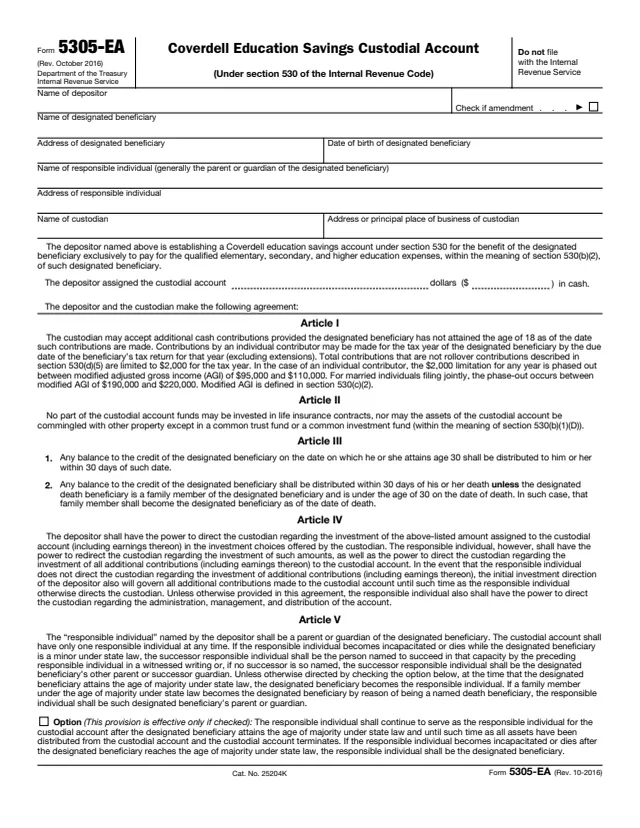
5305-EA
15 fields, 2 pages
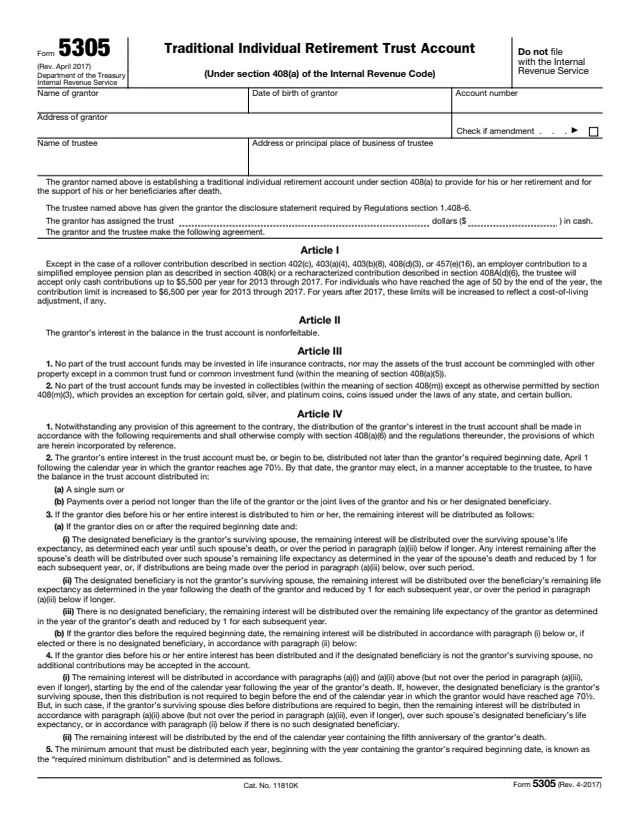
5305
10 fields, 2 pages
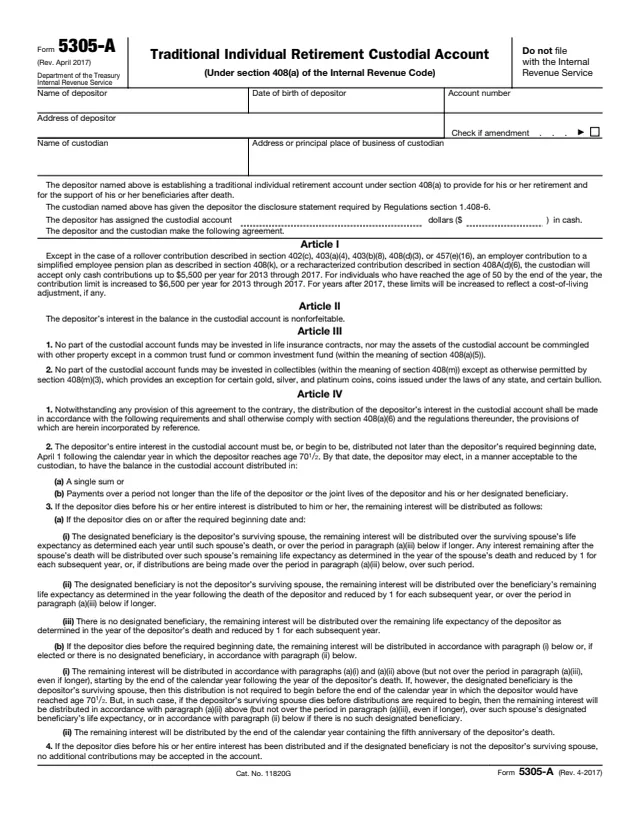
5305-A
10 fields, 2 pages
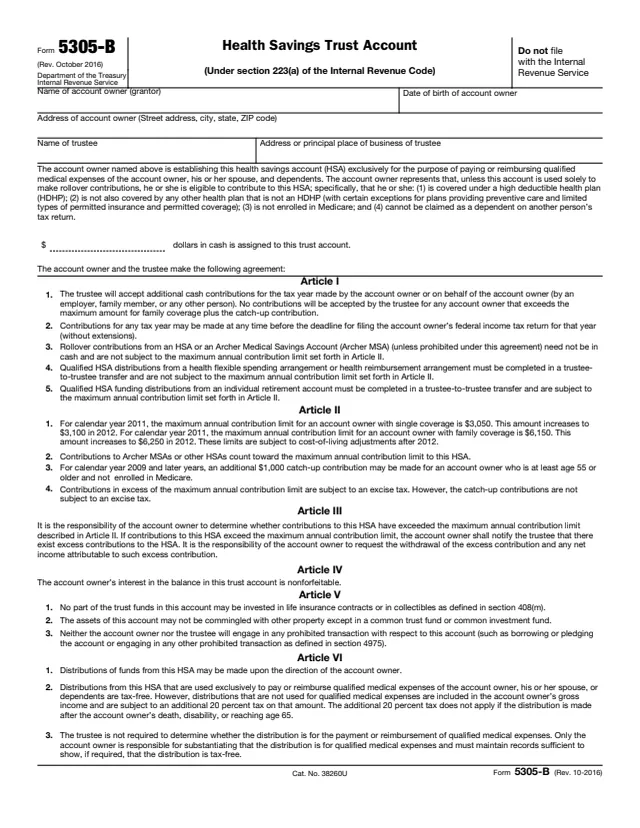
5305-B
6 fields, 2 pages
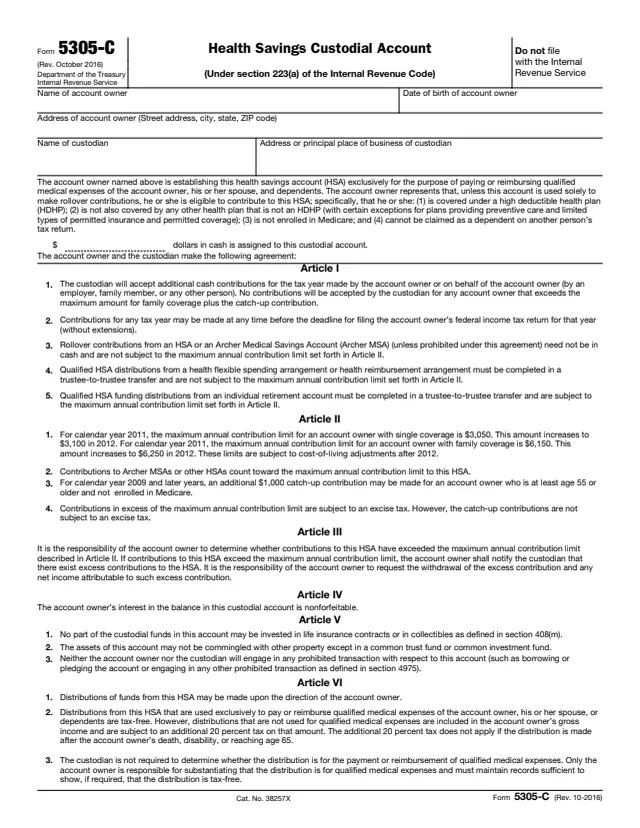
5305-C
6 fields, 2 pages
The grantor and the trustee sign the agreement. The form also names a designated beneficiary and a responsible individual, who do not sign it.
No tool matches that search.
No. The form says "Do not file with the Internal Revenue Service." The instructions say the grantor keeps the completed form in its records.
Form 5305-E is the model trust account agreement, signed by a grantor and a trustee. The instructions point to Form 5305-EA when the model account is a custodial account.
Article I says contributions that are not rollovers are limited to $2,000 for the tax year, with a phase-out by modified AGI, and that additional cash contributions are accepted only before the beneficiary reaches age 18.
Article III says any balance is distributed to the beneficiary within 30 days of the date the beneficiary reaches age 30. The instructions say the age limits are waived for a beneficiary with special needs.
The instructions say a bank or savings and loan association as defined in section 408(n), or any person with IRS approval to act as trustee. Anyone who may serve as trustee of a traditional IRA may serve.
Article VI has boxes saying the responsible individual may or may not change the beneficiary to another member of the beneficiary's family described in section 529(e)(2), following the trustee's procedures.