Grantor and trustee details
Name, date of birth and address of the grantor, account number, an amendment checkbox, the trustee's name and address, and the dollar amount the grantor assigns to the trust in cash.
5305
Traditional Individual Retirement Trust Account
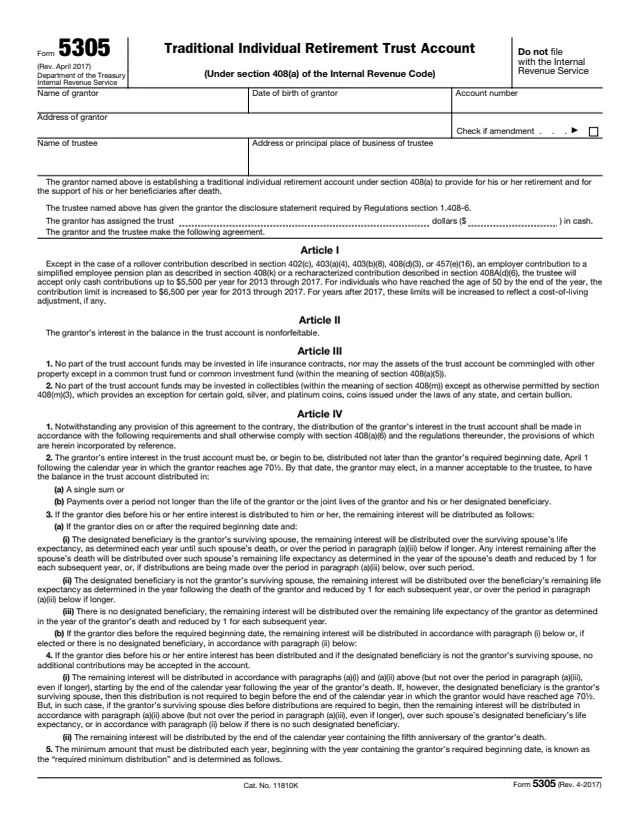
Form 5305 is the Traditional Individual Retirement Trust Account agreement under section 408(a). The instructions call it a model trust account agreement that meets the requirements of section 408(a), and say only Articles I through VII have been reviewed by the IRS.
The form is an agreement between two parties: the grantor, the individual who establishes the account, and the trustee. The instructions say a traditional IRA is established after the form is fully executed by both, and that the account is created in the United States for the exclusive benefit of the grantor and his or her beneficiaries.
The form says "Do not file with the Internal Revenue Service." It is kept with your records. The instructions are printed on page 2. You can fill out Form 5305 free in your browser on this page and download the result without an account.
Name, date of birth and address of the grantor, account number, an amendment checkbox, the trustee's name and address, and the dollar amount the grantor assigns to the trust in cash.
Article I limits the contributions the trustee accepts, Article II says the grantor's interest is nonforfeitable, and Article III bars life insurance investments and commingling, and limits collectibles to what section 408(m)(3) permits.
Distribution rules under section 408(a)(6), covering the required beginning date, distributions after the grantor's death and the required minimum distribution.
Article V covers the information and reports for the IRS, Article VI makes Articles I through III controlling, and Article VII covers amendments.
Space for any additional provisions, followed by the grantor's, trustee's and witness's signature and date lines.
Enter the grantor's name, date of birth and address and the account number. Check the amendment box if this form amends an existing agreement.
Enter the trustee's name and its address or principal place of business. The form states the trustee has given the grantor the disclosure statement required by Regulations section 1.408-6.
Enter the amount, in words and in dollars, that the grantor assigns to the trust in cash.
Add any extra provisions, or draw a line through the space if none are added. The form says added provisions comply with state law and the Internal Revenue Code and may not imply IRS review or pre-approval.
The grantor and the trustee sign and date. A witness signs only if a signature must be witnessed. Keep the signed form with your records.
You get the real form, filled in a browser tab, with nothing standing between you and the finished PDF.
The instructions say: "Do not file Form 5305 with the IRS. Instead, keep it with your records."
The instructions say a traditional IRA is established after the form is fully executed by both the grantor and the trustee.
To make a regular contribution for a year, the instructions say the IRA is established no later than the due date (excluding extensions) of the individual's income tax return for that year.
Under Article V the grantor gives the trustee the information needed for reports, and the trustee submits to the IRS and the grantor the reports the IRS prescribes.
The instructions point to Pub. 590-A and Pub. 590-B for more on IRAs, including the disclosures the trustee gives the grantor.
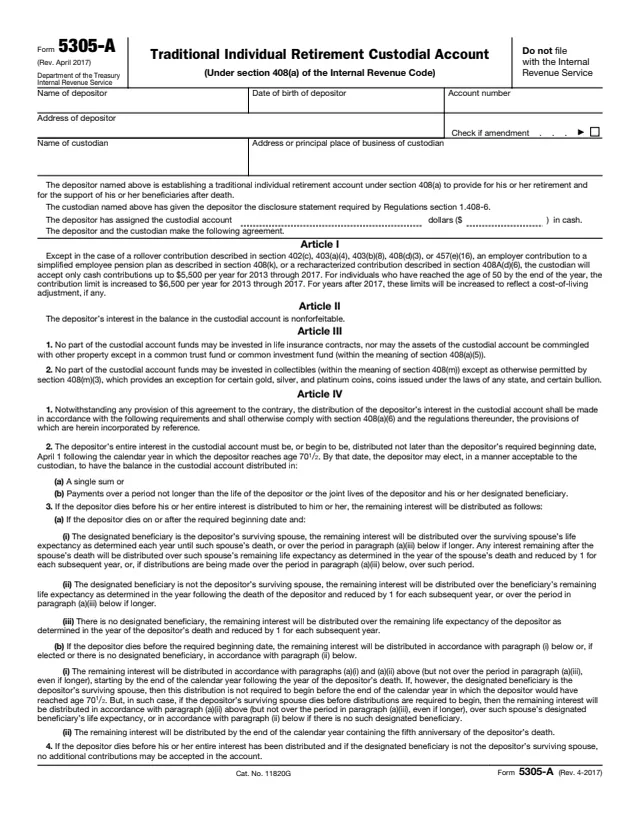
5305-A
10 fields, 2 pages
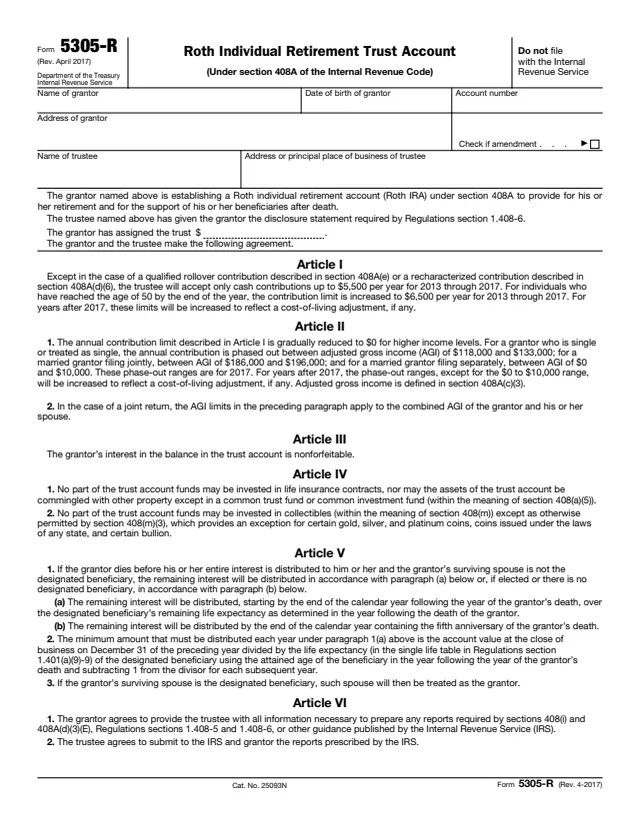
5305-R
9 fields, 2 pages
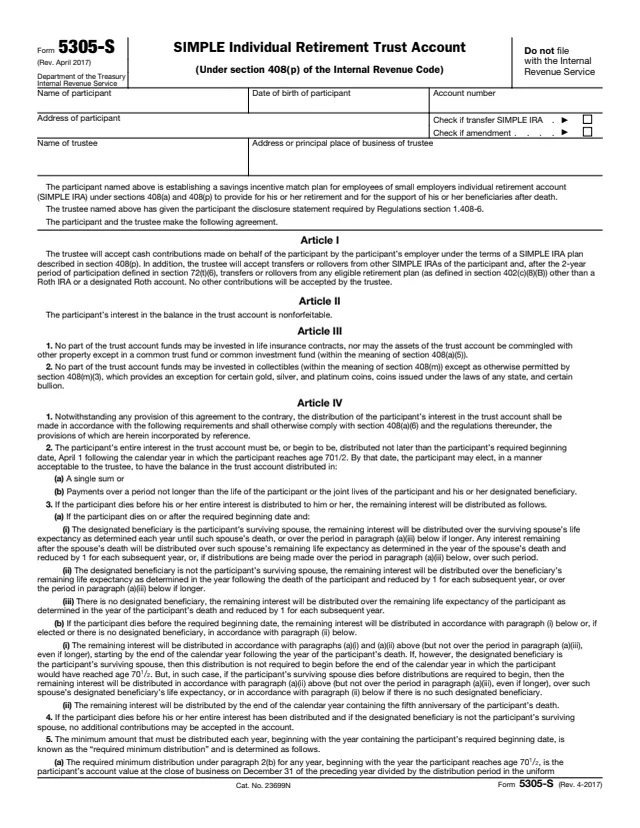
5305-S
9 fields, 2 pages
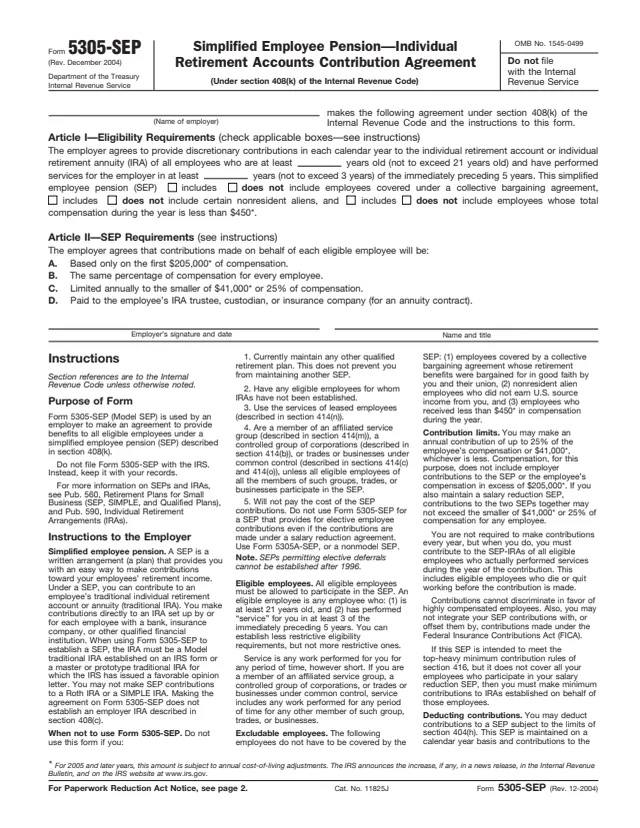
5305-SEP
7 fields, 2 pages
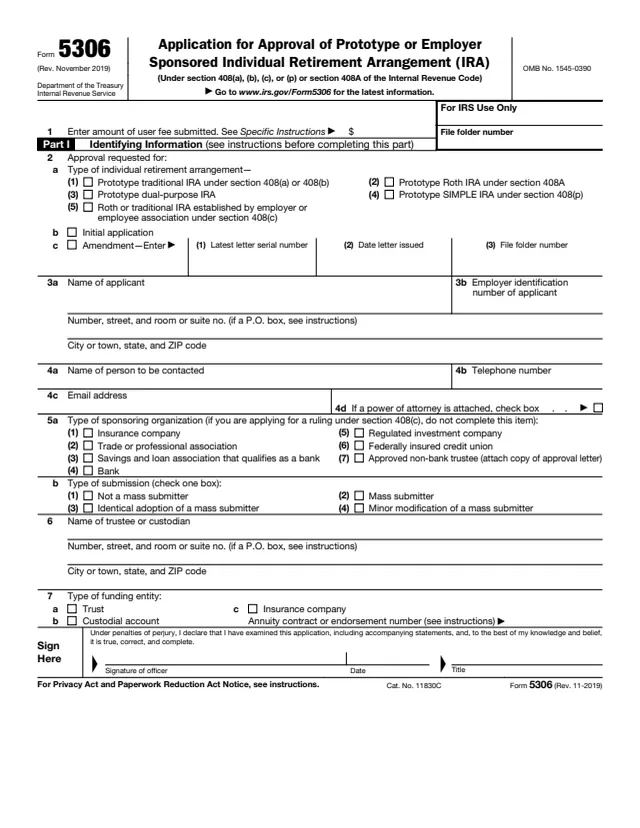
5306
68 fields, 3 pages
The grantor and the trustee complete and sign the agreement together. Neither files it with the IRS.
No tool matches that search.
No. The form says "Do not file with the Internal Revenue Service." The instructions say to keep it with your records.
The instructions say a bank or savings and loan association, as defined in section 408(n), or any person who has the approval of the IRS to act as trustee.
No. The instructions say only Articles I through VII have been reviewed by the IRS. Article VIII and any that follow hold provisions agreed to by the grantor and trustee.
Yes. The instructions say it may be used to establish the IRA trust for a nonworking spouse, with contributions made to a separate IRA trust account.
The April 2017 revision says the trustee accepts cash contributions up to $5,500 per year for 2013 through 2017, or $6,500 for individuals who reached age 50, with cost-of-living increases after 2017. Rollovers and certain other contributions are excepted.
The instructions give examples such as definitions, investment powers, voting rights, amendment and termination, removal of the trustee, trustee's fees and state law requirements.