Header and taxpayer block
The form number, the date July 2026, the title, a Date received by IRS box and the name and address of taxpayer(s).
15107
Information Request for a Deceased Taxpayer
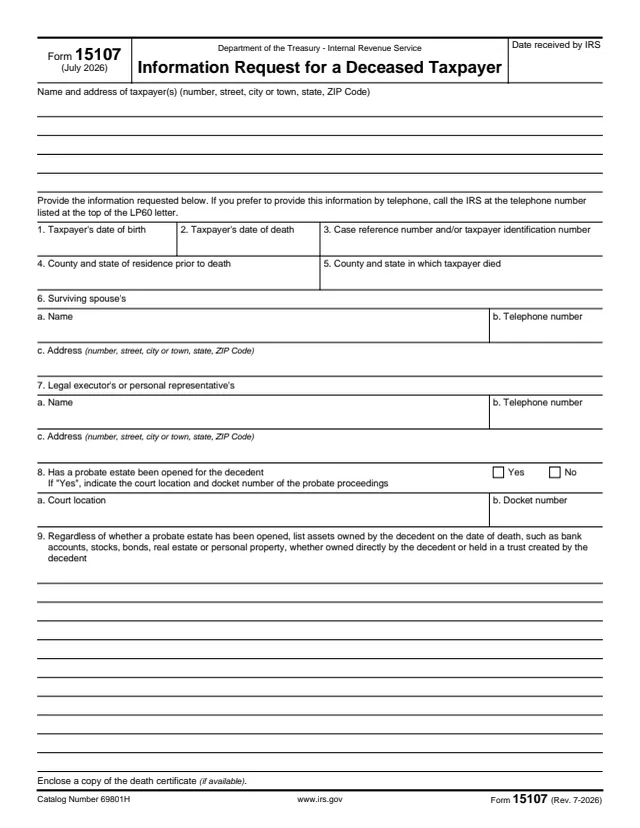
Form 15107, Information Request for a Deceased Taxpayer, is a one-page Department of the Treasury, Internal Revenue Service form (Rev. 7-2026). It opens with "Provide the information requested below." The form says that if you prefer to provide the information by telephone, you can call the IRS at the telephone number listed at the top of the LP60 letter.
The form asks for the taxpayer's dates of birth and death, a case reference number and/or taxpayer identification number, the county and state of residence before death and of death, contact details for a surviving spouse and for the legal executor or personal representative, whether a probate estate has been opened, and a list of assets the decedent owned on the date of death. It ends with "Enclose a copy of the death certificate (if available)."
The form prints no mailing address of its own. You can fill it out free in your browser on this page and download the result without an account.
The form number, the date July 2026, the title, a Date received by IRS box and the name and address of taxpayer(s).
Date of birth, date of death, case reference number and/or taxpayer identification number, county and state of residence prior to death, and county and state in which the taxpayer died.
The surviving spouse's name, telephone number and address.
The legal executor's or personal representative's name, telephone number and address.
A Yes or No question on whether a probate estate has been opened for the decedent, with the court location and docket number if Yes.
A space to list assets the decedent owned on the date of death, such as bank accounts, stocks, bonds, real estate or personal property, including assets held in a trust the decedent created.
Enter the name and address of the taxpayer(s) in the top block: number, street, city or town, state and ZIP Code.
Enter the taxpayer's date of birth and date of death, the case reference number and/or taxpayer identification number, and the counties and states of residence before death and of death.
Enter the surviving spouse's name, telephone number and address, then the same details for the legal executor or personal representative.
Check Yes or No. The form says that if Yes, indicate the court location and docket number of the probate proceedings.
List the assets. The form says to do so regardless of whether a probate estate has been opened, whether owned directly by the decedent or held in a trust the decedent created.
The last line says to enclose a copy of the death certificate (if available).
You get the real form, filled in a browser tab, with nothing standing between you and the finished PDF.
The form goes to the IRS. It prints no mailing address or deadline of its own and refers to the LP60 letter for the IRS telephone number.
The form says that if you prefer to provide this information by telephone, call the IRS at the telephone number listed at the top of the LP60 letter.
A copy of the death certificate, if available.
The form has no signature or date line.
The form does not name who completes it. It refers to an IRS LP60 letter, asks for facts about a deceased taxpayer and goes back to the IRS.
No tool matches that search.
The form says that if you prefer to provide this information by telephone, call the IRS at the telephone number listed at the top of the LP60 letter.
The form says to enclose a copy of the death certificate (if available).
Item 9 says to list assets regardless of whether a probate estate has been opened, including assets held in a trust created by the decedent.
The form has no signature or date line.
The form prints no address. It goes to the IRS, and it refers to the LP60 letter for the IRS telephone number.