Name, EIN and address
The corporation's name, employer identification number, number and street with room or suite number, and city or town, state and ZIP code.
1138
Extension of Time for Payment of Taxes by a Corporation Expecting a Net Operating Loss Carryback
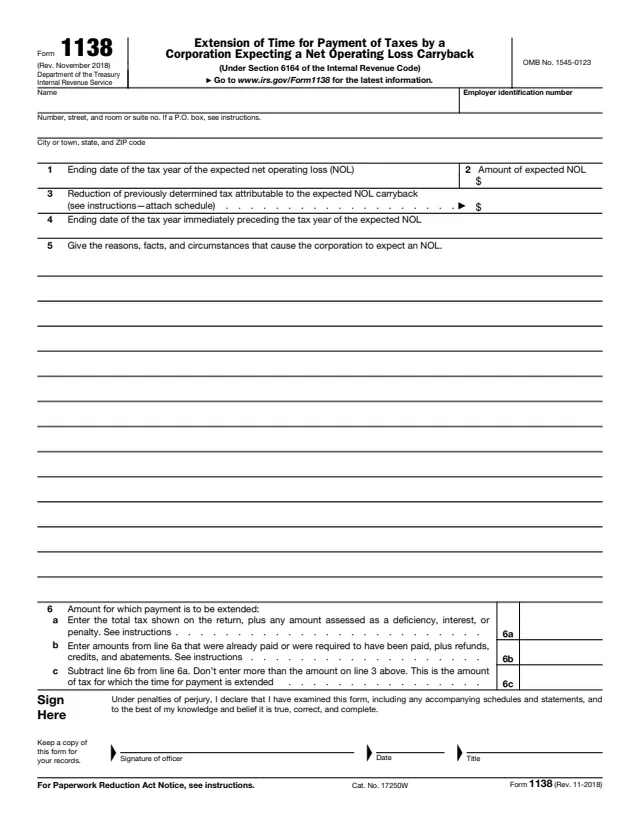
Form 1138 is the IRS form a corporation uses to extend the time for paying tax for the year before a year in which it expects a net operating loss (NOL). The IRS About page says a corporation that expects an NOL in the current tax year can file it to extend the time for payment of tax for the immediately preceding tax year. The form is filed under section 6164 of the Internal Revenue Code.
The instructions say the extension can include a tax deficiency, and the tax that can be postponed cannot exceed the expected overpayment from the carryback of the NOL. Only payments of tax required to be paid after Form 1138 is filed are eligible. The What's New section notes that the 2-year carryback rule generally does not apply to NOLs arising in tax years ending after December 31, 2017, with exceptions for certain farming losses and NOLs of insurance companies other than life insurance companies.
You can fill out Form 1138 free in your browser on this page and download it without an account.
The corporation's name, employer identification number, number and street with room or suite number, and city or town, state and ZIP code.
The ending date of the tax year of the expected NOL and the amount of the expected NOL.
The reduction of previously determined tax attributable to the expected NOL carryback. The form says to see the instructions and attach a schedule.
The ending date of the tax year immediately preceding the NOL year, and the reasons, facts and circumstances that cause the corporation to expect an NOL.
Line 6a is the total tax and assessed amounts, line 6b the amounts already paid or required to be paid plus refunds, credits and abatements, and line 6c the difference, which is the tax whose payment is extended.
A declaration under penalties of perjury with the officer's signature, the date and the officer's title. The form says to keep a copy for the corporation's records.
Include the suite, room or other unit number. The instructions say to show a P.O. box only if the post office does not deliver to the street address, to write C/O and the name for mail sent in care of a third party such as an accountant or attorney, and not to abbreviate a foreign country name.
The instructions say the expected NOL is based on all the facts about the corporation's operation, such as canceled government contracts, profit and loss statements and other factors peculiar to its operations. They point to section 172, and to sections 382 and 384 for limitations.
Enter the reduction of previously determined tax for tax years before the NOL year. The instructions say previously determined tax is generally the tax shown on the return plus deficiencies assessed before Form 1138 is filed, minus abatements, credits or refunds. Attach a schedule showing how it was figured.
For the year shown on line 4, enter the total tax shown on the return plus any amount assessed as a deficiency, interest or penalty before this Form 1138 is filed.
Enter tax paid or required to be paid before the filing date, plus refunds, credits and abatements made before that date. An assessed amount counts if the form is filed more than 21 calendar days after notice and demand for payment (more than 10 business days if that amount equals or exceeds $100,000).
Subtract line 6b from line 6a, but do not enter more than the amount on line 3. An officer then signs, dates and enters a title.
You get the real form, filled in a browser tab, with nothing standing between you and the finished PDF.
The instructions say to file Form 1138 after the start of the tax year of the expected NOL but before the tax of the preceding tax year is required to be paid.
Generally with the Internal Revenue Service Center where the corporation files its income tax return. If Form 1138 is filed with Form 7004, it goes to the address where the corporation files Form 7004.
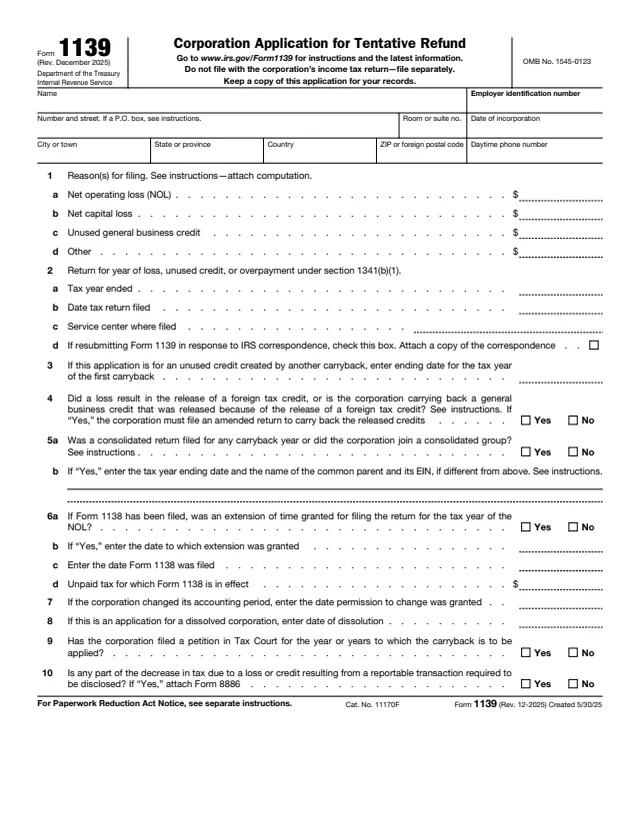
In general, the extension expires at the end of the month in which the return for the NOL year is required to be filed, including extensions. Filing Form 1139 before then extends it until the IRS allows or disallows that application.
The IRS can terminate the extension if it believes any part of the form contains erroneous or unreasonable information, or that it may not be able to collect the tax.
Interest is charged on postponed amounts from the dates the payments would normally be due, figured at the underpayment rate specified in section 6621.
If a revised Form 1138 lowers the expected NOL, the instructions say the corporation pays the tax to the extent the amount postponed on the original filing exceeds the amount postponed on the revised filing.
The form is filed by a corporation and signed by one of its officers. It goes to the IRS, not to another party.
No tool matches that search.
A corporation that expects an NOL in the current tax year that can be carried back to its preceding tax year. An officer of the corporation signs it.
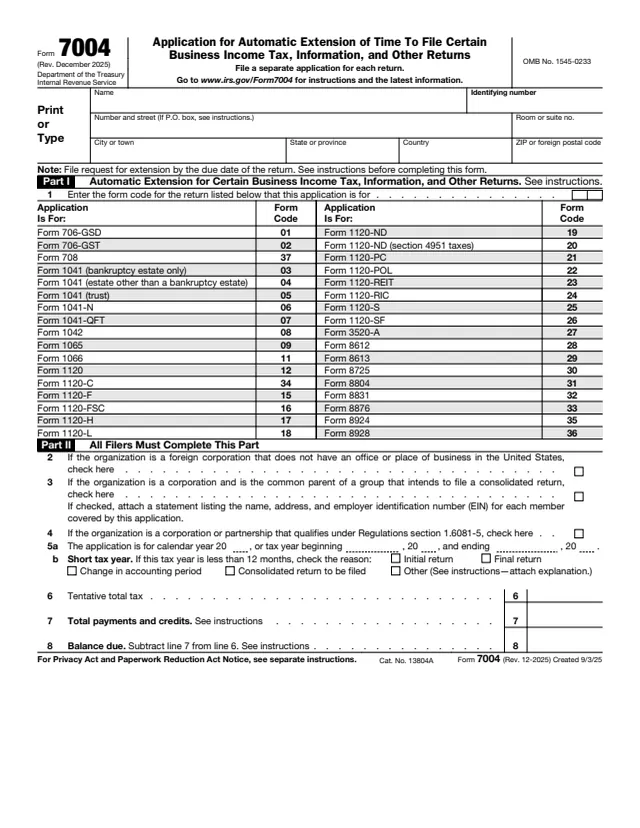
Yes. The instructions say it can be filed separately or with Form 7004. Filed together, Form 1138 reduces or eliminates the tax to be deposited when Form 7004 is filed.
In general, until the end of the month in which the return for the NOL year is due, including extensions. Filing Form 1139 before then extends it until the IRS acts on that application.
Yes. The instructions say interest is charged from the dates the payments would normally be due, at the underpayment rate in section 6621.
The instructions say the 2-year carryback rule generally does not apply to NOLs arising in tax years ending after December 31, 2017, with exceptions for certain farming losses and some insurance company NOLs.
The corporation can file a revised Form 1138. A larger NOL can postpone more tax that is not yet paid or due, and a smaller NOL means paying the difference.
Yes. The instructions say the IRS can terminate it for erroneous or unreasonable information, or if it believes it may not be able to collect the tax.