Lender and borrower boxes
The recipient's or lender's name, address and phone number, both TINs, the payer's or borrower's name and address, and an account number.
1098
Mortgage Interest Statement
Form 1098, Mortgage Interest Statement, is an information return filed by a person who receives mortgage interest in the course of a trade or business. The IRS page says it reports mortgage interest of $600 or more received during the year in the course of a trade or business from an individual, including a sole proprietor. The instructions add that it also reports mortgage insurance premiums of $600 or more when section 163(h)(3)(E) applies, points paid on the purchase of a principal residence, and refunds of overpaid interest.
The filer, called the recipient or lender, sends Copy A to the IRS and gives Copy B to the payer of record, the individual carried on its books as the principal borrower. Copy B carries the Instructions for Payer/Borrower, which explain each box and point to Pub. 936.
The instructions say to use the April 2025 revision to file 2026 information with the IRS in early 2027, and to keep using it until a superseding revision is issued. The PDF notes that Copy A printed from IRS.gov is for information only and cannot be scanned. You can fill out the PDF free in your browser on this page and download it without an account.
The recipient's or lender's name, address and phone number, both TINs, the payer's or borrower's name and address, and an account number.
Mortgage interest received from payers or borrowers, outstanding mortgage principal and mortgage origination date.
Refund of overpaid interest, mortgage insurance premiums, and points paid on purchase of principal residence.
A check box if the property address matches the borrower's address, and the address or description of the property securing the mortgage.
Number of properties securing the mortgage, an Other box, and the mortgage acquisition date.
The PDF holds Copy A for the IRS and Copy B for the payer or borrower, with VOID and CORRECTED boxes and the Instructions for Payer/Borrower.
Enter the filer's name, address and phone number, using the same name and address as on Form 1096, then the payer of record's name and address. An account number is required when one borrower has several accounts with more than one Form 1098.
Enter interest received during the calendar year, not including points. The instructions say to leave out government subsidy payments, seller payments and prepaid interest that does not meet the exception.
Enter the outstanding principal as of January 1, or as of the origination or acquisition date if that was in the current year. Box 3 is the date the mortgage originated with the original lender.
Enter the total refund or credit of prior year overpaid interest, qualified mortgage insurance premiums of $600 or more, and reportable points paid on the purchase of the principal residence.
Check box 7 if the property address is the borrower's mailing address, or complete box 8. A property with no address uses its jurisdiction and Assessor Parcel Number. Box 9 holds the number of properties if more than one.
Box 10 can hold other items, such as real estate taxes or insurance paid from escrow. Enter an acquisition date in box 11 only if the mortgage was acquired in the calendar year.
You get the real form, filled in a browser tab, with nothing standing between you and the finished PDF.
The PDF says not to print and file Copy A downloaded from IRS.gov, because a penalty may be imposed for filing forms that cannot be scanned. Official scannable forms can be ordered at IRS.gov/EmployerForms.
The PDF says a filer with 10 or more information returns may be required to e-file, and points to IRS.gov/InfoReturn. IRIS is the IRS online portal for e-filing information returns.
A filer of Form 1098 also provides a statement to the payer of record. The instructions say Copy B is fillable online in a PDF format for this purpose.
The instructions say to file a separate Form 1098 for each mortgage, and that the $600 threshold applies separately to each mortgage.
The borrower's TIN may be truncated on payee statements but not on documents filed with the IRS. The lender's TIN may not be truncated on any form.
The instructions point to Pub. 1099, General Instructions for Certain Information Returns, for when and where to file, corrections and penalties.
1096
55 fields, 3 pages
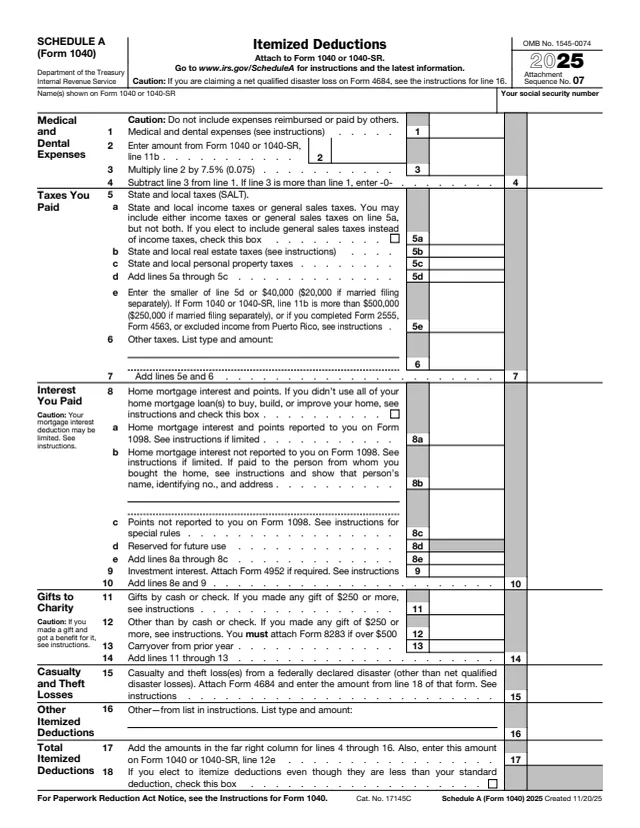
1040
33 fields, 1 page
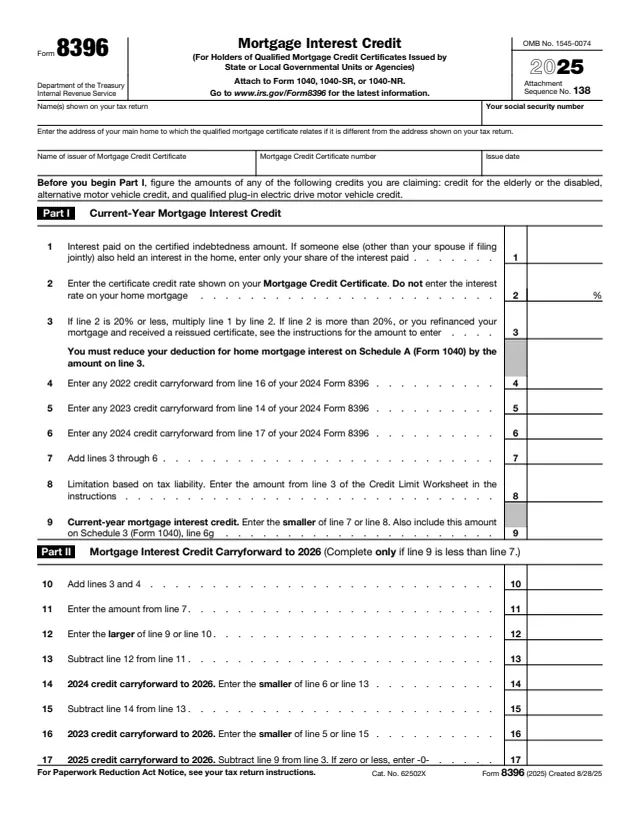
8396
26 fields, 2 pages
1099-INT
127 fields, 7 pages
1040
73 fields, 2 pages
W-8
23 fields, 1 page
The person engaged in a trade or business that received the mortgage interest completes and files the form. The borrower receives Copy B and does not file it.
No tool matches that search.
The Instructions for Payer/Borrower say a person engaged in a trade or business that received at least $600 of mortgage interest, including certain points, on any one mortgage in the calendar year furnishes this statement.
Copy B cautions that the amount may not be fully deductible. It says limits based on the loan amount and the cost and value of the property may apply, and points to Pub. 936.
The form is prepared only for the payer of record. Copy B says that person furnishes the other borrowers with information about the proper distribution of the amounts reported.
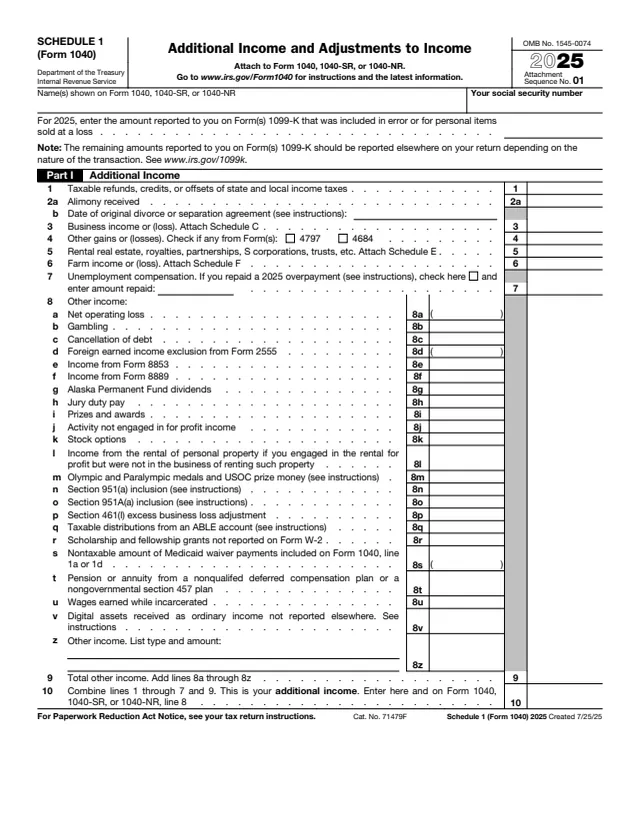
Copy B says box 4 is a refund or credit of interest overpaid in a prior year and is not deducted. Part or all of it may go on the Other income line of Schedule 1 (Form 1040).
Not when the interest is not received in the course of a trade or business. The instructions give the example of a mortgage on a former personal residence.
Copy B says the form may show only the last four digits of your TIN for your protection, but the issuer has reported your complete TIN to the IRS.