Items A to D
The REMIC's name, address and EIN, the date the REMIC started, total assets at the end of the tax year, and boxes for a final return, name change or address change.
1066
U.S. Real Estate Mortgage Investment Conduit (REMIC) Income Tax Return
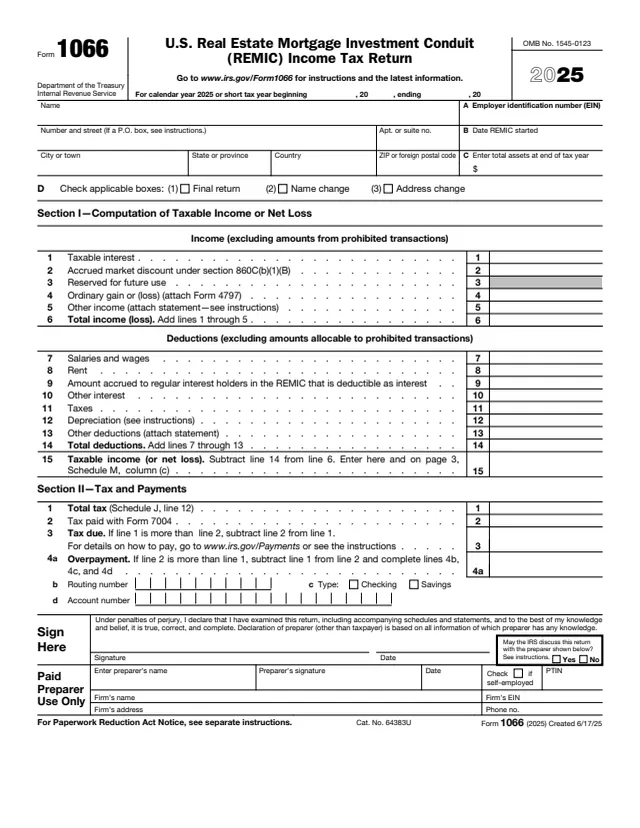
Form 1066, U.S. Real Estate Mortgage Investment Conduit (REMIC) Income Tax Return, is the 2025 return an entity files to report the income, deductions, and gains and losses from the operation of a REMIC. The instructions say the REMIC also uses it to report and pay the taxes on net income from prohibited transactions, net income from foreclosure property, and contributions after the startup day.
Apart from those three taxes, the instructions say the REMIC isn't subject to income tax, and the residual interest holders are liable for tax on their shares of the REMIC's taxable income, whether or not distributed. Each holder's quarterly share is reported on Schedule Q (Form 1066), which is a separate form.
The election to be treated as a REMIC is made by timely filing Form 1066 for the entity's first tax year. You can fill out Form 1066 free in your browser on this page and download the result without an account.
The REMIC's name, address and EIN, the date the REMIC started, total assets at the end of the tax year, and boxes for a final return, name change or address change.
Income lines 1 to 6 and deduction lines 7 to 14, both excluding prohibited transactions, with line 15 also entered on Schedule M.
Total tax from Schedule J, tax paid with Form 7004, tax due, and any overpayment with routing and account numbers for direct deposit.
Tax on net income from prohibited transactions, tax on net income from foreclosure property at 21% (0.21) of line 9, tax on contributions after the startup day, and total tax.
Entity type, number of residual interest holders, the election out of the centralized partnership audit regime, foreign accounts and foreign trusts, tax-exempt interest, classes of regular interests and the sum of daily accruals.
Balance sheets per books, the reconciliation of residual interest holders' capital accounts, and the Designation of Partnership Representative on page 4.
Fill in short tax year dates if they apply. Enter the startup day in item B. If the EIN has not arrived by the due date, the instructions say to write "Applied for." With no assets at year end, enter zero in item C.
Report income and deductions, excluding amounts from prohibited transactions. Line 15 subtracts line 14 from line 6 and is also entered on Schedule M, column (c).
Figure the three taxes. Part III is not completed if the startup day was before July 1, 1987. Line 12 adds lines 4, 10 and 11 and goes on page 1, Section II, line 1.
Enter tax paid with Form 7004 on line 2. If line 2 is more than line 1, enter the overpayment on line 4a and complete lines 4b, 4c and 4d for direct deposit.
Answer each item. The instructions say the balance sheet and capital account amounts should agree with the REMIC's books and records, with a statement explaining any differences.
If the REMIC had more than one residual interest holder at any time and did not elect out under item G, complete the Designation of Partnership Representative on page 4. Then sign and date the return.
You get the real form, filled in a browser tab, with nothing standing between you and the finished PDF.
The instructions say REMICs generally file the 2025 Form 1066 by March 15, 2026. A final return is due by the 15th day of the 3rd month following the date the REMIC ceased to exist.
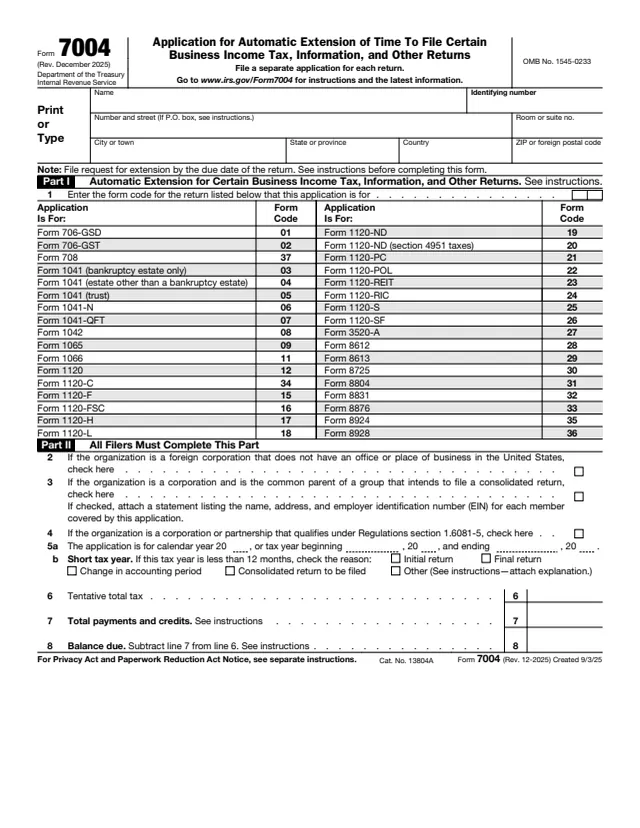
Form 7004 requests an automatic extension. The instructions say it is filed by the regular due date of Form 1066.
With its principal business, office or agency in the United States: Department of the Treasury, Internal Revenue Service, Ogden, UT 84201-0007. In a foreign country or U.S. territory: Internal Revenue Service, P.O. Box 409101, Ogden, UT 84409.
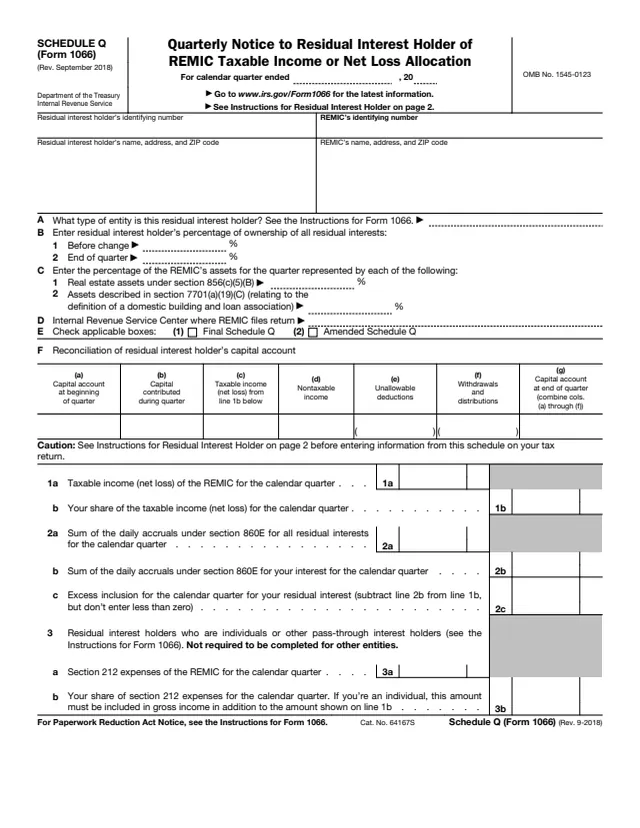
For each calendar quarter, a Schedule Q is completed for each residual interest holder and filed with Form 1066. A copy goes to the holder by the last day of the month following the month in which the quarter ends.
The instructions say tax due is paid in full by the 15th day of the 3rd month following the end of the tax year, and federal tax deposits are made by electronic funds transfer.
With no tax due, the instructions list a section 6698 penalty of $255 for each residual interest holder for each month or part of a month late, up to 12 months. With tax due, the section 6651 penalty is 5% of the unpaid tax per month, up to 25%.
1066 Sch. Q
35 fields, 2 pages
7004
26 fields, 1 page
1065-X
227 fields, 4 pages
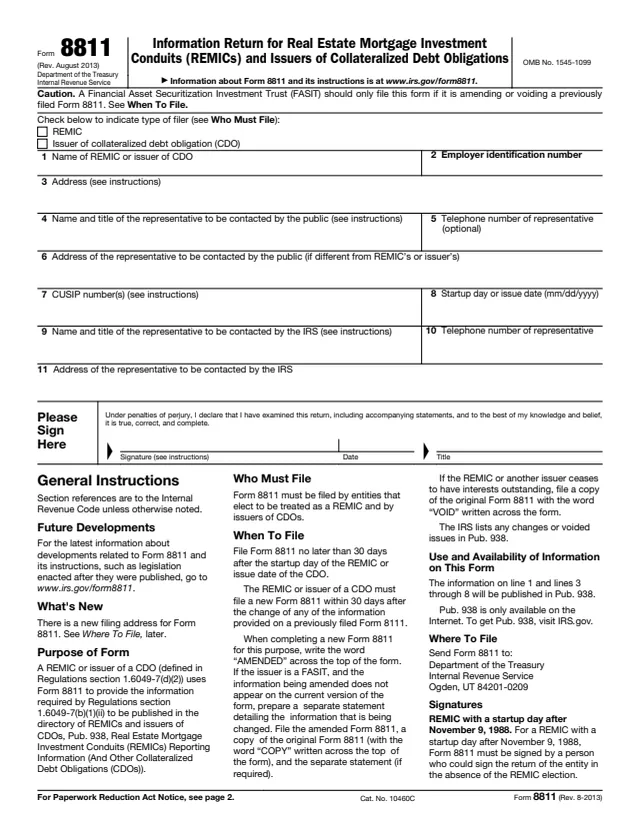
8811
14 fields, 2 pages
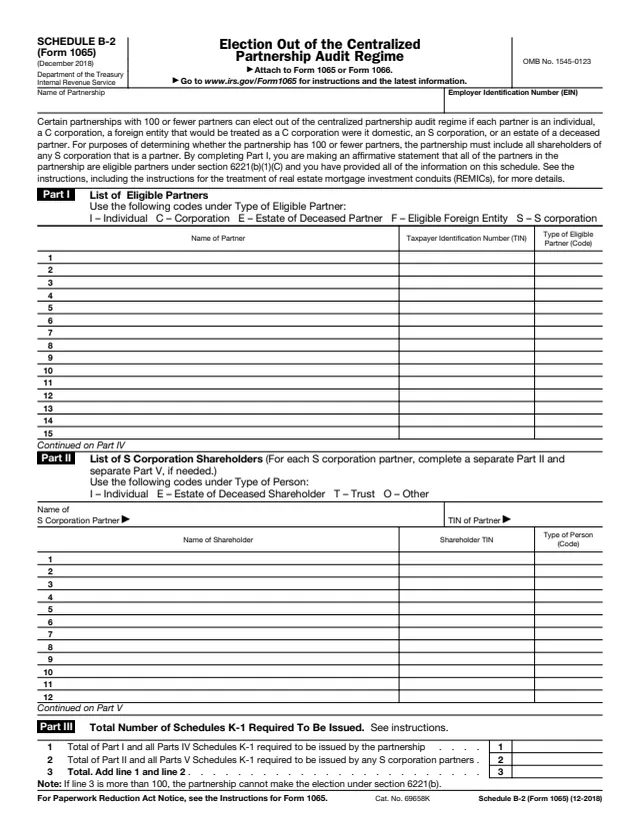
1065 Sch. B-2
613 fields, 5 pages
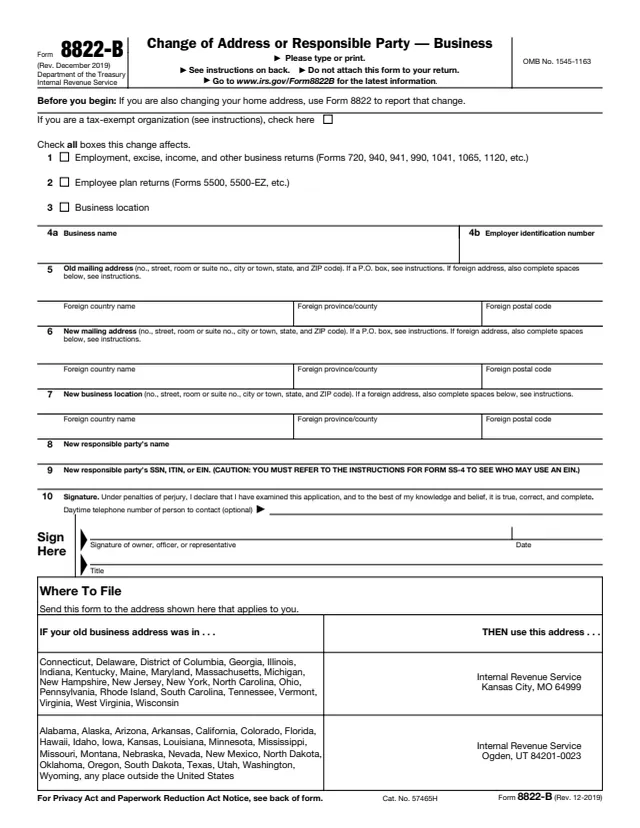
8822-B
22 fields, 2 pages
The instructions say an entity files Form 1066 if it elected to be treated as a REMIC for its first tax year, the election is still in effect, and it meets the section 860D(a) requirements.
No tool matches that search.
An entity that elected to be treated as a REMIC for its first tax year, still has the election in effect, and meets the section 860D(a) requirements, according to the instructions.
The instructions say a REMIC isn't subject to income tax except on net income from prohibited transactions, net income from foreclosure property and contributions after the startup day. The residual interest holders are taxed on their shares.
The instructions say generally by March 15, 2026. Form 7004 requests an automatic extension and is filed by the regular due date.
It shows each residual interest holder's share of the REMIC's quarterly taxable income or net loss, excess inclusion and section 212 expenses. The instructions say it is a separate tax form that isn't part of Form 1066.
By timely filing Form 1066 for the first tax year of the entity's existence, signed by an authorized person. The instructions say the election stays in effect until it is terminated.
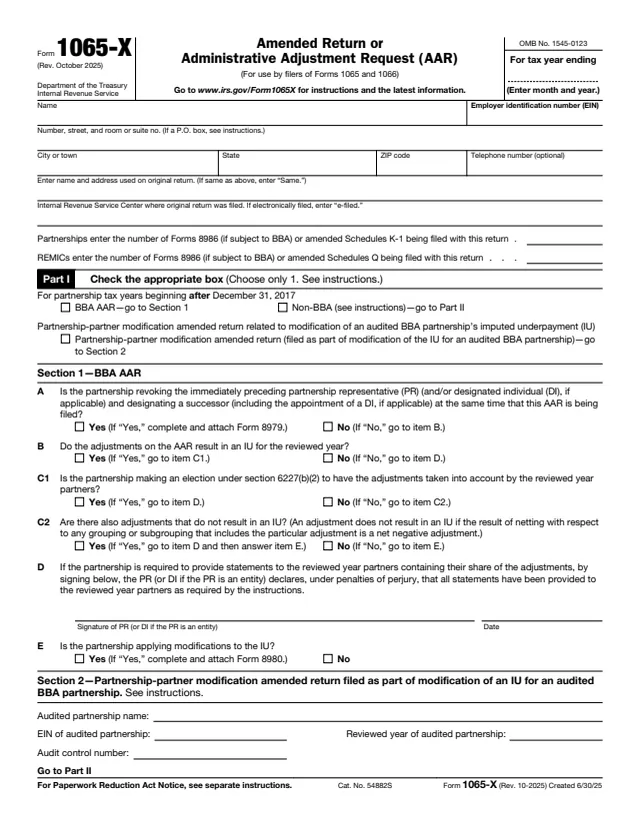
The instructions say a REMIC that later finds changes to income, deductions or other items files Form 1065-X, Amended Return or Administrative Adjustment Request (AAR).
The instructions say to use Form 8822-B to notify the IRS of a change in address or responsible party after the return is filed.