Section 1: employee identification
Name, date of birth, Social Security Number, home address, marital status, employee status, daytime telephone and office email, and company or home agency. Item 1d is reserved for agency use.
SF714
Financial Disclosure Report
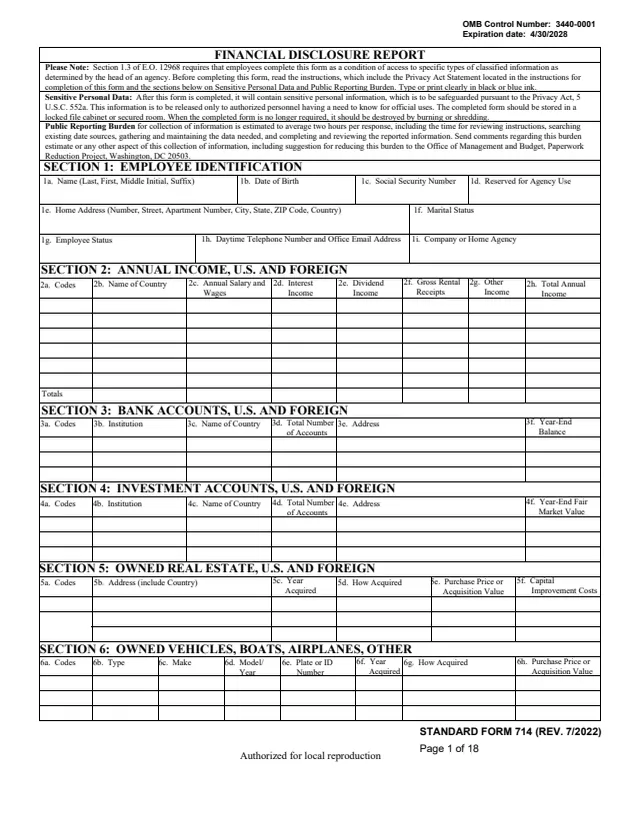
Standard Form 714 (SF 714) is the Financial Disclosure Report, Rev. 7/2022, with OMB Control Number 3440-0001 and an expiration date of 4/30/2028. GSA hosts a copy in its forms library, and GSA's page lists Executive Order 12968 as the authority.
The form says Section 1.3 of E.O. 12968 requires that employees complete it as a condition of access to specific types of classified information as determined by the head of an agency. It covers income, assets and liabilities of the filer, the filer's spouse and dependent children for the preceding calendar year, in United States dollars without cents.
SF 714 has 15 sections: employee identification, income, bank and investment accounts, owned and leased real estate and vehicles, other assets, loans, credit cards, additional income and bankruptcy, safe deposit boxes, comments and a signed certification. Pages 3 and 4 hold additional entry rows. You can fill it out free in your browser on this page and download the result without an account.
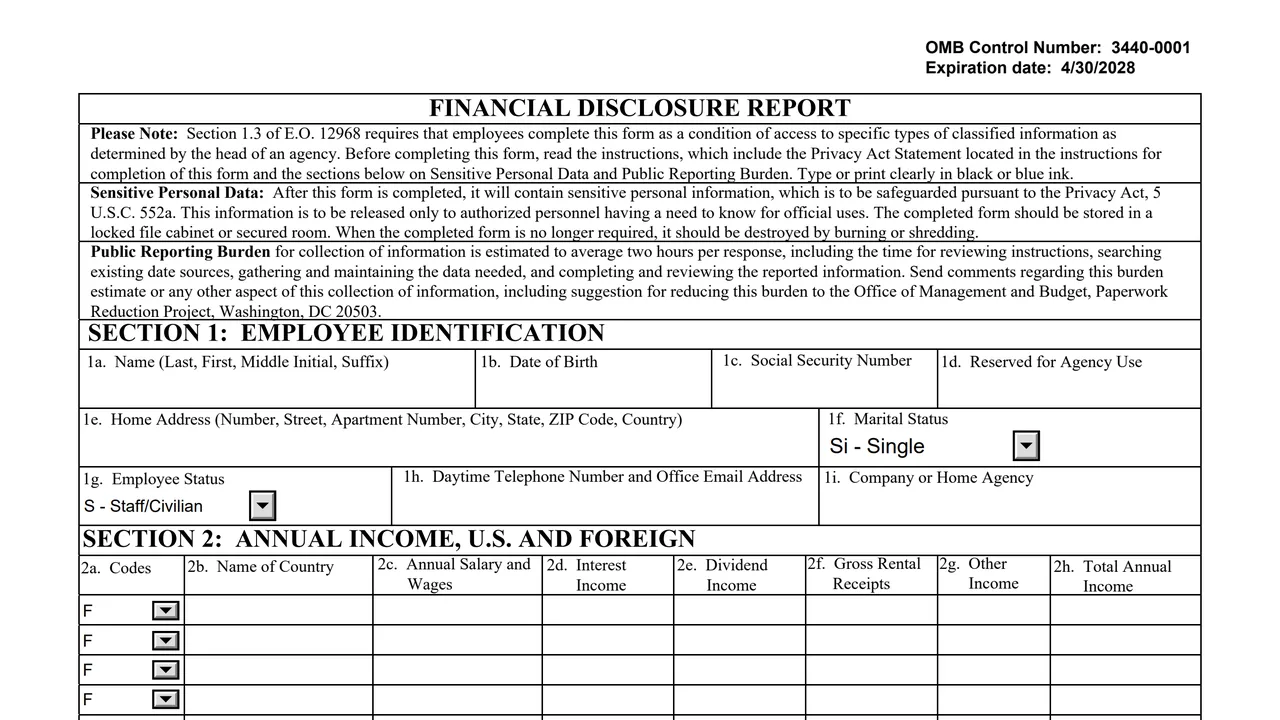
Name, date of birth, Social Security Number, home address, marital status, employee status, daytime telephone and office email, and company or home agency. Item 1d is reserved for agency use.
One row per person code and country, with salary and wages, interest, dividends, gross rental receipts, other income and a total. Losses are shown with a minus sign.
Institution, country, number of accounts, address and year-end balance or fair market value. The form says TSP, IRAs, Keogh, 401 (k) and 403 (b) accounts and college savings funds go in Section 4.
Owned real estate, owned vehicles, boats and airplanes, real estate leased or rented, leased vehicles, and other assets such as collectibles, jewelry, cash on hand, trusts and personal business net worth.
Mortgages, loans and other liabilities with a type code, creditor, original balance, year-end balance and monthly payment, then unpaid credit card balances as of December 31 with the last payment.
Gifts, inheritances, settlements, trust distributions, winnings, profits and bankruptcies with explanations, safe deposit boxes, comments, and the signed certification.
Each row starts with a code for whose item it is: F for filer, S for spouse, D for dependent child, O for other individuals, or a combination such as F and S.
The form asks you to read the instructions, including the Privacy Act Statement, and the notes on sensitive personal data and reporting burden, and to type or print clearly in black or blue ink.
The reporting period is the preceding calendar year. Amounts are in United States Dollars with no cents, and the form asks for your best honest estimate when an exact amount cannot be found.
For example, salary and wages less than $500 are entered as 0, interest and dividends less than $25 as 0, and nothing is reported for a credit card balance less than $500.
The form lists when to describe items in Section 12, such as Section 2 Other Income totaling $10,000 or more, non-recurring cash income over $10,000, and bankruptcies filed during the preceding year.
Additional entries for Sections 2 through 14 are on pages 3 and 4. Each of those pages has a line for your name and Social Security Number.
Section 15 asks for your typed name, signature and date signed. The instructions say to sign the report before mailing.
You get the real form, filled in a browser tab, with nothing standing between you and the finished PDF.
The PDF prints no filing address. It says the head of an agency determines which access requires the form, and the instructions mention signing before mailing.
The form estimates the public reporting burden at an average of two hours per response. Comments go to the Office of Management and Budget, Paperwork Reduction Project, Washington, DC 20503.
The form says a completed SF 714 contains sensitive personal information, should be stored in a locked file cabinet or secured room, and should be destroyed by burning or shredding when no longer required.
The Privacy Act Statement says it helps make personnel security determinations, and that failure to furnish it could result in being considered unfavorably for new or continued access to classified information.
The certification says a knowing and willful false statement can be punished by fine or imprisonment or both, citing U.S. Code Title 18, Section 1001.
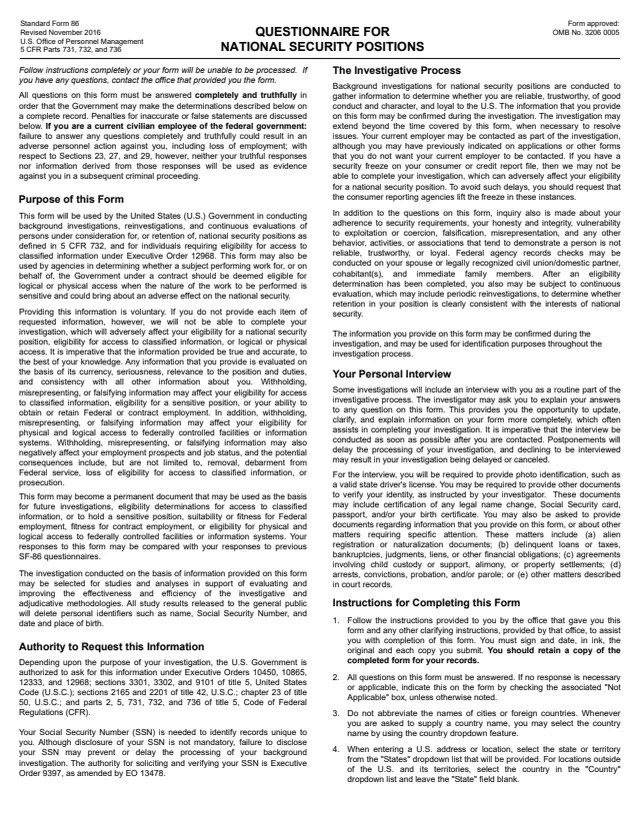
SF86
6,197 fields, 136 pages
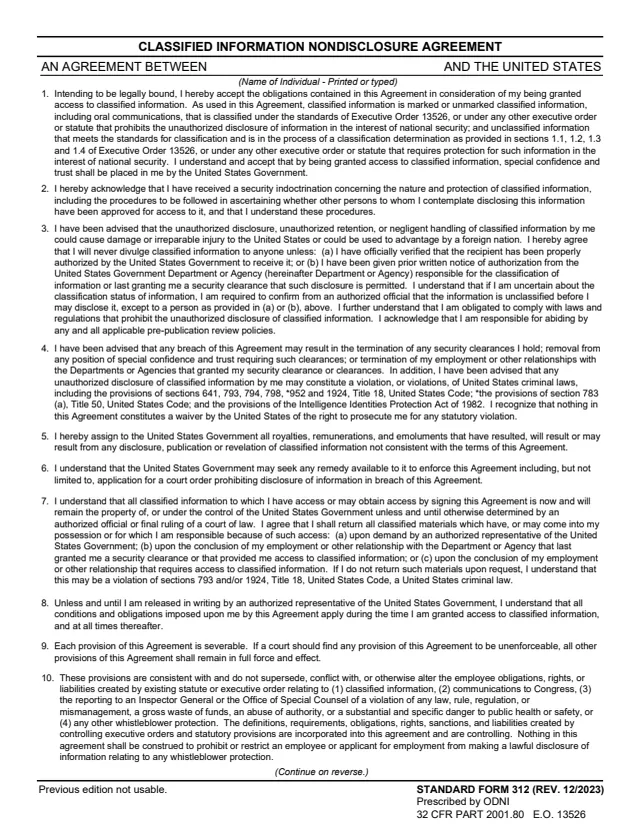
SF312
15 fields, 2 pages
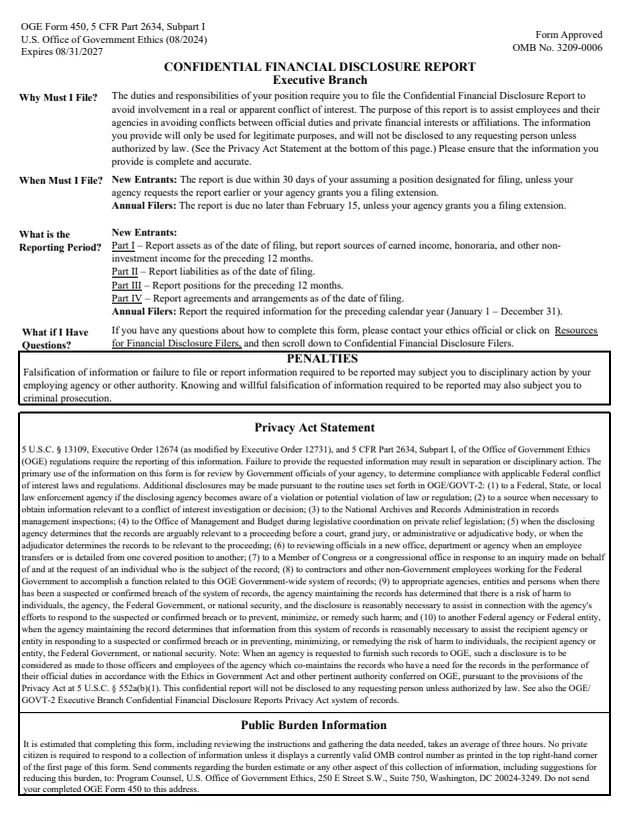
OGE450
396 fields, 12 pages
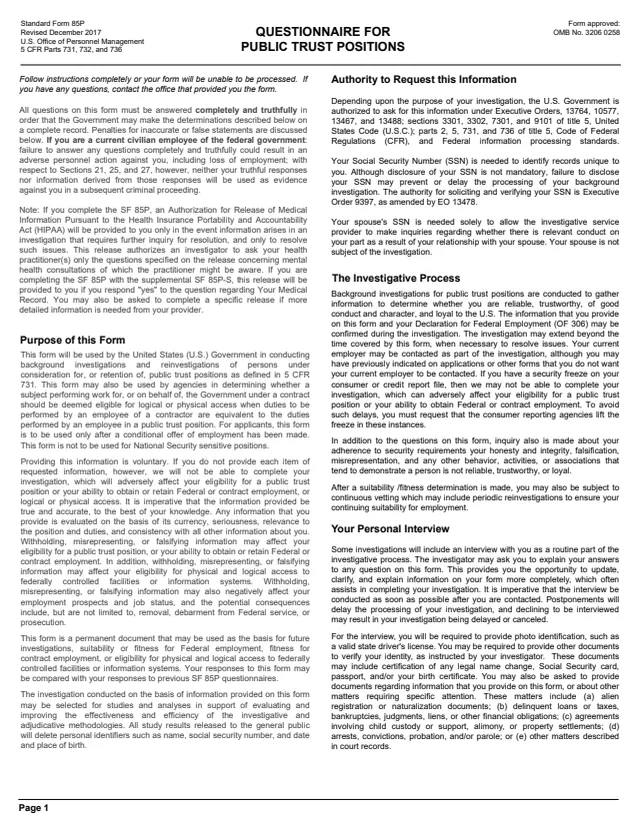
SF85P
4,128 fields, 95 pages
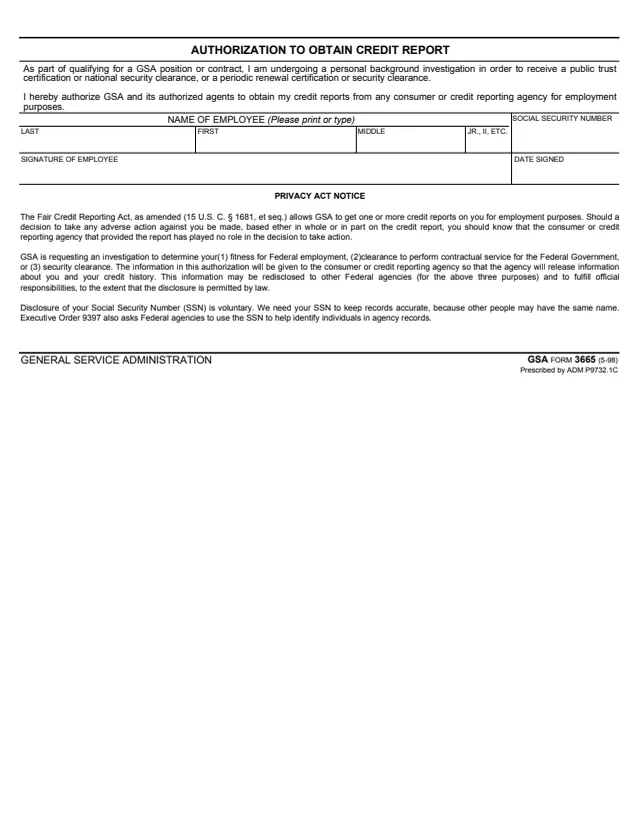
GSA3665
7 fields, 1 page
The form says employees complete it as a condition of access to specific types of classified information as determined by the head of an agency. Item 1g lists four employee status codes.
No tool matches that search.
The form asks for income, assets and liabilities of you, your spouse and your dependent children. It says not to include spousal information where there is a legal separation, or financial information for anyone else living with you.
The reporting period is the preceding calendar year. Balances and values are generally given as of December 31 of that year.
The form says to list all amounts in United States Dollars and not to report cents. If you cannot locate the exact amount, it asks for your best honest estimate.
Section 4, Investment Accounts. The form names Thrift Savings Plan (TSP), IRAs, Keogh, 401 (k) and 403 (b) accounts, college savings funds and other retirement and investment accounts.
The form says disclosure of your SSN is voluntary and will be used to confirm your identity. It cites Public Law 104-134 (April 26, 1996), as amended in Title 31, Section 7701, as the authority.
Pages 3 and 4 of SF 714 hold additional entries for Sections 2 through 14.
The form estimates an average of two hours per response, including time to review the instructions and gather the data.