Question 1: the 30-day test
Whether the employee has performed work or duties not consistent with their primary duties for more than 30 consecutive calendar days. Question 2 says to STOP on a NO.
GSA5030
FLSA Exemption Determination Checklist - Temporarily Performing Different Duties Exemption
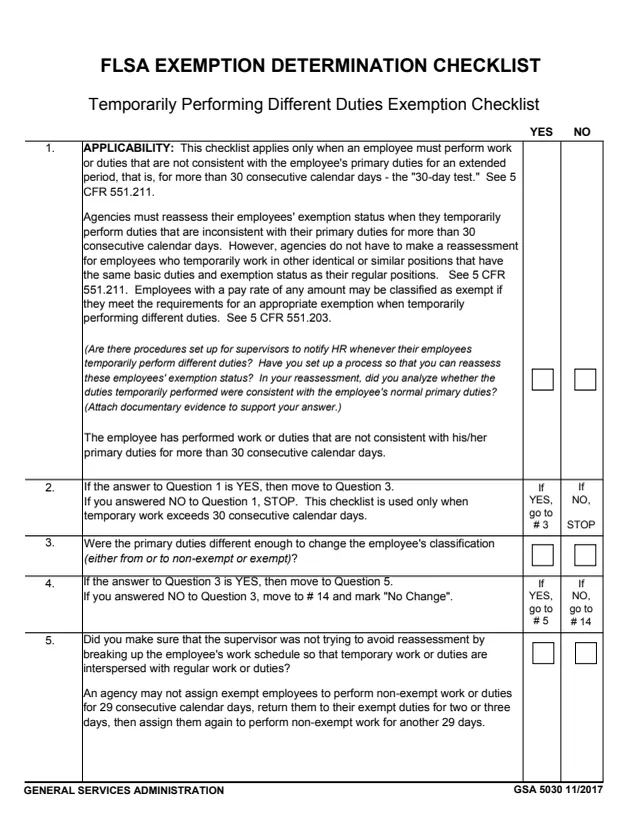
GSA Form 5030, FLSA Exemption Determination Checklist, Temporarily Performing Different Duties Exemption, is a three-page General Services Administration (GSA) form printed as GSA 5030 11/2017. GSA hosts it in its forms library. The form prints no OMB number, and GSA's page lists no authority or regulation.
The form says the checklist applies only when an employee performs work or duties that are not consistent with the employee's primary duties for more than 30 consecutive calendar days, the "30-day test" in 5 CFR 551.211. It asks whether the classification changed, whether pay was recalculated, and how emergency situations are handled.
Question 14 records the result: NO CHANGE, or a TEMPORARY CHANGE to exempt or non-exempt status with its dates and the exemption that applies. You can fill it out free in your browser on this page and download the result without an account.
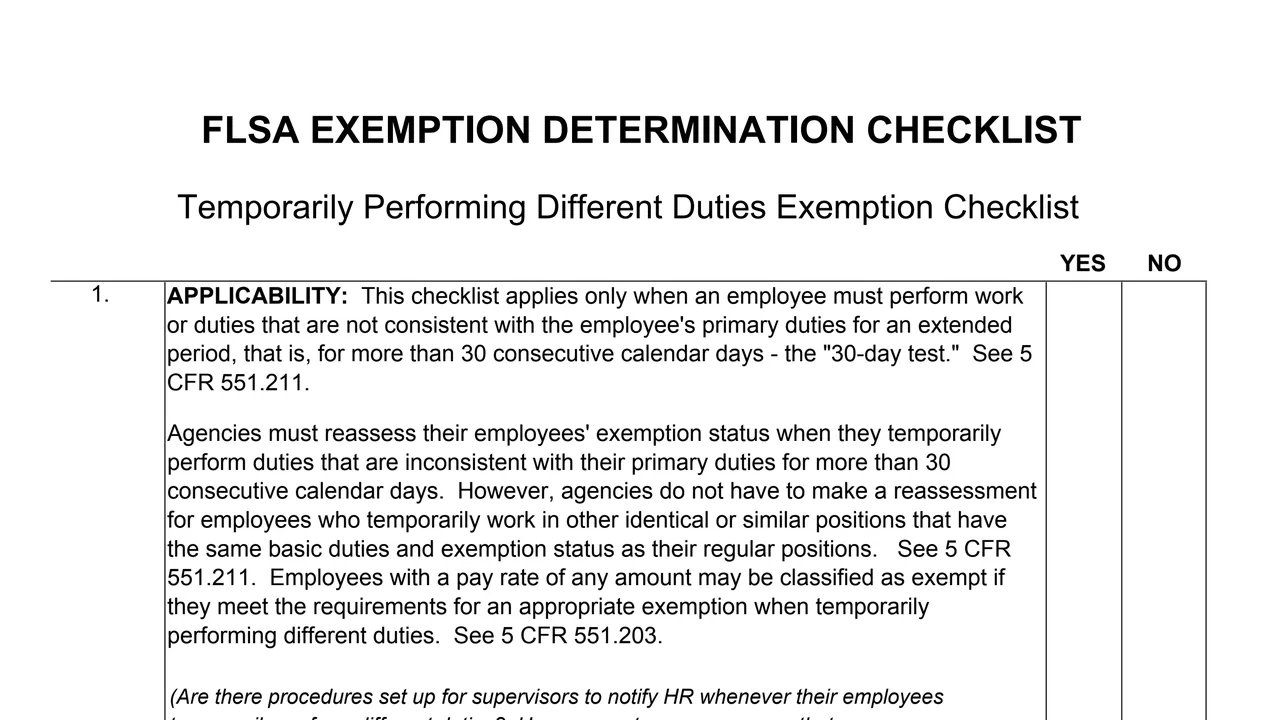
Whether the employee has performed work or duties not consistent with their primary duties for more than 30 consecutive calendar days. Question 2 says to STOP on a NO.
Whether the primary duties were different enough to change the classification, and whether the supervisor was not breaking up the work schedule to avoid reassessment.
Whether the classification was changed for the entire period of temporary work and total pay recalculated retroactive to the beginning of that period.
Whether the agency has determined an emergency situation exists, and whether the employee's normal primary duties are non-exempt.
Whether an exempt employee is temporarily performing non-exempt work during the emergency period, then the same pay recalculation questions as question 6.
NO CHANGE, or TEMPORARY CHANGE with a box for temporarily exempt and a box for temporarily non-exempt, each with from and until dates and the exemption.
Answer question 1. The form says that on a NO you STOP, because the checklist is used only when temporary work exceeds 30 consecutive calendar days.
Question 1 asks to attach documentary evidence to support the answer.
A NO to question 3 goes to question 14, marked No Change. A YES goes on to questions 5 and 6.
The form says an agency may not assign exempt employees non-exempt work for 29 consecutive calendar days, return them to exempt duties for two or three days, then assign them again for another 29 days.
Questions 7 to 13 are for emergency situations. The form says that on a NO to question 7 you STOP, as that section does not apply.
Mark No Change, or check the temporary change box and record the dates, the end date of the temporary duties and the exemption that applies.
You get the real form, filled in a browser tab, with nothing standing between you and the finished PDF.
The form gives no filing address, signature line or routing instructions.
Where the classification changed, the form asks whether total pay was recalculated so that, where applicable, temporarily non-exempt employees receive FLSA overtime pay and temporarily equivalent overtime pay.
The form says agencies do not have to make a reassessment for employees who temporarily work in other identical or similar positions with the same basic duties and exemption status.
5 CFR 551.211 for the 30-day test and 5 CFR 551.203 on pay rates.
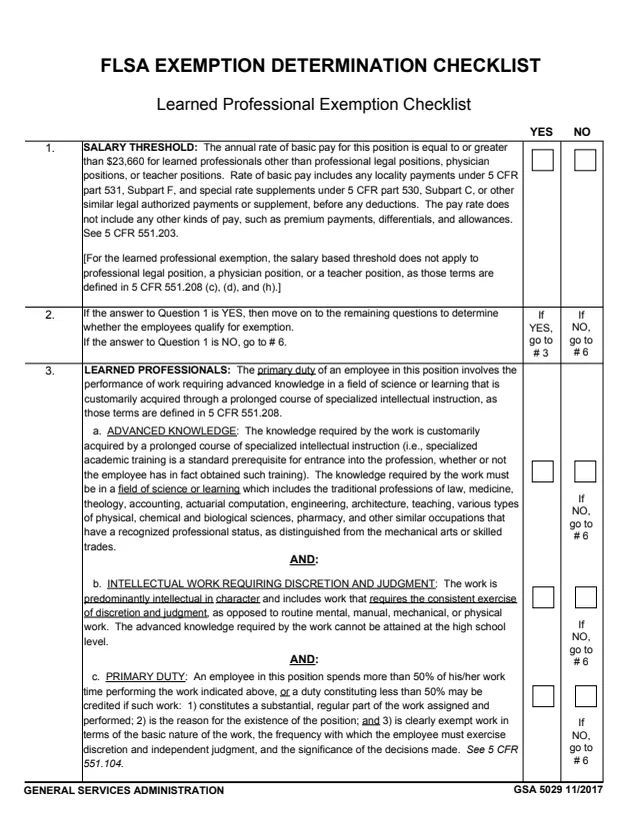
GSA5029
6 fields, 2 pages
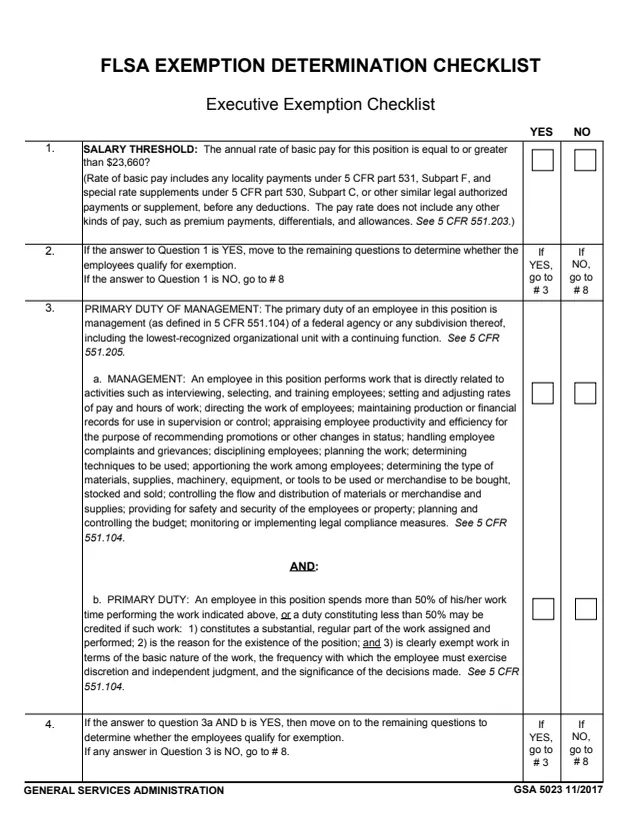
GSA5023
6 fields, 2 pages
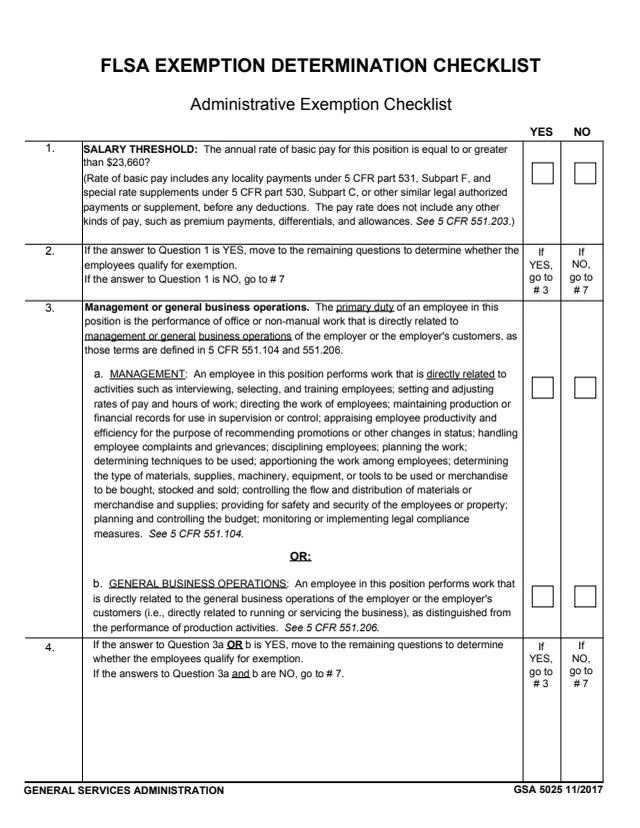
GSA5025
7 fields, 2 pages
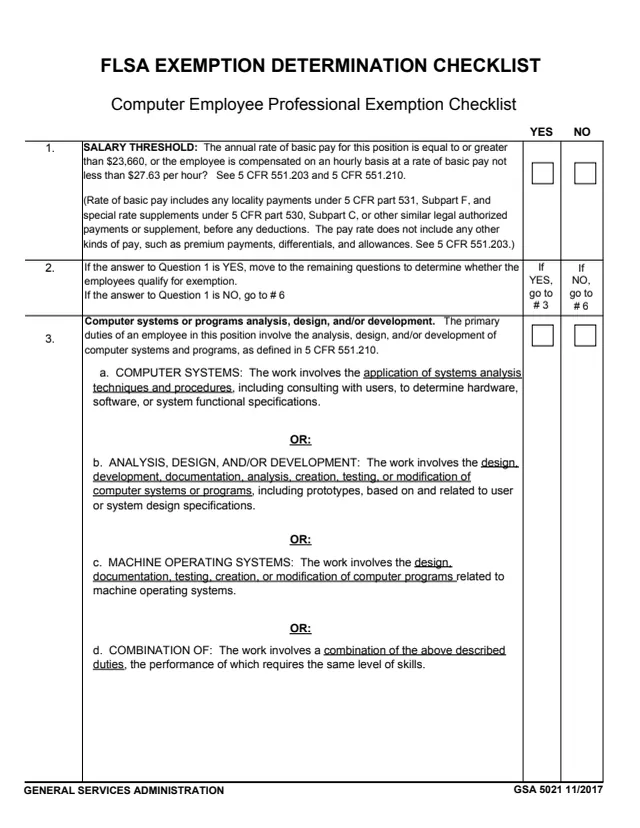
GSA5021
4 fields, 2 pages
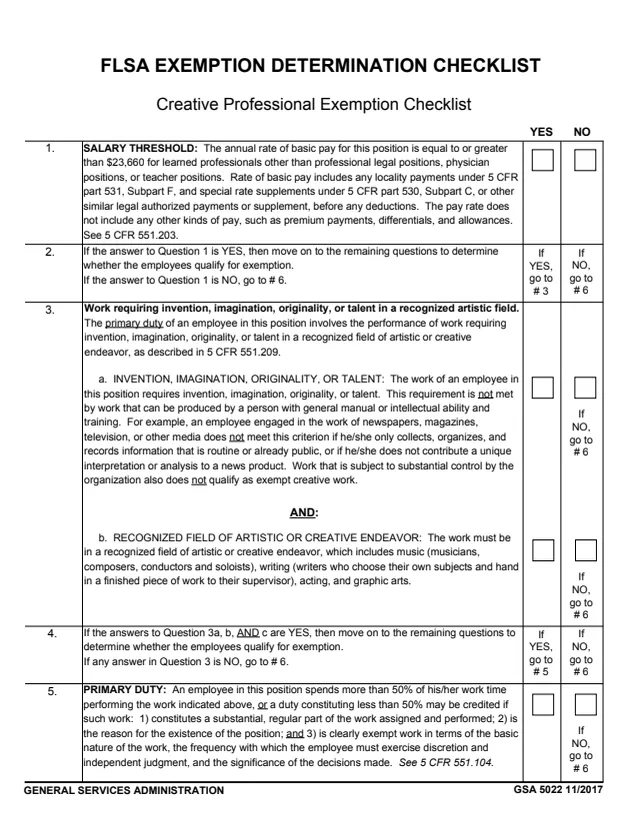
GSA5022
5 fields, 2 pages
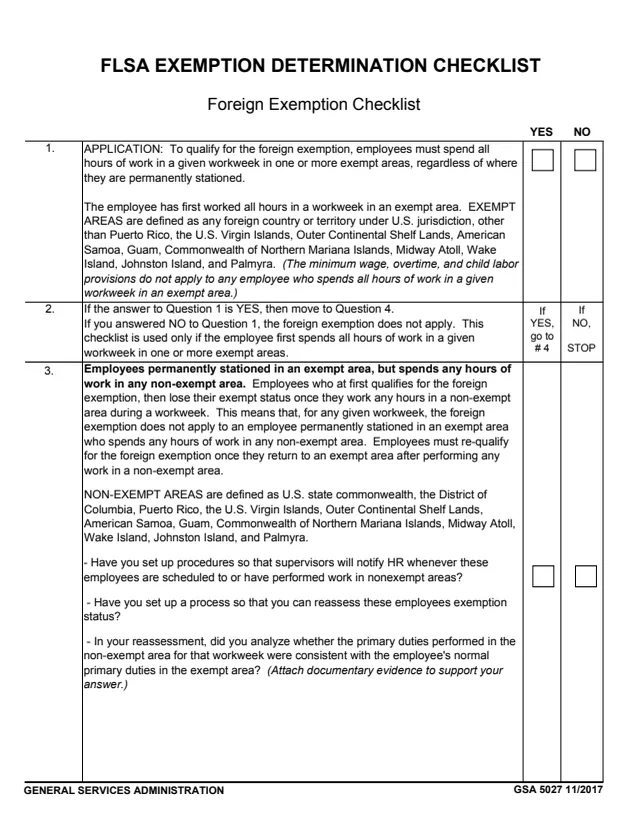
GSA5027
6 fields, 2 pages
The form does not name the office that completes it. Its questions ask about supervisors, HR and the reassessment of an employee's exemption status.
No tool matches that search.
It is a General Services Administration form, printed as GSA 5030 11/2017. GSA hosts it in its forms library.
The form says it applies only when an employee performs work or duties not consistent with the employee's primary duties for more than 30 consecutive calendar days, the "30-day test". It cites 5 CFR 551.211.
The form says agencies do not have to make a reassessment for employees who temporarily work in other identical or similar positions that have the same basic duties and exemption status as their regular positions.
It says an agency may not assign exempt employees to perform non-exempt work for 29 consecutive calendar days, return them to their exempt duties for two or three days, then assign them again for another 29 days.
The form says a non-exempt employee remains non-exempt whether performing non-exempt or exempt work during the emergency, and an exempt employee becomes non-exempt for any workweek in which the primary duties for the emergency work are non-exempt.
The form says employees with a pay rate of any amount may be classified as exempt if they meet the requirements for an appropriate exemption when temporarily performing different duties. It cites 5 CFR 551.203.