Header and time row
Building, group or city, date and machine number, then the time row and the outside wet bulb and dry bulb temperatures.
GSA480
Refrigeration Operating Record
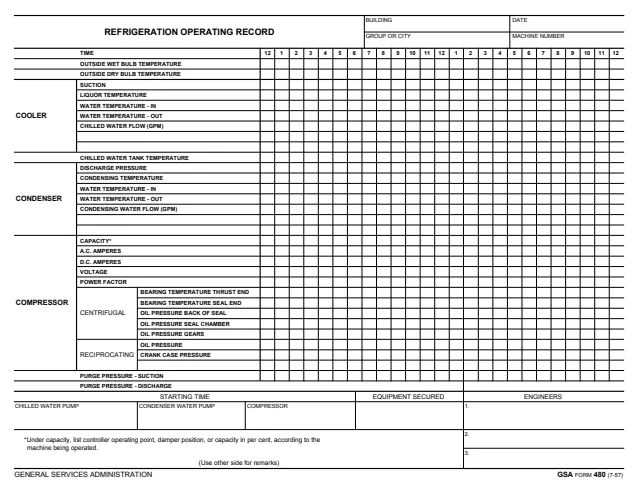
GSA Form 480, Refrigeration Operating Record, is a General Services Administration form, printed GSA FORM 480 (7-57). GSA hosts it in its forms library, and its page lists no authority or regulation.
The form is a one-page grid for one refrigeration machine on one date. Across the top are the building, group or city, date and machine number. Down the side are readings for outside wet bulb and dry bulb temperature, the cooler, the condenser and the compressor, with rows for centrifugal and reciprocating machines, and purge pressures. Each row has time columns labeled 12, then 1 to 11, 12, 1 to 11 and 12 again.
The bottom of the page records the starting time of the chilled water pump, condenser water pump and compressor, when the equipment was secured, and up to three engineers. The form prints no instructions beyond a footnote for the capacity row. You can fill it out free in your browser on this page and download the result without an account.
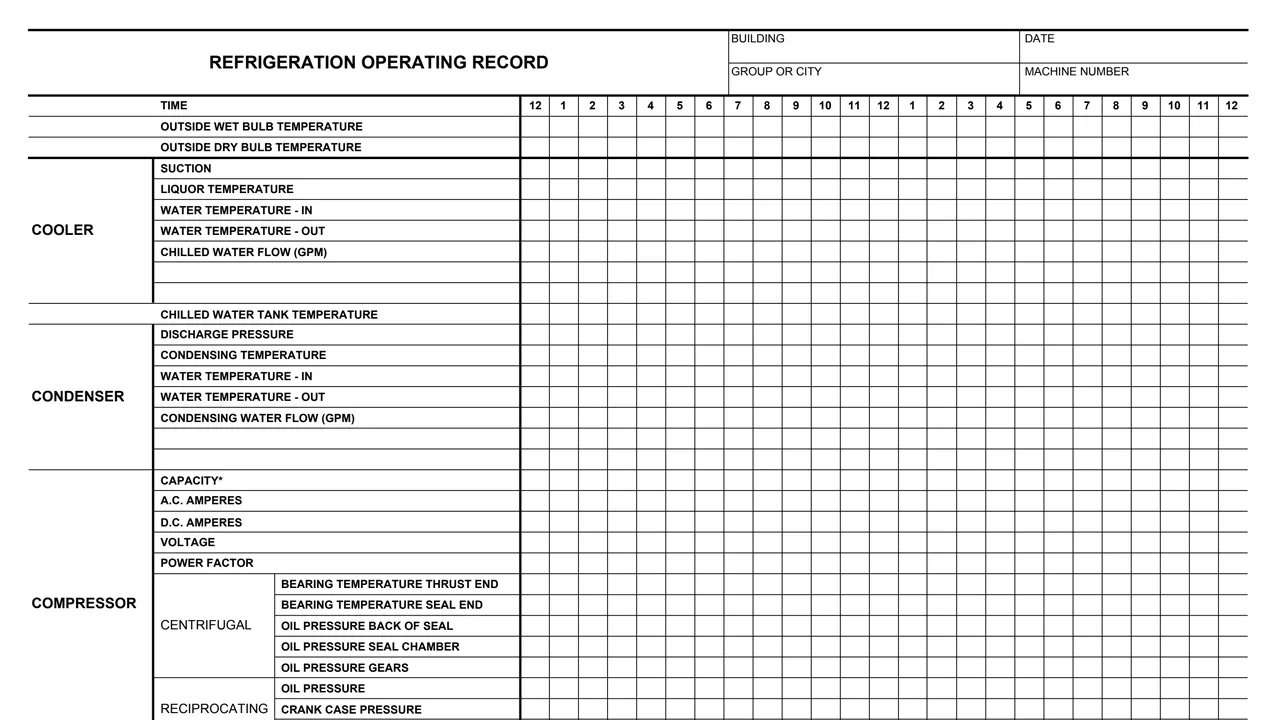
Building, group or city, date and machine number, then the time row and the outside wet bulb and dry bulb temperatures.
Suction, liquor temperature, water temperature in and out, chilled water flow (GPM) and two blank rows, followed by chilled water tank temperature.
Discharge pressure, condensing temperature, water temperature in and out, condensing water flow (GPM) and two blank rows.
Capacity, A.C. amperes, D.C. amperes, voltage and power factor; for centrifugal machines, bearing temperatures and oil pressures; for reciprocating machines, oil pressure and crank case pressure.
Purge pressure on the suction side and on the discharge side.
Starting time of the chilled water pump, condenser water pump and compressor, an Equipment Secured block, and three lines for engineers.
Fill in the building, group or city, date and machine number at the top right.
Enter each reading in the column for the time it was taken, from the outside temperatures down through the cooler and condenser rows.
The footnote says to list controller operating point, damper position, or capacity in per cent, according to the machine being operated.
Fill the centrifugal rows or the reciprocating rows, depending on the machine, plus the purge pressures.
Record the starting time of each pump and the compressor, when the equipment was secured, and the engineers on lines 1 to 3.
The form says to use the other side for remarks.
The form prints no step-by-step instructions. These steps follow the blocks in the order the page shows them.
You get the real form, filled in a browser tab, with nothing standing between you and the finished PDF.
The PDF gives no address, routing or retention instructions.
The form says to use the other side for remarks. The PDF GSA hosts is a single page.
The form prints GSA FORM 480 (7-57). GSA's page lists 07/1957 as the current revision date and no authority or regulation.
The PDF prints no OMB number, burden estimate or privacy statement.
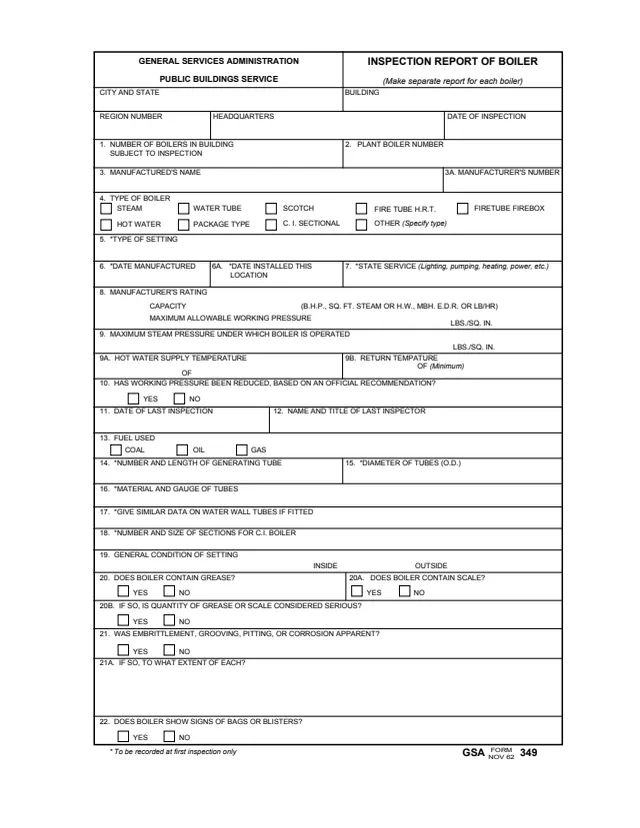
GSA349
130 fields, 4 pages
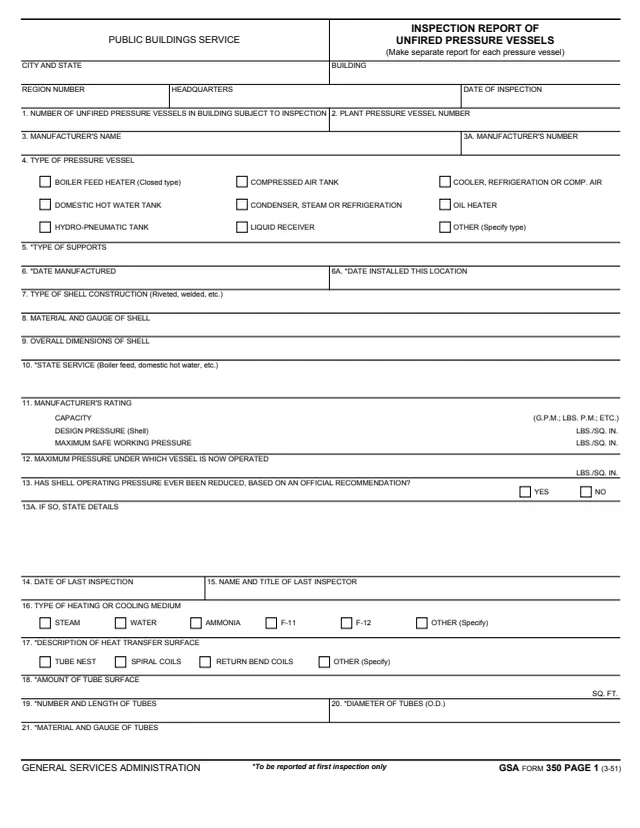
GSA350
124 fields, 4 pages
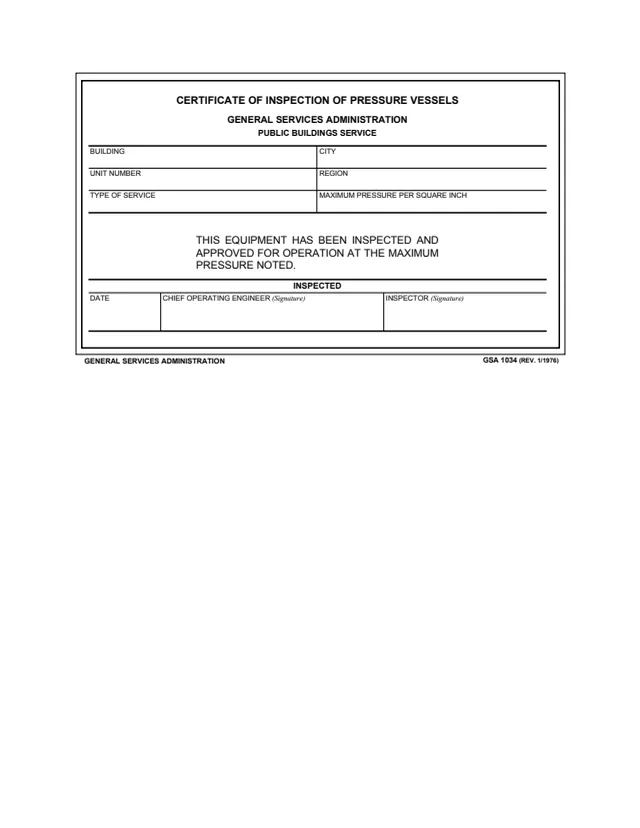
GSA1034
9 fields, 1 page
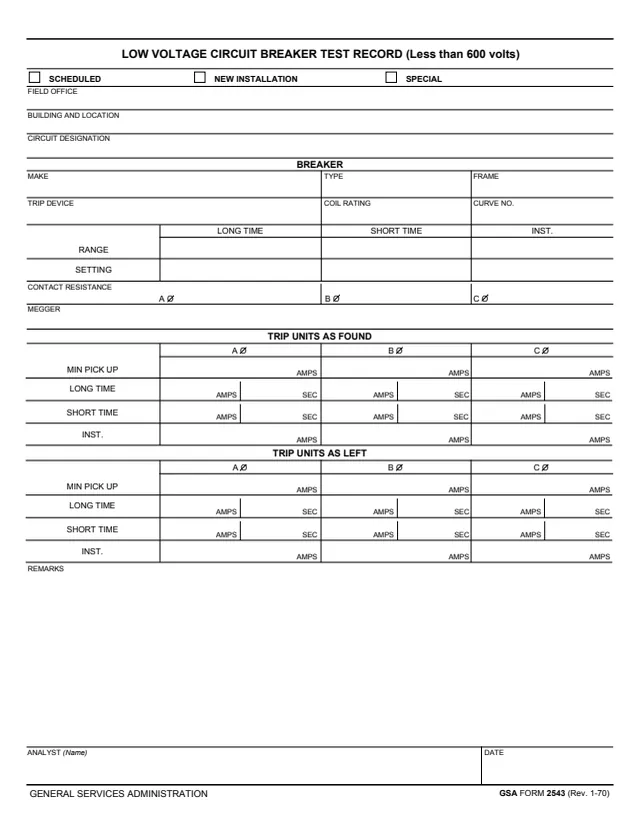
GSA2543
61 fields, 1 page
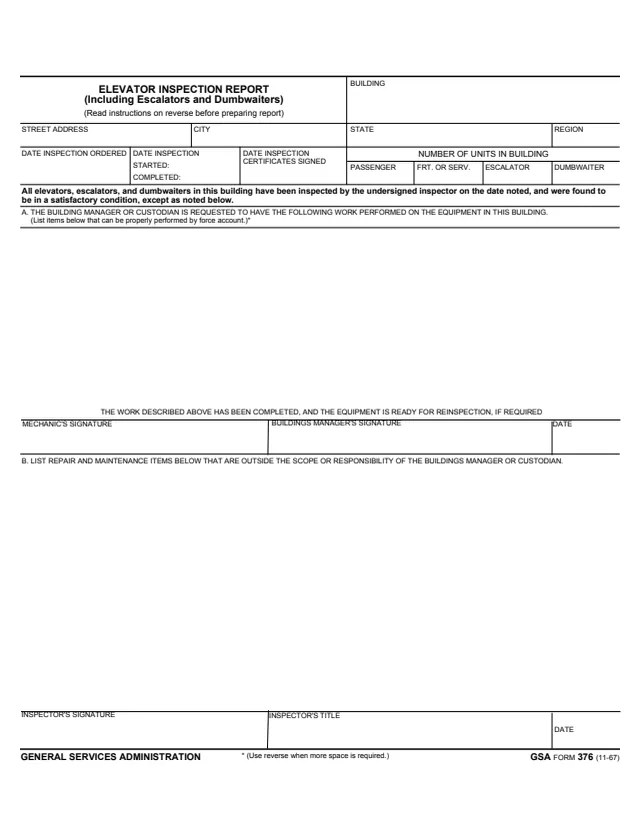
GSA376
22 fields, 2 pages
The form does not say who fills it out or where it goes. It identifies the people and equipment it covers with these blocks.
No tool matches that search.
It is a General Services Administration form, printed GSA FORM 480 (7-57). GSA hosts it in its forms library, and its page lists no authority or regulation.
The footnote says to list controller operating point, damper position, or capacity in per cent, according to the machine being operated.
Yes. The compressor section has rows for centrifugal machines, with bearing temperatures and oil pressures, and rows for reciprocating machines, with oil pressure and crank case pressure.
The form says to use the other side for remarks.
The PDF does not say. It prints no address, routing or retention instructions.