Header
Contractor, business unit, address, RFP/contract number and contract type.
GSA1766
Structured Approach Profit/Fee Objective
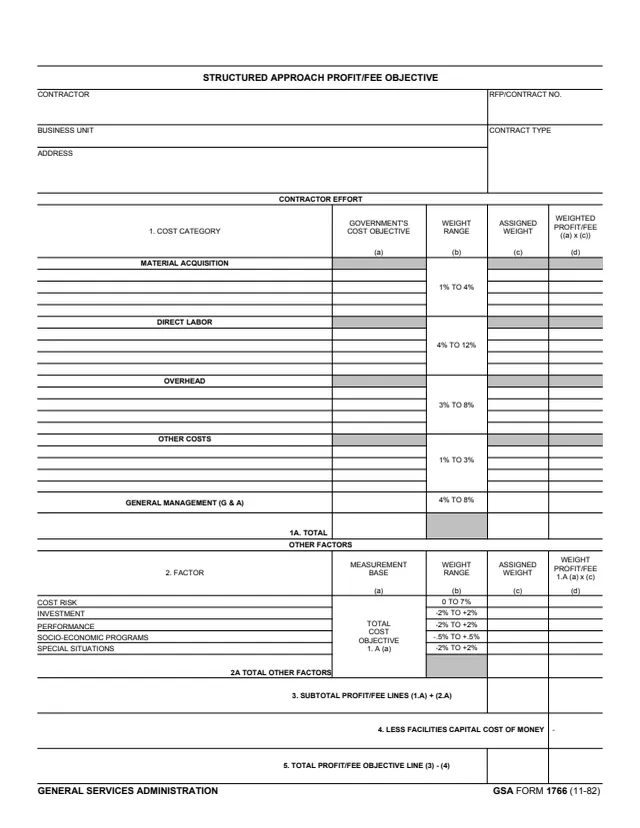
GSA Form 1766, Structured Approach Profit/Fee Objective, is a General Services Administration form. Its footer reads GSA FORM 1766 (11-82), and GSA hosts it in its forms library, where its page lists the authority or regulation APD 2800.12B.
The one-page worksheet identifies the contractor, business unit, address, RFP or contract number and contract type. Under Contractor Effort it lists cost categories with the Government's cost objective, a printed weight range, an assigned weight and the weighted profit or fee. Under Other Factors it weights cost risk, investment, performance, socio-economic programs and special situations against the total cost objective. Lines 3 to 5 bring these to a total profit/fee objective, less facilities capital cost of money. The form prints no instructions, no signature line, no OMB number and no privacy statement.
You can fill it out free in your browser on this page and download the result without an account.
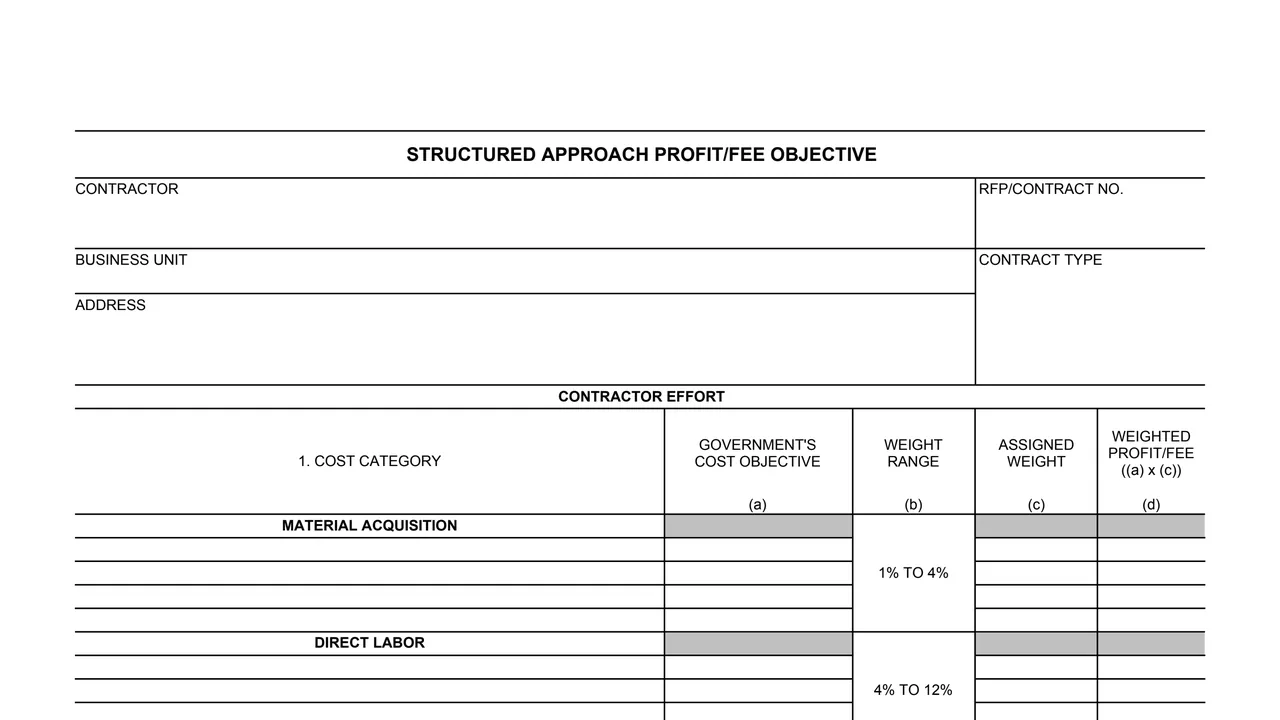
Contractor, business unit, address, RFP/contract number and contract type.
Material acquisition (1% to 4%), direct labor (4% to 12%), overhead (3% to 8%), other costs (1% to 3%) and general management (G & A) (4% to 8%), totaled on line 1A.
(a) Government's cost objective, (b) weight range, (c) assigned weight, and (d) weighted profit/fee, printed as (a) x (c).
Cost risk (0 to 7%), investment (-2% to +2%), performance (-2% to +2%), socio-economic programs (-.5% to +.5%) and special situations (-2% to +2%), totaled on line 2A.
The subtotal of lines 1.A and 2.A, less facilities capital cost of money, giving the total profit/fee objective, line (3) - (4).
Enter the contractor, business unit, address, RFP/contract number and contract type.
For each cost category, enter the Government's cost objective in column (a). Each heading has several blank lines beneath it.
Enter an assigned weight in column (c) for each category. Column (b) prints the weight range for that category.
Column (d) is printed as (a) x (c). Total the cost objective and weighted amounts on line 1A.
Enter an assigned weight for each other factor. Its column (d) is printed as 1.A (a) x (c), and line 2A totals them.
Line 3 adds lines 1.A and 2.A, line 4 subtracts facilities capital cost of money, and line 5 is the total profit/fee objective, line (3) - (4).
You get the real form, filled in a browser tab, with nothing standing between you and the finished PDF.
The form prints no address, no routing instructions and no signature line.
The footer reads GSA FORM 1766 (11-82). GSA's page gives a current revision date of 11/1982 and the authority or regulation APD 2800.12B.
The PDF prints no instructions, no OMB number and no privacy statement. Apart from the column formulas, the weight ranges are the only guidance it prints.
The form prints no preparer, signature or approval line. These are the parties and figures it names.
No tool matches that search.
The footer names the General Services Administration and reads GSA FORM 1766 (11-82). GSA's page lists APD 2800.12B as the authority or regulation.
Material acquisition 1% to 4%, direct labor 4% to 12%, overhead 3% to 8%, other costs 1% to 3%, general management (G & A) 4% to 8%, cost risk 0 to 7%, investment, performance and special situations -2% to +2%, and socio-economic programs -.5% to +.5%.
For cost categories, column (d) is printed as (a) x (c). For other factors, it is printed as 1.A (a) x (c), using the total cost objective on line 1.A as the measurement base.
Facilities capital cost of money. Line 5, the total profit/fee objective, is printed as line (3) - (4).
The PDF prints no signature, approval or preparer line, and no instructions, OMB number or privacy statement.