Items 1 to 10: The case
Court location code, person represented, magistrate, district, appeals and other docket numbers, case name, type of person represented, representation type, and up to five offenses charged.
CJA 31
Death Penalty Proceedings: Ex Parte Request for Authorization and Voucher for Expert and Other Services
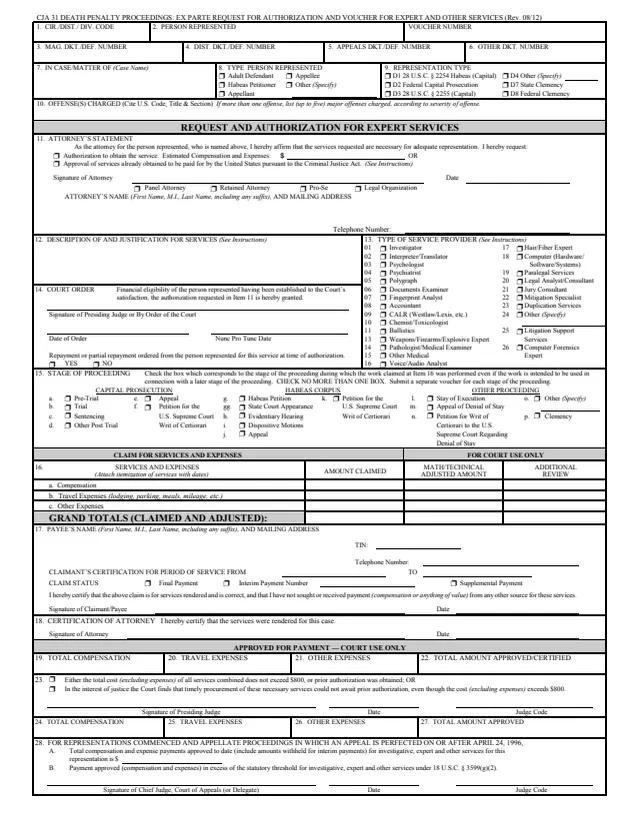
CJA 31, Death Penalty Proceedings: Ex Parte Request for Authorization and Voucher for Expert and Other Services, is a Criminal Justice Act (CJA) form from the U.S. Courts. The U.S. Courts list it under Vouchers. The PDF is dated Rev. 08/12, and the page lists it as effective on August 1, 2012. The page says CJA Form 31 should be used to obtain investigative, expert, and other services in all death eligible cases through disposition of the case, regardless of whether the death penalty is authorized, not authorized, or de-authorized.
The one-page form moves through several hands. Counsel asks for authorization to obtain a service, or for approval of a service already obtained, and the presiding judge signs the court order. The service provider then claims compensation and expenses, the attorney certifies that the services were rendered, and the presiding judge approves payment. Items 24 to 28 are for payments above the statutory threshold, approved by the chief judge of the court of appeals or a delegate.
This page explains the form in plain words and is not legal advice. You can fill it out free in your browser on this page and download the result without an account.
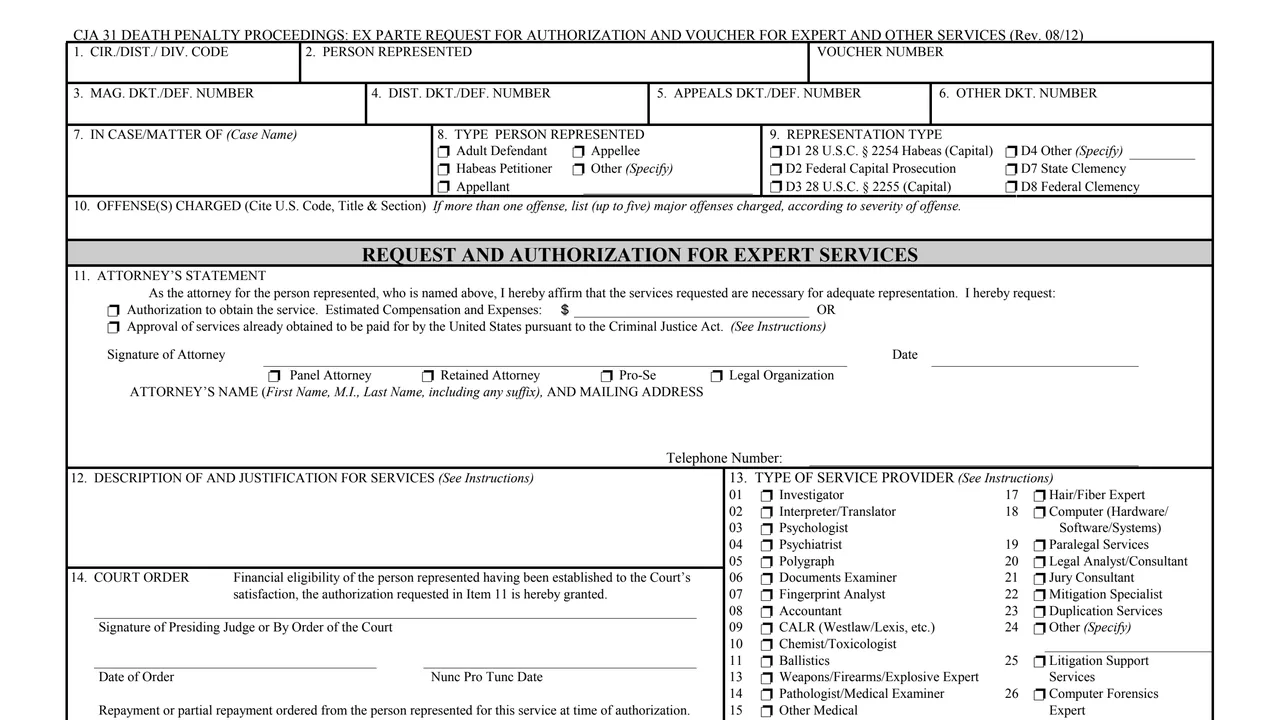
Court location code, person represented, magistrate, district, appeals and other docket numbers, case name, type of person represented, representation type, and up to five offenses charged.
Counsel affirms the services are necessary for adequate representation and asks for either authorization to obtain the service, with estimated compensation and expenses, or approval of services already obtained.
A description of and justification for the services, and the type of service provider, from 01 Investigator to 26 Computer Forensics Expert, including 22 Mitigation Specialist and 24 Other (Specify).
The court order granting the authorization, with the date of order, any nunc pro tunc date and whether repayment was ordered, and one box for the stage of proceeding.
Compensation, travel and other expenses claimed, the payee's name, address and TIN, the period of service and claim status, the claimant's certification and the attorney's certification that the services were rendered.
Amounts approved by the presiding judge, a box on whether costs exceed $800 or prior authorization was obtained, and approval of payments above the statutory threshold under 18 U.S.C. § 3599(g)(2).
The page asks to read the instructions carefully, type or print clearly in blue or black ink, and attach an itemized statement with the date and number of hours for each service.
The page says prior authorization from the presiding judicial officer is needed for services whose combined cost, excluding reasonable expenses, will exceed the limit in § 310.20.30 of the CJA Guidelines.
Item 12 asks briefly what the services are and why they are necessary. For a psychiatric or psychological exam, the page asks whether it concerns the current mental state or the mental state at the time of the alleged offense.
Item 15 takes one box only, and the form asks for a separate voucher for each stage of the proceeding.
The page asks the provider to list services with dates and time in hours and tenths of hours, state the basis for the fee, itemize travel on a separate sheet, and attach documentation for single item expenses in excess of $50.
The page says the claimant signs the Item 17 certification before submitting the claim to the attorney, who then certifies in Item 18 that the services were rendered.
You get the real form, filled in a browser tab, with nothing standing between you and the finished PDF.
In Item 23 the presiding judge checks that the total cost of all services combined, excluding expenses, does not exceed $800 or prior authorization was obtained, or that the services could not await prior authorization.
The page says payment above the statutory amount in 18 U.S.C. § 3599(g)(2) is certified by the presiding judicial officer and approved by the chief judge of the court of appeals (or delegate). Item 28 covers cases commenced on or after April 24, 1996.
The page says payments are subject to post-audit, overpayments are subject to collection, and time and expense records are retained for three years after approval of the final voucher (CJA Guidelines § 320.90).
The form does not print a fee for submitting it or a rate for the service. The page asks the provider to state the basis for the fee claimed, such as an hourly rate, daily rate or fixed fee.
The page has added billing instructions for interpreters, including the times of day billed and the number of other vouchers for the same date, and refers to CJA Guidelines § 320.15.
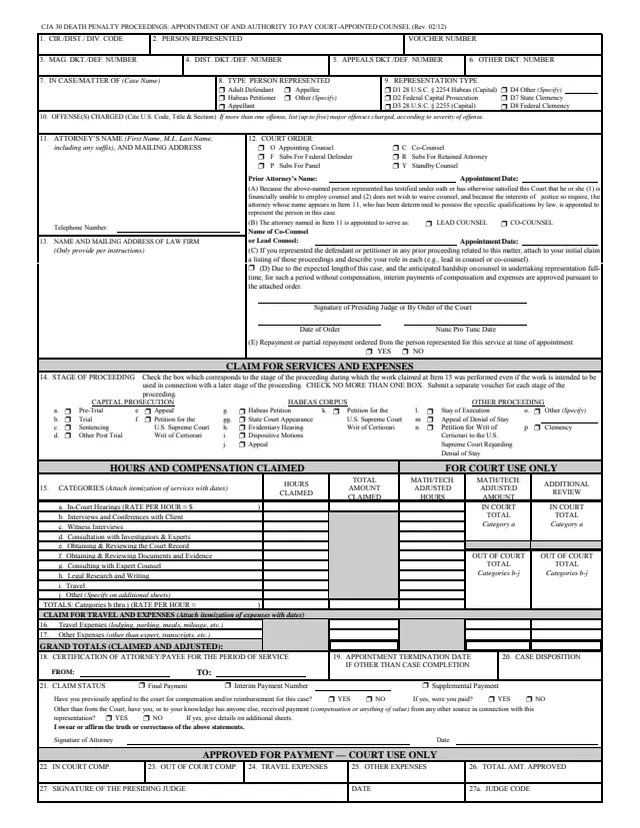
CJA 30
90 fields, 1 page
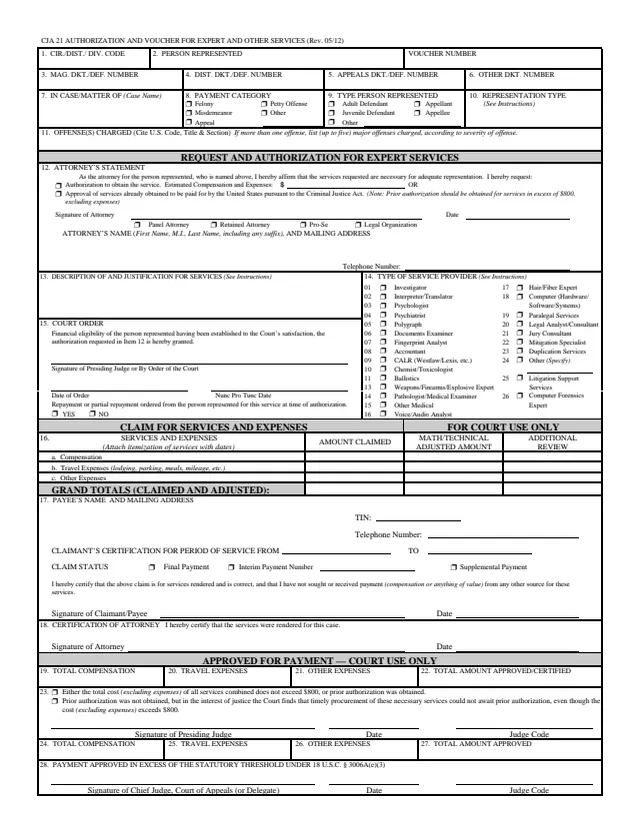
CJA 21
69 fields, 1 page
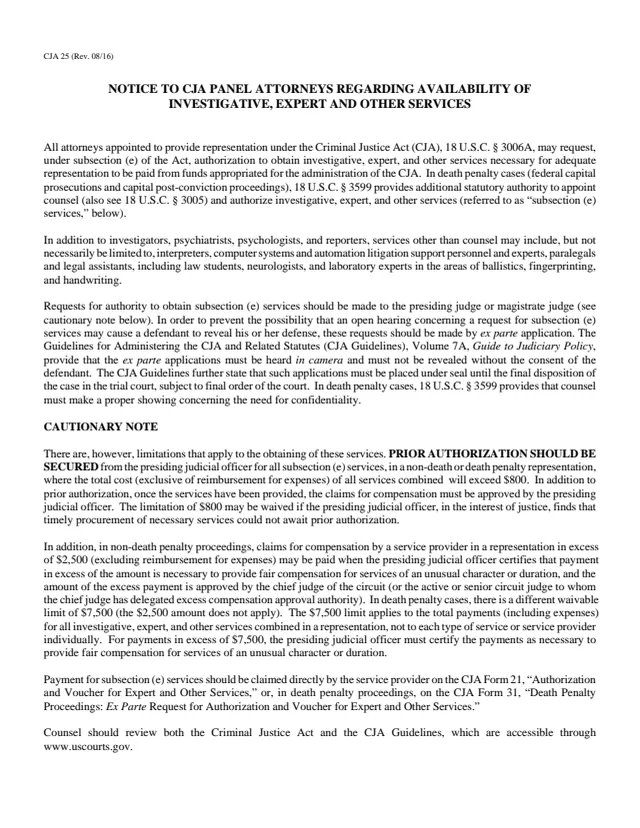
CJA 25
1 field, 1 page
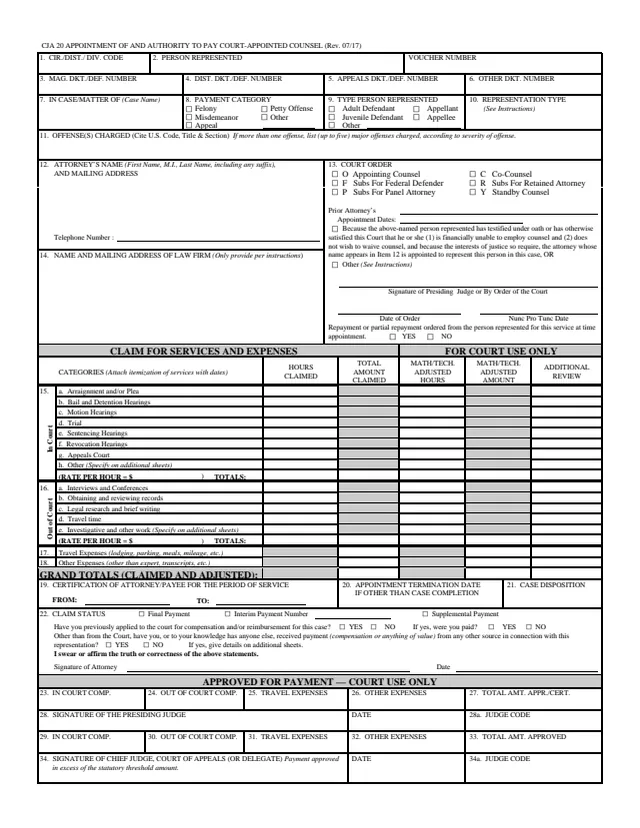
CJA 20
149 fields, 1 page
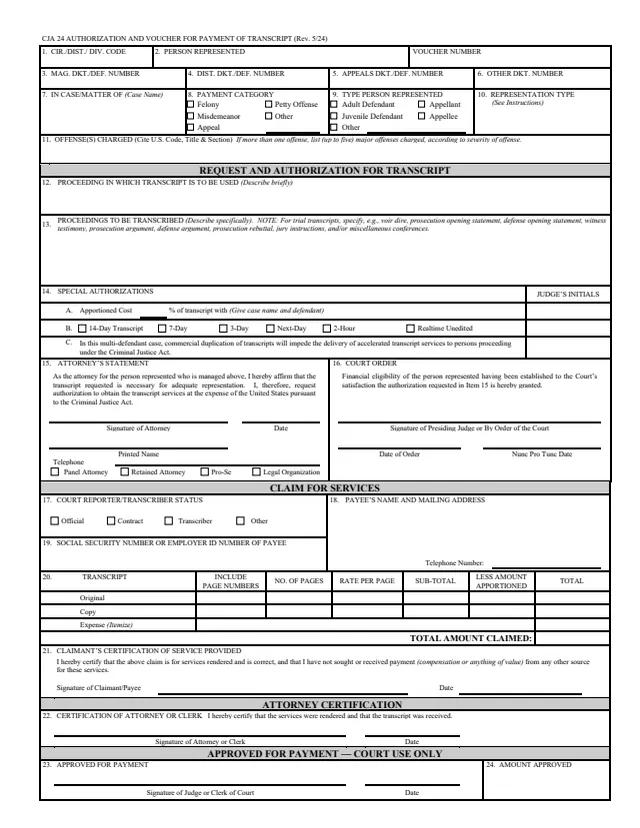
CJA 24
74 fields, 1 page
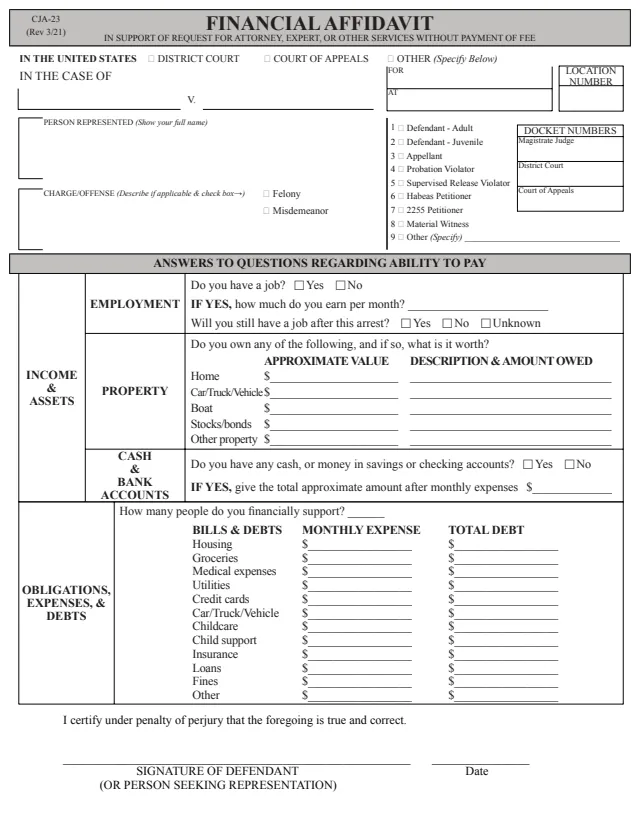
CJA 23
71 fields, 1 page
Different people complete different items. The form and the U.S. Courts page name them.
No tool matches that search.
The U.S. Courts page says CJA Form 31 should be used to obtain investigative, expert, and other services in all death eligible cases through disposition of the case, regardless of whether the death penalty is authorized, not authorized, or de-authorized.
Counsel, or a person proceeding pro se, signs the Item 11 request. The service provider completes the claim in Items 16 and 17, the attorney certifies Item 18, and the presiding judge signs Items 14 and 23. Items 24 to 28 are for the chief judge of the court of appeals or a delegate.
Item 11 has a box for approval of services already obtained, to be paid for by the United States under the Criminal Justice Act. The page says that without prior authorization, compensation above the § 310.20.30 limit is disallowed unless the presiding judicial officer finds timely procurement could not await prior authorization.
Item 23 has the presiding judge check either that the total cost of all services combined, excluding expenses, does not exceed $800 or prior authorization was obtained, or that the services could not await prior authorization even though the cost exceeds $800.
The page says that if a service was authorized and its cost will later exceed the initial estimate by a significant amount, further prior authorization should be sought from the presiding judicial officer for the additional amount.
The page says the payee's Taxpayer Identification Number (TIN) is used to report these earnings to the Internal Revenue Service (IRS).
The page says time spent in common on more than one CJA representation is either prorated among separate vouchers or billed on one voucher, double billing is prohibited, and the other representations are cross-referenced in the supporting documentation.