Items 1 to 10: The case
Court location code, person represented, magistrate, district, appeals and other docket numbers, case name, type of person represented, representation type (D1 to D4, D7 or D8 on the form), and up to five offenses charged.
CJA 30
Death Penalty Proceedings: Appointment of and Authority to Pay Court-Appointed Counsel
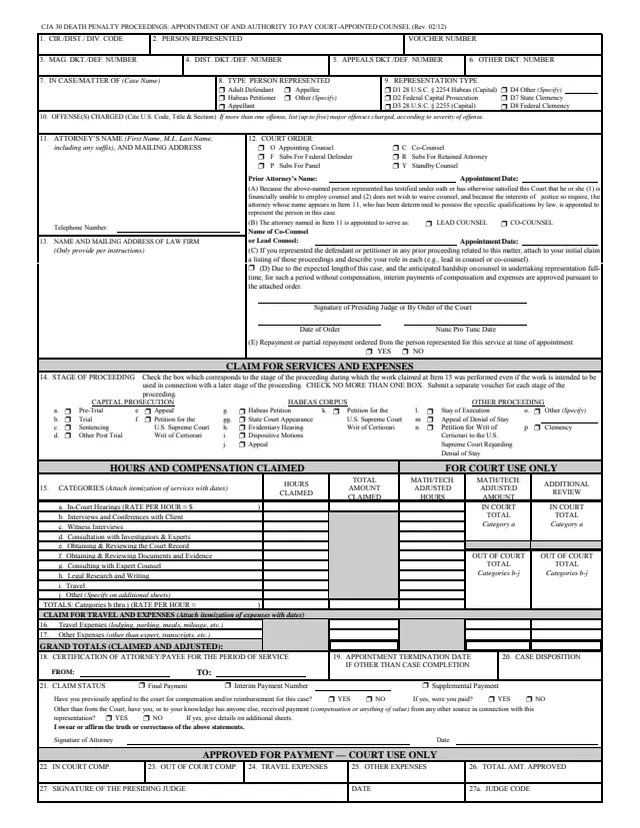
CJA 30, Death Penalty Proceedings: Appointment of and Authority to Pay Court-Appointed Counsel, is a Criminal Justice Act (CJA) form from the U.S. Courts. The U.S. Courts list it under Vouchers. The PDF is dated Rev. 02/12, and the page lists it as effective on February 1, 2012. The page says CJA Form 30 should be used for all death-eligible cases, regardless of whether the death penalty is authorized, not authorized, or de-authorized.
The one-page form combines the court order appointing counsel with the attorney's claim for payment. The top items identify the case, the person represented and the type of representation, Item 12 is the court order, Items 14 to 21 are the attorney's claim for services and expenses, and Items 22 to 27a are the amounts approved for payment in the section marked court use only. The page prints item by item instructions.
This page explains the form in plain words and is not legal advice. You can fill it out free in your browser on this page and download the result without an account.
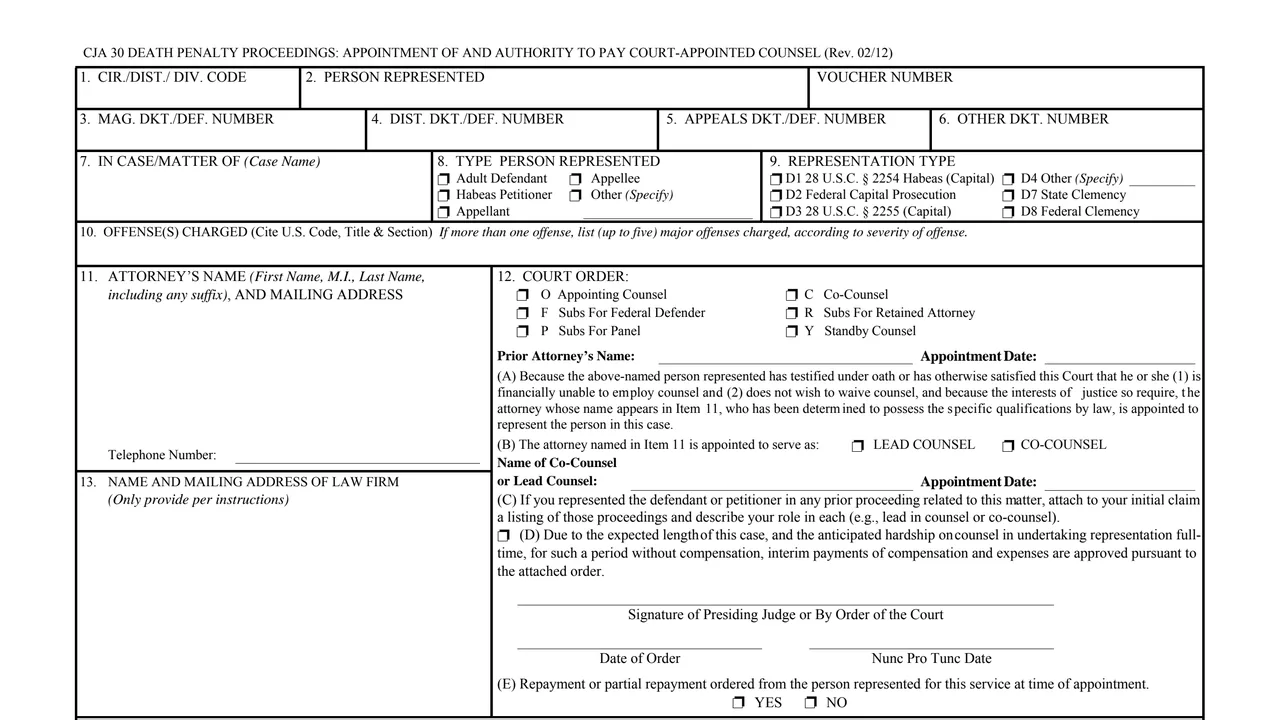
Court location code, person represented, magistrate, district, appeals and other docket numbers, case name, type of person represented, representation type (D1 to D4, D7 or D8 on the form), and up to five offenses charged.
The attorney's name and address, a law firm only under a pre-existing agreement, and the court order: type of counsel, lead or co-counsel, interim payments, and whether repayment was ordered from the person represented.
Boxes under Capital Prosecution, Habeas Corpus and Other Proceeding. The form says to check no more than one box and to submit a separate voucher for each stage of the proceeding.
In-court hearings (category a) and out-of-court work (categories b to j), such as client interviews, witness interviews, legal research and travel, with hours, a rate per hour and columns for court use only.
Travel and other expenses, the period of service, an appointment termination date, a case disposition code, and whether this is a final, interim or supplemental payment, with a sworn statement and signature.
Court use only: in-court and out-of-court compensation, travel and other expenses, the total amount approved, and the signature of the presiding judge with a judge code.
The page asks to read the instructions carefully and type or print clearly in blue or black ink. It says Items 1 to 11 and 13 are preprinted when the form is generated from the automated system.
The page gives the format YY-NNNNNN-DDD. If two or more cases are heard or tried together, it asks for a separate voucher for each docket number, with the total time prorated among the cases.
Item 14 takes the one box that matches the stage when the work claimed in Item 15 was done, even if the work will be used at a later stage.
The page asks for actual time in hours and tenths of hours on lines a to j, multiplied by the allowable rate, with an attached itemization of services with dates.
Travel expenses go on a separate sheet with dates and supporting documentation. For other expenses, the page asks for supporting documentation for single item expenses in excess of $50.
Check final, interim or supplemental payment, answer the questions about earlier payments and other sources, then sign and date the affirmation before the claim goes for court approval.
You get the real form, filled in a browser tab, with nothing standing between you and the finished PDF.
The page says the attorney signs the affirmation before submitting the claim for court approval, and the presiding judicial officer indicates the amount approved for each category in Items 22 to 27a.
The page says vouchers should be submitted no later than 45 days after the final disposition of the case, unless good cause is shown (CJA Guidelines § 230.13(a)).
The page says all payments are subject to post-audit, time and expense records are kept for three years after approval of the final voucher, and overpayments are subject to collection.
The form does not print a fee for submitting it. The page lists filing fees among expenses not to claim and says these fees are waived for persons proceeding under the CJA.
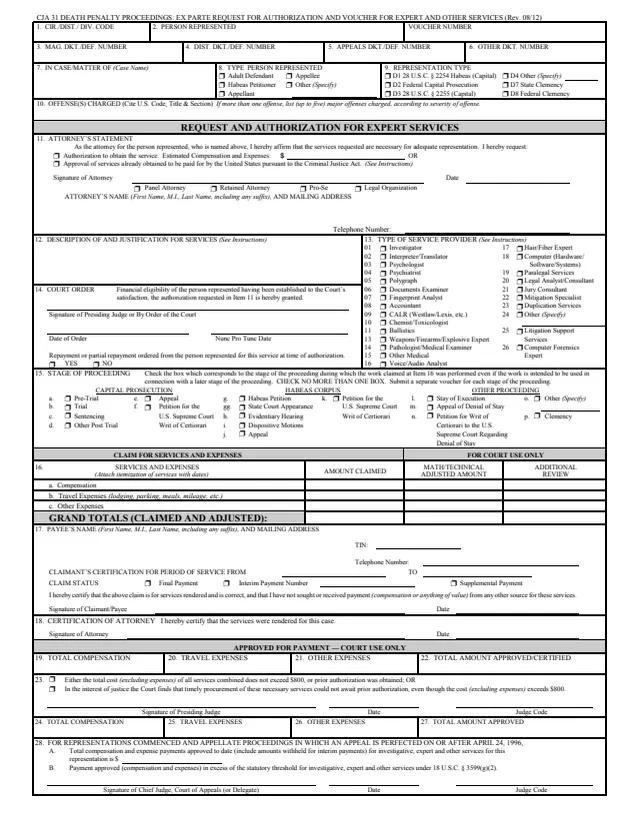
The page says services whose cost will exceed the limits in § 310.20.30 need prior authorization from the presiding judicial officer, and are claimed by the service provider on CJA Form 31.
CJA 31
71 fields, 1 page
CJA 20
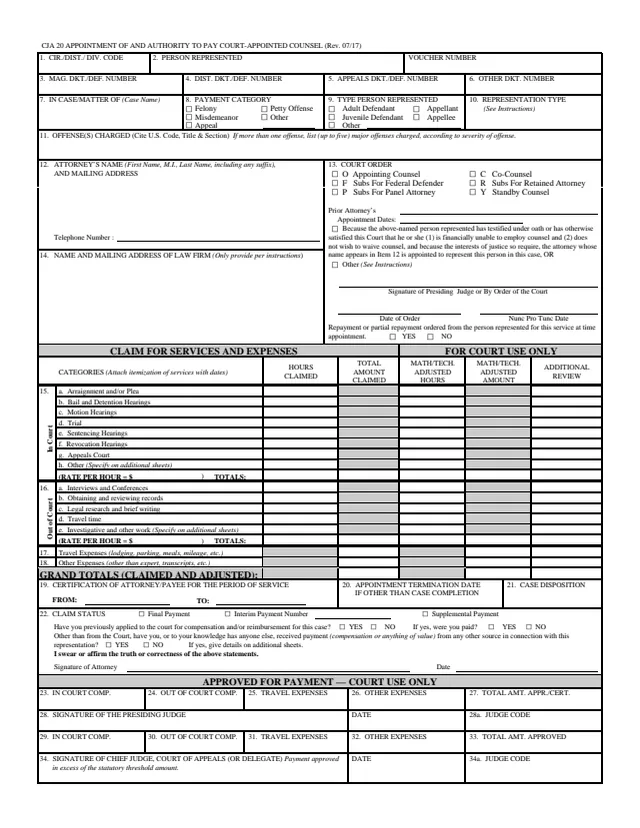
149 fields, 1 page
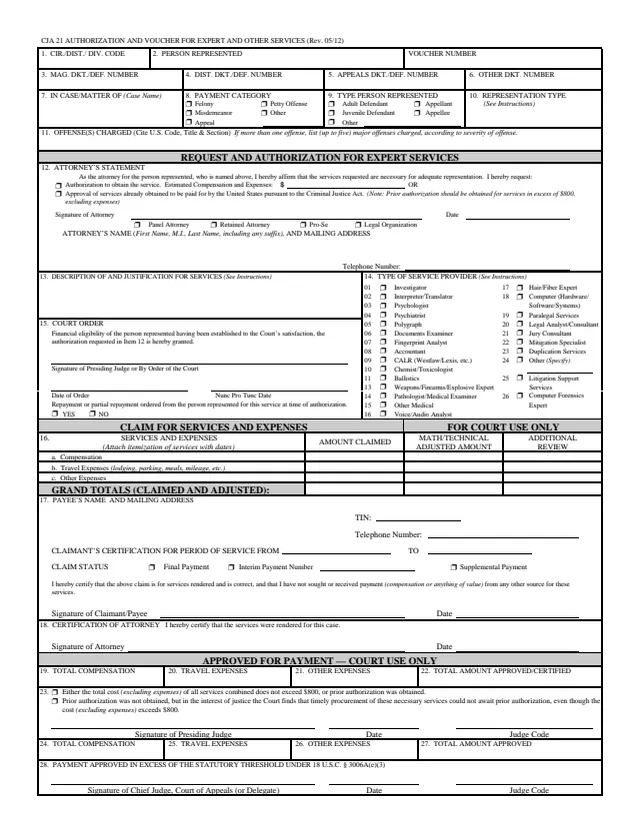
CJA 21
69 fields, 1 page
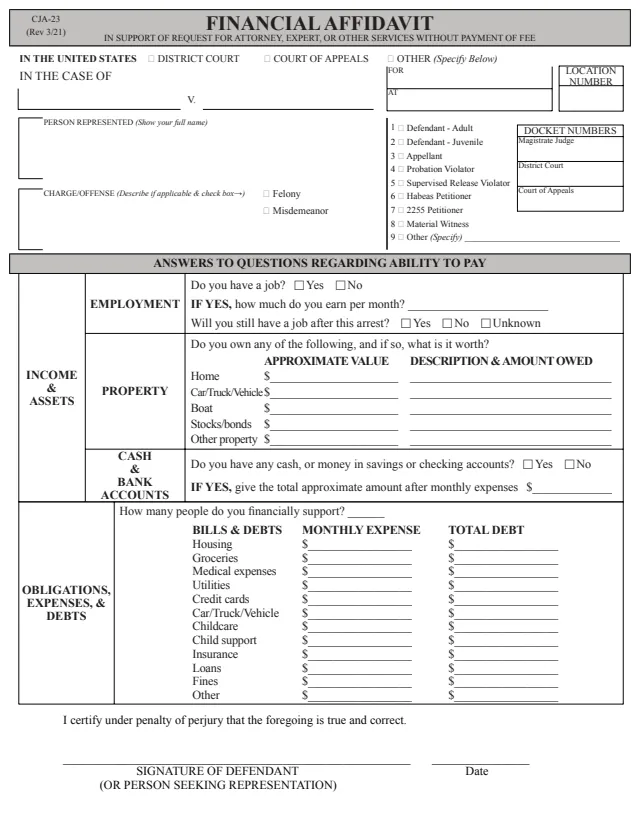
CJA 23
71 fields, 1 page
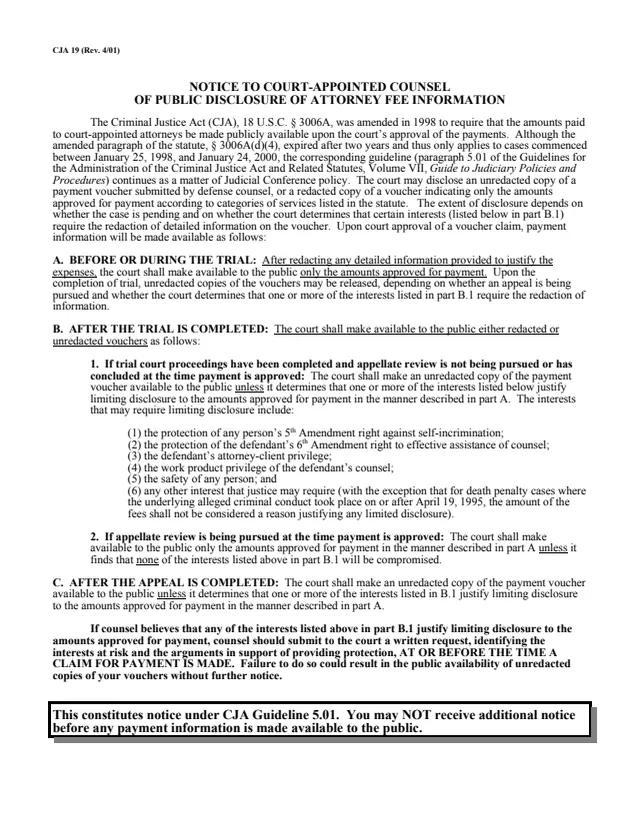
CJA 19
2 fields, 1 page
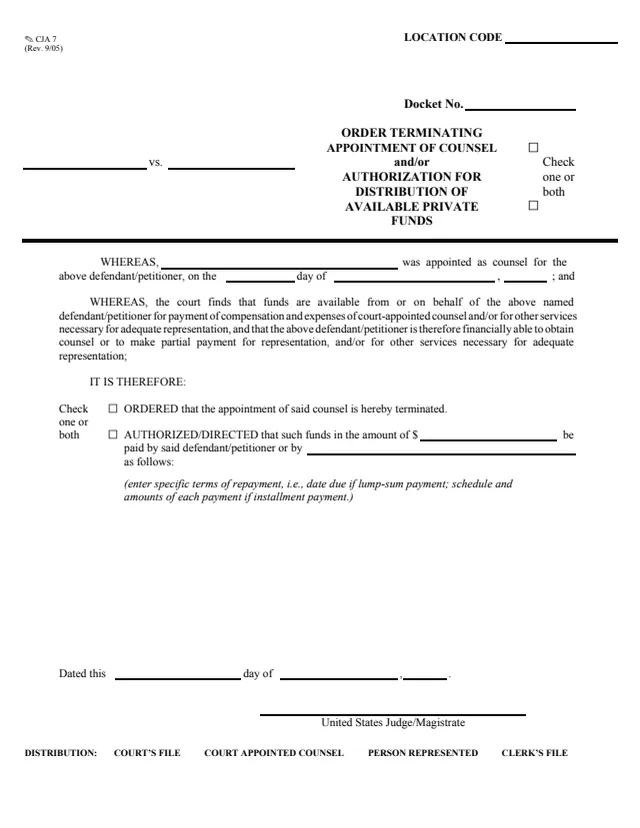
CJA 7
25 fields, 1 page
Different people complete different items. The form and the U.S. Courts page name them.
No tool matches that search.
The U.S. Courts page says CJA Form 30 should be used for all death-eligible cases, regardless of whether the death penalty is authorized, not authorized, or de-authorized.
The page says the presiding judicial officer or clerk of court signs and dates the court order to validate the appointment. If services came before the appointment, the presiding judicial officer may ratify them with a nunc pro tunc date.
No. The form says to check no more than one box in Item 14 and to submit a separate voucher for each stage of the proceeding.
The page says vouchers should be submitted no later than 45 days after the final disposition of the case, unless good cause is shown.
The page lists general office overhead, personal items for the client, the cost of printing briefs, fact witness fees and costs of serving subpoenas, filing fees, and taxes on attorney compensation. It says photocopying is reimbursable.
The page says payment for investigative, expert and other services should be claimed directly by the service provider on the CJA Form 31, and that fees and expenses for expert attorneys and other consultants should be authorized and claimed on a CJA Form 31.
Only when, before appointment, the attorney had a pre-existing agreement that CJA earnings belong to a law firm or corporation. The page says this lets earnings be reported to the IRS on a 1099 as earnings of the firm or corporation.