Court and case
Boxes for district court, court of appeals or other, the location number, the case name, and docket numbers for the magistrate judge, the district court and the court of appeals.
CJA 23
Financial Affidavit
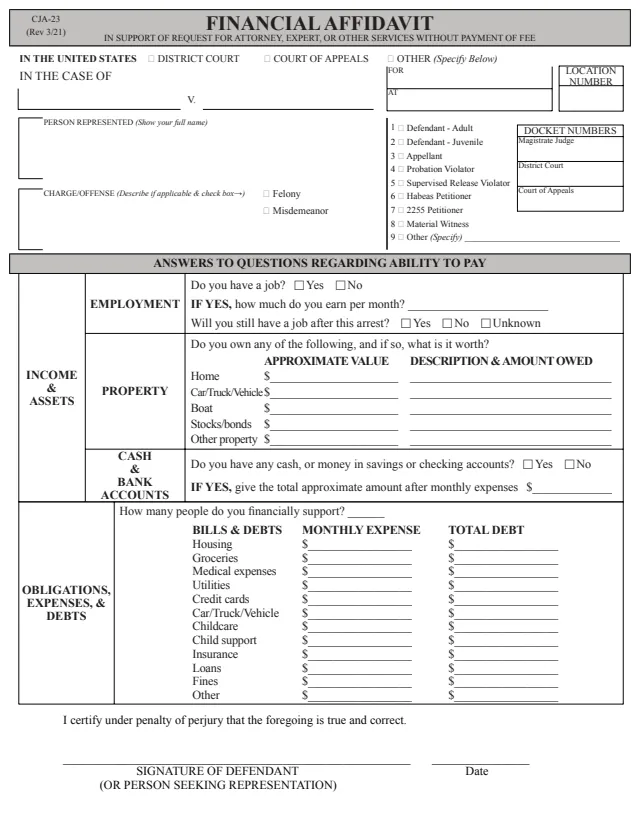
CJA 23, Financial Affidavit, is a Criminal Justice Act (CJA) form from the U.S. Courts. The PDF titles it a financial affidavit in support of request for attorney, expert, or other services without payment of fee. The U.S. Courts list it under CJA Forms. The PDF is dated Rev 3/21, and the page lists it as effective on March 29, 2021.
The one-page form names the court, the case, the person represented and the charge, then asks questions about ability to pay: employment, property, cash and bank accounts, the number of people supported, and monthly bills and debts. It ends with a certification under penalty of perjury signed by the defendant or person seeking representation. The U.S. Courts page says the CJA Form 23 is not a required statutory form but an administrative tool used to assist the court in appointing counsel.
This page explains the form in plain words and is not legal advice. You can fill it out free in your browser on this page and download the result without an account.
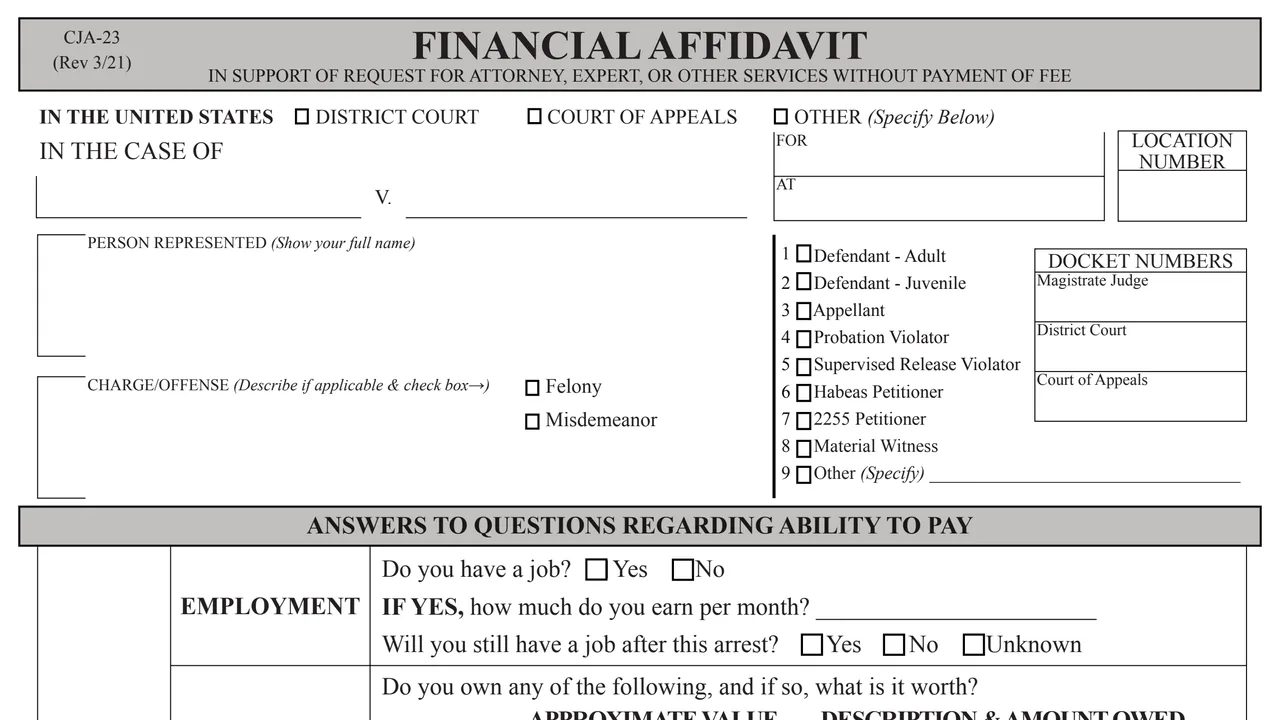
Boxes for district court, court of appeals or other, the location number, the case name, and docket numbers for the magistrate judge, the district court and the court of appeals.
The person's full name, one of nine numbered roles, and the charge or offense, described if applicable, with a felony or misdemeanor box.
Whether the person has a job, how much they earn per month, and whether they will still have a job after this arrest (yes, no or unknown).
The approximate value, description and amount owed for a home, a car, truck or vehicle, a boat, stocks or bonds and other property, and whether there is cash or money in savings or checking accounts, with the total approximate amount after monthly expenses.
How many people the person financially supports, then a monthly expense and a total debt for housing, groceries, medical expenses, utilities, credit cards, vehicle, childcare, child support, insurance, loans, fines and other.
A certification under penalty of perjury that the foregoing is true and correct, with the signature of the defendant (or person seeking representation) and the date.
Check the court box, then fill in the location, the case name and any docket numbers that are known.
Show the full name, as the form asks, check the numbered box for the person's role, and describe the charge if applicable with the felony or misdemeanor box.
Answer the job questions, list any property with its approximate value and amount owed, and say whether there is cash or money in bank accounts.
Enter the number of people supported, then the monthly expense and total debt on the bills and debts lines.
The defendant or person seeking representation signs and dates the certification, which is made under penalty of perjury.
You get the real form, filled in a browser tab, with nothing standing between you and the finished PDF.
The form is captioned for a United States district court, court of appeals or other court. The U.S. Courts page says the magistrate judge or the court appoints counsel if satisfied, after appropriate inquiry, that the person is financially unable to obtain counsel.
The form does not print a fee. It supports a request for an attorney, expert or other services without payment of fee.
The page says that under Judicial Conference policy, financial affidavits seeking appointment of counsel should not be in the public case file or available to the public at the courthouse or by remote electronic access, and if docketed should be filed under seal.
The page says that when a colorable claim is made that disclosure to the government would be self-incriminating, the court may not adopt an unconditional requirement that the defendant complete the CJA 23 first. It describes an in camera examination with the affidavit sealed as one approach courts have taken.
The page lists the Defender Services Office, Legal and Policy Division at 202-502-3030 for questions on the use of the form or instructions.
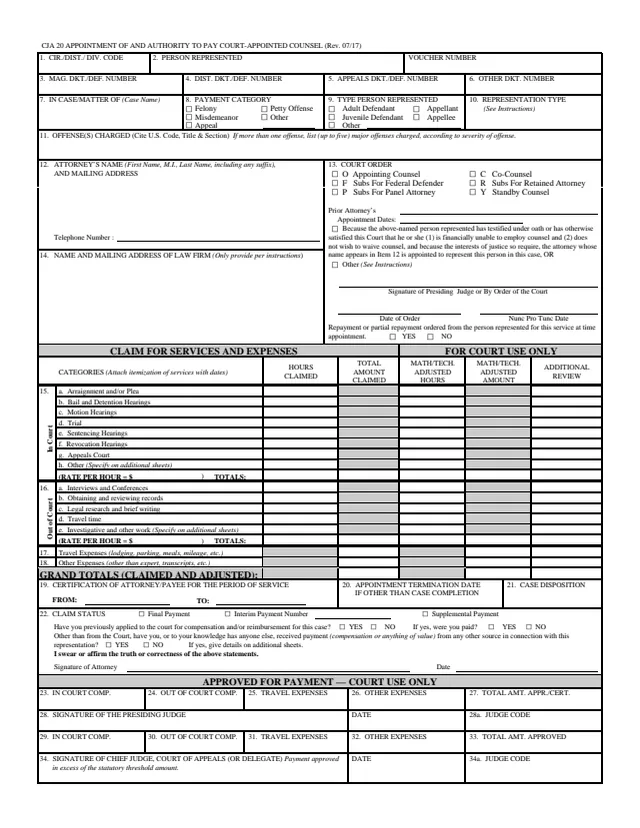
CJA 20
149 fields, 1 page
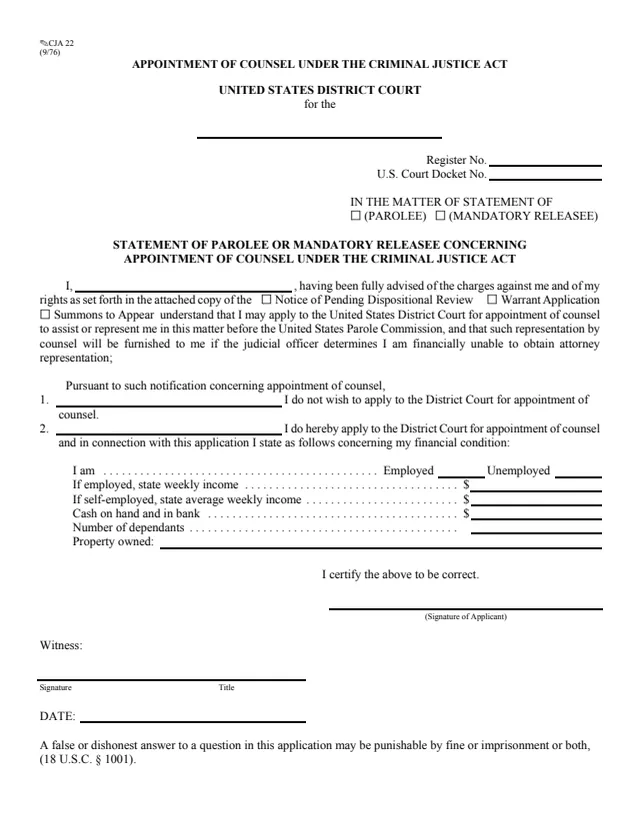
CJA 22
26 fields, 1 page
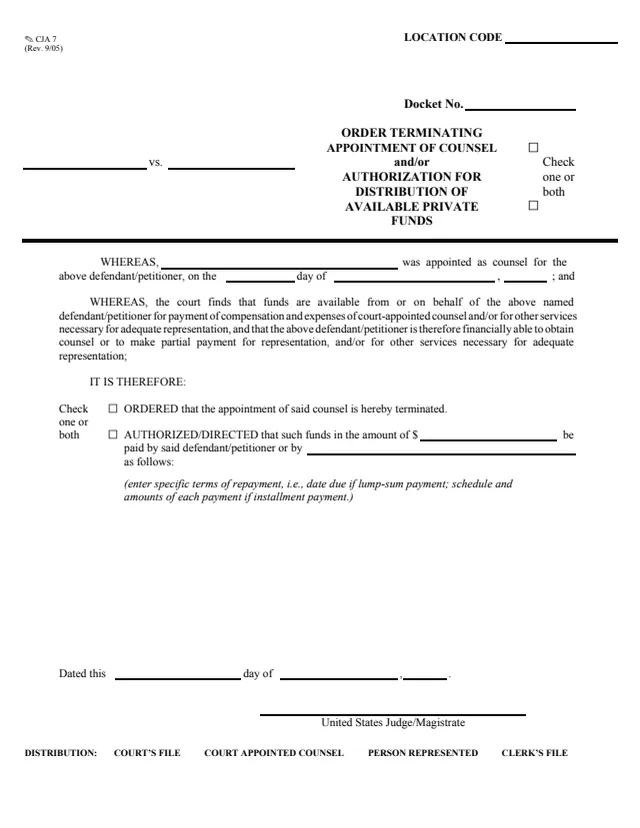
CJA 7
25 fields, 1 page
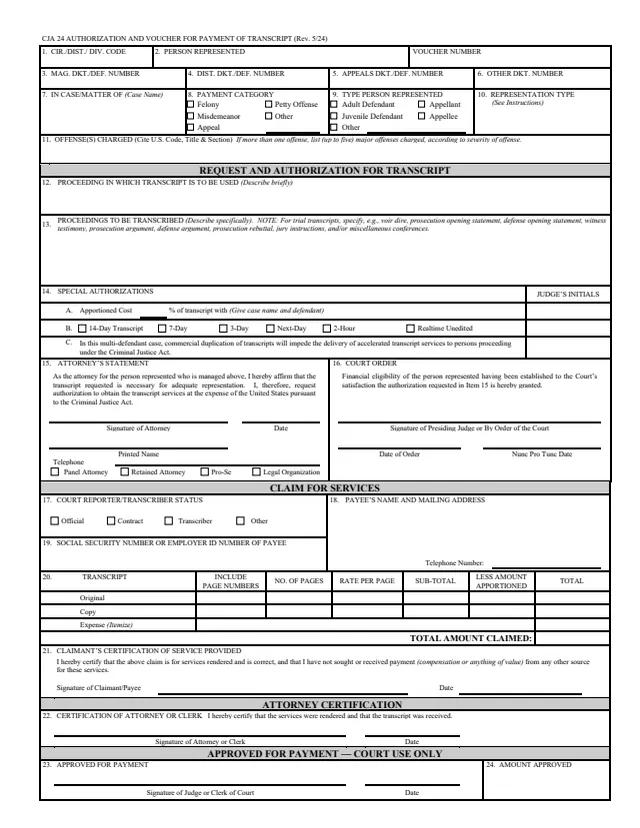
CJA 24
74 fields, 1 page
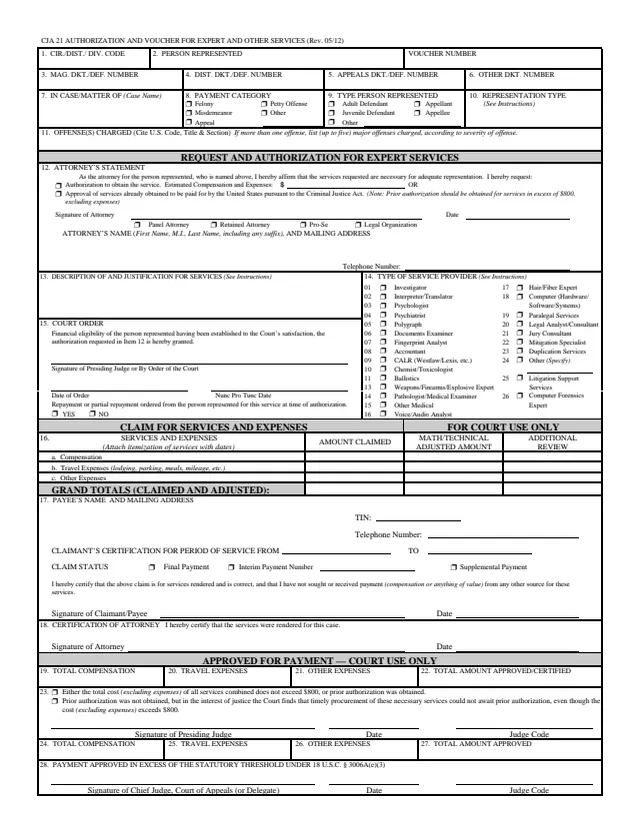
CJA 21
69 fields, 1 page
The form and the U.S. Courts page name these people.
No tool matches that search.
The U.S. Courts page says the CJA Form 23 is not a required statutory form. It calls it an administrative tool used to assist the court in appointing counsel.
The page says determining eligibility for representation under the CJA is a judicial function, and the magistrate judge or the court appoints counsel if satisfied, after appropriate inquiry, that the person is financially unable to obtain counsel. This page cannot say whether anyone qualifies.
The page says counsel must be appointed if the person is "financially unable to obtain counsel," citing 18 U.S.C. §3006A(b), and that indigency is not the standard under the Criminal Justice Act. It lists the cost of necessities of life for the person and dependents, the cost of securing pretrial release, asset encumbrance and the likely cost of retained counsel as considerations.
The page says the initial determination of eligibility is made without regard to the financial ability of the person's family to retain counsel, unless the family indicates willingness and ability to do so promptly.
The page says that under Judicial Conference policy, financial affidavits seeking appointment of counsel should not be included in the public case file or made available to the public, and that a docketed affidavit should be filed under seal.
The form says: "I certify under penalty of perjury that the foregoing is true and correct." It is signed by the defendant or person seeking representation, with the date.
The U.S. Courts page lists the Defender Services Office, Legal and Policy Division at 202-502-3030 for questions on the use of the form or instructions.