Heading
AO 39 (Rev. 11/08), Administrative Office of the United States Courts, the title Transcript Orders and Collections Ledger, and a Period Ended box in the top corner.
AO 39
Transcript Orders and Collections Ledger
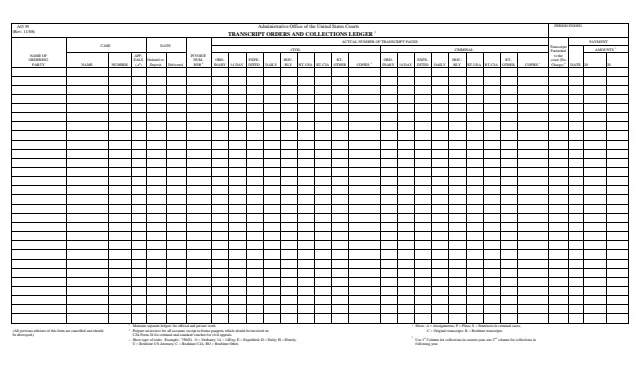
AO 39, Transcript Orders and Collections Ledger, is a one-page ledger from the Administrative Office of the United States Courts. The U.S. Courts page lists it under Court Reporter Forms, effective on November 1, 2008, and the PDF is dated Rev. 11/08.
Each row records one transcript order: the ordering party, the case, the dates ordered and delivered, the invoice number, the actual number of transcript pages by type of order for civil and criminal cases, transcripts furnished to the court at no charge, and the payment date and amounts. Five numbered notes at the bottom explain how to keep the ledger. The form says all previous editions are cancelled and should be destroyed.
The form has no signature line and is not a filing made by the public. This page explains the form in plain words and is not legal advice. You can fill it out free in your browser on this page and download the result without an account.
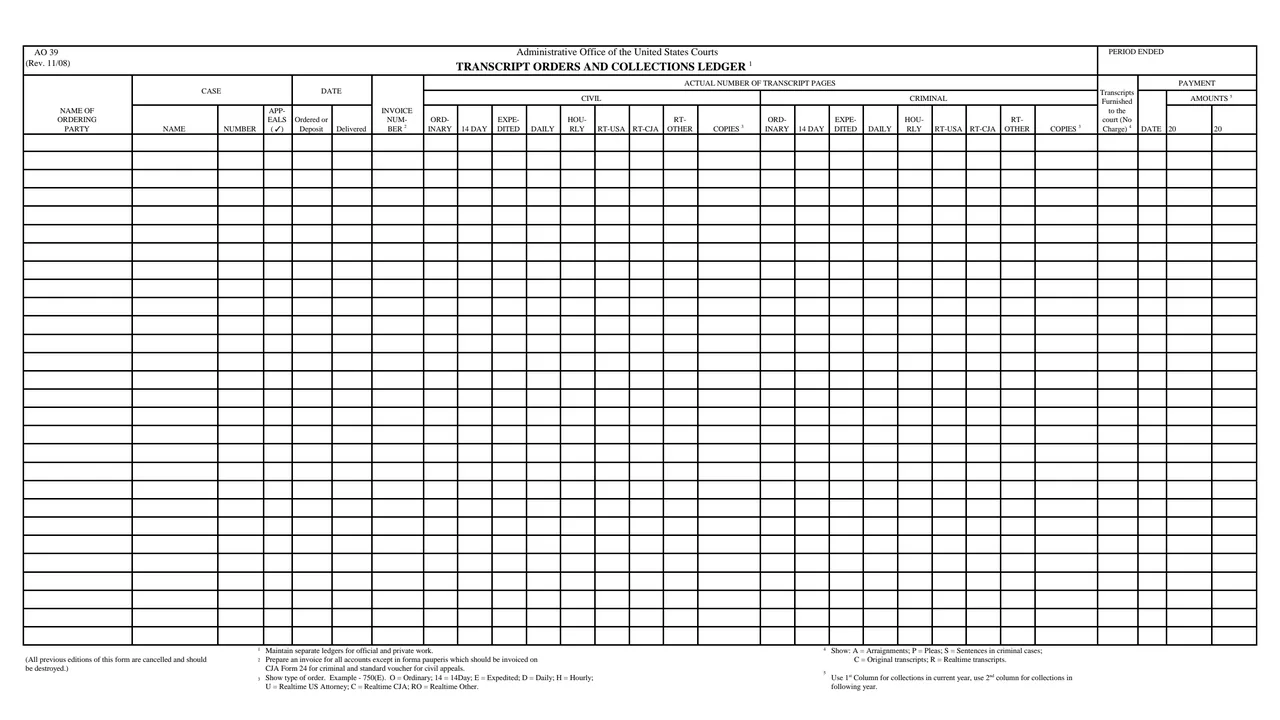
AO 39 (Rev. 11/08), Administrative Office of the United States Courts, the title Transcript Orders and Collections Ledger, and a Period Ended box in the top corner.
Name of ordering party, case name and number, an Appeals check mark column, the date ordered or deposit, the date delivered, and the invoice number.
Under Actual Number of Transcript Pages, the civil columns are Ordinary, 14 Day, Expedited, Daily, Hourly, RT-USA, RT-CJA, RT-Other and Copies.
The criminal columns repeat the same order types: Ordinary, 14 Day, Expedited, Daily, Hourly, RT-USA, RT-CJA, RT-Other and Copies.
One column for transcripts furnished to the court with no charge, using the letter codes in note 4.
A Date column and two Amounts columns, each headed 20 with a blank for the year. Note 5 says the first is for collections in the current year and the second for the following year.
Note 1 says to maintain separate ledgers for official and private work. Fill in the Period Ended box at the top.
Write the ordering party, the case name and number, a check mark if it is an appeal, and the date ordered or deposit and the date delivered.
Note 2 says to prepare an invoice for all accounts except in forma pauperis, which should be invoiced on CJA Form 24 for criminal and standard voucher for civil appeals.
Enter the actual number of pages in the civil or criminal columns. Note 3 says to show the type of order, for example 750(E), with O, 14, E, D, H, U, C and RO as the codes.
In the no charge column, note 4 says to show A, P or S for arraignments, pleas or sentences in criminal cases, C for original transcripts and R for realtime transcripts.
Enter the payment date and amount. Note 5 says to use the first column for collections in the current year and the second for collections in the following year.
The numbered notes printed at the bottom of the form explain each column.
You get the real form, filled in a browser tab, with nothing standing between you and the finished PDF.
The U.S. Courts page lists AO 39 under Court Reporter Forms. The form does not print a signature line or say where the ledger is sent.
AO 39 does not print transcript rates or any fee. It only records page counts and payment amounts.
Note 2 points in forma pauperis accounts to CJA Form 24 for criminal cases and a standard voucher for civil appeals.
The PDF is dated Rev. 11/08 and says all previous editions of this form are cancelled and should be destroyed.
The U.S. Courts page offers AO 39 as a PDF, effective on November 1, 2008.
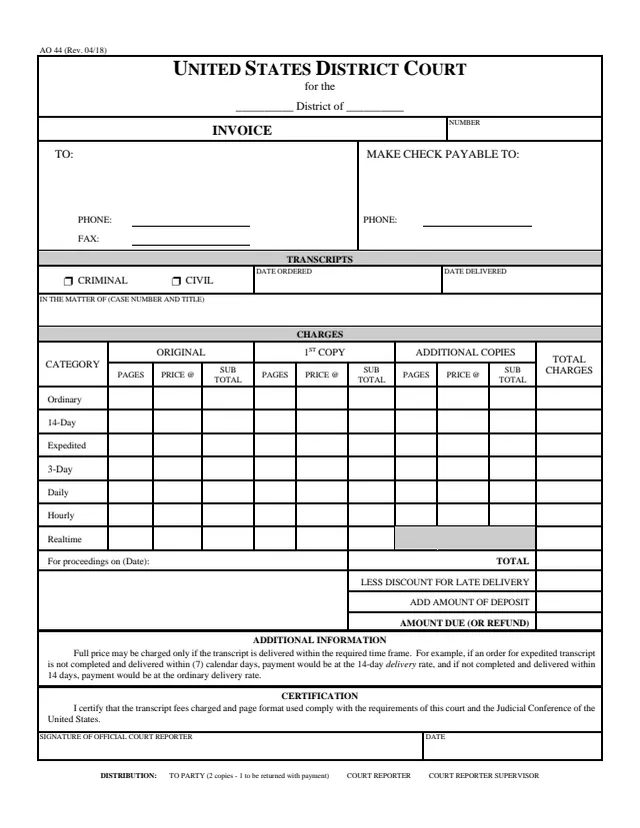
AO 44
89 fields, 1 page
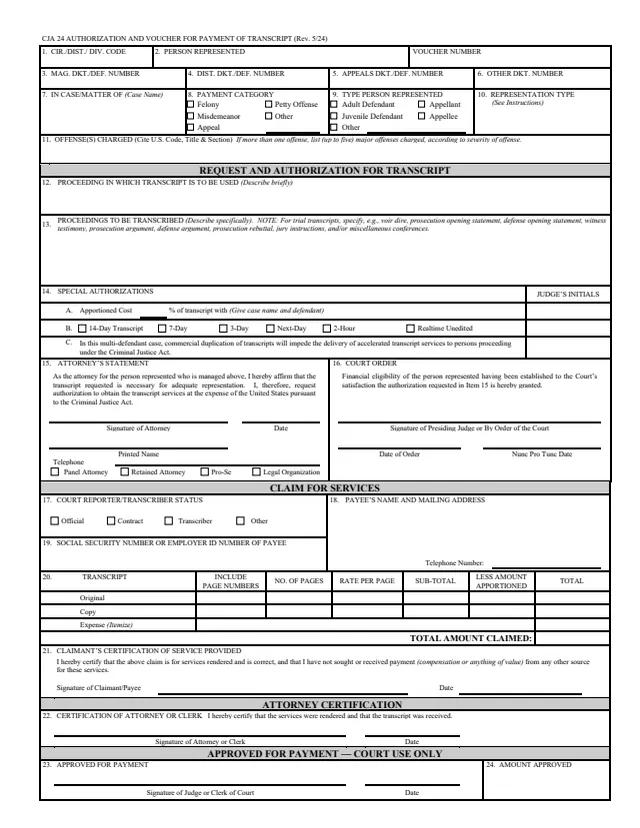
CJA 24
74 fields, 1 page
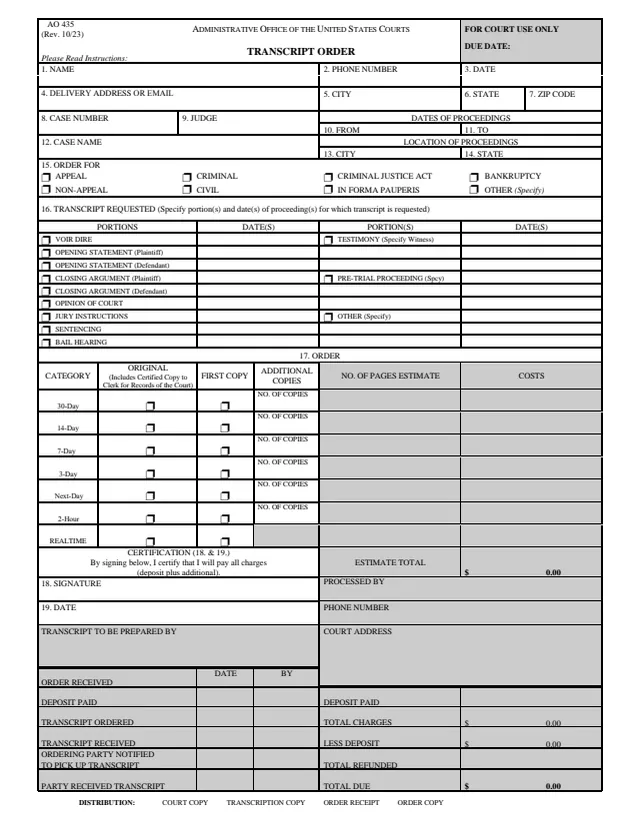
AO 435
123 fields, 2 pages
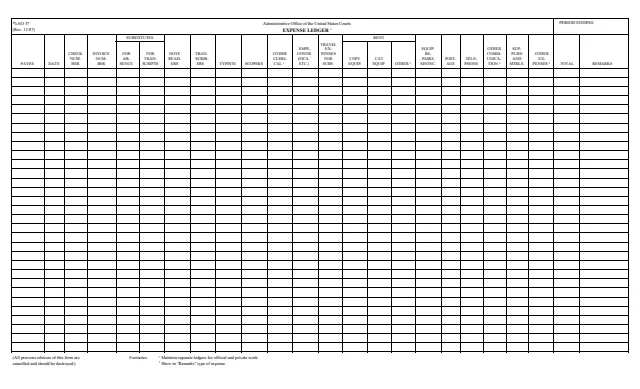
AO 37
750 fields, 1 page
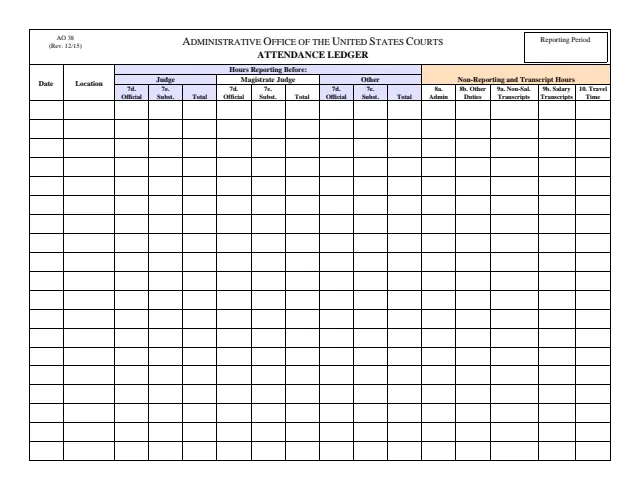
AO 38
308 fields, 1 page
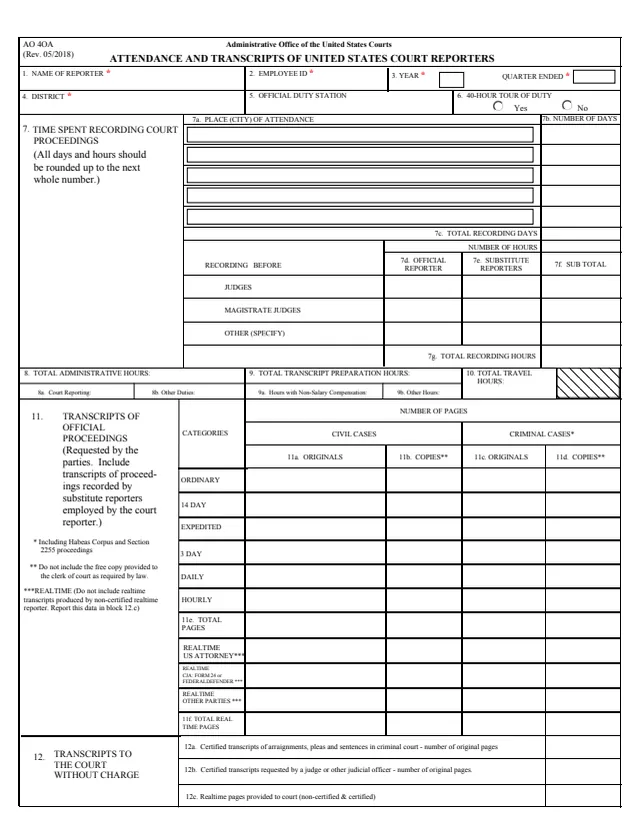
AO 40A
117 fields, 2 pages
The U.S. Courts page lists AO 39 under Court Reporter Forms. The form itself prints no name or signature line for the person keeping it.
No tool matches that search.
No. The U.S. Courts page lists it under Court Reporter Forms. It is a ledger of transcript orders and collections, and ordering parties appear only as names in the first column.
Note 1 on the form says to maintain separate ledgers for official and private work.
It is the example in note 3, which says to show the type of order. The codes are O for Ordinary, 14 for 14 Day, E for Expedited, D for Daily, H for Hourly, U for Realtime US Attorney, C for Realtime CJA and RO for Realtime Other.
Note 2 says to prepare an invoice for all accounts except in forma pauperis, which should be invoiced on CJA Form 24 for criminal and standard voucher for civil appeals.
Note 5 says to use the first column for collections in the current year and the second column for collections in the following year.
No. The form records page counts by type of order and the amounts collected, but it does not print any rate or fee.