Page 1: The order
The district, United States of America v. the defendant, the case number, the recital about 21 U.S.C. § 844, the probation period, and the judge's signature.
AO 246
Probation Order Under 18 U.S.C. § 3607
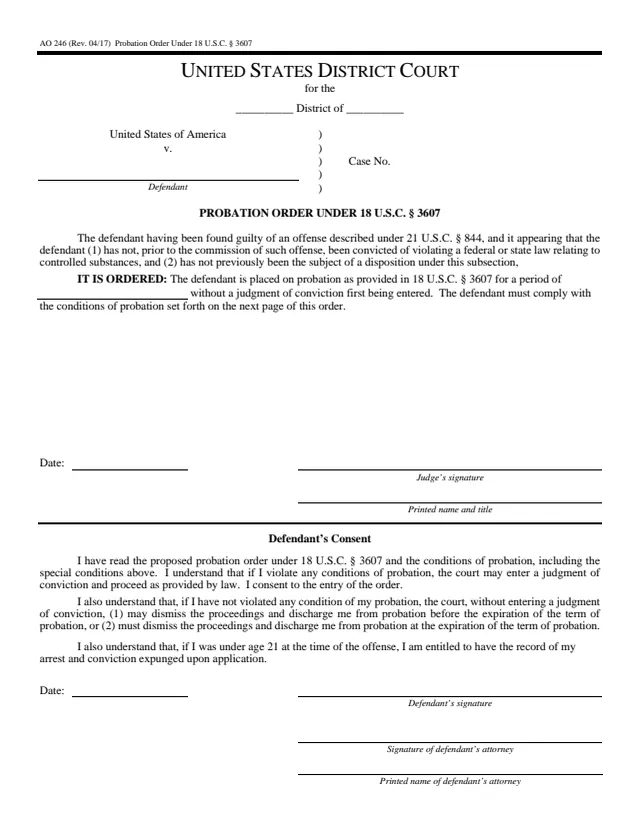
AO 246, Probation Order Under 18 U.S.C. § 3607, is the order a United States District Court uses to place a defendant on probation as provided in 18 U.S.C. § 3607 for a period set in the order, without a judgment of conviction first being entered. The U.S. Courts lists it under Presentence and Probation Forms. The page says it is effective on April 1, 2017, and the edition printed on the form is Rev. 04/17.
The order recites that the defendant was found guilty of an offense described under 21 U.S.C. § 844, had not, before that offense, been convicted of violating a federal or state law relating to controlled substances, and had not been the subject of an earlier disposition under that subsection. It is followed by the defendant's consent, the probation term and mandatory conditions, the standard conditions of supervision, additional conditions and a schedule of payments.
It is a court order. The judge signs it, and the defendant and the defendant's attorney sign the consent. This page explains the form in plain words and is not legal advice. You can fill it out free in your browser on this page and download the result without an account.
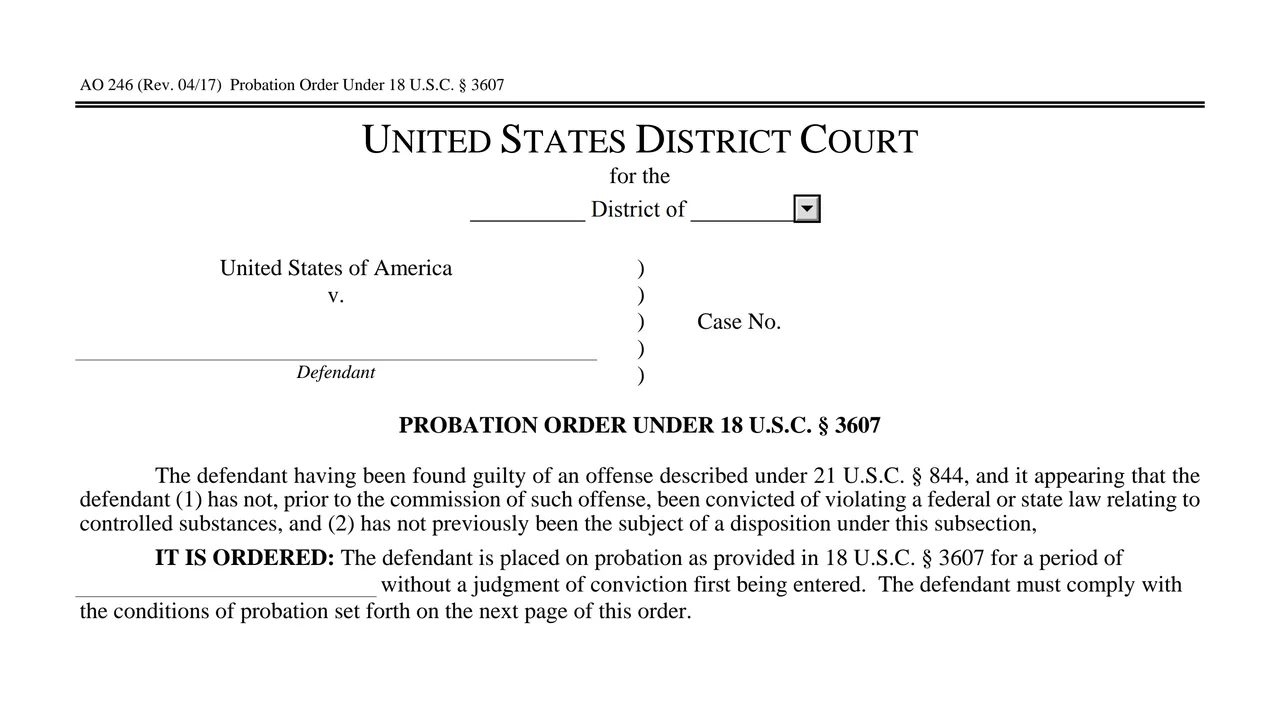
The district, United States of America v. the defendant, the case number, the recital about 21 U.S.C. § 844, the probation period, and the judge's signature.
The defendant states an understanding that a violation may lead the court to enter a judgment of conviction, that without a violation the court may dismiss the proceedings before the term ends or must dismiss them when it ends, and what the form says about expungement for a defendant under age 21 at the time of the offense.
The probation term and ten mandatory conditions, including drug testing, DNA collection, Sex Offender Registration and Notification Act requirements, a domestic violence program and restitution, several marked check if applicable, and the assessment under 18 U.S.C. § 3013.
Thirteen standard conditions of supervision, such as reporting to the probation office, living at an approved place, work, contact with law enforcement and firearms, then the U.S. Probation Office Use Only acknowledgment.
A page headed Additional Supervision Conditions for any conditions the court adds.
Payment options A to D, joint and several amounts, the cost of prosecution, court costs and forfeited property, the order in which payments are applied, and pages for additional co-defendants and forfeited property.
Page 1 takes the district, the defendant's name and the case number.
The order on page 1 has a blank for the period of probation, and page 2 repeats the term of probation.
Page 2 has check if applicable boxes, including one that suspends the drug testing condition based on the court's determination of a low risk of future substance abuse.
Page 4 holds any additional supervision conditions. The Schedule of Payments takes the payment option, any joint and several amounts, costs and forfeited property.
The judge signs and dates the order. The defendant signs and dates the consent, and the defendant's attorney signs and prints a name.
After a U.S. probation officer gives instructions on the conditions and a written copy of the order, the defendant signs and dates the box on page 3.
You get the real form, filled in a browser tab, with nothing standing between you and the finished PDF.
Standard condition 1 sets reporting to the probation office in the federal judicial district where the defendant is authorized to reside within 72 hours of the time of sentencing, unless the probation officer instructs a different office or time frame.
Mandatory condition 3 sets one drug test within 15 days of placement on probation and at least two periodic drug tests thereafter, as determined by the court, unless the court checks the box suspending it.
Standard conditions 5 and 7 call for notice to the probation officer at least 10 days before a change, or within 72 hours of becoming aware of it when advance notice is not possible due to unanticipated circumstances.
All criminal monetary penalties are made to the clerk of the court, and the defendant receives credit for all payments previously made. The form lists the order in which payments are applied.
The form does not print a fee or an assessment amount. It refers to the assessment imposed in accordance with 18 U.S.C. § 3013.
Page 3 points to Overview of Probation and Supervised Release Conditions, available at www.uscourts.gov.
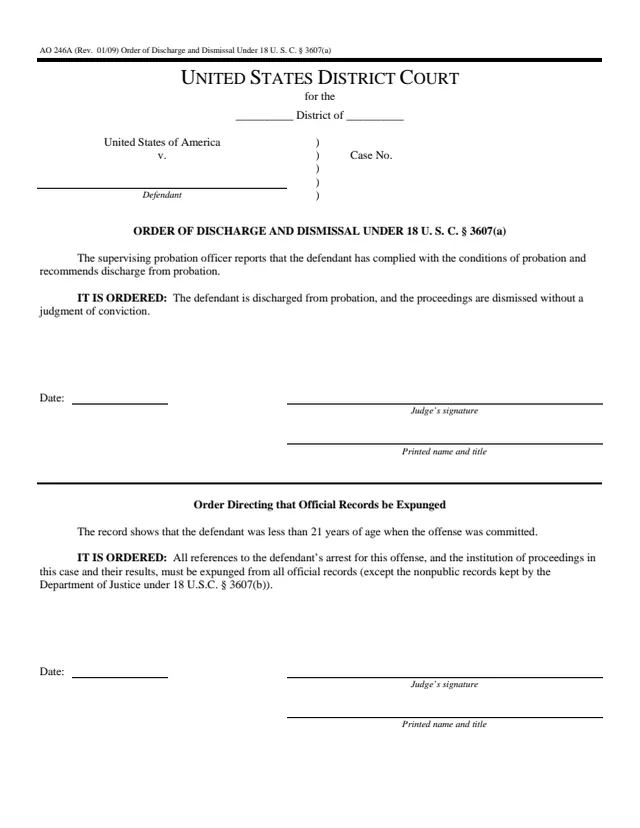
AO 246A
12 fields, 1 page
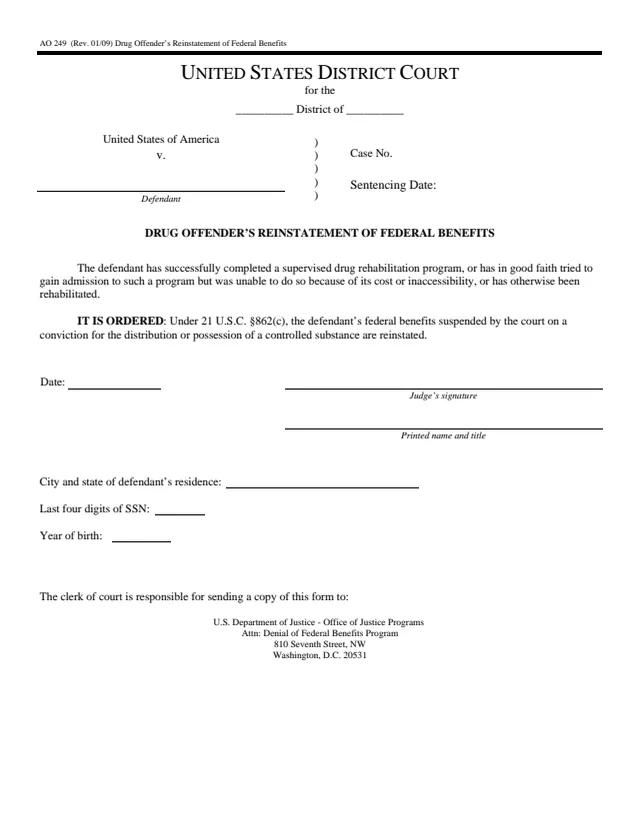
AO 249
13 fields, 1 page
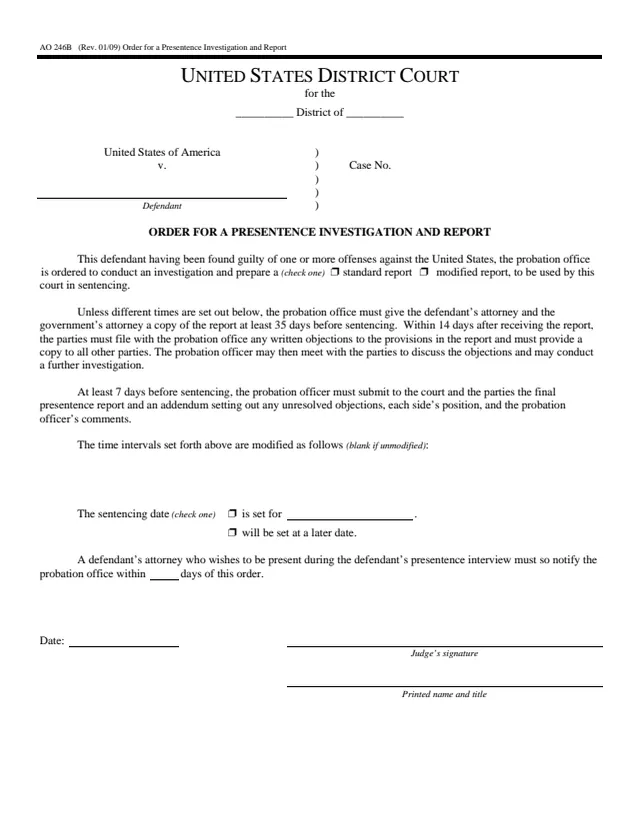
AO 246B
14 fields, 1 page
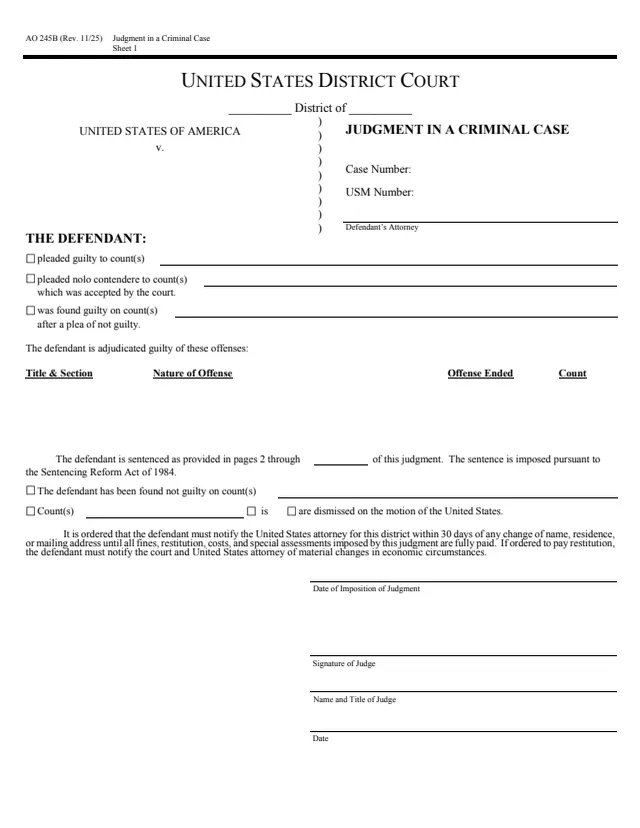
AO 245B
767 fields, 25 pages
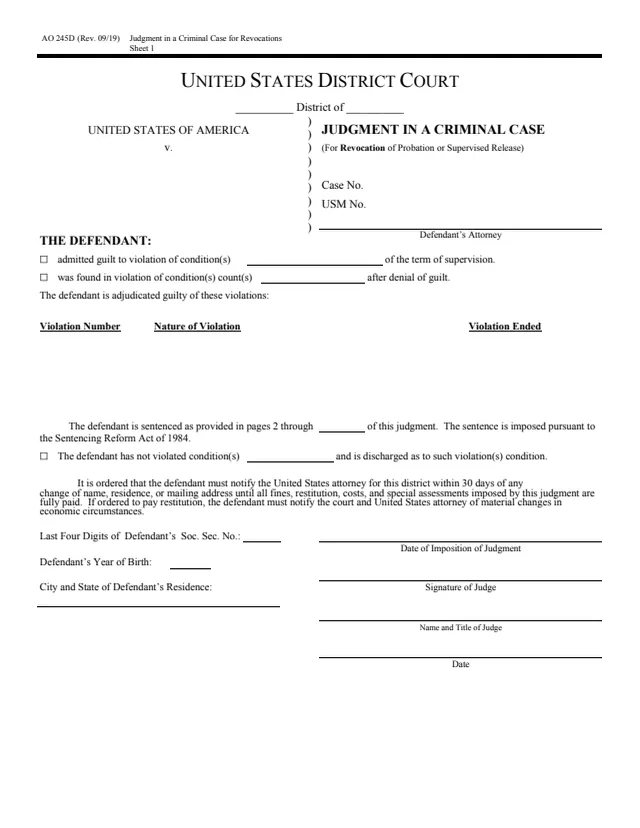
AO 245D
566 fields, 21 pages
The court prepares the order. These are the people whose names or signatures it calls for.
No tool matches that search.
The court. The judge signs the order. The defendant and the defendant's attorney sign the Defendant's Consent, and the defendant later signs the U.S. Probation Office Use Only acknowledgment.
The order says the defendant is placed on probation as provided in 18 U.S.C. § 3607 without a judgment of conviction first being entered.
The defendant states an understanding that if any condition of probation is violated, the court may enter a judgment of conviction and proceed as provided by law.
It says the court, without entering a judgment of conviction, may dismiss the proceedings and discharge the defendant before the term expires, or must do so at the expiration of the term.
The consent says a defendant who was under age 21 at the time of the offense is entitled to have the record of the arrest and conviction expunged upon application. AO 246A is the U.S. Courts order of discharge and dismissal under 18 U.S.C. § 3607(a).
The Schedule of Payments says all criminal monetary penalties are made to the clerk of the court.