AO 245B

Judgment in a Criminal Case

Agency
U.S. Courts
Revision
Rev. 11/25
Fillable fields
767
Pages
25
Official source
U.S. Courts form page
Checked
October 20, 2026
Fill AO 245B online
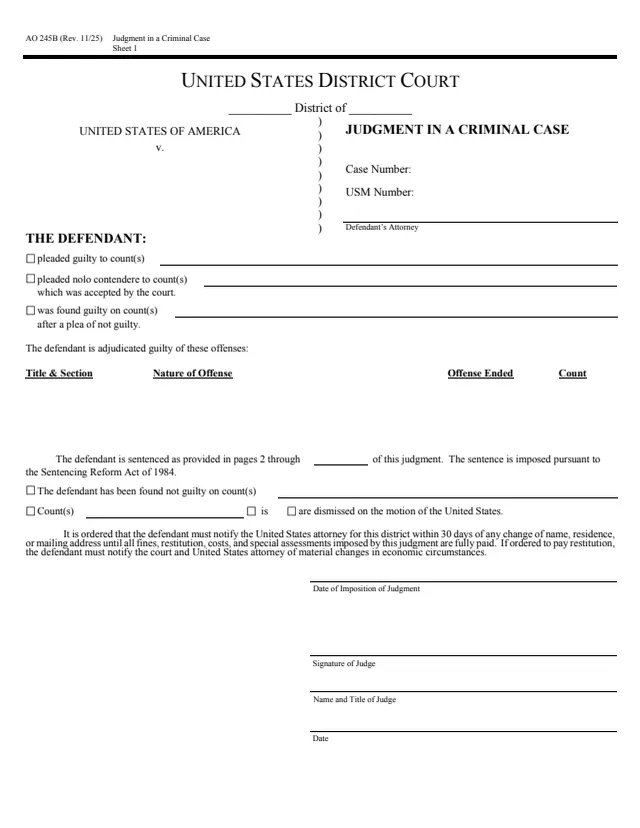
Page 1 of form AO 245B

AO 245B: Judgment in a Criminal Case

AO 245B, Judgment in a Criminal Case, is the form a United States District Court uses for the judgment against a defendant in a criminal case. The U.S. Courts lists it under Criminal Judgment Forms. The page says it is effective on September 1, 2019 and updated on November 10, 2025, and the edition printed on the form is Rev. 11/25.

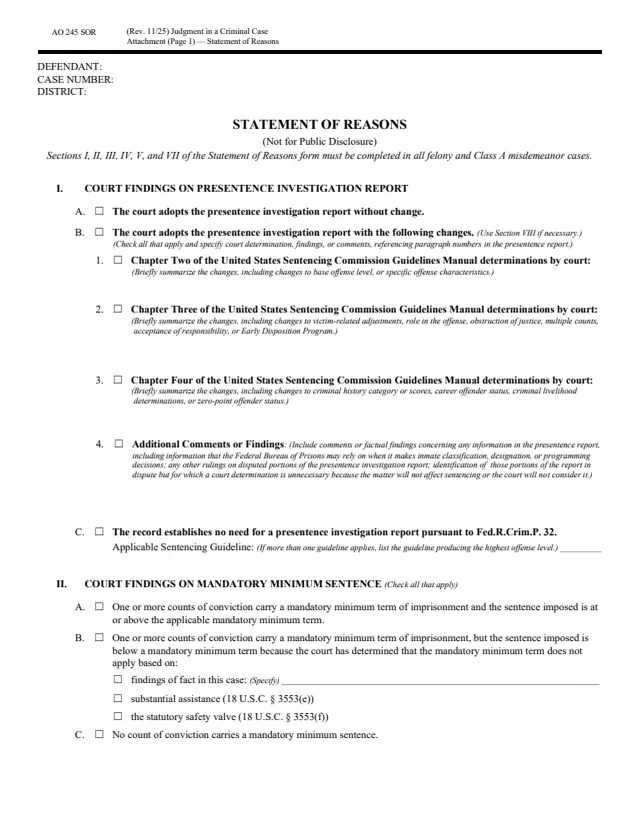
The form is a set of sheets: the judgment and counts of conviction, imprisonment, supervised release, probation, criminal monetary penalties, the schedule of payments, denial of federal benefits, and a four-page Statement of Reasons marked Not for Public Disclosure. Sheet 1 is always included when printing, and every other sheet has a choice to include it or not.

It is a court document. The judge signs it, the United States Marshal completes the Return, and the defendant signs only the probation office acknowledgment. This page explains the form in plain words and is not legal advice. You can fill it out free in your browser on this page and download the result without an account.

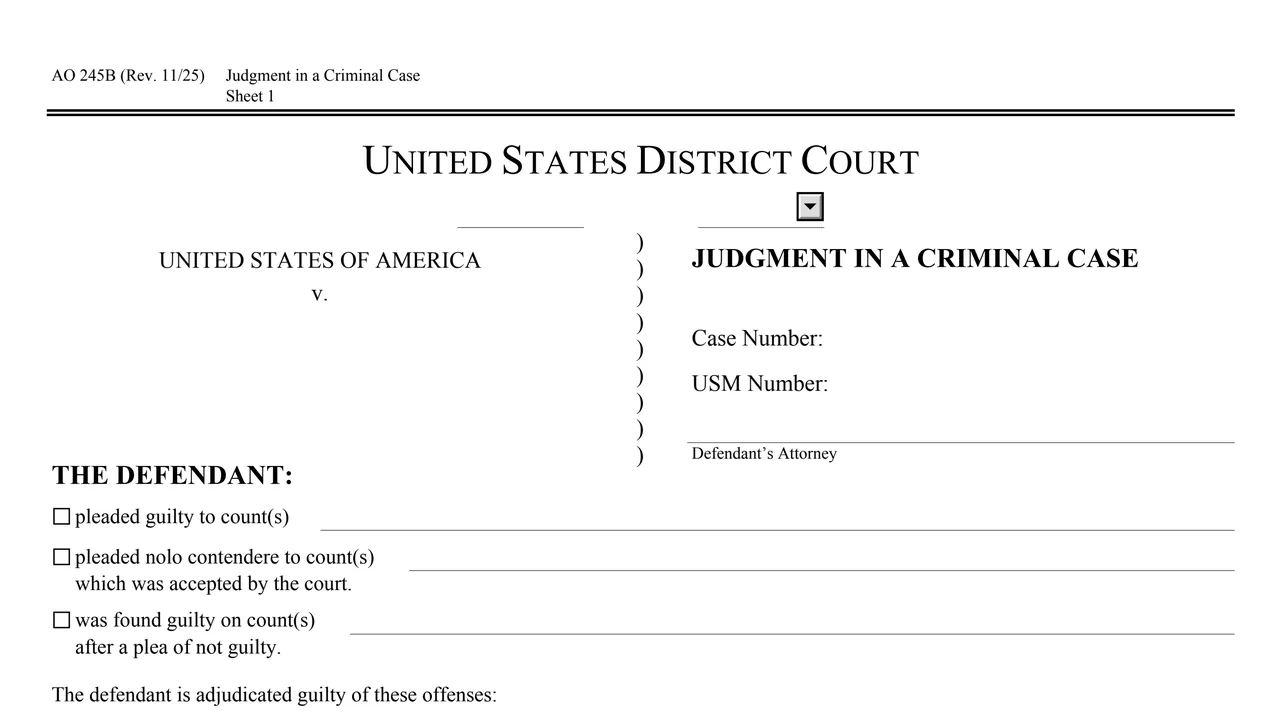
Top of page 1 of AO 245B: Judgment in a Criminal Case, as printed by COURTS

What's on AO 245B

Sheets 1 and 1A: Judgment

The district, case number, USM number and defendant's attorney, whether the defendant pleaded guilty, pleaded nolo contendere or was found guilty, the offenses by title and section with the date ended and count, counts dismissed, and additional counts on Sheet 1A.
Sheets 2 and 2A: Imprisonment

The total term of imprisonment in the custody of the Federal Bureau of Prisons, recommendations to the Bureau of Prisons, remand or surrender instructions, and the Marshal's Return.

Sheets 3 to 4D: Supervision

A term of supervised release or probation with its mandatory conditions, 13 standard conditions of supervision, and pages for additional terms, additional standard conditions and special conditions.

Sheets 5 to 5B: Criminal monetary penalties

Totals for the assessment, restitution, fine, AVAA assessment and JVTA assessment, restitution payees with total loss, restitution ordered and priority, and interest on restitution and a fine of more than $2,500.

Sheets 6 to 7: Payments and federal benefits

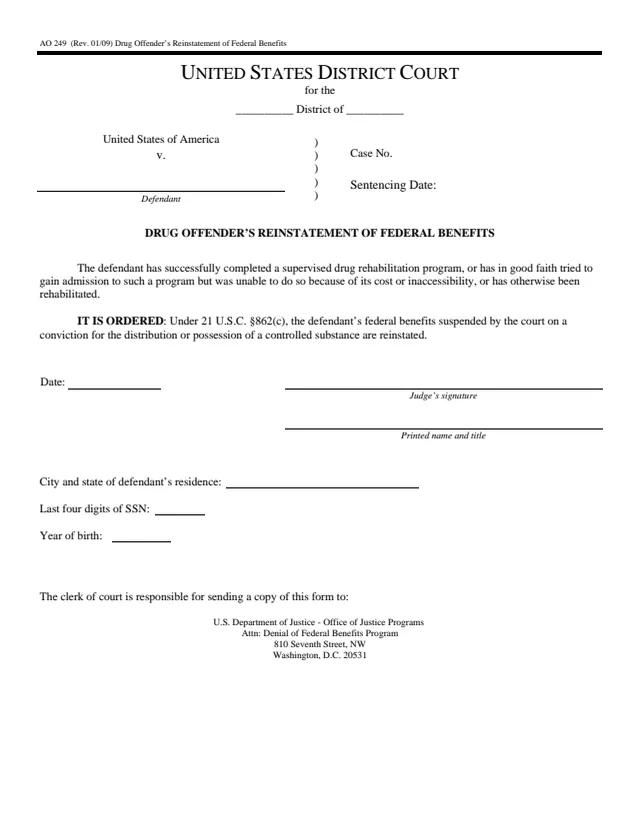
The schedule of payments (options A to F), joint and several amounts, costs, forfeited property and the order payments are applied, then any denial of federal benefits under 21 U.S.C. § 862 for drug traffickers or drug possessors.

Statement of Reasons

A four-page attachment marked Not for Public Disclosure: findings on the presentence report and mandatory minimums, the plea agreement, the guideline range, reasons for the sentence, restitution, and the defendant's personal identifiers.

How AO 245B is filled out

  1. 1

    Fill in the caption

    Sheet 1 takes the district, the defendant's name, the case number, the USM number and the defendant's attorney. Each later sheet repeats the defendant's name and case number.

  2. 2

    Record the outcome on each count

    Sheet 1 records how the defendant was found guilty, lists each offense, and has boxes for counts on which the defendant was found not guilty and counts dismissed on the motion of the United States.

  3. 3

    Choose the sheets to include

    Sheet 1 is always included when printing. Every other sheet has a yes or no choice to include it, so the judgment holds only the sheets the sentence uses.

  4. 4

    Complete the Statement of Reasons

    The attachment says Sections I, II, III, IV, V and VII are completed in all felony and Class A misdemeanor cases. Section VIII holds any additional basis for the sentence.

  5. 5

    Sign and date

    The judge signs Sheet 1 under the date of imposition of judgment, and signs the Statement of Reasons with the date signed.

Why fill Form AO 245B on indox

You get the real form, filled in a browser tab, with nothing standing between you and the finished PDF.

  • Fill the form right in your browser, no software to install
  • Free to fill and free to download, with no account
  • The official blank straight from the U.S. Courts, not a copy someone retyped
  • Works on a phone, tablet or computer

Notices, payments and privacy

Change of address

Sheet 1 orders the defendant to notify the United States attorney for the district within 30 days of any change of name, residence or mailing address until all fines, restitution, costs and special assessments are fully paid.

Where payments go

Sheet 6 says criminal monetary penalties, except payments made through the Federal Bureau of Prisons' Inmate Financial Responsibility Program, are made to the clerk of the court, and lists the order in which payments are applied.

Interest

Sheet 5 has a box for interest on restitution and a fine of more than $2,500 unless paid in full before the fifteenth day after the date of the judgment, under 18 U.S.C. § 3612(f), and boxes for the court to waive or modify it.

Deferred restitution

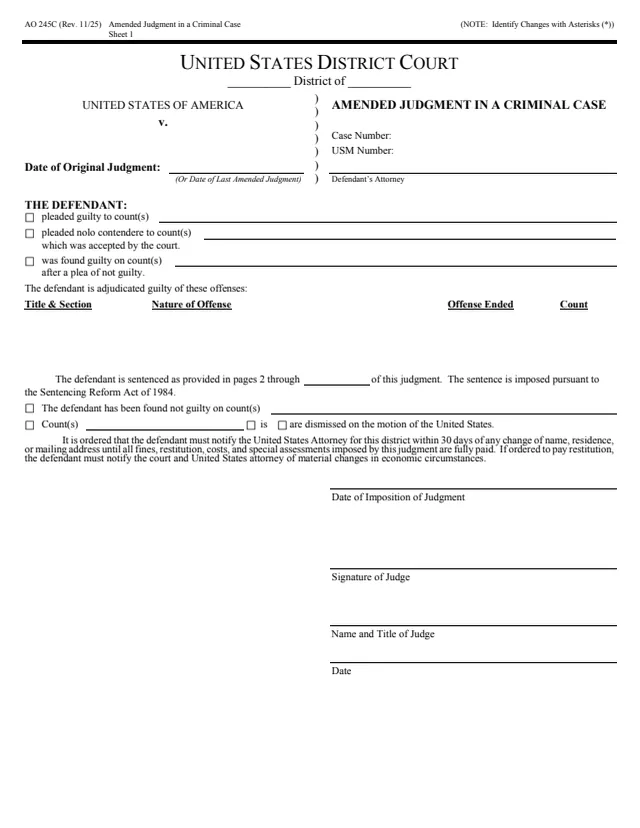
If the determination of restitution is deferred, Sheet 5 says an Amended Judgment in a Criminal Case (AO 245C) will be entered after that determination.

Privacy

The Statement of Reasons is marked Not for Public Disclosure. Its last page holds the defendant's Social Security number, date of birth, and residence and mailing addresses.

Fees

The form does not print a fee. It is a judgment the court enters.

Who completes AO 245B?

  • The sentencing judge

    Sheet 1 has the date of imposition of judgment and the judge's signature, name and title. The Statement of Reasons ends with the judge's signature and the date signed.

  • The United States Marshal

    The Return on Sheet 2 is signed by the United States Marshal or a deputy and records when and where the defendant was delivered, with a certified copy of the judgment.

  • The defendant

    The judgment is entered against the defendant. In the U.S. Probation Office Use Only box on Sheets 3A and 4A, the defendant signs and dates a statement that a U.S. probation officer explained the conditions and gave a written copy of the judgment.

  • The clerk of court

    Sheet 6 says criminal monetary penalties, except payments made through the Federal Bureau of Prisons' Inmate Financial Responsibility Program, are made to the clerk of the court. Sheet 7 says the clerk sends that page and the first page to the U.S. Department of Justice, Office of Justice Programs.

The court completes the judgment. These are the people the sheets name.

Official sources and the blank

Do it all with indox

View all 94 tools

Questions about Form AO 245B

Who fills out AO 245B?

The court. The judge signs Sheet 1 and the Statement of Reasons, the United States Marshal or a deputy signs the Return on Sheet 2, and the defendant signs the probation office acknowledgment on Sheet 3A or 4A.

Why does AO 245B have so many sheets?

Each sheet covers one part of the sentence. Sheet 1 is always included when printing, and every other sheet has a yes or no choice, so a judgment holds only the sheets that apply.

What is the Statement of Reasons?

A four-page attachment marked Not for Public Disclosure. It records findings on the presentence report and mandatory minimums, the plea agreement, the guideline range, the reasons for the sentence and restitution, and says Sections I, II, III, IV, V and VII are completed in all felony and Class A misdemeanor cases.

What if restitution is decided later?

Sheet 5 has a box saying the determination of restitution is deferred until a date, and that an Amended Judgment in a Criminal Case (AO 245C) will be entered after that determination.

Where are criminal monetary penalties paid?

Sheet 6 says they are made to the clerk of the court, except payments made through the Federal Bureau of Prisons' Inmate Financial Responsibility Program, and that the defendant receives credit for all payments previously made.

What does the Return on Sheet 2 record?

The date the defendant was delivered, to whom and where, with a certified copy of the judgment. It is signed by the United States Marshal or a deputy.