Caption and Section I
The defendant organization, case number and district, then the court's findings on the presentence investigation report: adopted without change, or adopted with changes, using Section VI if necessary.
AO 245E
Judgment in a Criminal Case for Organizational Defendants Attachment - Statement of Reasons
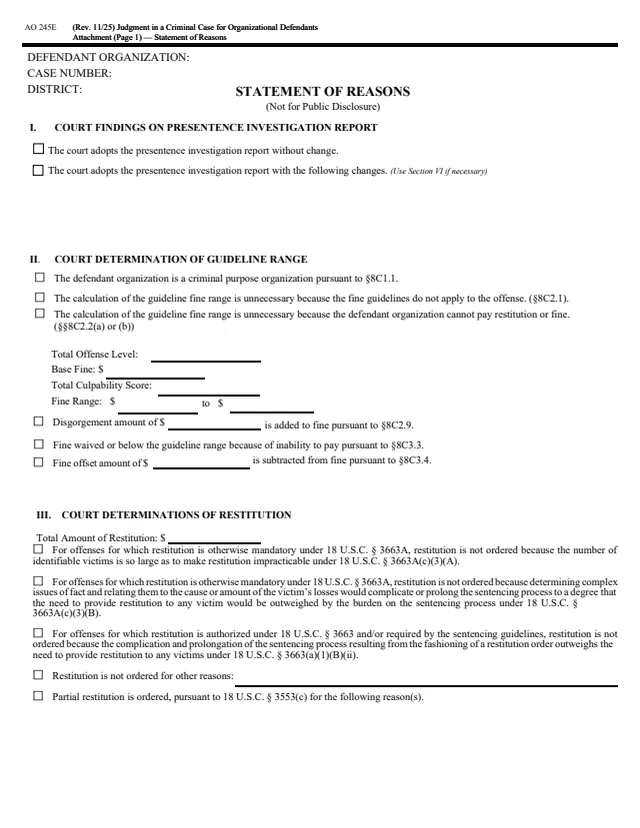
AO 245E, Judgment in a Criminal Case for Organizational Defendants Attachment, Statement of Reasons, is a two-page attachment a court completes when it sentences a defendant organization. The U.S. Courts lists it under Criminal Judgment Forms. The page says it is effective on November 1, 2025, and the edition printed on the form is Rev. 11/25.
The attachment records the court's findings on the presentence investigation report, the guideline fine range, restitution, the plea agreement, the guideline sentencing determination and any additional basis for the sentence. Page 1 is headed Statement of Reasons and marked Not for Public Disclosure.
It is a court document. The judge signs it, and it has no signature line for the defendant organization or the public. This page explains the form in plain words and is not legal advice. You can fill it out free in your browser on this page and download the result without an account.
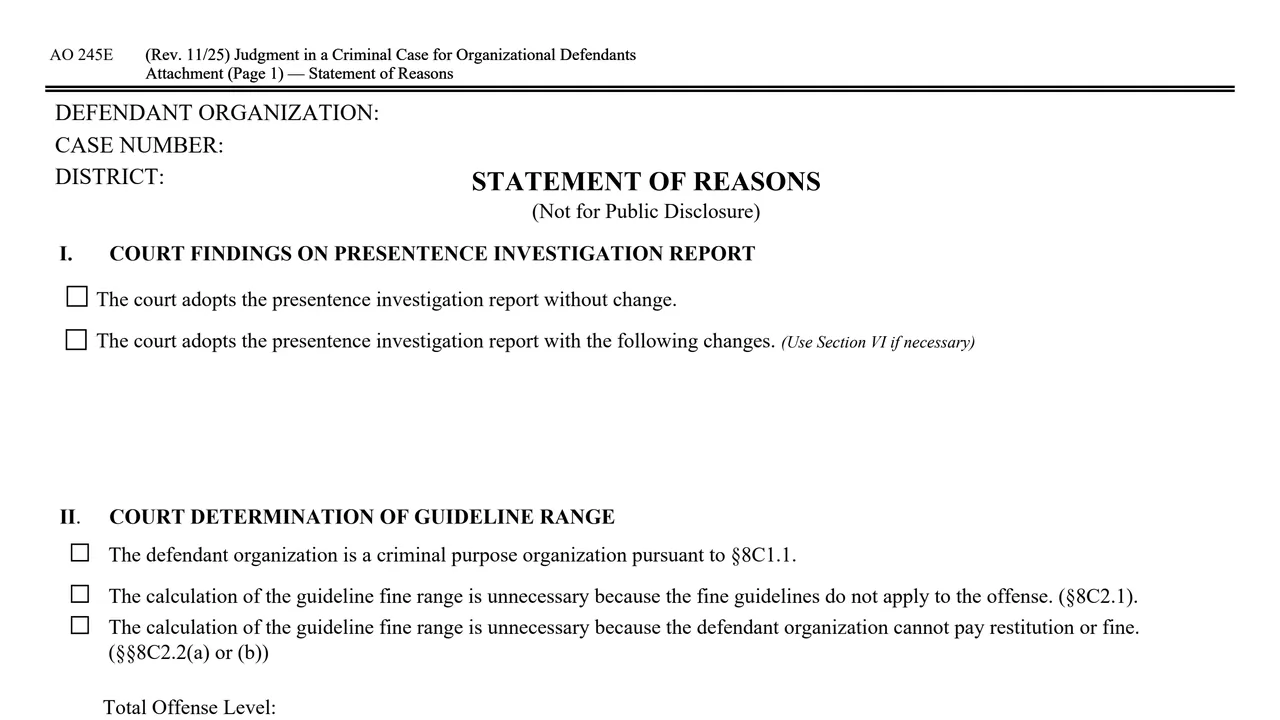
The defendant organization, case number and district, then the court's findings on the presentence investigation report: adopted without change, or adopted with changes, using Section VI if necessary.
Boxes for a criminal purpose organization (§8C1.1), fine guidelines that do not apply (§8C2.1) or an inability to pay (§§8C2.2(a) or (b)), then the total offense level, base fine, total culpability score and fine range, disgorgement (§8C2.9), a fine waived or below the range for inability to pay (§8C3.3) and a fine offset (§8C3.4).
The total amount of restitution, boxes for restitution not ordered under 18 U.S.C. § 3663A(c)(3)(A), 18 U.S.C. § 3663A(c)(3)(B) or 18 U.S.C. § 3663(a)(1)(B)(ii), other reasons, and partial restitution under 18 U.S.C. § 3553(c).
Check only one: a non-binding plea agreement (Rule 11(c)(1)(A), Rule 11(c)(1)(B)), a binding plea agreement accepted by the court (Rule 11(c)(1)(C)), or no plea agreement (conviction after trial or plea without agreement).
Check all that apply: no applicable guideline fine range, a fine within the range, below it because of substantial assistance (§5K1.1), below it for reasons specified, or above it, with the government's position.
Section VI holds any additional basis for the sentence in the case, if applicable. The page ends with the date of imposition of judgment and the judge's signature, name and title, and date signed.
Both pages repeat the defendant organization, the case number and the district at the top.
Section I has one box for adopting the presentence investigation report without change and one for adopting it with changes, with Section VI for more room.
Section II takes the total offense level, base fine, total culpability score and fine range, plus any disgorgement amount added or fine offset amount subtracted.
Section III takes the total amount of restitution, or a checked reason it is not ordered, or the reasons for partial restitution.
Section IV says to check only one plea agreement box. Section V says to check all that apply and to specify reasons for a fine below or above the guideline fine range.
The judge fills in the date of imposition of judgment, signs, prints a name and title, and enters the date signed.
You get the real form, filled in a browser tab, with nothing standing between you and the finished PDF.
Page 1 of the Statement of Reasons is marked Not for Public Disclosure.
Each page is headed Judgment in a Criminal Case for Organizational Defendants Attachment, with the page number and Statement of Reasons.
The form does not print a fee. It is a court document the judge signs.
The U.S. Courts page offers AO 245E as a PDF and lists it under Criminal Judgment Forms, effective on November 1, 2025.
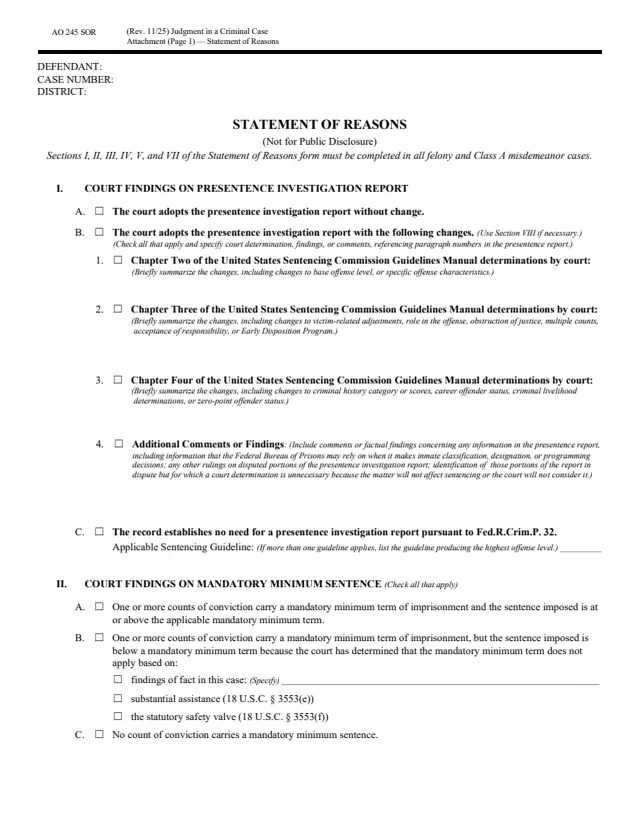
AO 245SOR
125 fields, 4 pages
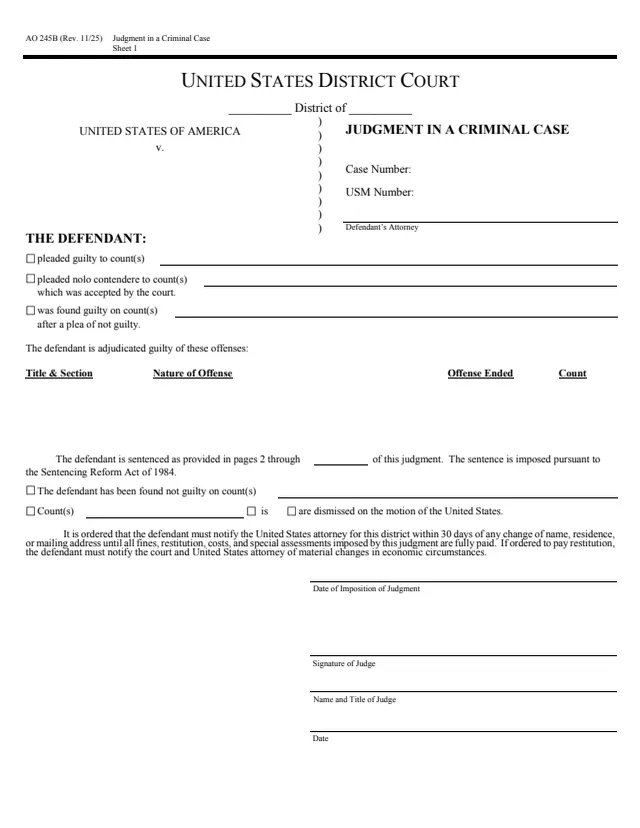
AO 245B
767 fields, 25 pages
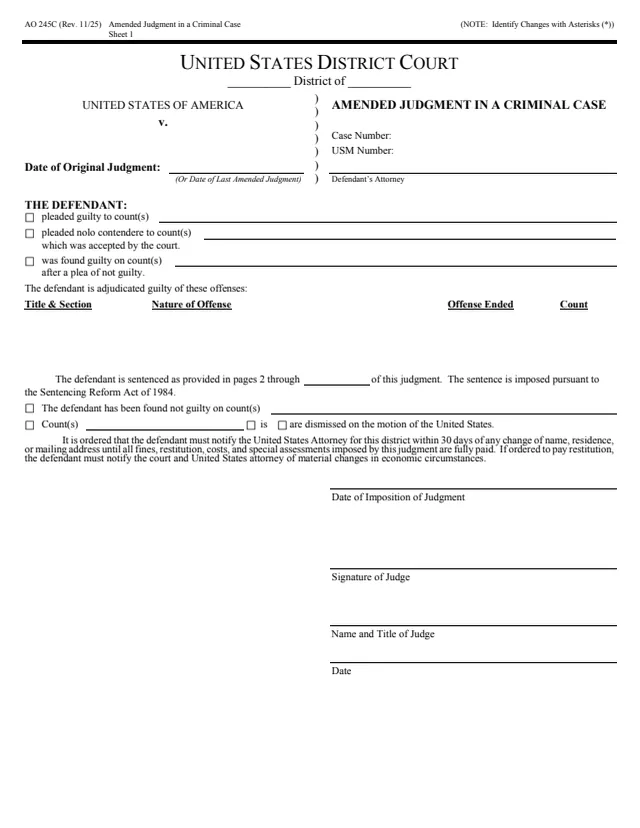
AO 245C
638 fields, 22 pages
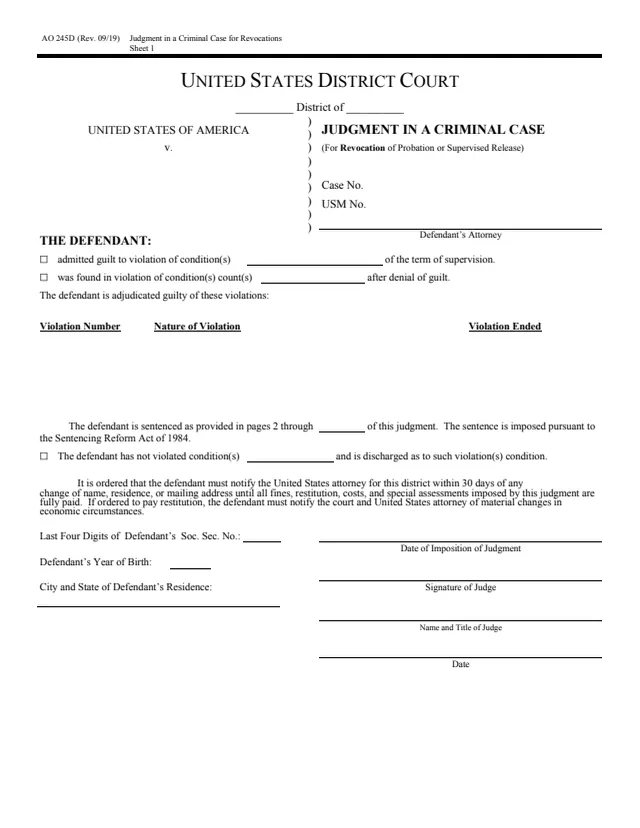
AO 245D
566 fields, 21 pages
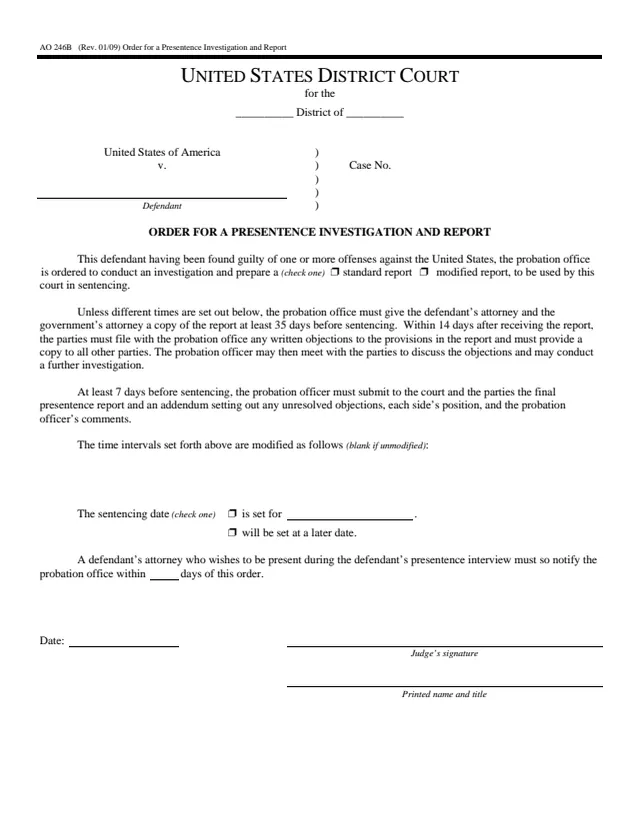
AO 246B
14 fields, 1 page
The court completes the attachment. These are the people and parties it names.
No tool matches that search.
The court. The judge signs page 2 under the date of imposition of judgment and enters the date signed. The form has no signature line for the defendant organization.
Page 1 of the Statement of Reasons is marked Not for Public Disclosure.
The court's determination of the guideline range: the total offense level, base fine, total culpability score and fine range, and boxes for a criminal purpose organization, fine guidelines that do not apply, an inability to pay, disgorgement, a fine waived or below the range for inability to pay, and a fine offset.
A number of identifiable victims so large as to make restitution impracticable, complex issues of fact that would complicate or prolong sentencing, a burden on the sentencing process that outweighs the need for restitution, or other reasons. It also has a box for partial restitution under 18 U.S.C. § 3553(c).
AO 245E is the Statement of Reasons for a defendant organization and works from a guideline fine range with a base fine and culpability score. AO 245SOR is the Statement of Reasons attachment to the Judgment in a Criminal Case.
The form does not print one. It is an attachment the court completes and the judge signs.