Caption
The district, the matter of the search (a brief description of the property to be searched, or the person's name and address) and a Case No. line.
AO 106A
Application for a Warrant by Telephone or Other Reliable Electronic Means
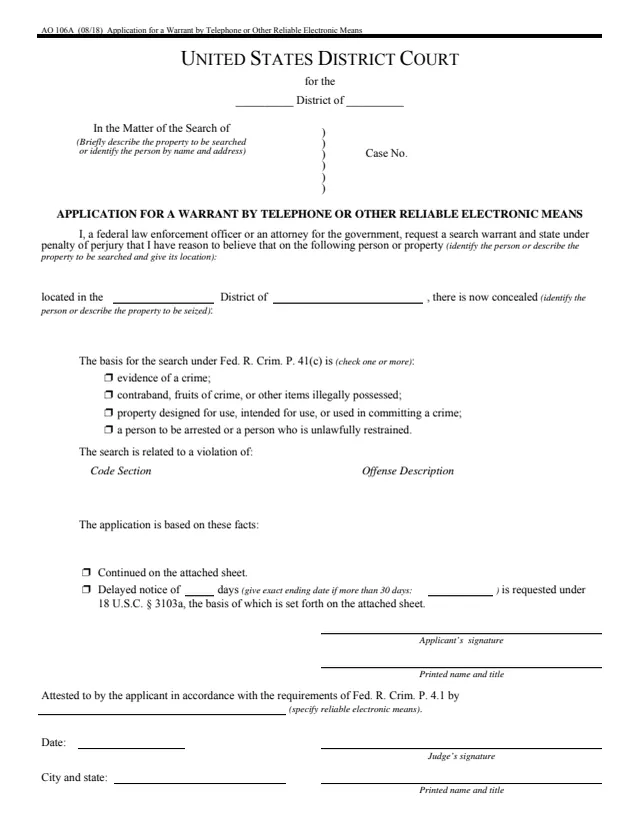
AO 106A, Application for a Warrant by Telephone or Other Reliable Electronic Means, is a United States District Court form from the U.S. Courts. The U.S. Courts page lists it under Law Enforcement, Grand Jury, and Prosecution Forms, effective on August 1, 2018, and the PDF prints the edition AO 106A (08/18).
The form is written in the words of a federal law enforcement officer or an attorney for the government, who requests a search warrant and states under penalty of perjury which person or property is to be searched, what is concealed there, the basis for the search under Fed. R. Crim. P. 41(c), the code sections involved and the facts. Instead of a line sworn in the judge's presence, it closes with an attestation "in accordance with the requirements of Fed. R. Crim. P. 4.1" by a reliable electronic means the form asks to specify, and a judge's signature. It is not a form a member of the public completes.
This page explains the form in plain words and is not legal advice. You can fill it out free in your browser on this page and download the result without an account.
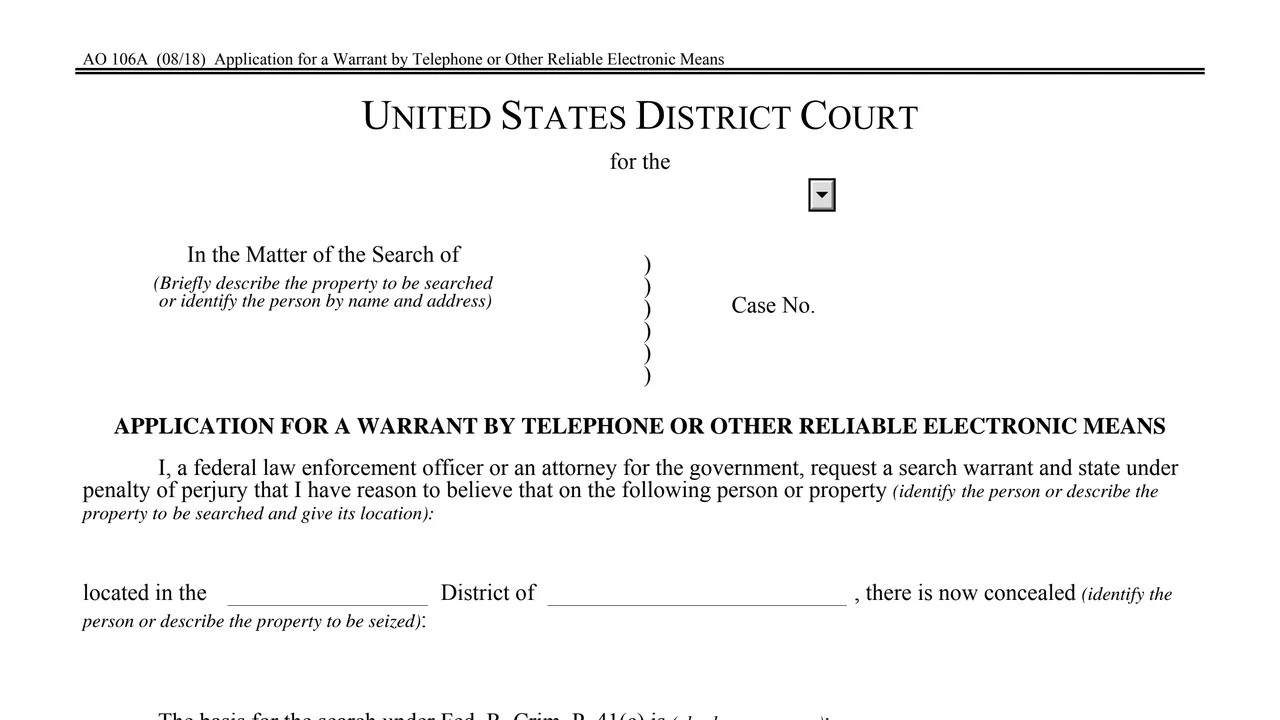
The district, the matter of the search (a brief description of the property to be searched, or the person's name and address) and a Case No. line.
The person or property to be searched and its location, the district it is in, and the person or property to be seized that is concealed there.
Under Fed. R. Crim. P. 41(c), one or more boxes: evidence of a crime; contraband, fruits of crime, or other items illegally possessed; property designed for use, intended for use, or used in committing a crime; a person to be arrested or a person who is unlawfully restrained.
A Code Section and Offense Description table, the facts the application is based on, a box for "Continued on the attached sheet," and a box to request delayed notice under 18 U.S.C. § 3103a.
The line "Attested to by the applicant in accordance with the requirements of Fed. R. Crim. P. 4.1 by" followed by a blank to specify the reliable electronic means.
The applicant's signature and printed name and title, then the date, the judge's signature, the city and state, and the judge's printed name and title.
Enter the district, then briefly describe the property to be searched or identify the person by name and address, as the caption asks. A Case No. line sits beside it.
Identify the person or describe the property to be searched and give its location, name the district, and identify the person or describe the property to be seized.
Check one or more of the Fed. R. Crim. P. 41(c) boxes, then list each code section and offense description the search is related to.
Write the facts the application is based on and check "Continued on the attached sheet" if they continue. A delayed notice request gives the days, the exact ending date if more than 30 days, and the basis on the attached sheet.
In the attestation line, specify the reliable electronic means by which the applicant attested to the application under Fed. R. Crim. P. 4.1.
The applicant signs and prints a name and title. The judge's block has the date, the judge's signature, the city and state, and a printed name and title.
You get the real form, filled in a browser tab, with nothing standing between you and the finished PDF.
The form is captioned for a United States District Court, with the district named at the top.
The applicant states the facts under penalty of perjury and attests to the application in accordance with the requirements of Fed. R. Crim. P. 4.1, by the reliable electronic means written on the form.
The form does not print a fee.
The U.S. Courts page offers AO 106A as a PDF (751.83 KB). The PDF has Print, Save As, Attach and Reset buttons.
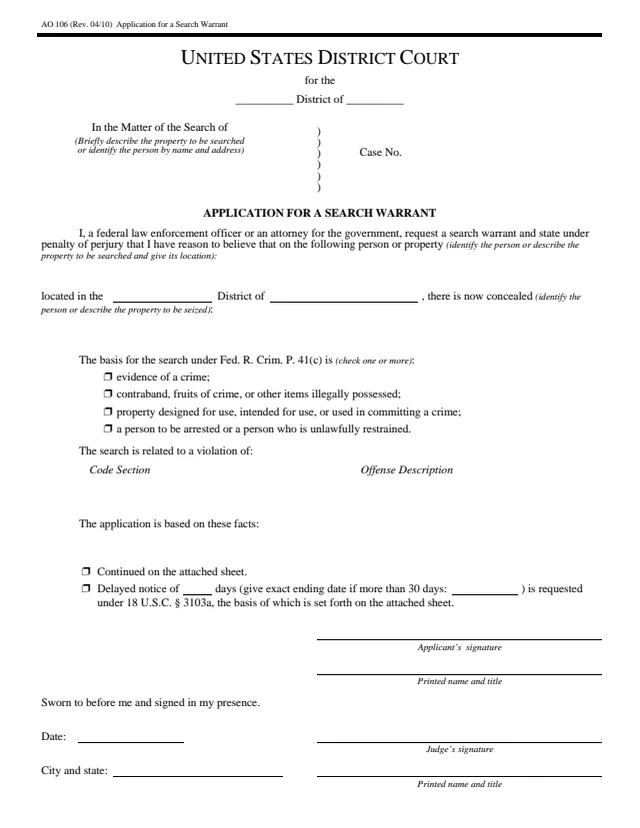
AO 106
28 fields, 1 page
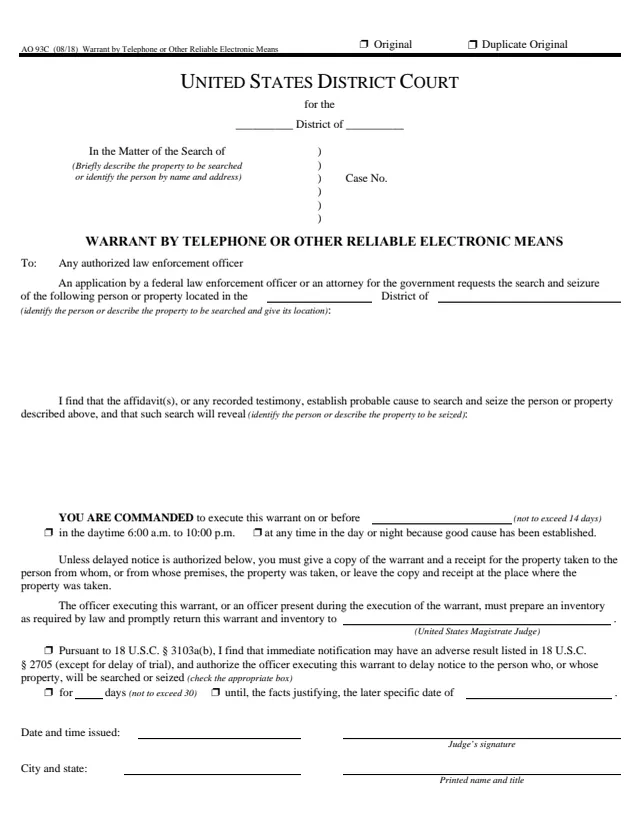
AO 93C
29 fields, 2 pages
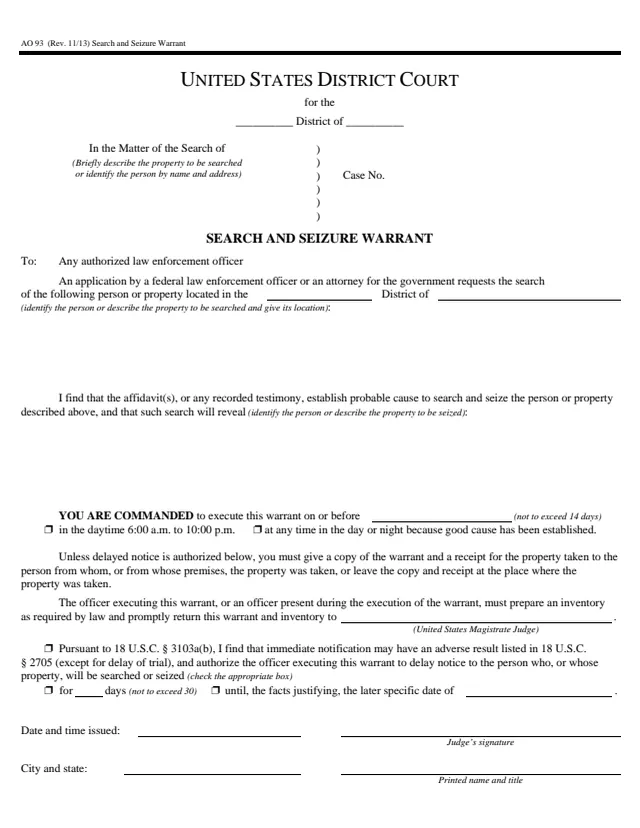
AO 93
28 fields, 2 pages
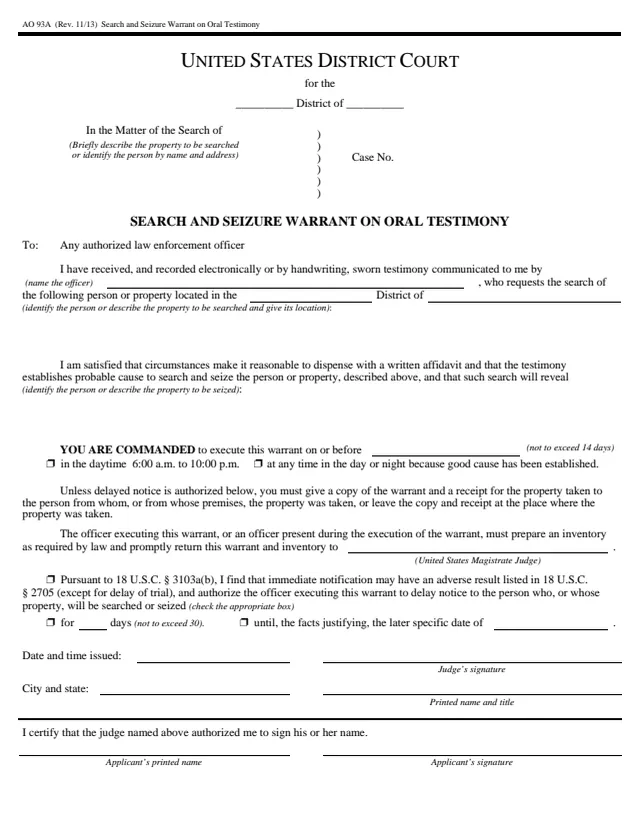
AO 93A
31 fields, 2 pages
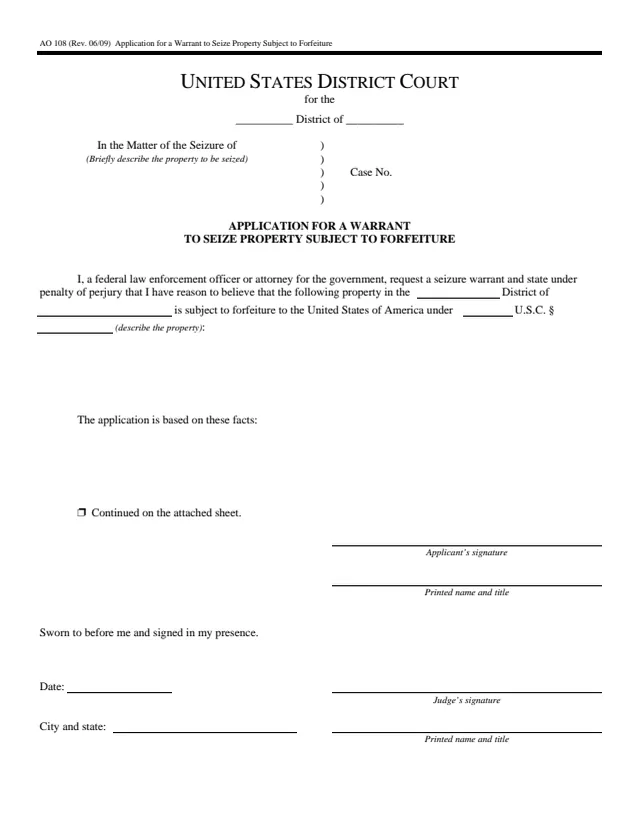
AO 108
20 fields, 1 page
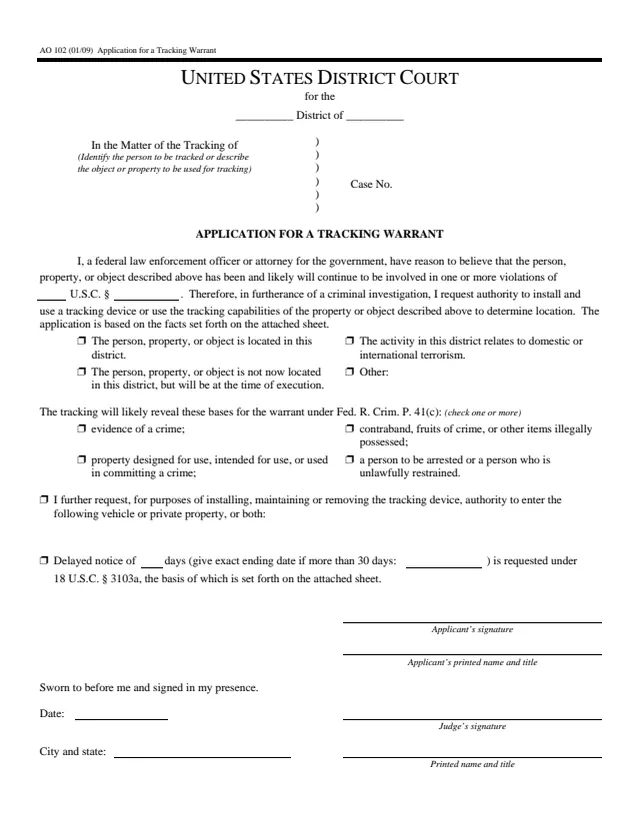
AO 102
28 fields, 1 page
The form names its applicant in its first line and leaves a signature block for a judge.
No tool matches that search.
The form's first line names the applicant as a federal law enforcement officer or an attorney for the government. A judge signs the bottom of the form. It is not a form a member of the public completes.
Both ask for the same search details. AO 106 closes with "Sworn to before me and signed in my presence." AO 106A instead closes with an attestation by the applicant in accordance with Fed. R. Crim. P. 4.1 by a reliable electronic means that the form asks to specify.
Under Fed. R. Crim. P. 41(c), the form lists four boxes: evidence of a crime; contraband, fruits of crime, or other items illegally possessed; property designed for use, intended for use, or used in committing a crime; and a person to be arrested or a person who is unlawfully restrained.
Yes. It has a box to request delayed notice of a number of days under 18 U.S.C. § 3103a, with the exact ending date if more than 30 days and the basis set forth on the attached sheet.
No. The form does not print a fee.
No. This page explains the form in plain words and is not legal advice. It does not say whether a warrant should be requested or granted.