Original or duplicate and caption
Boxes for Original and Duplicate Original, then the district, "In the Matter of the Search of" with a brief description of the property or the person's name and address, and a Case No. line.
AO 93C
Warrant by Telephone or Other Reliable Electronic Means
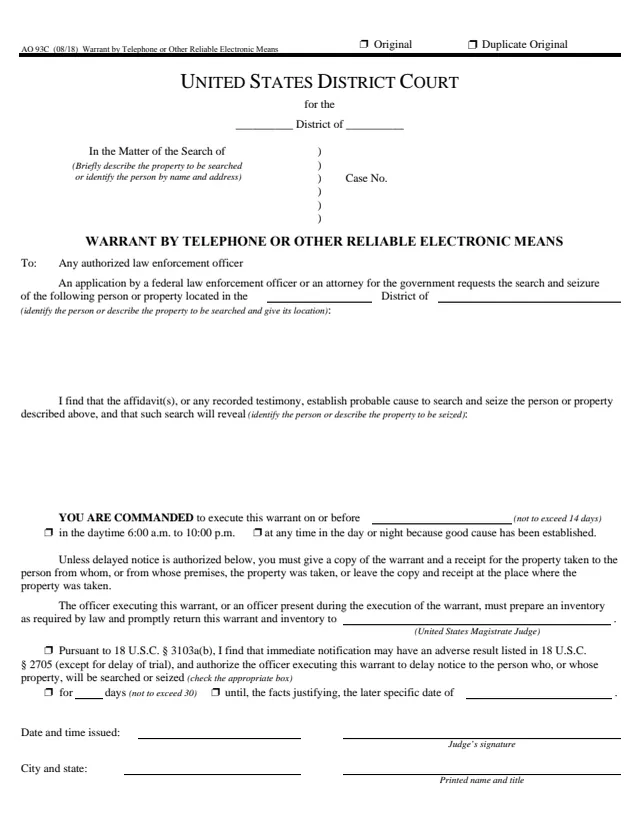
AO 93C, Warrant by Telephone or Other Reliable Electronic Means, is a United States District Court form from the U.S. Courts. The U.S. Courts page lists it under Law Enforcement, Grand Jury, and Prosecution Forms, effective on August 1, 2018, and the PDF prints the edition AO 93C (08/18).
It is a search and seizure warrant the court issues, not an application. The top of page 1 has boxes for Original and Duplicate Original. Page 1 is addressed "To: Any authorized law enforcement officer," identifies the person or property to be searched and what is to be seized, records the judge's finding of probable cause, and sets the time limits and notice terms. Page 2 is the Return, where the executing officer lists the property taken and certifies the inventory under penalty of perjury. It is not a form a member of the public completes.
This page explains the form in plain words and is not legal advice. You can fill it out free in your browser on this page and download the result without an account.
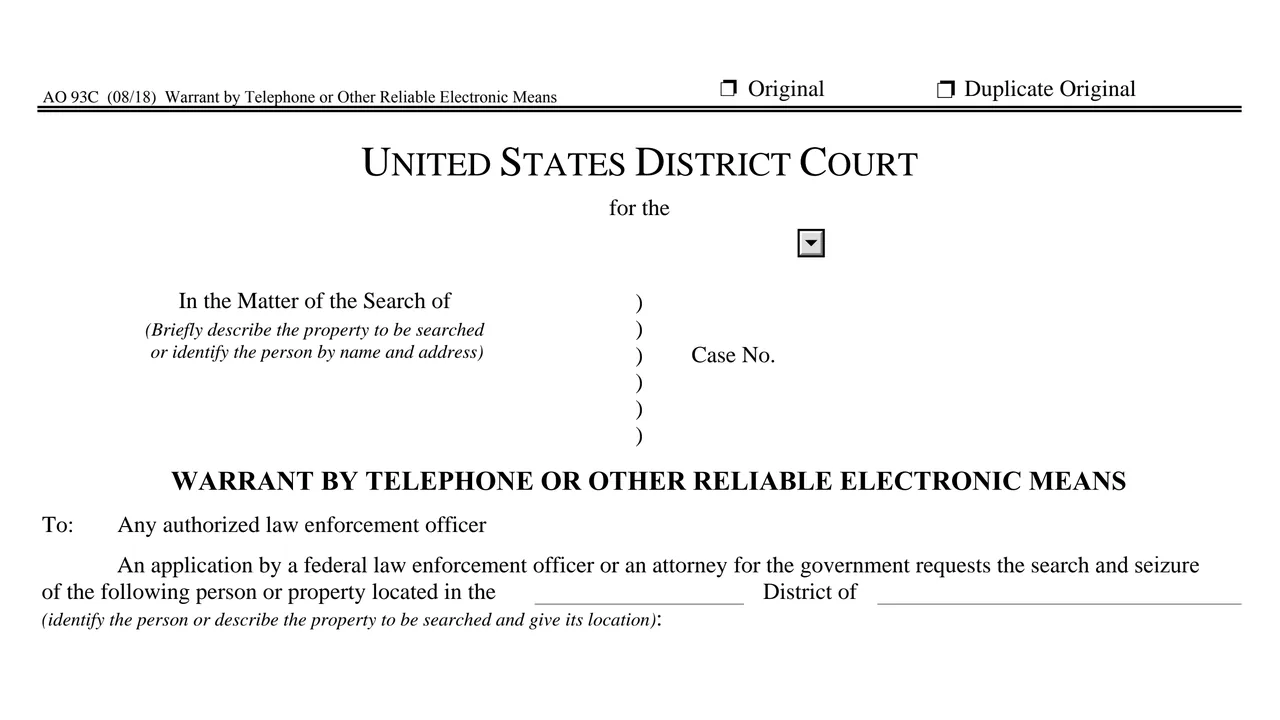
Boxes for Original and Duplicate Original, then the district, "In the Matter of the Search of" with a brief description of the property or the person's name and address, and a Case No. line.
The district where the person or property is located, its description and location, then the judge's finding of probable cause and what the search will reveal.
The command to execute the warrant on or before a date (not to exceed 14 days), with boxes for "in the daytime 6:00 a.m. to 10:00 p.m." or "at any time in the day or night because good cause has been established."
Terms for leaving a copy of the warrant and a receipt, preparing an inventory as required by law, and returning the warrant and inventory to the named United States Magistrate Judge.
A box under 18 U.S.C. § 3103a(b) for a finding that immediate notification may have an adverse result listed in 18 U.S.C. § 2705 (except for delay of trial), with a choice of a number of days (not to exceed 30) or a later specific date.
Page 2 records the case number, the date and time executed, who the copy and inventory were left with, who was present for the inventory, and the property taken and the name(s) of any person(s) seized, then a certification under penalty of perjury.
Check the Original or the Duplicate Original box at the top of page 1.
Enter the district, the matter line and the case number, then identify the person or property to be searched, its location, and what the search will reveal.
Enter the date the warrant is to be executed by, check the daytime or any time box, name the United States Magistrate Judge for the return, and check the delayed notice box only if it is authorized.
The judge enters the date and time issued and the city and state, then signs and adds a printed name and title.
After execution, page 2 records the execution details and the inventory, and the executing officer declares under penalty of perjury that the inventory is correct and was returned with the original warrant to the designated judge.
You get the real form, filled in a browser tab, with nothing standing between you and the finished PDF.
The warrant is captioned for a United States District Court, with the district named at the top.
The warrant is to be executed on or before a date "not to exceed 14 days," and delayed notice is "for ___ days (not to exceed 30)" or until a later specific date.
The form says the officer executing the warrant, or an officer present during the execution, prepares an inventory and promptly returns the warrant and inventory to the United States Magistrate Judge named on page 1.
The form does not print a fee.
The U.S. Courts page offers AO 93C as a PDF (585.46 KB). The PDF has Print, Save As and Reset buttons.
AO 106A
29 fields, 1 page
AO 93
28 fields, 2 pages
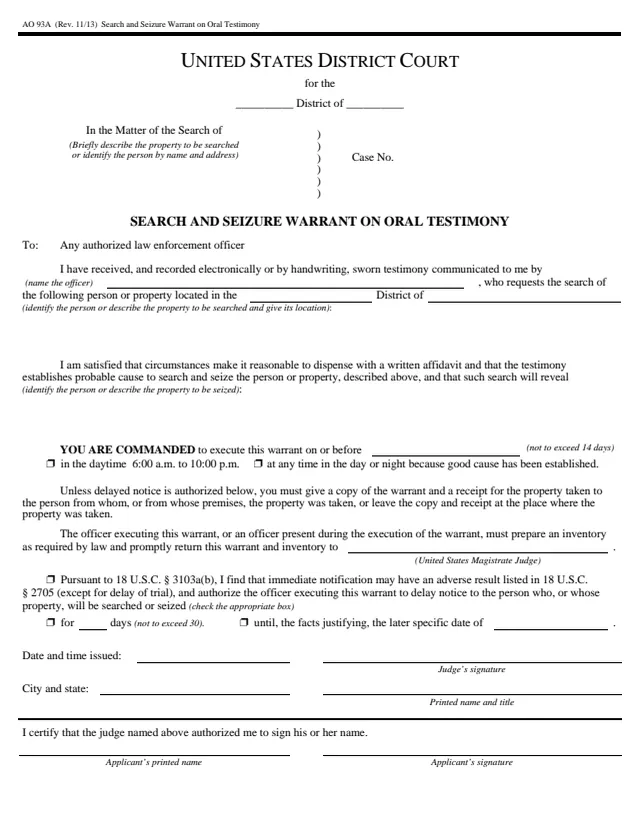
AO 93A
31 fields, 2 pages
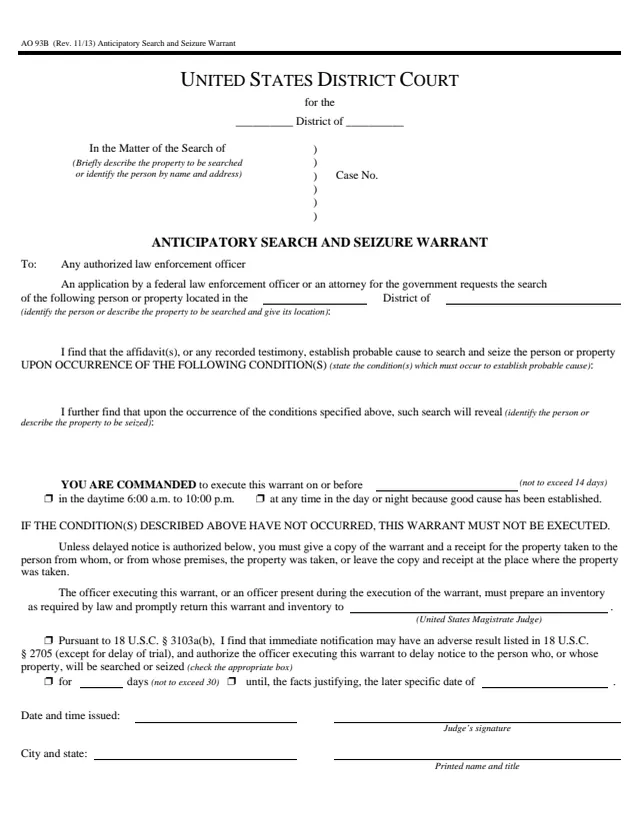
AO 93B
29 fields, 2 pages
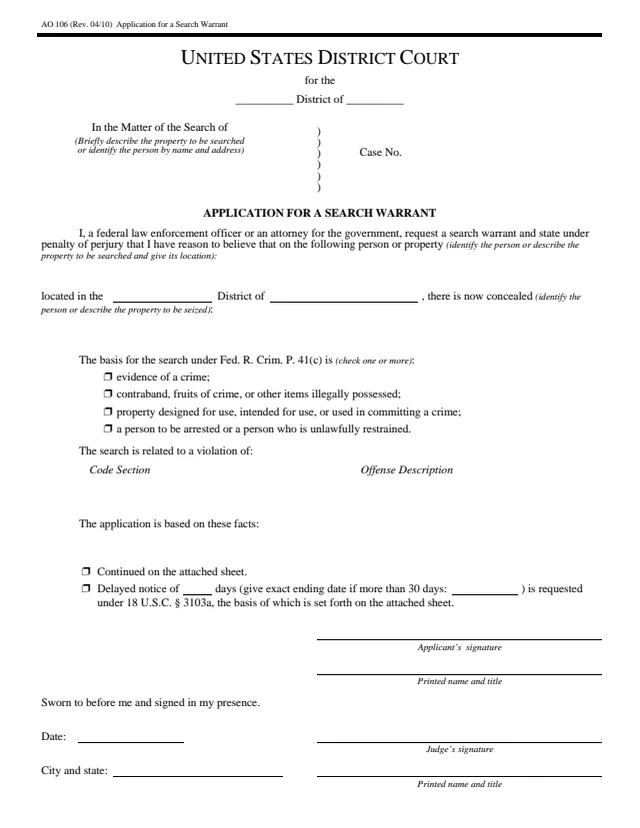
AO 106
28 fields, 1 page
The form is issued and signed by a judge and completed on page 2 by the officer who executes it.
No tool matches that search.
A judge. The judge signs page 1 with the date and time issued and a printed name and title. The form says an application by a federal law enforcement officer or an attorney for the government requests the search and seizure.
They are two check boxes at the top of page 1 of AO 93C. The form and its U.S. Courts page do not print instructions for them.
The warrant is to be executed on or before a date not to exceed 14 days, and the judge checks either "in the daytime 6:00 a.m. to 10:00 p.m." or "at any time in the day or night because good cause has been established."
Unless delayed notice is authorized, the form says a copy of the warrant and a receipt for the property taken are given to the person from whom, or from whose premises, the property was taken, or left at the place where it was taken.
The Return: the case number, the date and time executed, who the copy and inventory were left with, who was present for the inventory, the property taken and the name(s) of any person(s) seized, and the executing officer's certification under penalty of perjury.
No. This page explains the form in plain words from the U.S. Courts form and its page. It does not say whether a warrant is valid or how it applies to anyone.