Caption
The district, the case title In the Matter of the Tracking of, which identifies the person to be tracked or describes the object or property to be used for tracking, and the case number.
AO 102
Application for a Tracking Warrant
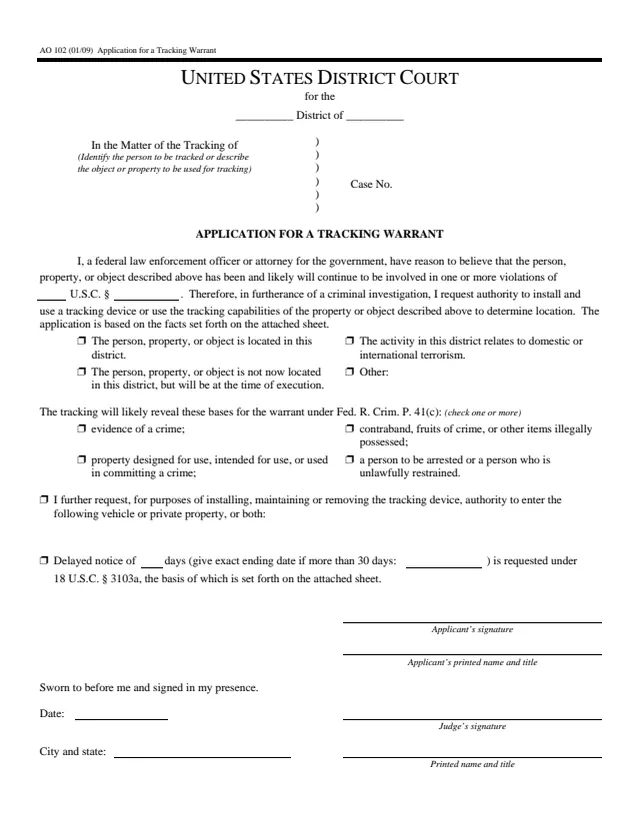
AO 102, Application for a Tracking Warrant, is a form from the U.S. Courts in which a federal law enforcement officer or attorney for the government asks a United States District Court, in furtherance of a criminal investigation, for authority to install and use a tracking device or use the tracking capabilities of the property or object described to determine location. The U.S. Courts list it under Law Enforcement, Grand Jury, and Prosecution Forms. The PDF prints the edition (01/09), and the U.S. Courts page lists it as effective on January 1, 2009.
The one-page application names the U.S. Code violations involved, where the person, property or object is located, the bases for the warrant under Fed. R. Crim. P. 41(c), any request to enter a vehicle or private property, and any request for delayed notice under 18 U.S.C. § 3103a. The facts go on an attached sheet. The applicant signs it, and it is sworn to before a judge, who signs it. The form is written for federal officers and government attorneys, not for members of the public.
This page explains the form in plain words and is not legal advice. You can fill it out free in your browser on this page and download the result without an account.
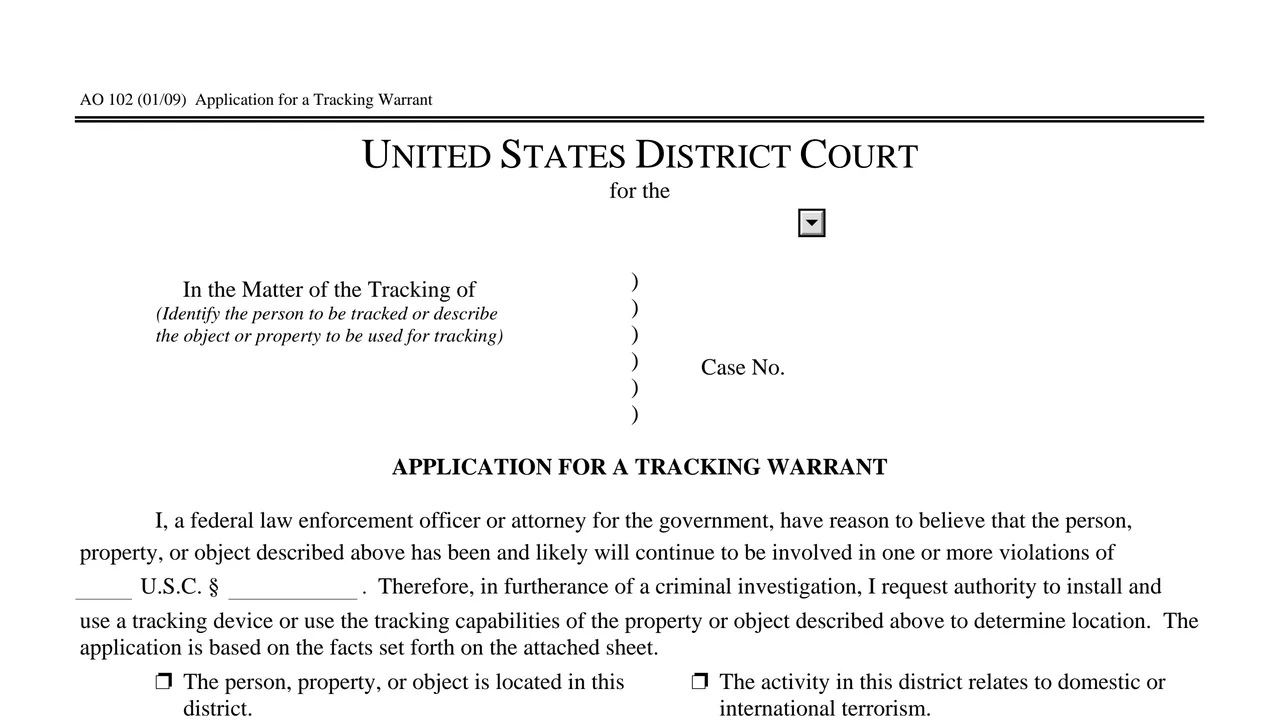
The district, the case title In the Matter of the Tracking of, which identifies the person to be tracked or describes the object or property to be used for tracking, and the case number.
The applicant's statement of reason to believe the person, property or object has been and likely will continue to be involved in violations of the U.S. Code section named, and the request for tracking authority. The facts go on the attached sheet.
Boxes for: located in this district; not now located in this district, but will be at the time of execution; the activity in this district relates to domestic or international terrorism; or other.
Check one or more: evidence of a crime; contraband, fruits of crime, or other items illegally possessed; property designed for use, intended for use, or used in committing a crime; a person to be arrested or a person who is unlawfully restrained.
Optional requests for authority to enter a named vehicle or private property to install, maintain or remove the device, and for delayed notice of a number of days under 18 U.S.C. § 3103a, with an exact ending date if more than 30 days.
The applicant's signature and printed name and title, then the date, the judge's signature, the city and state, and the judge's printed name and title.
Enter the district, identify the person to be tracked or describe the object or property to be used for tracking, and add the case number.
Fill in the U.S. Code title and section in the opening statement. The form says the application is based on the facts set forth on the attached sheet.
Check the location box that applies and one or more bases for the warrant under Fed. R. Crim. P. 41(c).
If authority to enter a vehicle or private property is requested, check that box and describe the vehicle or property in the space below it.
Check the delayed notice box, enter the number of days, and give the exact ending date if more than 30 days. The basis goes on the attached sheet.
The applicant signs and prints a name and title. The form says the application is sworn to before the judge and signed in the judge's presence.
You get the real form, filled in a browser tab, with nothing standing between you and the finished PDF.
The application is captioned for the United States District Court for the district named at the top and is sworn to before a judge, who dates and signs it.
The form says the application is based on the facts set forth on the attached sheet, and that the basis for any delayed notice request is set forth there too.
The form and its U.S. Courts page do not print a fee.
The form asks for delayed notice to be requested under 18 U.S.C. § 3103a, with the number of days and an exact ending date if more than 30 days.
The PDF prints AO 102 (01/09). The U.S. Courts page lists it under Law Enforcement, Grand Jury, and Prosecution Forms, effective on January 1, 2009.
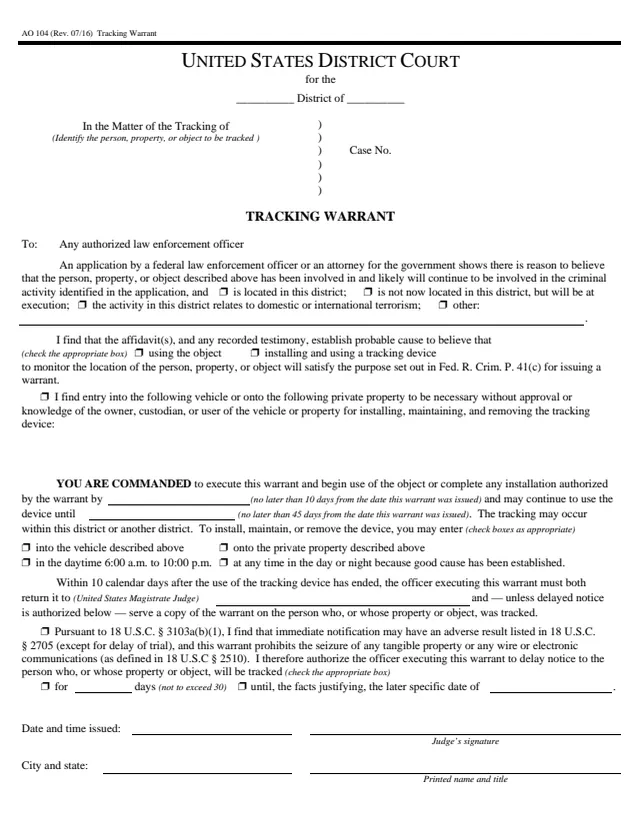
AO 104
37 fields, 2 pages
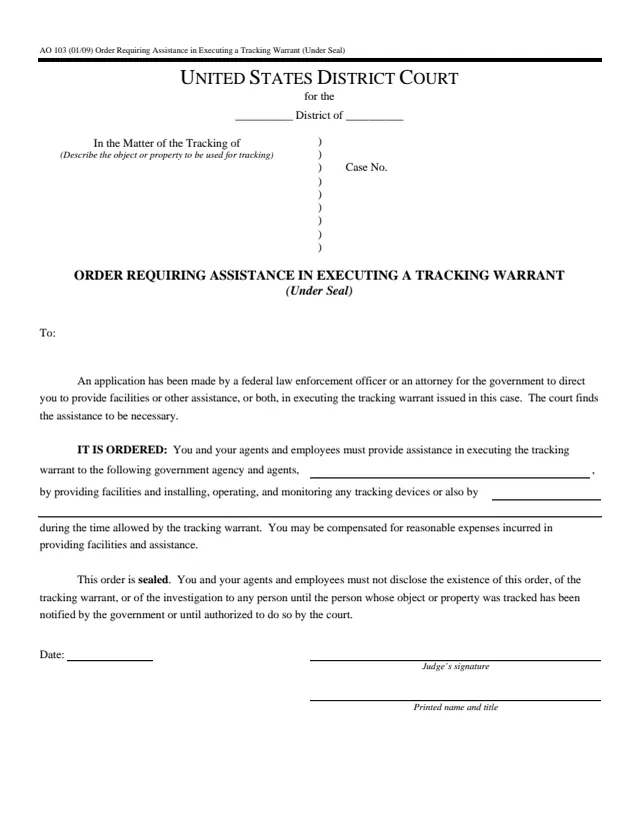
AO 103
13 fields, 1 page
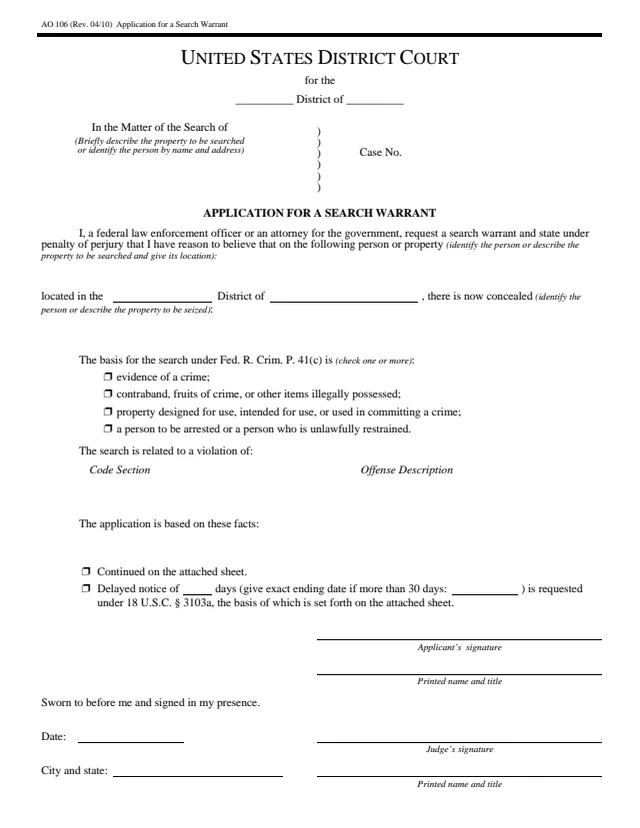
AO 106
28 fields, 1 page
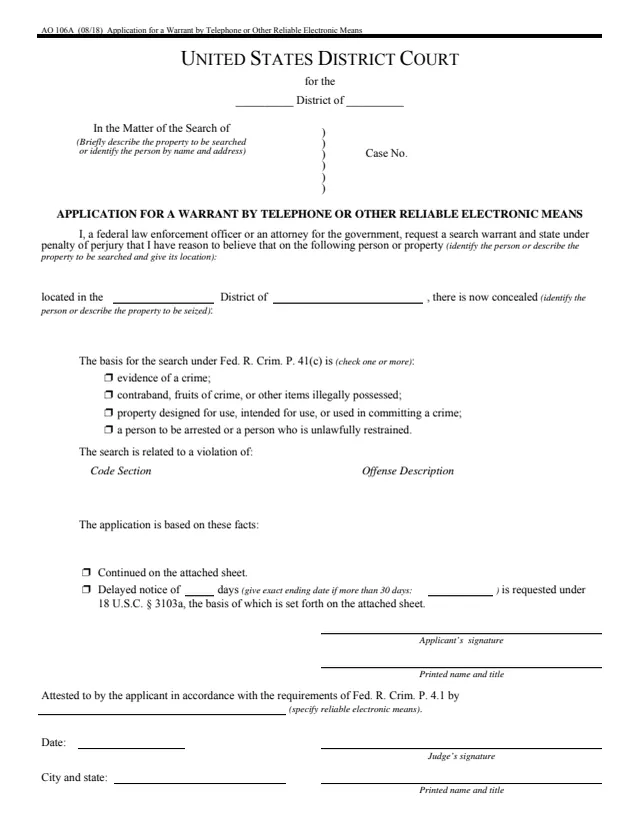
AO 106A
29 fields, 1 page
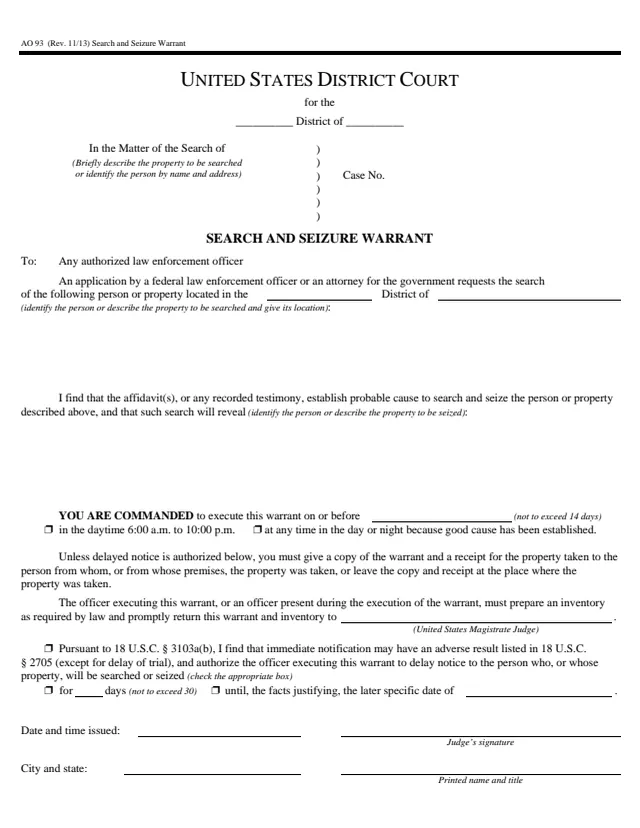
AO 93
28 fields, 2 pages
The form names who applies and who the application is sworn before.
No tool matches that search.
The form is written for a federal law enforcement officer or attorney for the government, who signs as the applicant. It is not a form for members of the public.
A judge. The form says "Sworn to before me and signed in my presence," with the date, the judge's signature, the city and state, and the judge's printed name and title.
Under Fed. R. Crim. P. 41(c): evidence of a crime; contraband, fruits of crime, or other items illegally possessed; property designed for use, intended for use, or used in committing a crime; and a person to be arrested or a person who is unlawfully restrained. One or more may be checked.
On an attached sheet. The form says the application is based on the facts set forth on the attached sheet.
It has a box to request delayed notice of a number of days under 18 U.S.C. § 3103a, with an exact ending date if more than 30 days, and the basis set forth on the attached sheet.
AO 102 does not name one. The U.S. Courts forms include AO 104, Tracking Warrant, and AO 103, Order Requiring Assistance in Executing a Tracking Warrant (Under Seal).
No. This page explains the form in plain words and is not legal advice.