AO 104

Tracking Warrant

Agency
U.S. Courts
Revision
Rev. 07/16
Fillable fields
37
Pages
2
Official source
U.S. Courts form page
Checked
October 20, 2026
Fill AO 104 online
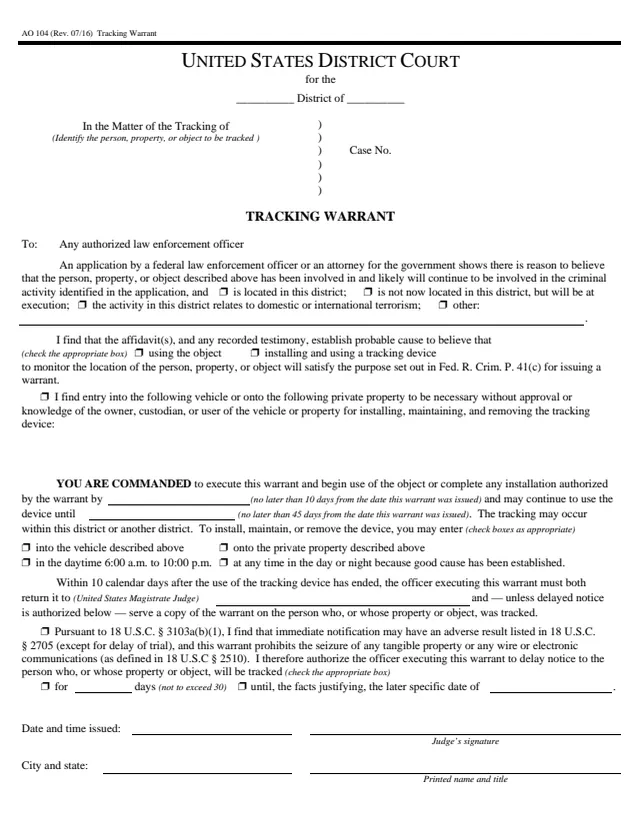
Page 1 of form AO 104

AO 104: Tracking Warrant

AO 104, Tracking Warrant, is a warrant a judge of a United States District Court issues to any authorized law enforcement officer. It rests on an application by a federal law enforcement officer or an attorney for the government and covers using an object, or installing and using a tracking device, to monitor the location of a person, property or object. The U.S. Courts list it under Law Enforcement, Grand Jury, and Prosecution Forms. The current version is Rev. 07/16, and the U.S. Courts page lists it as effective on July 1, 2016.

Page 1 is the warrant itself: the judge's findings, the dates for starting and ending use of the device, the entry and timing allowed, the return, and any delayed notice. Page 2 is the return, which the executing officer completes with installation or without installation and certifies under penalty of perjury. It is a court-issued warrant, not a form members of the public file.

This page explains the form in plain words and is not legal advice. You can fill it out free in your browser on this page and download the result without an account.

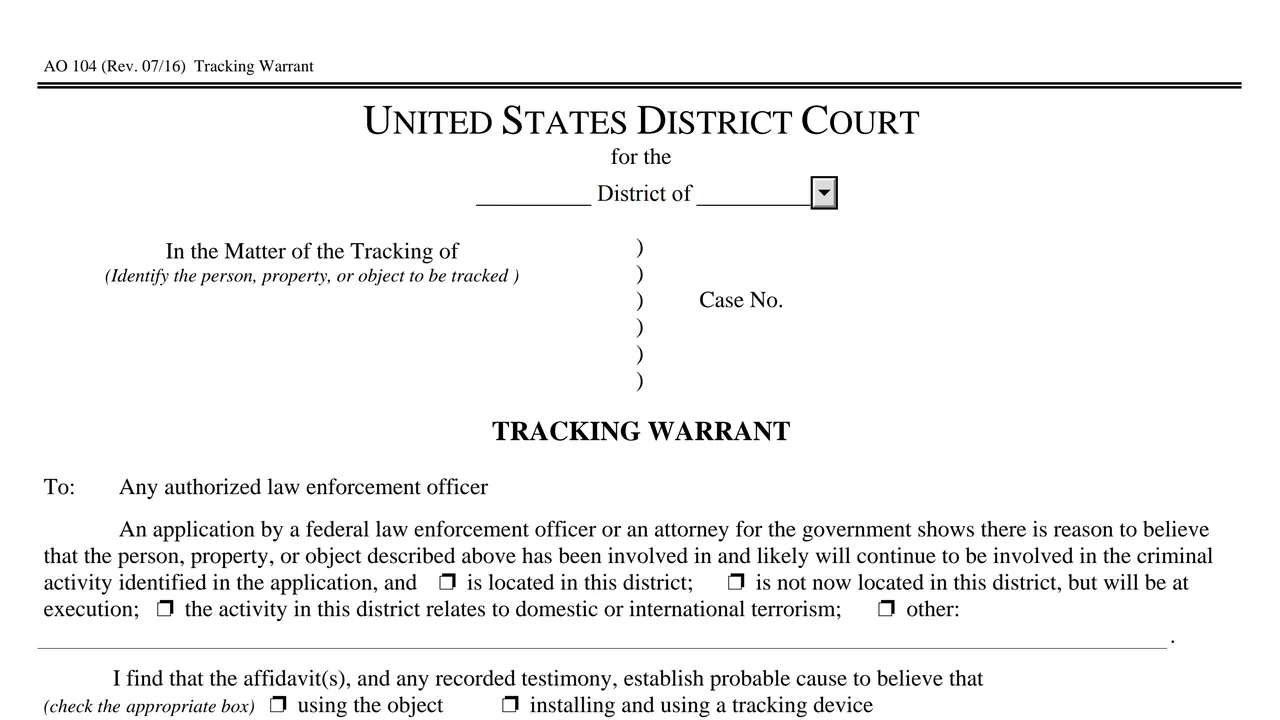
Top of page 1 of AO 104: Tracking Warrant, as printed by COURTS

What's on AO 104

Caption and findings

The district, the case title In the Matter of the Tracking of, the case number, and the judge's findings on location and on probable cause for using the object or installing and using a tracking device under Fed. R. Crim. P. 41(c).
Entry

An optional finding that entry into a named vehicle or onto named private property is necessary without approval or knowledge of the owner, custodian or user, with boxes for the vehicle or property and for daytime 6:00 a.m. to 10:00 p.m. or any time for good cause.

Dates of use

A date to begin use or complete installation, no later than 10 days from the date the warrant was issued, and a date use may continue until, no later than 45 days from that date. Tracking may occur within this district or another district.

Return and delayed notice

The return to the United States Magistrate Judge named, and a box for delayed notice under 18 U.S.C. § 3103a(b)(1) for a number of days, not to exceed 30, or until a later specific date.

Page 2: Return

With installation: the dates and times the device was installed, maintained and removed and the period it was used. Without installation: the date the warrant was executed and the period the tracking information was obtained from.

Certification

The executing officer declares under penalty of perjury that the return is correct and was returned along with the original warrant to the designated judge, then dates and signs it with a printed name and title.

How to fill out AO 104

  1. 1

    Fill in the caption

    Enter the district, identify the person, property or object to be tracked, and add the case number.

  2. 2

    Mark the findings

    Check the location box that applies and whether the warrant covers using the object or installing and using a tracking device. If entry is found necessary, check that box and describe the vehicle or property.

  3. 3

    Set the dates and entry terms

    Enter the date to begin use, no later than 10 days from issue, and the date use ends, no later than 45 days from issue. Check the entry and daytime or any time boxes that apply.

  4. 4

    Name the judge for the return

    Enter the United States Magistrate Judge the warrant is returned to. If delayed notice is authorized, check the box and enter the days, not to exceed 30, or a later specific date.

  5. 5

    Issue and sign

    The judge enters the date and time issued and the city and state, signs, and adds a printed name and title.

  6. 6

    Complete the return

    After tracking ends, the executing officer completes the With Installation or Without Installation return on page 2 and signs the certification.

Why fill Form AO 104 on indox

You get the real form, filled in a browser tab, with nothing standing between you and the finished PDF.

  • Fill the form right in your browser, no software to install
  • Free to fill and free to download, with no account
  • The official blank straight from the U.S. Courts, not a copy someone retyped
  • Works on a phone, tablet or computer

Return, notice and fees

Court

The warrant is captioned for the United States District Court for the district named at the top and signed by a judge. It says the tracking may occur within this district or another district.

Return deadline

The form says that within 10 calendar days after the use of the tracking device has ended, the officer executing the warrant returns it to the United States Magistrate Judge named on page 1.

Notice to the person tracked

Unless delayed notice is authorized, the executing officer serves a copy of the warrant on the person who, or whose property or object, was tracked. Delayed notice is for a number of days, not to exceed 30, or until a later specific date the facts justify.

Delayed notice terms

The delayed notice finding refers to an adverse result listed in 18 U.S.C. § 2705 (except for delay of trial) and says the warrant prohibits the seizure of any tangible property or any wire or electronic communications (as defined in 18 U.S.C § 2510).

Fees

The form and its U.S. Courts page do not print a fee.

Who uses AO 104?

  • The judge

    The judge finds that the affidavits and any recorded testimony establish probable cause, then signs page 1 with the date and time issued, the city and state, and a printed name and title.

  • Any authorized law enforcement officer

    The warrant is addressed "To: Any authorized law enforcement officer" and commands the officer to execute it within the dates it sets.

  • The applicant

    The warrant says it rests on an application by a federal law enforcement officer or an attorney for the government.

  • The executing officer

    Page 2 is completed and signed by the executing officer, who declares under penalty of perjury that the return is correct and was returned along with the original warrant to the designated judge.

  • The person tracked

    Unless delayed notice is authorized, the executing officer serves a copy of the warrant on the person who, or whose property or object, was tracked.

The warrant names who issues it, who executes it and who completes the return.

Official sources and the blank

Do it all with indox

View all 94 tools

Questions about Form AO 104

Who issues AO 104?

A judge of the United States District Court signs and issues it to any authorized law enforcement officer, on an application by a federal law enforcement officer or an attorney for the government. It is not a form members of the public file.

How long can the device be used under AO 104?

The form sets a date to begin use or complete installation, no later than 10 days from the date the warrant was issued, and a date use may continue until, no later than 45 days from the date the warrant was issued.

When may the officer enter to install the device?

The judge checks either in the daytime 6:00 a.m. to 10:00 p.m. or at any time in the day or night because good cause has been established.

When is the warrant returned?

The form says within 10 calendar days after the use of the tracking device has ended, to the United States Magistrate Judge named on the warrant.

Is the person tracked told about the warrant?

The form says the executing officer serves a copy of the warrant on the person who, or whose property or object, was tracked, unless delayed notice is authorized. Delayed notice is for a number of days, not to exceed 30, or until a later specific date.

What is on page 2 of AO 104?

The return. With installation, it records when the device was installed, maintained, removed and used. Without installation, it records the date the warrant was executed and the period the tracking information was obtained. The executing officer certifies it under penalty of perjury.

Is this page legal advice?

No. This page explains the form in plain words and is not legal advice.