Header
The submission identification number (SID), the taxpayer's and spouse's names, and their Social Security numbers.
8878
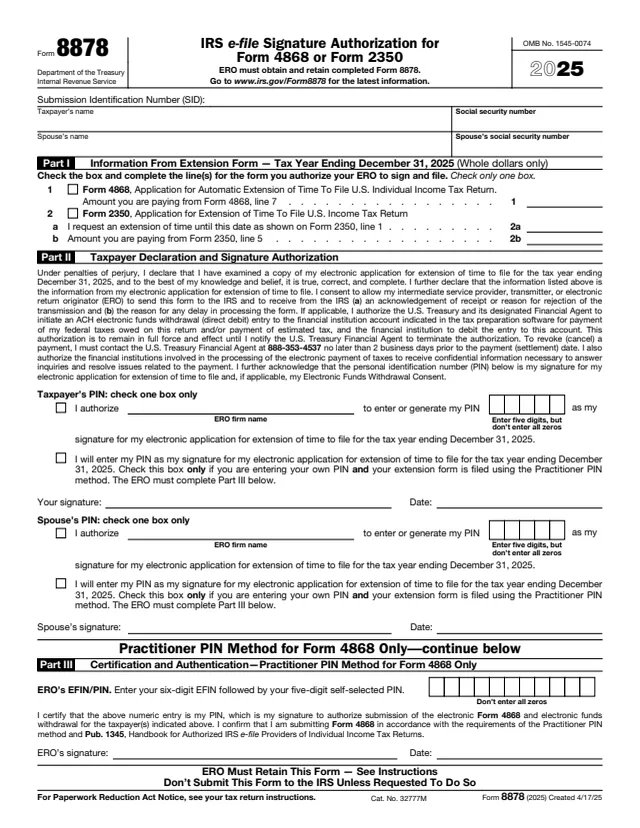
IRS e-file Signature Authorization for Form 4868 or Form 2350 (Spanish Version)
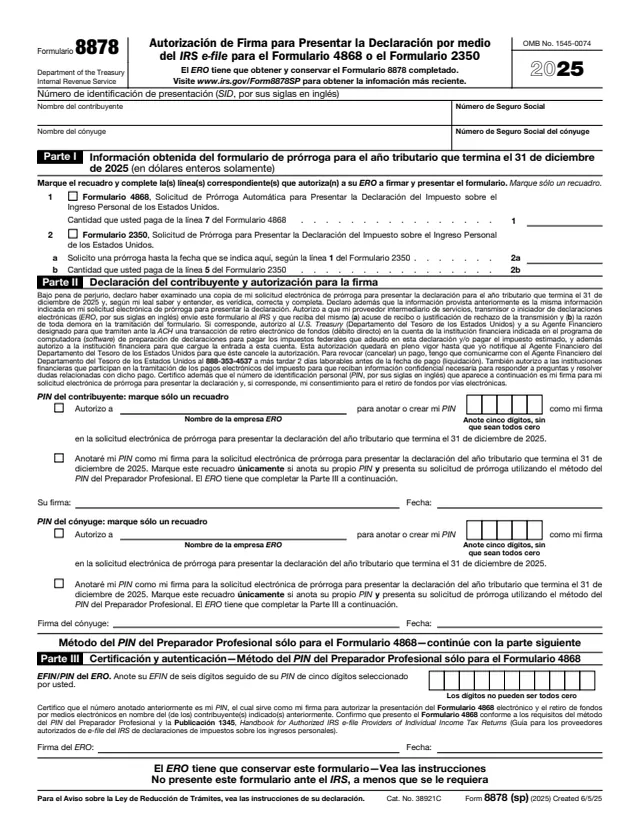
Form 8878 (SP), Autorización de Firma para Presentar la Declaración por medio del IRS e-file para el Formulario 4868 o el Formulario 2350, is the Spanish version of Form 8878. This 2025 edition covers an extension request for the tax year ending December 31, 2025. The form, its declaration and its instructions on page 2 are in Spanish.
The IRS About page says Form 8878 is completed when Form 4868 is filed using the Practitioner PIN method, or when the taxpayer authorizes the electronic return originator (ERO) to enter or generate the taxpayer's personal identification number (PIN) on Form 4868 or Form 2350. The form says the ERO obtains and keeps the completed Form 8878, and that it is not filed with the IRS unless requested. The instructions add that Form 8878 is not itself a request for an extension.
The English edition is Form 8878. You can fill out Form 8878 (SP) free in your browser on this page and download it without an account.
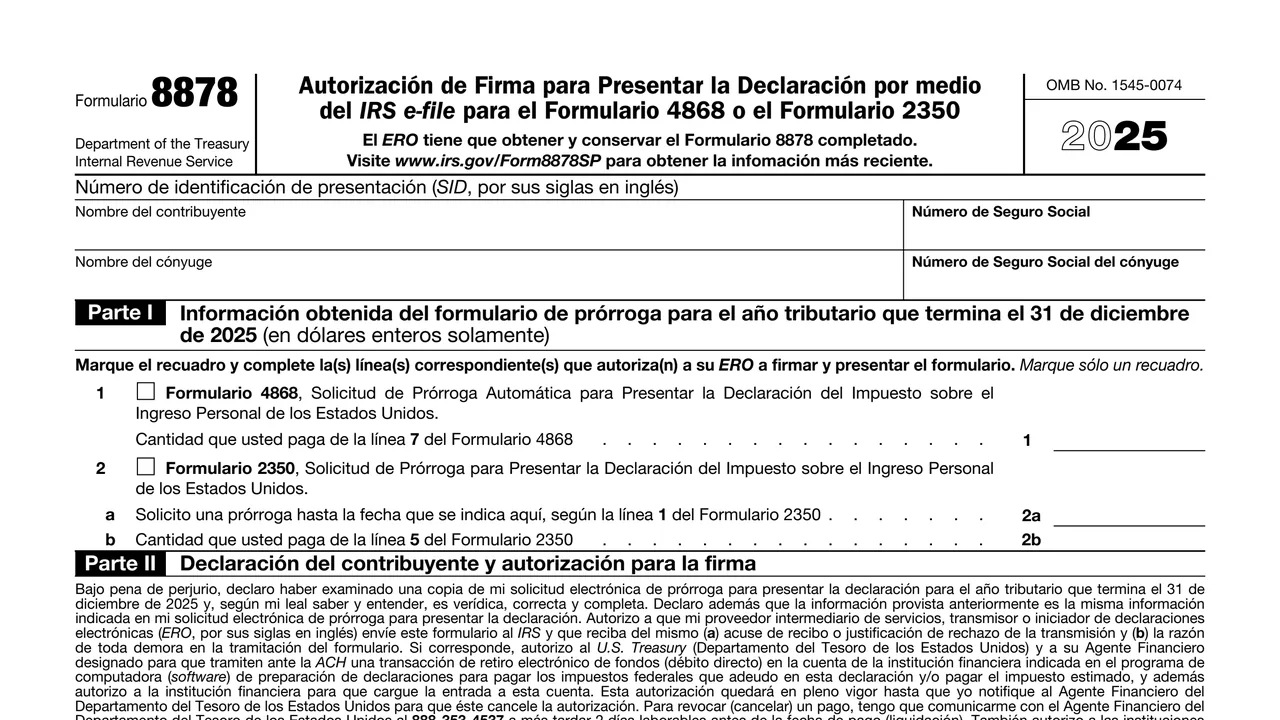
The submission identification number (SID), the taxpayer's and spouse's names, and their Social Security numbers.
In whole dollars. Line 1 is the amount paid from line 7 of Form 4868. Line 2a is the extension date from line 1 of Form 2350, and line 2b the amount paid from line 5 of Form 2350. One box only.
A declaration under penalties of perjury, authority for the ERO to send the form and receive acknowledgment, and, if it applies, authority for an electronic funds withdrawal.
Each checks one box: authorize the named ERO firm to enter or generate the PIN, five digits and not all zeros, or enter their own PIN, then sign and date.
For the Practitioner PIN method with Form 4868 only: the ERO's EFIN and PIN, a certification citing Publication 1345, and the ERO's signature.
A chart of when and how to complete the form, the ERO's and taxpayer's responsibilities, and important points for EROs.
The ERO enters the names and SSNs, then the information from the extension form selected in Part I.
If the taxpayer authorizes it, the ERO enters or generates the PIN in Part II and writes the ERO firm name, not the name of the individual preparer.
The taxpayer checks the extension request, checks the right box in Part II, and signs by hand or by electronic signature if the software supports it.
In person or by U.S. mail, private delivery service, email, website or fax. The request is not transmitted until the ERO receives the signed form.
The ERO enters the 20-digit SID or attaches Form 9325 after filing, and completes Part III only for the Practitioner PIN method.
You get the real form, filled in a browser tab, with nothing standing between you and the finished PDF.
The form says not to file it with the IRS unless requested. The ERO keeps it.
3 years from the return due date or the date the IRS received it, whichever is later. It can be kept electronically under Rev. Proc. 97-22.
The instructions say the ERO receives the completed and signed form from the taxpayer before transmitting the extension request.
The declaration says to contact the U.S. Treasury Financial Agent at 888-353-4537 no later than 2 business days before the payment (settlement) date.
For an electronic funds withdrawal on Form 4868 without the Practitioner PIN method, the ERO enters the taxpayer's date of birth and the prior-year adjusted gross income or PIN, or both.
The instructions say EROs may sign with a rubber stamp, a mechanical device such as a signature pen, or software, and point to Notice 2007-79.
8878
19 fields, 2 pages
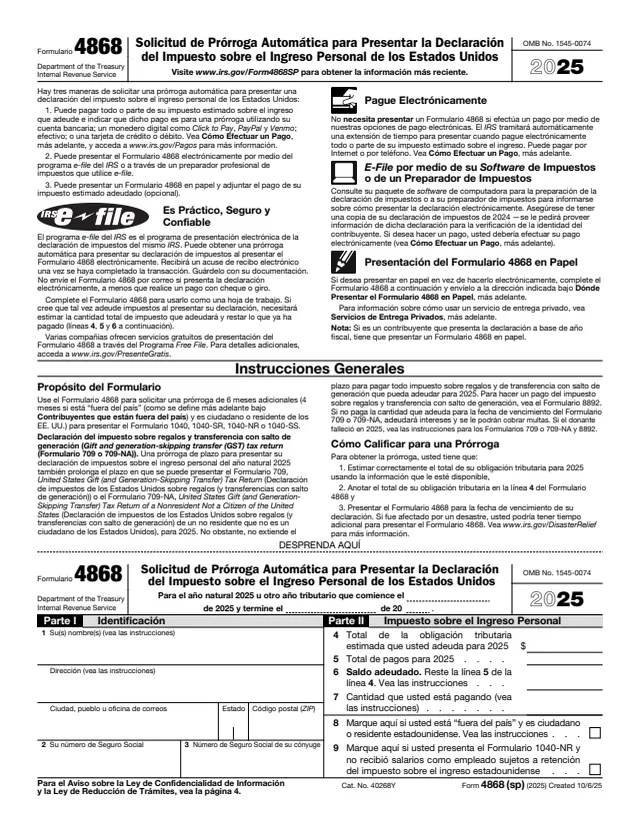
4868
17 fields, 4 pages
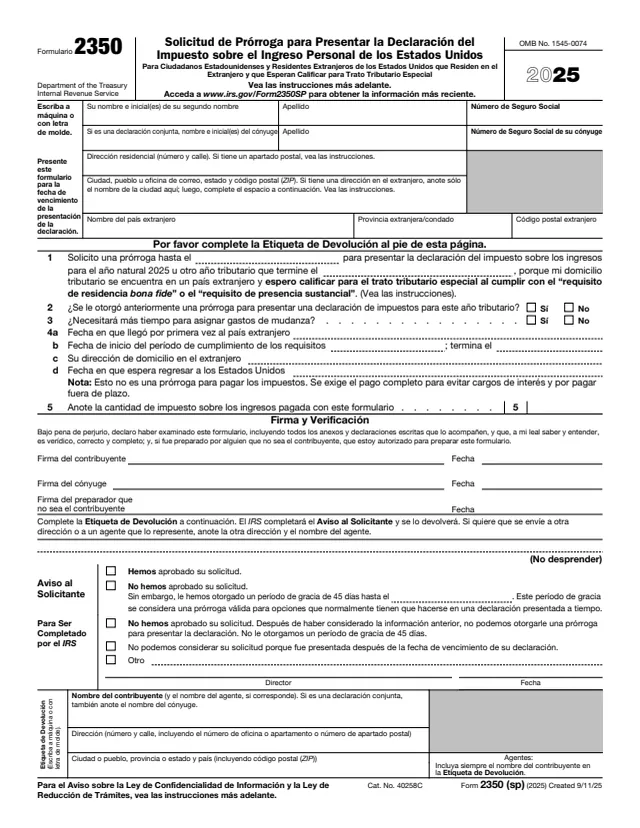
2350
26 fields, 4 pages
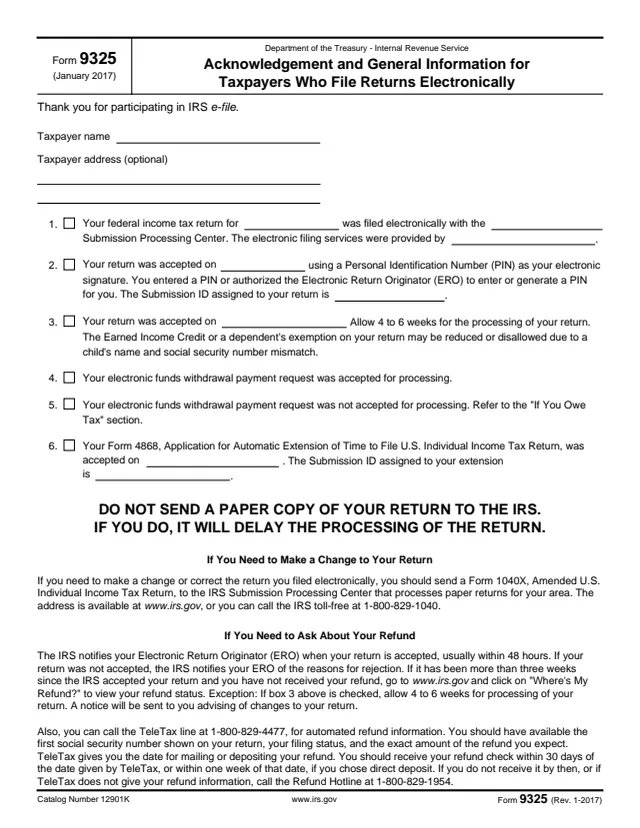
9325
16 fields, 2 pages
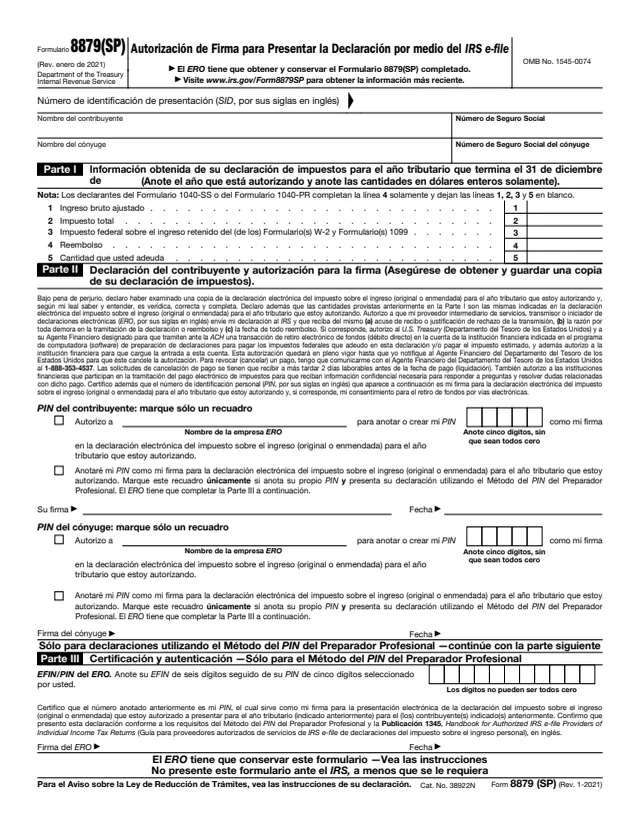
8879
20 fields, 2 pages
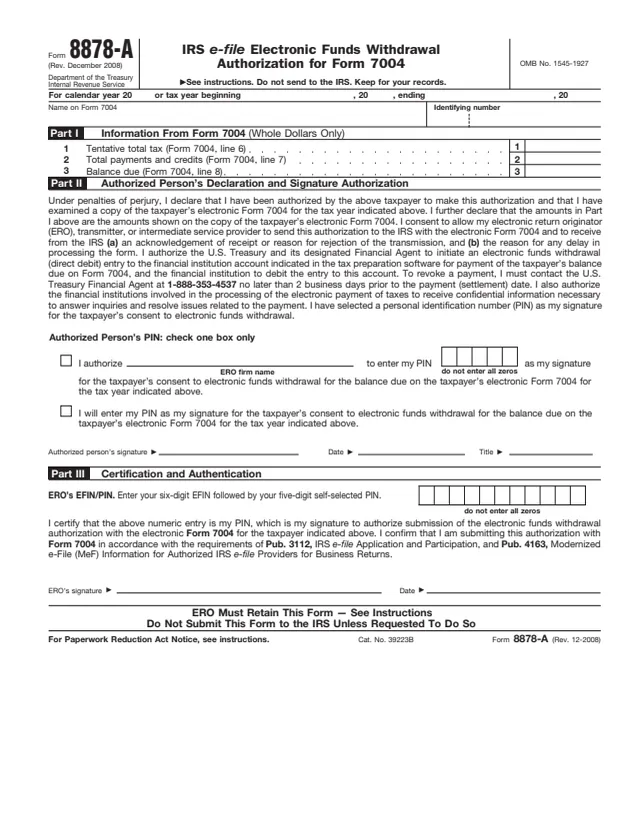
8878-A
17 fields, 2 pages
The ERO prepares the form, the taxpayer and any spouse review and sign it, and the ERO keeps it.
No tool matches that search.
Spanish. Some publications it names, such as Publication 1345 and Publication 4164, keep their English titles with a Spanish translation. The English edition is Form 8878.
No. The instructions say Form 8878 is not a request to extend the time to file, and that Form 4868 or Form 2350 is the extension request.
The ERO, for 3 years from the return due date or the IRS received date, whichever is later. It is not sent to the IRS unless requested.
A five-digit PIN that is not all zeros. In Part III, the ERO enters a six-digit EFIN followed by a five-digit PIN.
Only when Form 4868 is filed using the Practitioner PIN method.
The instructions say taxpayers sign by hand or by electronic signature if the software supports it.