Payer, recipient and account details
Names, addresses and TINs, an account number, and the 2nd TIN not. box. The instructions say the account number is required if the recipient has more than one account or box 11 is checked.
1099-DIV
Dividends and Distributions
Form 1099-DIV is the information return for dividends and other distributions. The IRS page says banks and other financial institutions use it to report dividends and other distributions to taxpayers and to the IRS. The payer files Copy A with the IRS and gives Copy B to the recipient.
The instructions say to file it for each person to whom you paid dividends and other distributions of $10 or more, for whom you withheld and paid foreign tax on dividends, for whom you withheld federal income tax under the backup withholding rules, or to whom you paid $600 or more as part of a liquidation.
Form 1099-DIV is a continuous-use form: the instructions say the form and its instructions are updated as needed, not every year, and the current revision is January 2024. The PDF says not to print and file Copy A downloaded from IRS.gov, because a penalty may apply to forms that can't be scanned. You can fill out Copies 1, B and 2 free on this page.
Names, addresses and TINs, an account number, and the 2nd TIN not. box. The instructions say the account number is required if the recipient has more than one account or box 11 is checked.
Box 1a is total ordinary dividends, including reinvested dividends and money market fund dividends. Box 1b is the part of box 1a that qualifies for the reduced capital gains rates.
Box 2a is total long-term capital gain distributions. Boxes 2b, 2c, 2d and 2f show parts of it, and box 2e shows section 897 gain inside box 1a. The instructions say only RICs and REITs complete boxes 2e and 2f.
Nondividend distributions, federal income tax withheld (backup withholding), section 199A dividends and investment expenses of a nonpublicly offered fund.
Foreign tax paid and the country, cash and noncash liquidation distributions, the FATCA filing requirement box, exempt-interest dividends, and specified private activity bond interest dividends.
State, state identification number and state tax withheld. The instructions say these boxes, and Copies 1 and 2, are provided for convenience.
The instructions say to use Form W-9 to request a recipient's TIN, and the applicable Form W-8 for a foreign recipient.
Fill in names, addresses and TINs. The recipient's TIN may be truncated on the copy given to the recipient, but not on the copy filed with the IRS. The payer's TIN is never truncated.
Box 1a includes the amounts in boxes 1b, 2e and 6. The instructions say box 1b can't be less than zero and doesn't include investment expenses.
Enter total capital gain distributions in box 2a, including the amounts shown in boxes 2b, 2c, 2d and 2f.
Enter nondividend distributions, withholding, foreign tax and exempt-interest dividends. Liquidation amounts in boxes 9 and 10 stay out of boxes 1a and 1b, and box 12 includes box 13.
Copy A goes to the IRS, on paper with Form 1096 or electronically, and Copy B goes to the recipient. You can fill this form free on this page.
You get the real form, filled in a browser tab, with nothing standing between you and the finished PDF.
The instructions point to the General Instructions for Certain Information Returns for when and where to file and for furnishing statements to recipients.
The instructions say the e-file threshold is 10 information returns in total, for returns filed on or after January 1, 2024. Paper filers send Copy A with Form 1096.
The PDF says Copy A printed from IRS.gov can't be scanned. Official scannable forms can be ordered at IRS.gov/EmployerForms.
Box 4 shows backup withholding on recipients who did not furnish a TIN as required. The instructions say the rate is in part N of the General Instructions.
Putting liquidation distributions in box 1a or 1b, entering an amount less than zero in box 1b, including investment expenses in box 1b, and reporting credit union share account dividends here instead of on Form 1099-INT.
1099-INT
127 fields, 7 pages
1040
55 fields, 2 pages
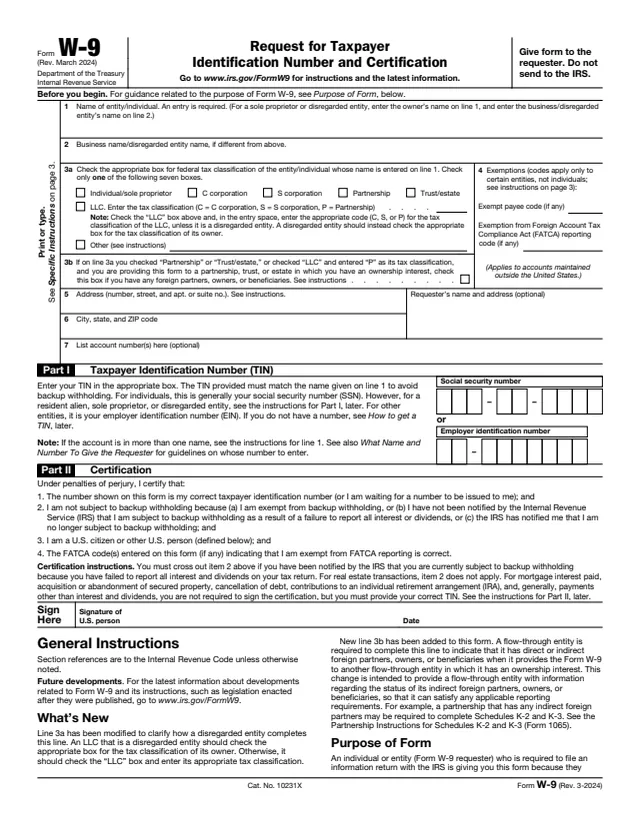
W-9
23 fields, 6 pages
1040
199 fields, 2 pages
1040
72 fields, 1 page
1096
55 fields, 3 pages
No tool matches that search.
The payer of the dividends or distributions, such as a bank, fund or corporation. The IRS page says banks and other financial institutions use it to report dividends and other distributions to taxpayers and to the IRS.
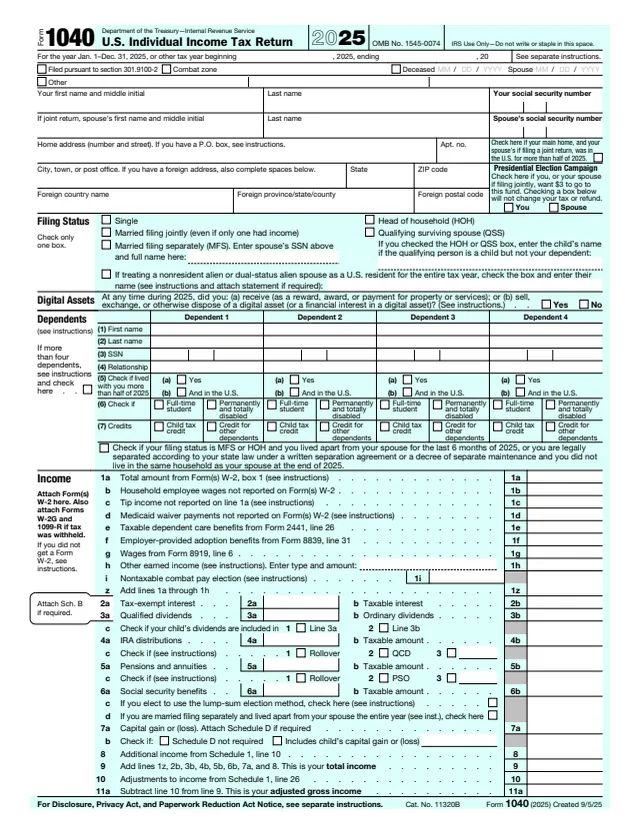
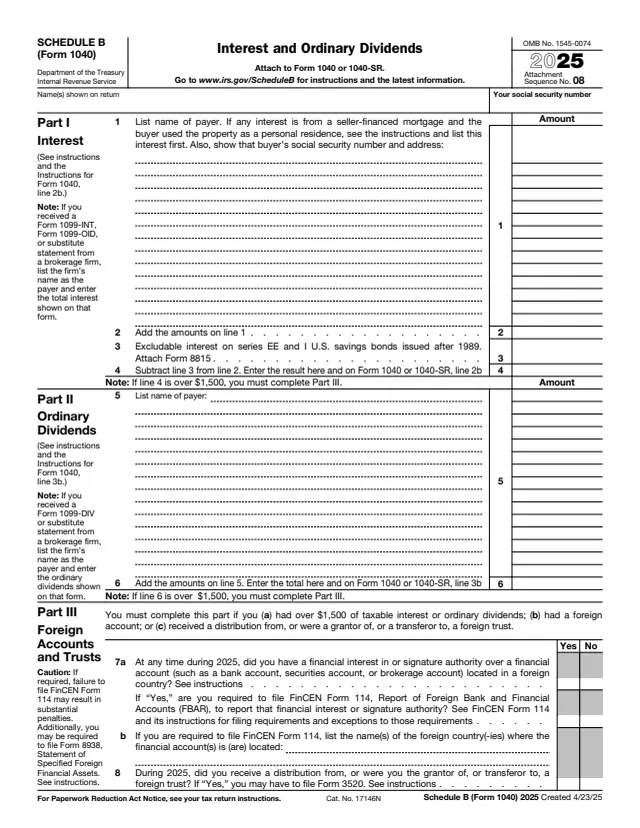
Copy B says to include it on the Ordinary dividends line of Form 1040 or 1040-SR, and on Schedule B if required. The 2025 Form 1040 instructions say Schedule B is needed if the total is over $1,500 or you received dividends as a nominee.
Box 1a is total ordinary dividends. Box 1b is the part of box 1a that may be eligible for reduced capital gains rates.
Copy B says box 3 is a return of capital. Up to your cost or other basis in the stock it reduces your basis and is not taxable, and any amount above your basis is taxable as capital gain. See Pub. 550.
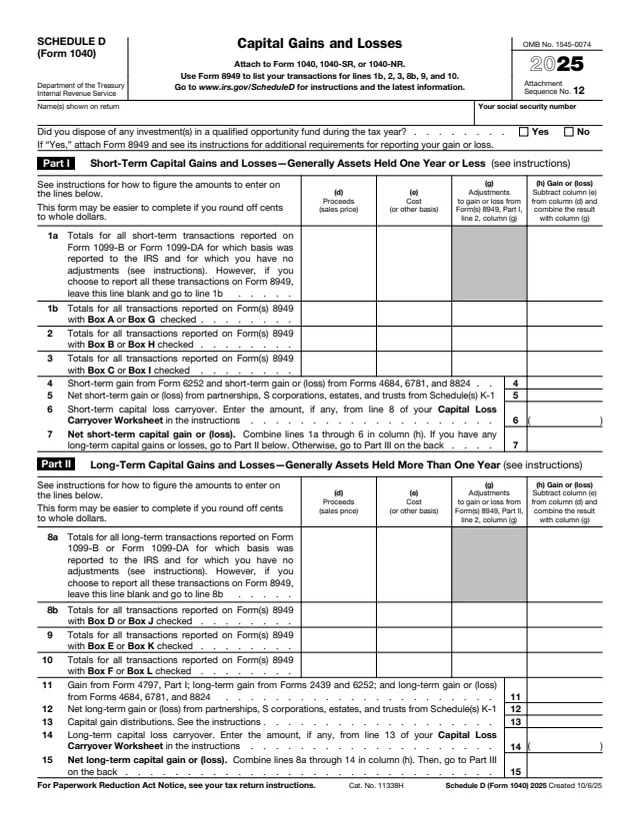
Maybe not. Copy B says that if boxes 2b, 2c, 2d and 2f are empty and your only capital gains and losses are capital gain distributions, you may be able to report box 2a on Form 1040 or 1040-SR instead of Schedule D.
The instructions say so-called dividends on deposit or share accounts at credit unions, cooperative banks and savings institutions are interest, reported on Form 1099-INT.
Copy B says the form may show only the last four digits for your protection. The issuer has reported your complete TIN to the IRS.