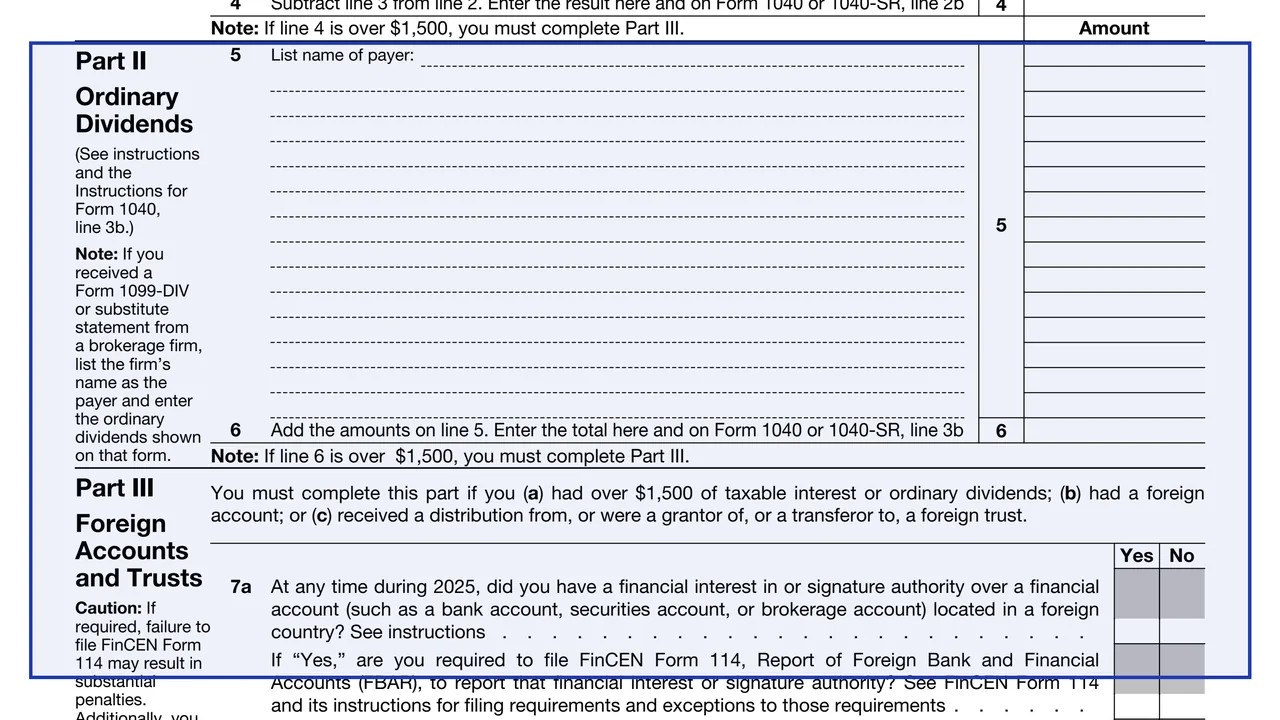
Part I, line 1: interest by payer
Each payer's name and amount. The form says that for a Form 1099-INT, Form 1099-OID or substitute statement from a brokerage firm, the firm's name is listed with the total interest it shows.
1040
Interest and Ordinary Dividends
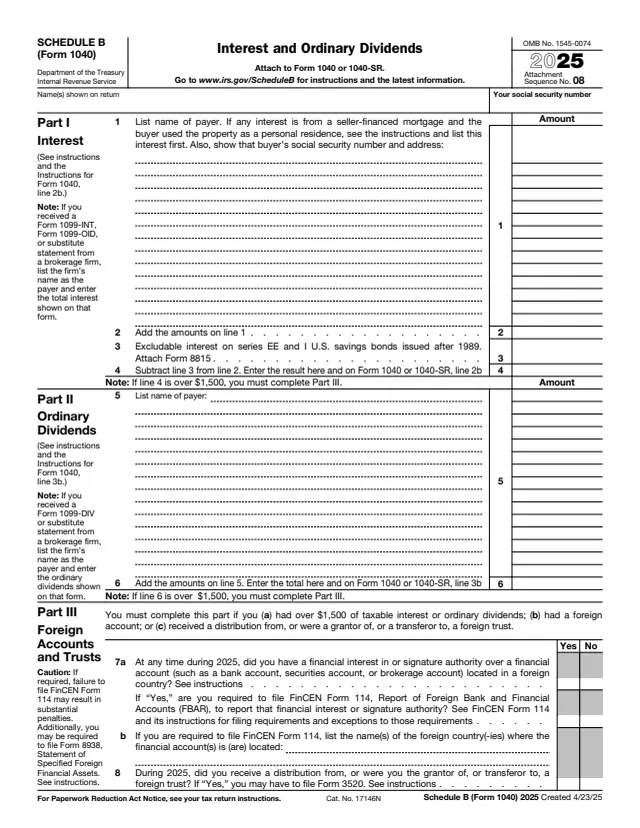
Schedule B lists the payers behind your taxable interest and ordinary dividends, then asks a short set of questions about foreign accounts and foreign trusts. Part I covers interest, and its total on line 4 goes to Form 1040 or 1040-SR, line 2b. Part II covers ordinary dividends, and its total on line 6 goes to line 3b.
The IRS page lists when the schedule is used, starting with having over $1,500 of taxable interest or ordinary dividends. It also covers interest from a seller-financed mortgage, income received as a nominee, the savings bond interest exclusion and any foreign account or foreign trust.
Part III asks about financial accounts in a foreign country and about foreign trusts. The form notes that FinCEN Form 114 and Form 8938 may also be required.
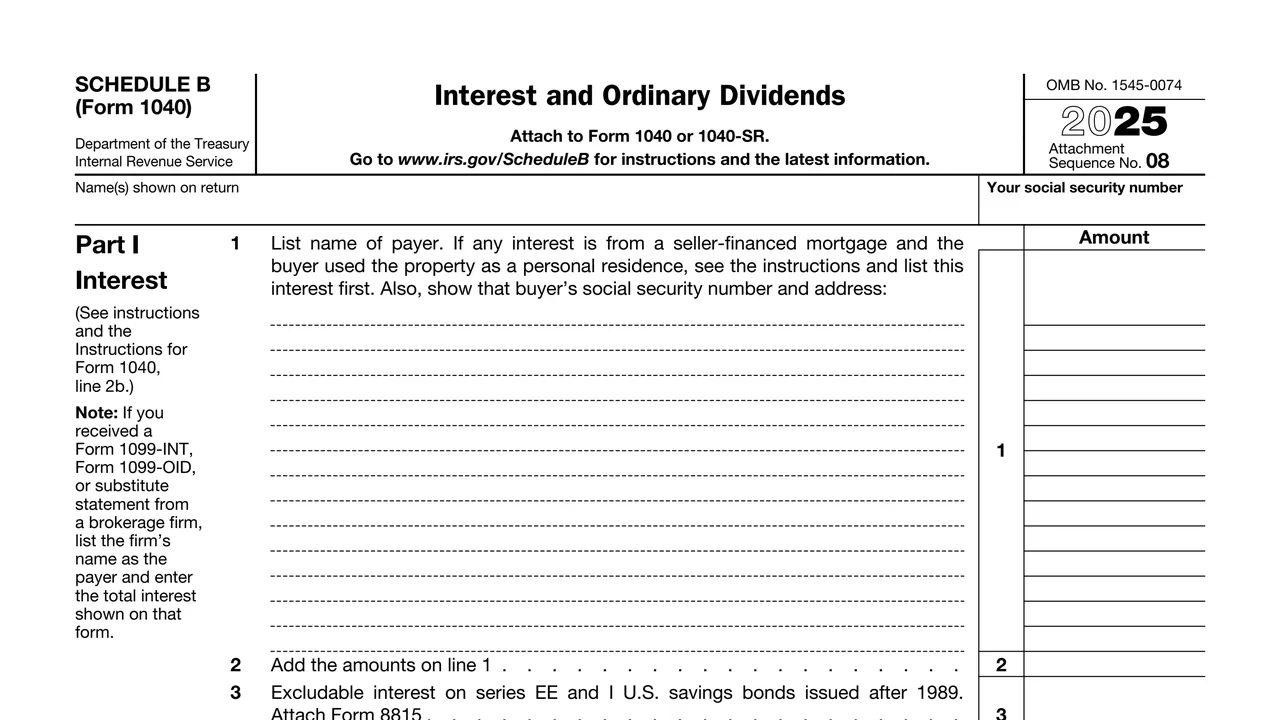
Each payer's name and amount. The form says that for a Form 1099-INT, Form 1099-OID or substitute statement from a brokerage firm, the firm's name is listed with the total interest it shows.
Line 2 adds line 1, line 3 subtracts excludable savings bond interest from Form 8815, and line 4 goes on Form 1040 or 1040-SR, line 2b.
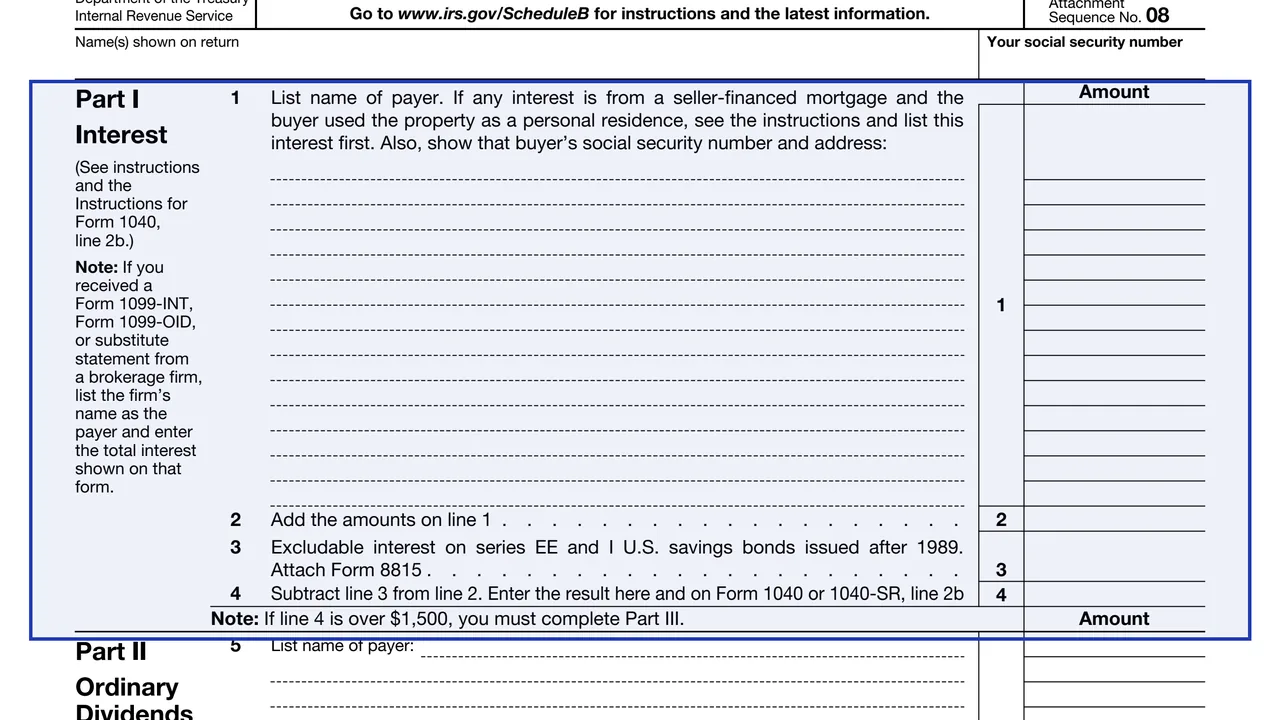
Each payer's name and the ordinary dividends it paid. The instructions say this amount should be shown in box 1a of Forms 1099-DIV.
Line 6 adds the amounts on line 5 and goes on Form 1040 or 1040-SR, line 3b.
Yes or No questions on a financial interest in or signature authority over a foreign account and on whether FinCEN Form 114 (FBAR) is required. Line 7b lists the countries where the accounts are.
A Yes or No question on receiving a distribution from, or being the grantor of or transferor to, a foreign trust. The form says Form 3520 may be required.
Forms 1099-INT, 1099-OID and 1099-DIV, or substitute statements, show the interest and dividends each payer reported.
Enter each payer and amount, with any seller-financed mortgage interest first. The instructions allow more than one payer on an entry space if each amount is shown next to its name.
Under the last entry, the instructions say to show a subtotal, then the amount labeled Nominee Distribution, Accrued Interest, OID Adjustment or ABP Adjustment, and subtract it.
The instructions say not to report tax-exempt interest on line 1. It goes on Form 1040 or 1040-SR, line 2a.
Enter each payer's ordinary dividends from box 1a of Form 1099-DIV and carry the line 6 total to Form 1040 or 1040-SR, line 3b.
Answer lines 7a and 8 when Part III applies. The instructions say to check Yes on the first line 7a question even if FinCEN Form 114 isn't required. You can fill this form free on this page.
You get the real form, filled in a browser tab, with nothing standing between you and the finished PDF.
Schedule B is attached to Form 1040 or 1040-SR and is due with it.
Attach it to your return when you mail it, or let tax software transmit it when you e-file. The instructions say extra statements carry your name and SSN and go at the end of the return.
The IRS form is free.
The instructions say FinCEN Form 114 is filed electronically with FinCEN, not attached to the tax return. For 2025 they say it is required when the combined value of foreign financial accounts exceeds $10,000 at any time during the year.
The instructions say Form 3520 isn't attached to Form 1040 or 1040-SR. It is filed at the address shown in its own instructions.
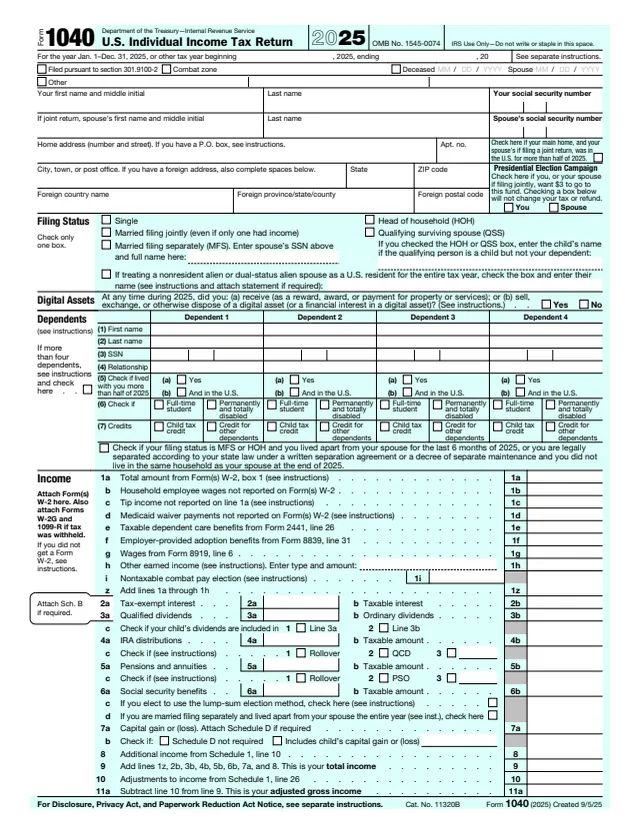
1040
199 fields, 2 pages
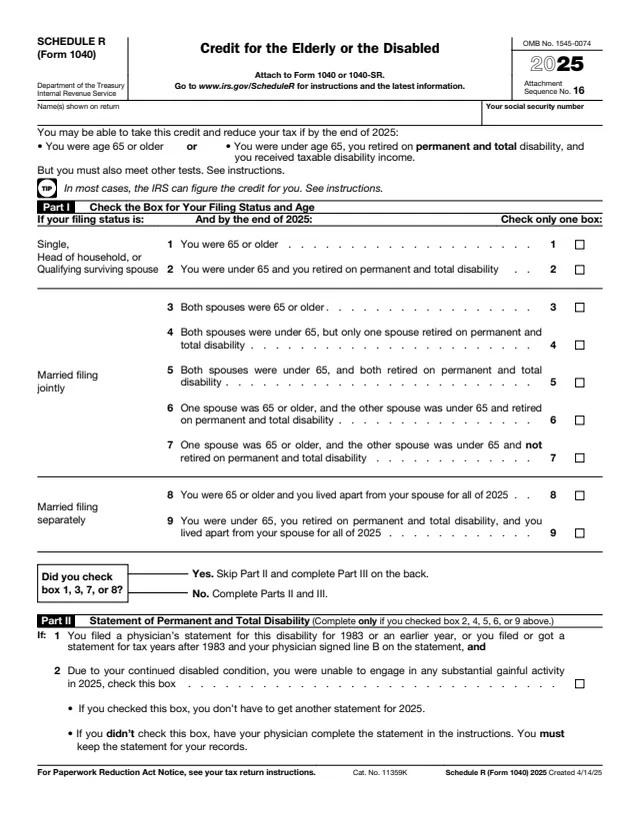
1040
27 fields, 2 pages
1099-INT
127 fields, 7 pages
1099-DIV
140 fields, 6 pages
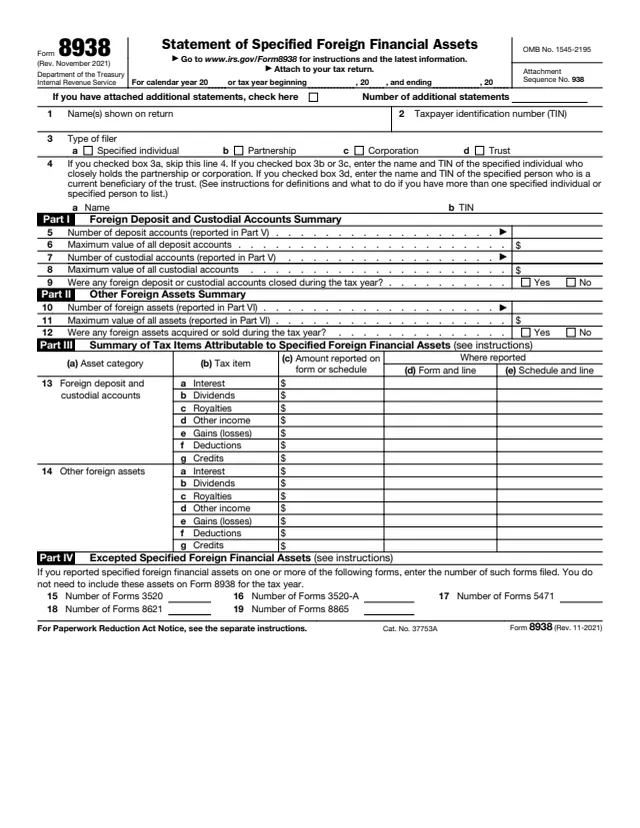
8938
131 fields, 2 pages
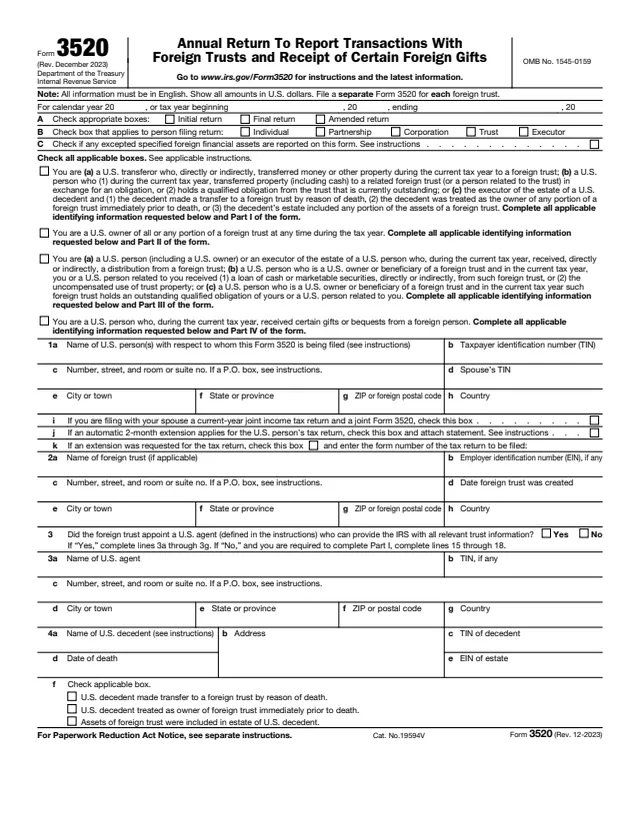
3520
462 fields, 6 pages
No tool matches that search.
Only if another item on the IRS list applies, such as seller-financed mortgage interest, income received as a nominee, the savings bond interest exclusion, or a foreign account or foreign trust.
Line 4 interest goes on Form 1040 or 1040-SR, line 2b. Line 6 ordinary dividends go on line 3b.
No. The instructions say not to report tax-exempt interest on line 1. It is entered on Form 1040 or 1040-SR, line 2a.
The instructions say an account is foreign if it is physically located outside the United States. Examples include bank, securities and brokerage accounts, mutual fund shares, and insurance or annuity policies with a cash value.
No. Schedule B asks whether you have a foreign account and whether FBAR is required. FinCEN Form 114 is a separate report filed electronically with FinCEN, and Form 8938 may also be required with the return.
The instructions call that nominee interest. The full amount goes on line 1 and the nominee part is subtracted as Nominee Distribution. They also say a Form 1099-INT goes to the actual owner, unless the owner is your spouse.