Taxpayer information
Taxpayer name, social security number, daytime telephone number and mailing address.
8821-A
IRS Disclosure Authorization for Victims of Identity Theft
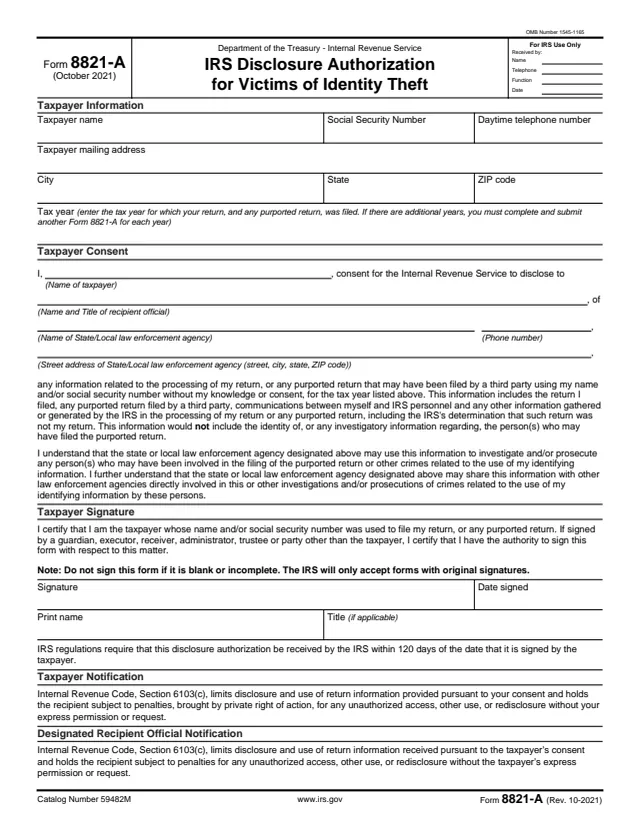
Form 8821-A, IRS Disclosure Authorization for Victims of Identity Theft, is a consent signed by a taxpayer. The instructions say it allows the IRS to disclose the taxpayer's return, any purported return, and other related return information to state or local law enforcement in the event of possible identity theft, and that it may not be used for any other purpose.
The form is handled by law enforcement, not mailed in by the taxpayer alone. The instructions say it is available only from IRS Criminal Investigation or state or local law enforcement agencies, and that it must be submitted by IRS Criminal Investigation and/or state or local law enforcement agencies. The consent does not cover the identity of, or investigatory information about, the person who may have filed the purported return.
You can fill out the PDF free in your browser on this page and download it without an account. The form notes that the IRS will only accept forms with original signatures.
Taxpayer name, social security number, daytime telephone number and mailing address.
The one tax year for which the return and any purported return was filed. Each additional year takes another Form 8821-A.
The taxpayer's name, the recipient official's name and title, and the law enforcement agency's name, phone number and street address.
Covers the return filed, any purported return, communications with IRS personnel and the IRS determination that the return was not the taxpayer's.
A certification, signature, date signed, printed name and an optional title.
Notices about Internal Revenue Code section 6103(c) limits for the taxpayer and the recipient official, and a For IRS Use Only box.
Enter the taxpayer's name, SSN and street address. The instructions say to furnish the correct name and SSN so the IRS can respond.
Enter the tax year for which the return and any purported return was filed. Use another form for each additional year.
Enter the taxpayer's name, then the full name and title of the law enforcement official and the agency's name, address and telephone number.
The form says not to sign it if it is blank or incomplete. Sign and date it with an original signature.
Return the signed form to the IRS Criminal Investigation or law enforcement contact, since the instructions say those agencies submit it.
You get the real form, filled in a browser tab, with nothing standing between you and the finished PDF.
The instructions say the form must be submitted by IRS Criminal Investigation and/or state or local law enforcement agencies.
The instructions give: Internal Revenue Service, RAIVS Team, Stop 6716 AUSC, Austin, TX 73301.
The instructions say the IRS must receive the form within 120 days of the date the taxpayer signs and dates it, and forms received after 120 days are invalid.
The form says the IRS will only accept forms with original signatures.
Each additional tax year needs its own Form 8821-A, according to the form.
The taxpayer signs the consent, and the instructions say law enforcement agencies provide and submit the form.
No tool matches that search.
The instructions say it is available only from IRS Criminal Investigation or state or local law enforcement agencies, as appropriate.
The instructions say it must be submitted by IRS Criminal Investigation and/or state or local law enforcement agencies.
The IRS must receive it within 120 days of the date the taxpayer signs and dates it. The instructions say forms received later are invalid.
No. The form says the disclosure does not include the identity of, or investigatory information about, the persons who may have filed the purported return.
No. The form says to complete and submit another Form 8821-A for each additional year.