Item 1 and Part I: the individual who paid
Boxes for an amended report or a suspicious transaction, then the name, TIN, address, date of birth, occupation and identifying document of the individual from whom the cash was received.
8300
Report of Cash Payments Over $10,000 Received in a Trade or Business
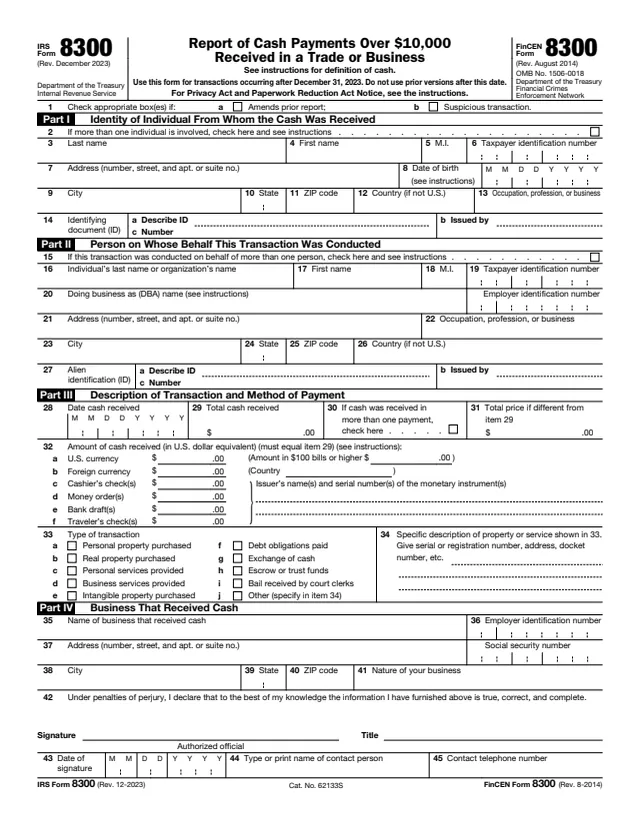
Form 8300 is filed by the business that receives the cash, not by the customer who pays it. The instructions say each person engaged in a trade or business who, in the course of that trade or business, receives more than $10,000 in cash in one transaction or in two or more related transactions files Form 8300.
It is a joint form: the PDF prints IRS Form 8300 (Rev. December 2023) and FinCEN Form 8300 (Rev. August 2014). The instructions say section 6050I and 31 U.S.C. 5331 require the information to be reported to the IRS and the Financial Crimes Enforcement Network (FinCEN). The form says to use this version for transactions occurring after December 31, 2023.
Cash includes U.S. and foreign coin and currency, and in some cases a cashier's check, money order, bank draft or traveler's check with a face amount of $10,000 or less. The instructions say a check drawn on the payer's own account, such as a personal check, is not cash. You can fill out the PDF free in your browser on this page and download the result without an account.
Boxes for an amended report or a suspicious transaction, then the name, TIN, address, date of birth, occupation and identifying document of the individual from whom the cash was received.
The individual or organization the transaction was conducted for: name, TIN, DBA name, EIN, address, occupation and alien identification.
Date cash received, total cash, a box for more than one payment, total price, the amount of each form of cash in item 32, the type of transaction in item 33 and a description in item 34.
The business's name, EIN or social security number, address and nature of business, the signature of an authorized official, and a contact person and phone number.
Extra Part I and Part II entries when box 2 or 15 is checked, and a Comments section the instructions limit to 720 characters.
Check box 1a to amend a prior report and complete the whole form; the instructions say not to attach the original. Check box 1b for a suspicious transaction and describe what was suspicious in the Comments section.
Enter the individual's name, TIN, address and date of birth as eight numerals. Describe the occupation clearly, such as plumber, not businessperson. Item 14 records the ID examined, such as a driver's license or passport: type, issuer and number.
The instructions say Part II may be skipped if the individual in Part I conducted the transaction on their own behalf. For an organization, enter its name and EIN. Item 27 is for a person who does not furnish a TIN.
Enter the date of the payment that caused the total to exceed $10,000, the total cash received, check item 30 for more than one payment, and enter the total price if it differs from item 29.
Enter each form of cash in U.S. dollars; the sum equals item 29. List the issuer and serial number of each cashier's check, money order, bank draft or traveler's check. Check up to three transaction types and describe the property or service.
A sole proprietorship enters its SSN and any EIN; other entities enter an EIN. Describe the business clearly, such as jewelry dealer. The instructions say the form is signed by an individual authorized to do so for the business.
You get the real form, filled in a browser tab, with nothing standing between you and the finished PDF.
The instructions say to file by the 15th day after the date the cash was received, or the next business day if that date falls on a Saturday, Sunday or legal holiday.
The instructions say to e-file through the FinCEN BSA E-Filing System at http://bsaefiling.fincen.treas.gov/main.html. E-filing applies to a filer required to file at least 10 information returns, other than Form 8300, during the calendar year.
For filers not required to e-file, the instructions give this address as printed: Internal Revenue Service, Detroit Federal Building, P.O. Box 32621, Detroit, MI 48232.
By January 31 of the following year, a statement to each person named on a required form showing the business contact's name, phone and address, the aggregate cash and that the IRS was told. Not for voluntary suspicious filings.
The instructions say to keep a copy of each Form 8300 for 5 years from the date filed. A filing confirmation is not a substitute for the form.
The instructions say a minimum penalty of $25,000 may be imposed for intentional or willful disregard of the cash reporting requirements, and list criminal penalties for structuring transactions to avoid reporting.
The filer is the business, court clerk or casino that received the cash. The person who paid the cash does not file the form; the instructions say that person receives a statement from the filer.
No tool matches that search.
The business. The instructions say each person engaged in a trade or business who receives more than $10,000 in cash in one transaction or related transactions files it. The customer receives a statement.
No. The instructions say cash does not include a check drawn on the payer's own account, such as a personal check, regardless of the amount.
The instructions say by the 15th day after the date the cash was received, moving to the next business day for a Saturday, Sunday or legal holiday.
The instructions say multiple payments for one or related transactions are reported once the total exceeds $10,000 within any 12-month period, within 15 days of the payment that pushes the total over $10,000.
The instructions say a filer required to file at least 10 information returns, other than Form 8300, during the calendar year e-files Form 8300 too. Others may file on paper or choose to e-file.
Yes. The instructions say the form may be filed voluntarily for any suspicious transaction, even if the total does not exceed $10,000. No statement is sent to the named person in that case.
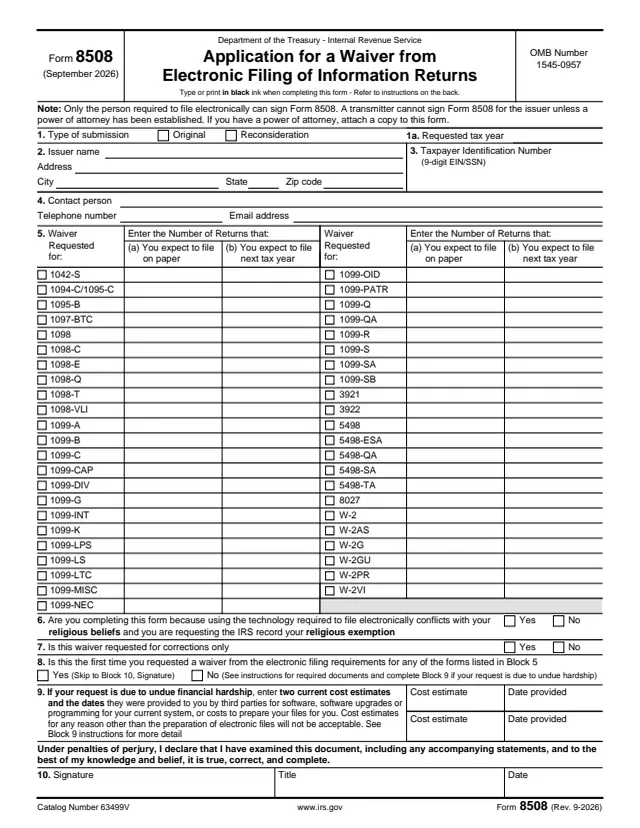
The instructions point to Form 8508 for the waiver request and say to write WAIVER on the center top of page 1 of each paper Form 8300.