Header
Name of clinic and grant year.
13424-C
Low Income Taxpayer Clinic (LITC) Advocacy Information Report
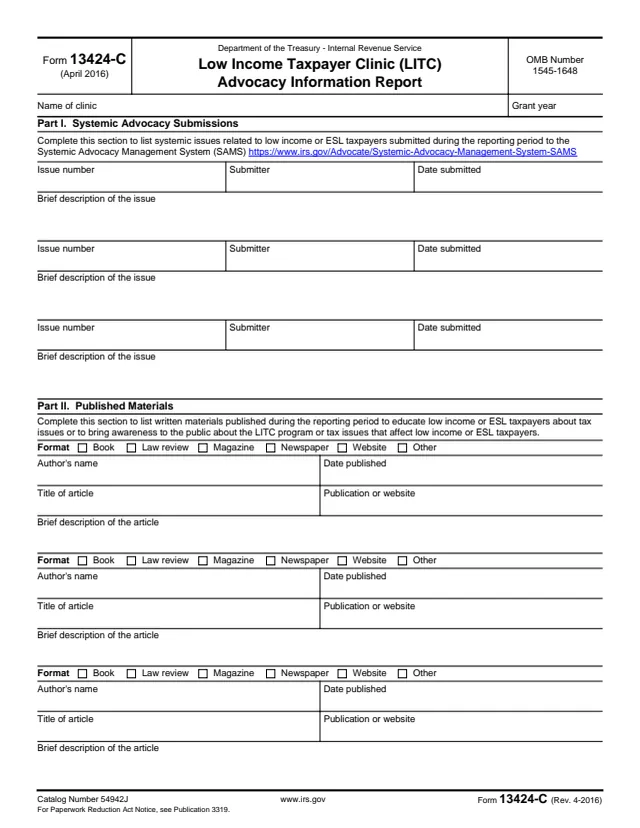
Form 13424-C, Low Income Taxpayer Clinic (LITC) Advocacy Information Report, is completed by Low Income Taxpayer Clinics, not by individual taxpayers. The instructions say it is used to report all systemic advocacy issues submitted, written materials published, television and radio appearances made, and public service announcements aired during the reporting period.
The instructions say the Program Office uses the information on this form and the other reporting forms to determine the scope of services provided by clinics, and aggregates it into program-wide statistics about services to low income and English as a Second Language (ESL) taxpayers. Clinics report twice for each grant year, in an Interim Report and a Year-End Report. The form notes that these reports may be released under the Freedom of Information Act after appropriate redactions.
You can fill out the PDF free in your browser on this page and download the result without an account.
Name of clinic and grant year.
Issue number, submitter, date submitted and a brief description for each systemic issue submitted to SAMS during the reporting period.
Format (Book, Law review, Magazine, Newspaper, Website or Other), author's name, date published, title of article, publication or website, and a brief description.
Airing dates of the segment, number of potential listeners or viewers, discussion topic, presenter and a brief description of the topic.
Number of times the segment aired, number of potential listeners or viewers, discussion topic, presenter and a brief description.
The Freedom of Information Act note, purpose, reporting requirements, reporting period and specific instructions for each part.
Fill in the name of the clinic and the grant year the report covers.
List each issue relating to low income or ESL taxpayers submitted to SAMS in the period, with the SAMS issue number, the submitter's name, the date and a brief description.
Include website postings and social media distribution. Check one format box; if released in several formats, list the others in the Program Narrative on Form 13424-N, line 2.ix.
Enter airing dates, a reasonable estimate of listeners or viewers, the topic, the clinic representatives involved and a brief description.
Enter the number of times each segment aired, a reasonable estimate of listeners or viewers, the topic, the clinic representatives involved and a brief description.
The instructions say that if more room is needed for details about the activities, include them in the program narrative.
You get the real form, filled in a browser tab, with nothing standing between you and the finished PDF.
The instructions say clinics report twice for each grant year: an Interim Report for January 1 through June 30, and a Year-End Report for January 1 through December 31.
For Form 13424-C, the instructions say to report work from January 1 to June 30 on the Interim Report and work from July 1 to December 31 on the Year-End Report.
The instructions say the grant year is January 1 through December 31 for the year in which a grant award is received.
The form says these reports may be released under FOIA, and the LITC Program Office will release them after appropriate redactions to keep taxpayer information confidential.
The form points to Publication 3319 for reporting requirements and for its Paperwork Reduction Act Notice.
The form is completed by a Low Income Taxpayer Clinic as part of its LITC program reporting. The instructions say the LITC Program Office uses the information.
No tool matches that search.
Low Income Taxpayer Clinics. The instructions say all clinics must complete this form.
Twice for each grant year, the instructions say: an Interim Report and a Year-End Report.
Not for this form. The instructions say clinics are not required to repeat information from the Interim Report on the Year-End Report.
In the Program Narrative on Form 13424-N, line 2.ix, according to the instructions for Parts II and III.
The form says it may be released under the Freedom of Information Act, after redactions to ensure confidentiality of taxpayer information.
The instructions say to include the posting of educational materials to a website or their distribution via social media.