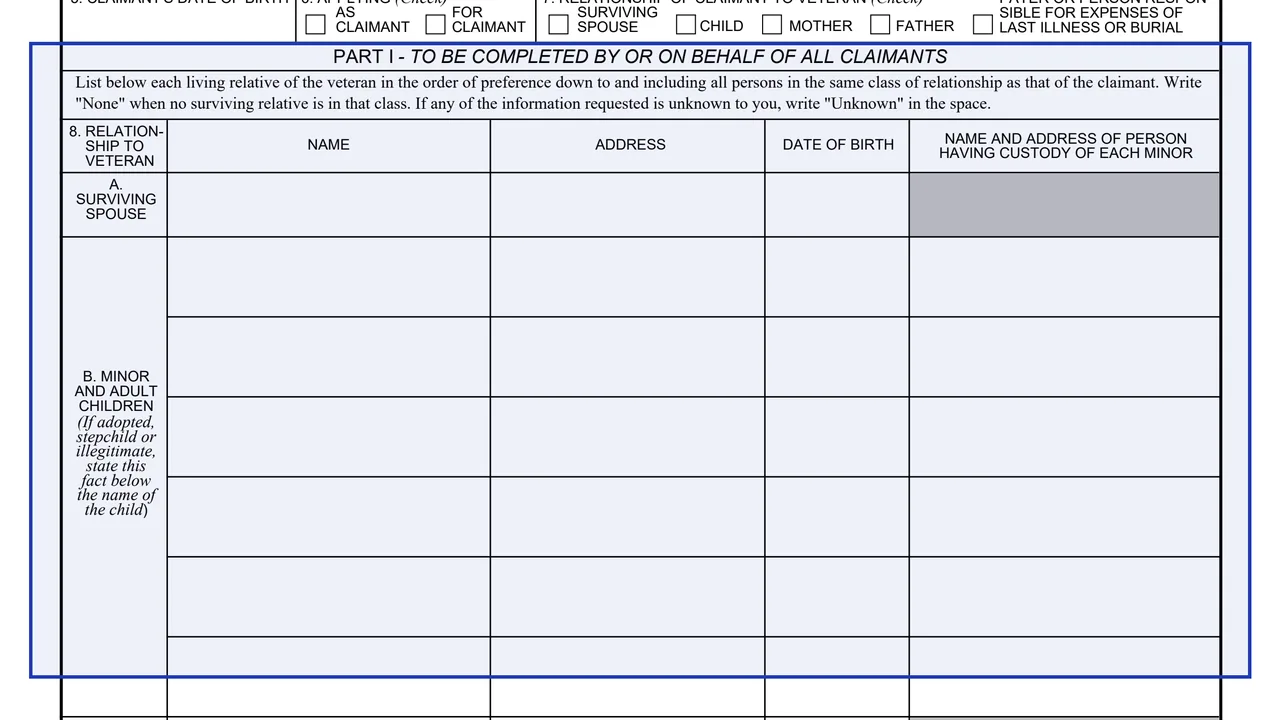
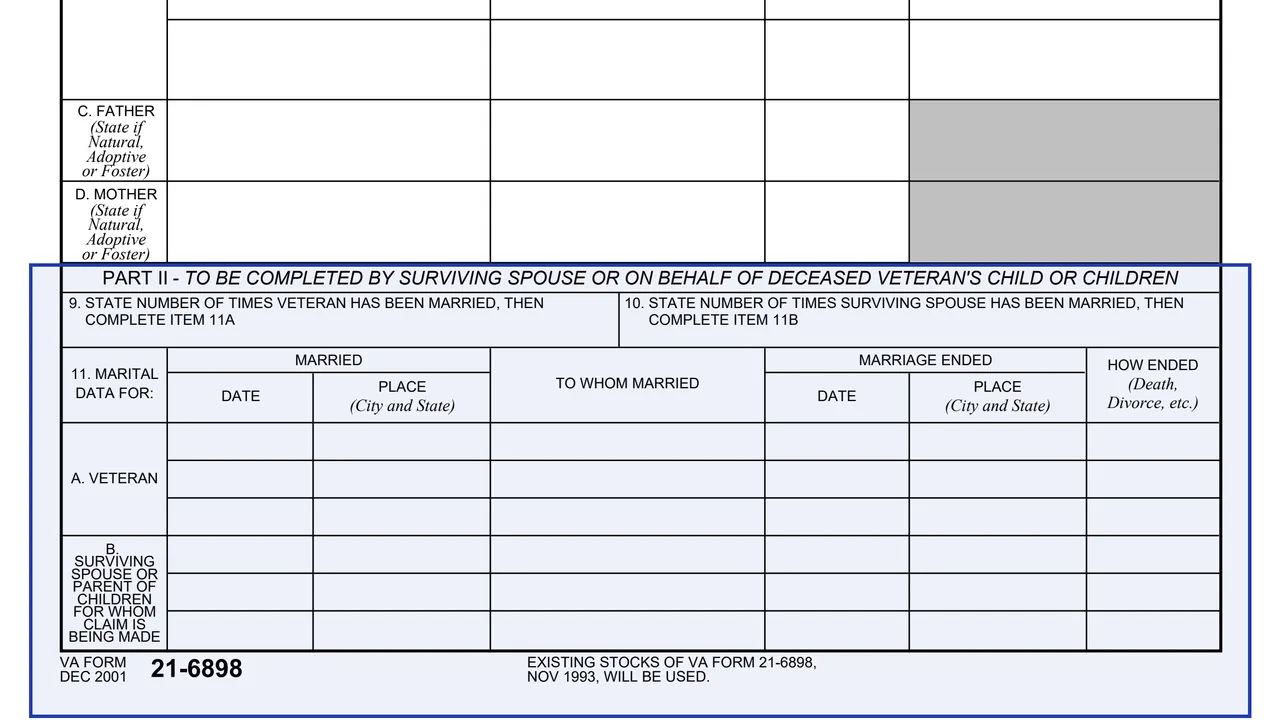
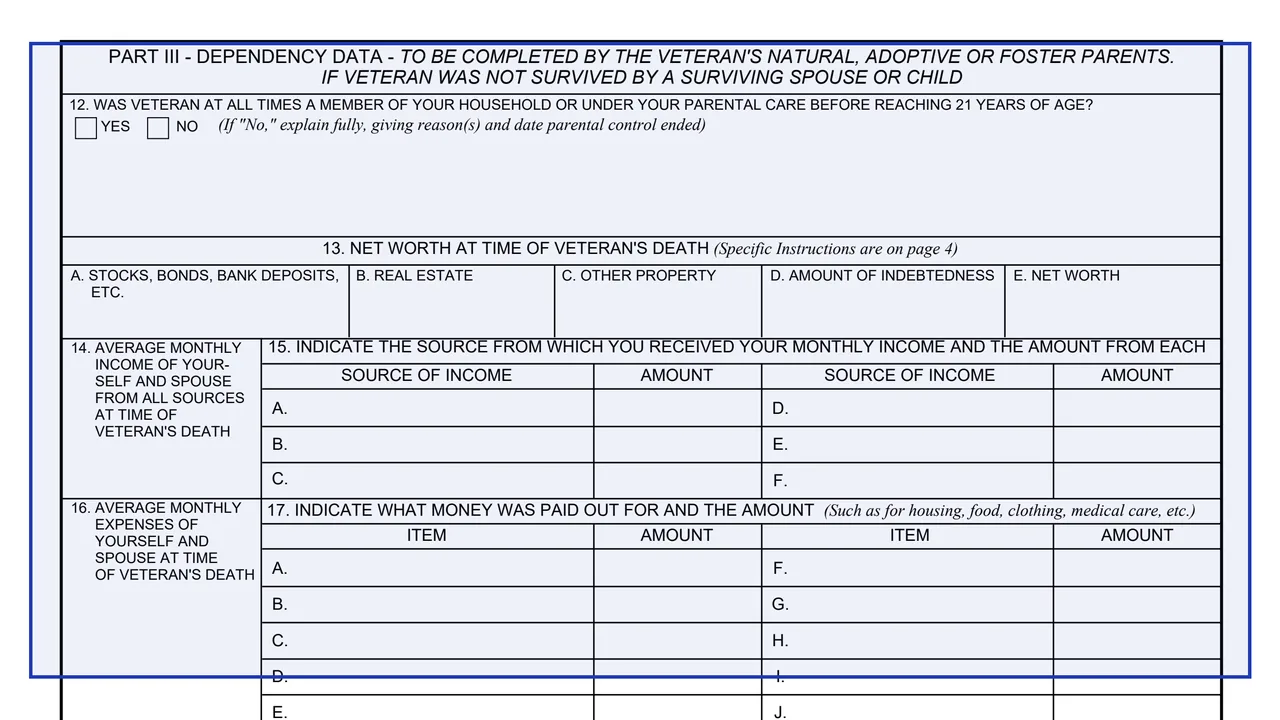
Items 1 to 7: Veteran and claimant
The Veteran's name and VA file number, the claimant's name, address and date of birth, whether you are applying as claimant or for claimant, and the claimant's relationship to the Veteran.
21-6898
Application for Amounts on Deposit for Deceased Veteran
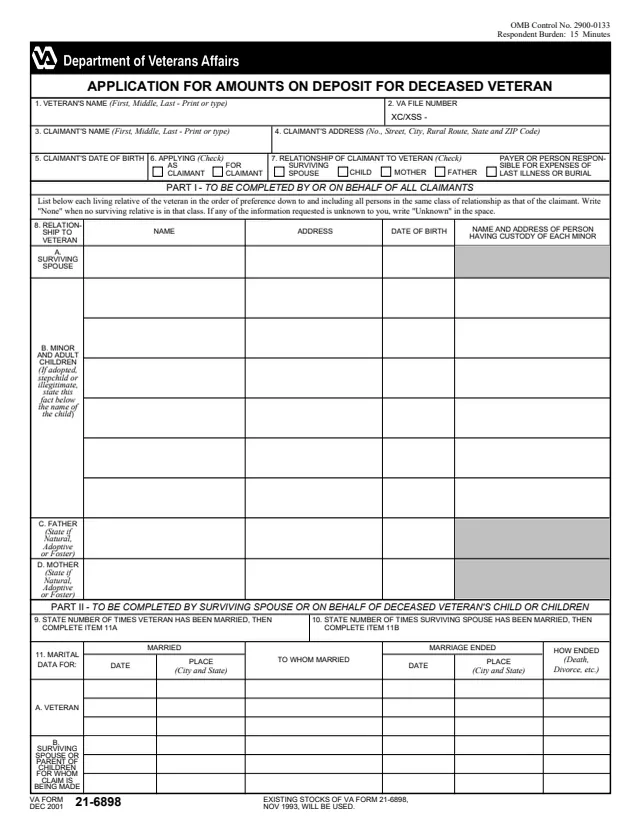
VA Form 21-6898 is the U.S. Department of Veterans Affairs Application for Amounts on Deposit for Deceased Veteran. VA's page lists it under the Veterans Benefits Administration (VBA). The form's instructions say that under Section 5502(d) of 38 U.S.C., gratuitous benefits VA deposited into the Personal Funds of Patients for a Veteran during hospital treatment, institutional or domiciliary care, and due the Veteran at the date of death, are paid in an order of preference: the surviving spouse, then the children in equal parts, then the dependent father and mother, and in all other cases only as much as reimburses the person who bore the expense of last sickness and burial.
The form is four pages. Page 1 identifies the Veteran and the claimant and holds Parts I and II, page 2 holds Part III dependency data and Part IV expenses, page 3 holds the reimbursement waiver, the claimant's certification and remarks, and page 4 holds the laws governing payments and the instructions. VA's page offers the PDF and lists no online version. You can fill out the PDF free in your browser on this page and download the result without an account.
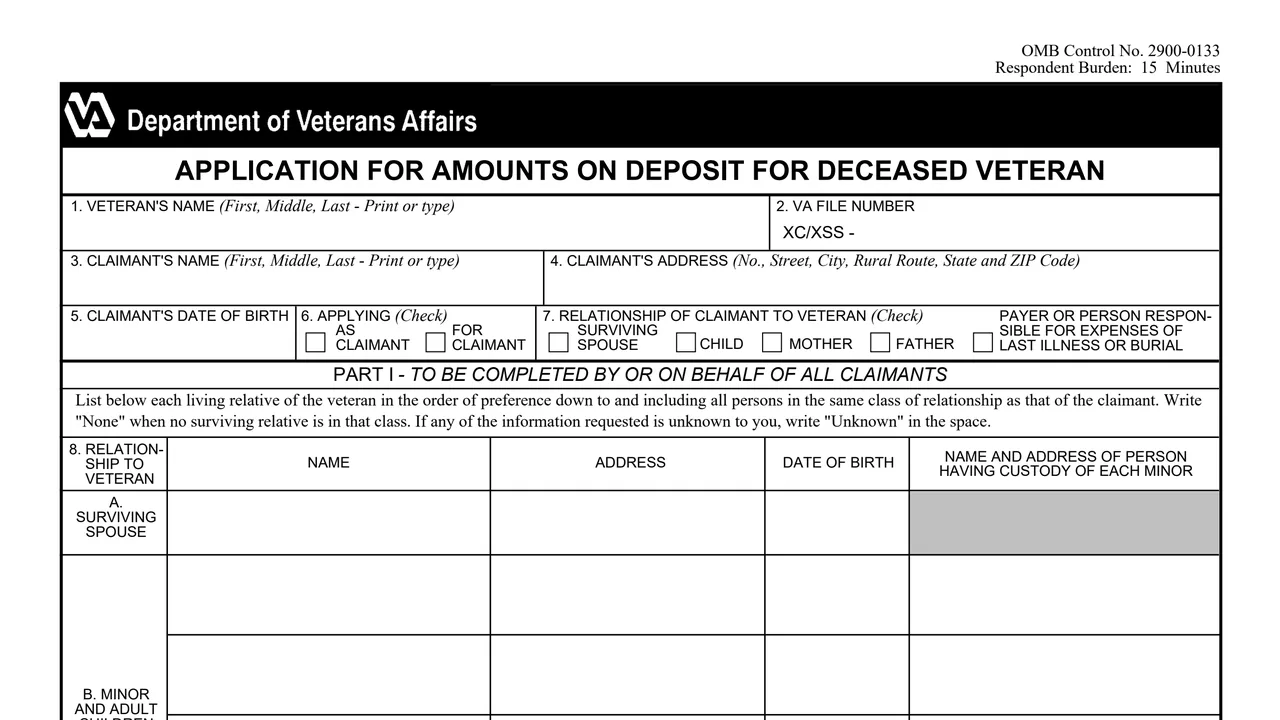
The Veteran's name and VA file number, the claimant's name, address and date of birth, whether you are applying as claimant or for claimant, and the claimant's relationship to the Veteran.
Item 8 lists each living relative of the Veteran in the order of preference: surviving spouse, minor and adult children, father and mother, with addresses, birth dates and who has custody of each minor. The form says to write None or Unknown where that applies.
Items 9 to 11 ask how many times the Veteran and the surviving spouse were married, with the date, place and spouse for each marriage and when, where and how it ended.
Items 12 to 18 ask about the Veteran's place in the parents' household before age 21, net worth at the time of the Veteran's death, average monthly income and expenses at that time, and any persons dependent solely on the claimant.
Items 19 and 20 ask for the place of death and burial, then a table of physician, hospital, nursing, burial and other expenses, who rendered each service, the amount, whether it was paid, and any reimbursement received.
Page 3 holds the creditors' reimbursement waiver, the claimant's certification and signature with the date signed, and a remarks space for more information, each entry identified by item number.
The form says to read the instructions carefully before completing it. Answers are written in a clear, legible hand, or typed.
Complete the identification items and the Part I relatives list, then Part II, III or IV, depending on who is claiming. More space goes under Remarks or on a numbered sheet.
The instructions describe proof of death, proof of marriage and proof of relationship of a child or parent, such as certified copies of public or church records. Evidence already filed with VA need not be filed again.
Each charge in Part IV should be supported by a bill or statement of account from the person who rendered the service, showing the name of the deceased and whether and by whom it was paid.
Sign the claimant's certification and enter the date. The instructions say to write the Veteran's name and claim number on each paper submitted.
You get the real form, filled in a browser tab, with nothing standing between you and the finished PDF.
Neither the form nor VA's page prints a mailing address. The instructions say that if any question is not clear, you can write to VA for instructions.
The instructions say existing law requires that a claim for this benefit be filed within five (5) years after the death of the Veteran. For a person under legal disability at the time of death, the five-year period runs from the date the legal disability ends or is removed.
The form says the payment of any fee in the preparation of this application is prohibited by law.
The PDF footer reads VA FORM DEC 2001, matching the December 2001 revision date on VA's page, and says existing stocks of the NOV 1993 edition will be used. It carries OMB Control No. 2900-0133 and a respondent burden of 15 minutes.
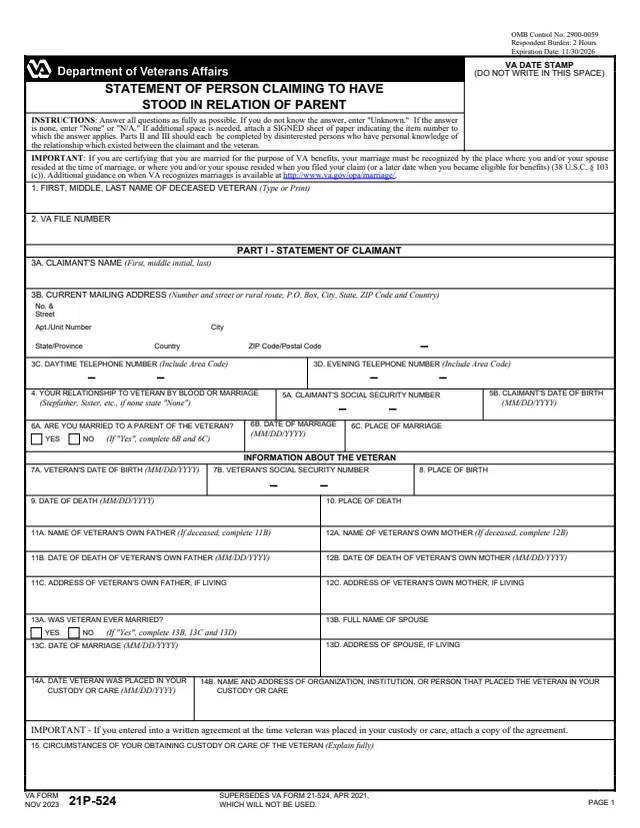
21P-524
190 fields, 6 pages
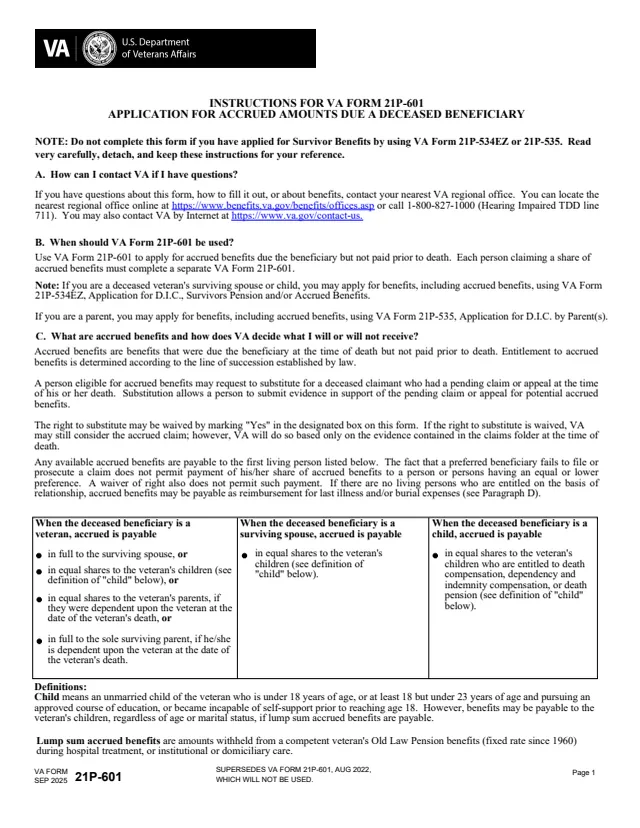
21P-601
107 fields, 5 pages
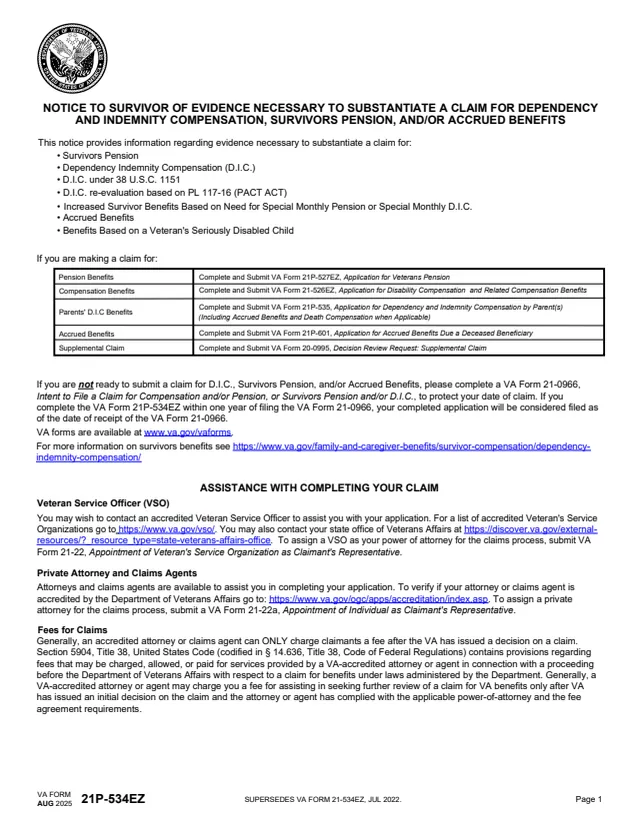
21P-534EZ
626 fields, 20 pages
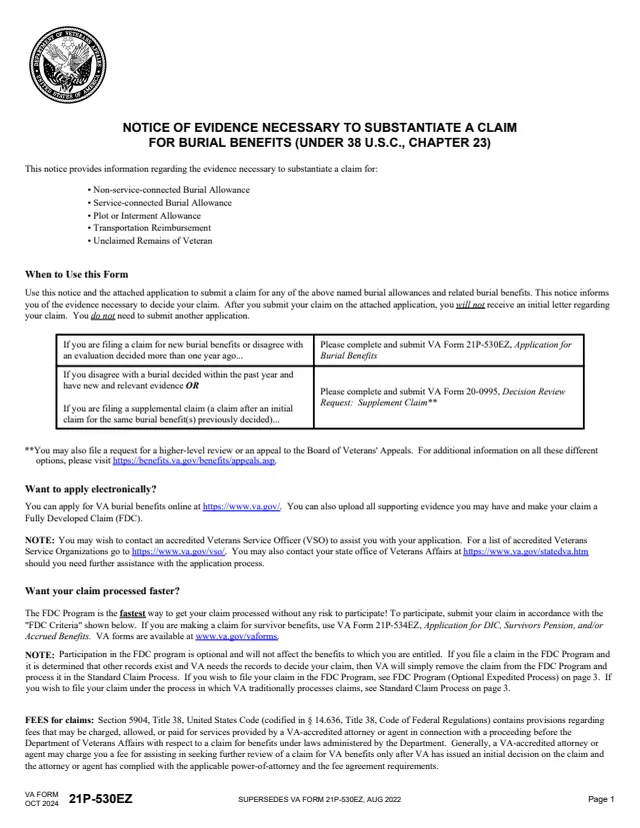
21P-530EZ
93 fields, 8 pages
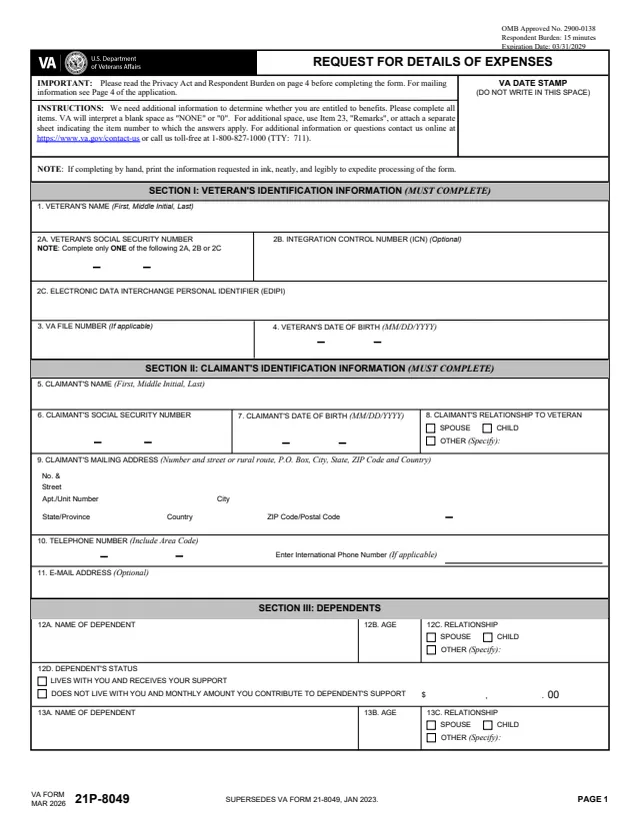
21P-8049
154 fields, 4 pages
The form names who completes each part and who signs.
No tool matches that search.
It is the application for amounts on deposit for a deceased Veteran. The instructions describe these as gratuitous benefits VA deposited into the Personal Funds of Patients during hospital, institutional or domiciliary care and due the Veteran at the date of death.
The form lists the surviving spouse first, then the children in equal parts, then the dependent father and mother. In all other cases only as much as reimburses the person who bore the expense of last sickness and burial may be paid.
The instructions say the claim is to be filed within five (5) years after the death of the Veteran, or from the date a legal disability ends for a person under legal disability at the time of death.
The form says a separate claim is filed on behalf of each minor or adult person for whom a share of the benefit is claimed.
The instructions say the person responsible for paying them may file, but the reimbursement waiver in Part IV is signed by all unpaid creditors.
The form says the payment of any fee in the preparation of this application is prohibited by law.