Items 1 to 12: Status requested and personal details
Box A or B, your name, date of birth, other A-Numbers and names used, phone numbers, home and mailing address, Social Security number, citizenship, place of birth, marital status, sex and race.
I-687
Application for Status as a Temporary Resident Under Section 245A of the Immigration and Nationality Act
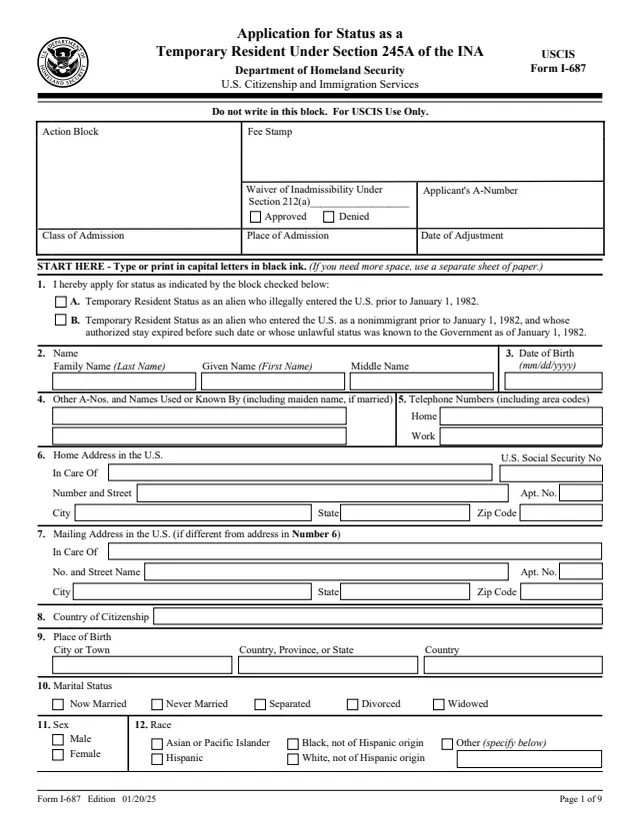
Form I-687, Application for Status as a Temporary Resident Under Section 245A of the Immigration and Nationality Act, was made for the INA section 245A legalization program of the 1986 Immigration Reform and Control Act. USCIS says that program ended in 1988.
The USCIS page says the form is now used to apply to USCIS for benefits under the terms and conditions of certain settlement agreements. The form asks the applicant to check one of two boxes: a person who entered the United States illegally before January 1, 1982, or a person who entered as a nonimmigrant before that date whose authorized stay expired or whose unlawful status was known to the Government.
The USCIS page says there is currently no open filing period. It says USCIS may accept Form I-687 under certain circumstances and will give those applicants an address when appropriate.
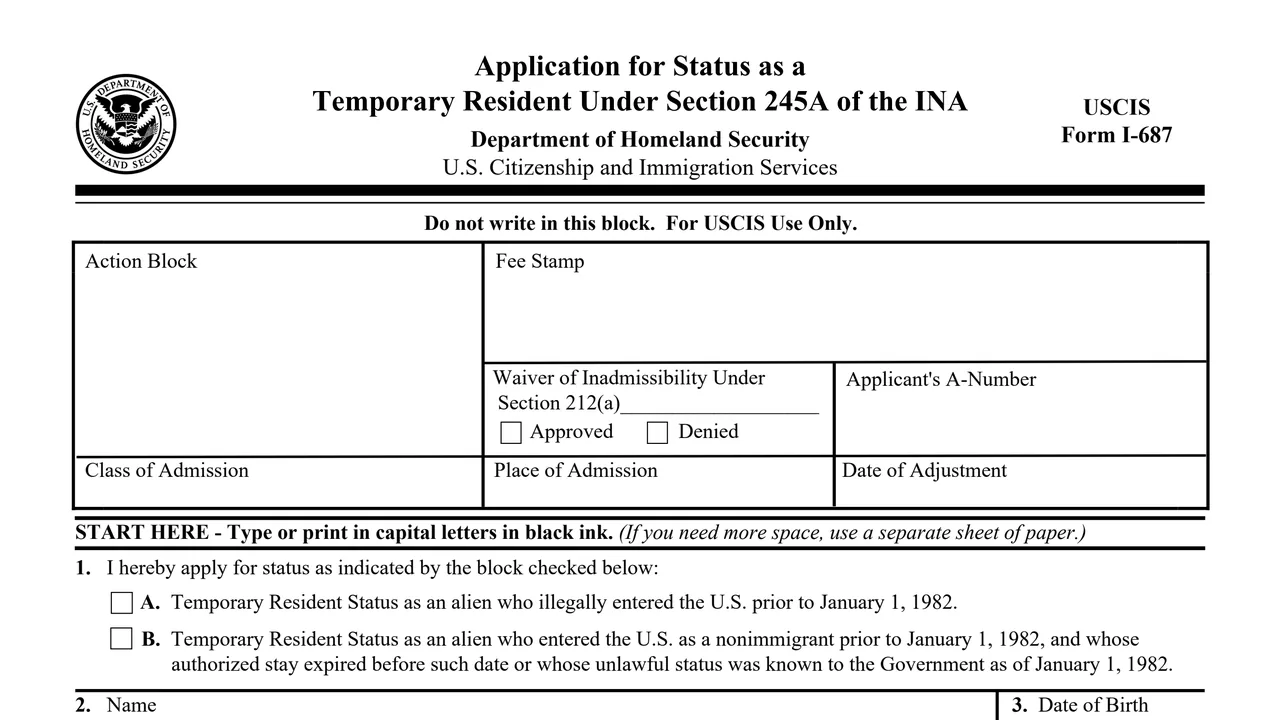
Box A or B, your name, date of birth, other A-Numbers and names used, phone numbers, home and mailing address, Social Security number, citizenship, place of birth, marital status, sex and race.
Any earlier legalization application, other USCIS or former INS records, your first entry date, manner and place of entry, your parents, and all present and past spouses and all sons and daughters.
Passport and visa details, the date the authorized stay expired, class of admission, and whether a status violation before January 1, 1982 was known to the Government.
Every U.S. residence since first entry, affiliations and associations, every absence from the United States, and all U.S. employment since first entry, each with dates.
Selective Service registration, then Yes or No questions on persecution, treatment, criminal history, public assistance and other grounds listed on the form.
Your name in your native alphabet if it is not Roman letters, your signature and certification (Item 47), and the preparer's declaration and signature (Item 48).
The form says to type or print in capital letters in black ink. The USCIS page says the edition date and page numbers should be visible on every printed page, all from the same edition. Write N/A or None where it fits.
The form says to complete Items 21 to 29 only if you were admitted as a nonimmigrant before January 1, 1982, and otherwise to leave them blank and go to Item 30.
Item 30 starts with your present address, and Items 32 and 33 start with the most recent absence and job. Extra sheets carry your name, A-Number and the item number.
If any part of Item 37 is Yes, fill in the table, and the form says to attach all certified police reports, indictments and certified court dispositions.
Choose the line that fits: registered with a number, registering now with SSS Form 1 attached, unable to register now, or exempt as listed on the form.
The instructions say a stamped or typewritten name is not accepted, and a parent or legal guardian may sign for an applicant under 14. This page lets you fill the form online free, then print it for signature.
You get the real form, filled in a browser tab, with nothing standing between you and the finished PDF.
The USCIS page and instructions say there is currently no open filing period. USCIS may accept Form I-687 under certain circumstances and will provide those applicants with an address when appropriate.
The fee is on the USCIS Fee Schedule page, and the instructions point to Form G-1055. Fees can change, so check it on the day you file.
The instructions give examples: a birth or baptismal certificate, a national identification card, a passport, a driver's license, a school or state identification card, or military identification.
Examples include leases, rent receipts, children's U.S. birth certificates, employment records, utility bills, church or medical records and third-party affidavits. Landlord letters include the landlord's address and the dates of residence.
To show nonimmigrant status before January 1, 1982 and that unlawful status was known to the Government, the instructions list visas, Social Security and tax records, school transcripts, W-2 forms, Form I-20 and Form I-94.
The instructions say applicants seeking employment authorization file Form I-765, and those seeking emergent travel authorization file Form I-131, at the address under Where to File.
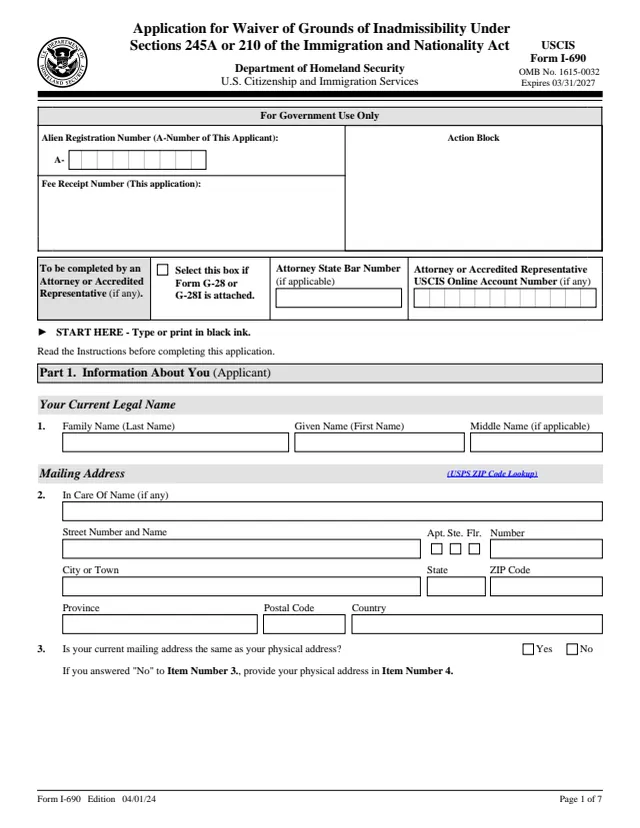
I-690
189 fields, 7 pages
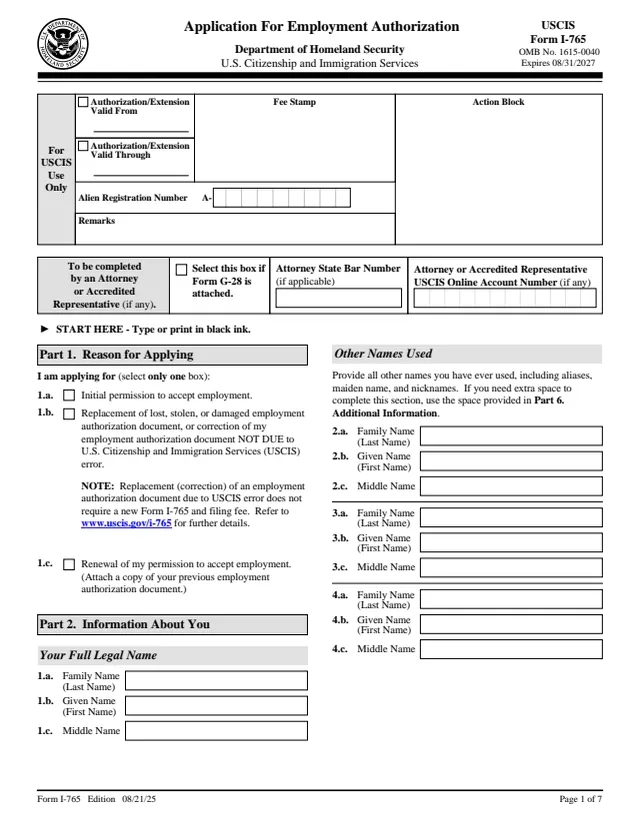
I-765
161 fields, 7 pages
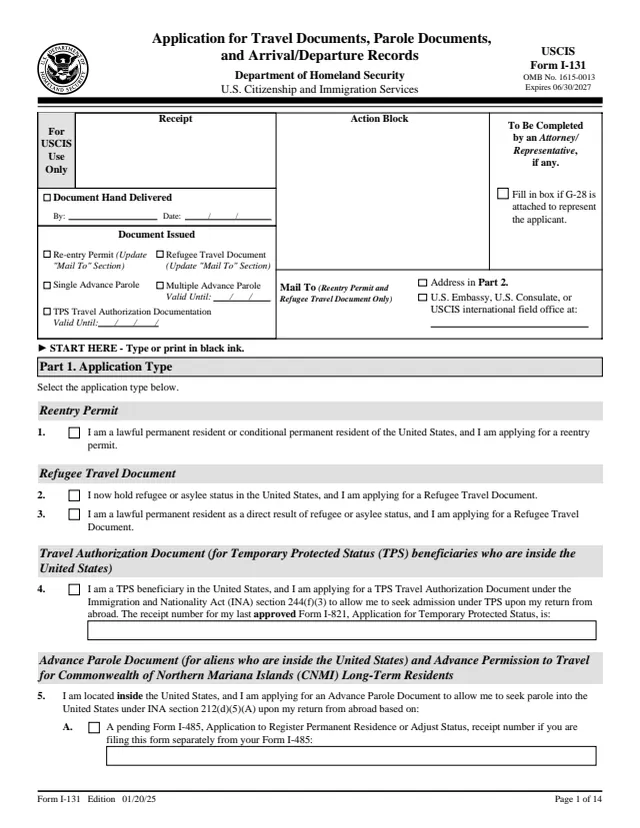
I-131
339 fields, 14 pages
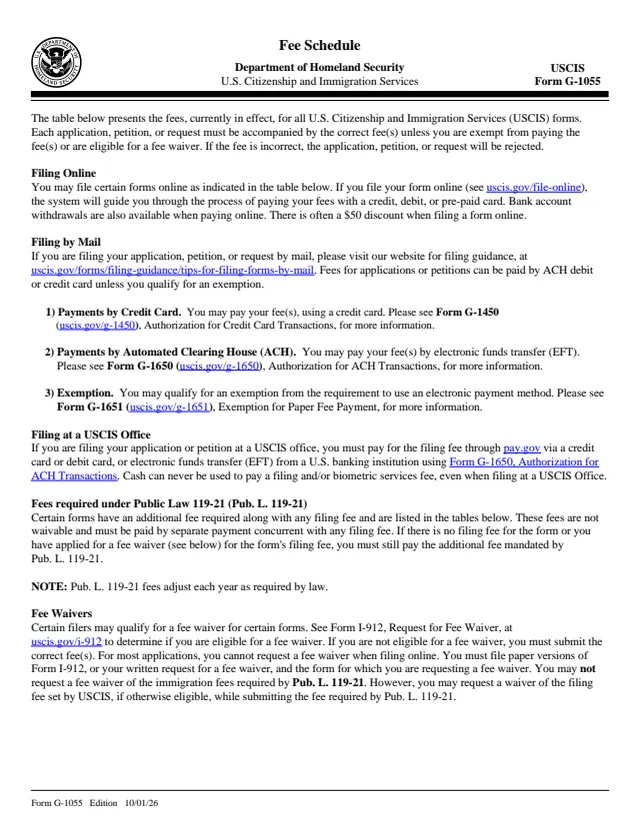
G-1055
64 fields, 58 pages
No tool matches that search.
The USCIS page says there is currently no open filing period. USCIS may accept the form under certain circumstances and will provide those applicants with an address when appropriate.
The USCIS page says it was made for the 1986 legalization program, which ended in 1988, and is now used to apply for benefits under the terms and conditions of certain settlement agreements.
The instructions say Form I-690 may be filed to request a waiver. They also list grounds the Secretary of Homeland Security may not waive, such as multiple criminal convictions and security grounds.
The instructions say failure to appear for a scheduled interview results in the application being denied for abandonment, and there is no appeal of an abandonment denial.
The instructions say the information is confidential, may only be used as provided in INA section 245A(c)(5), and is subject to verification by USCIS.
USCIS fees change, so this page does not list one. The I-687 page points to the USCIS Fee Schedule, and the instructions point to Form G-1055.