Part 1: Information about you
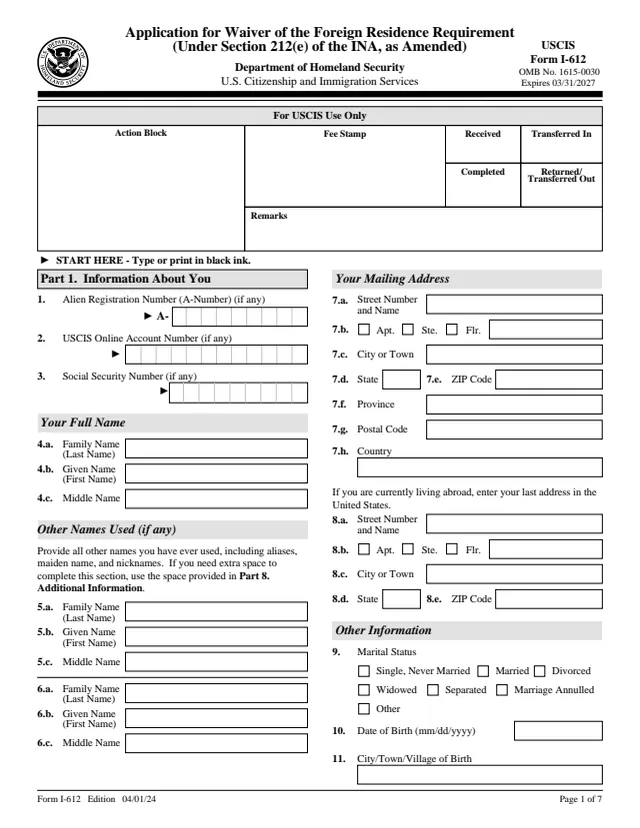
A-Number, USCIS online account number, Social Security number, names, mailing address, your last U.S. address if you live abroad, marital status, birth details, citizenship and country of last foreign residence.
I-612
Application for Waiver of the Foreign Residence Requirement (under Section 212(e) of the Immigration and Nationality Act, as Amended)
Form I-612, Application for Waiver of the Foreign Residence Requirement (under Section 212(e) of the INA, as Amended), is how a J-1 exchange visitor asks for a waiver of the two-year foreign residence requirement.
The instructions say INA section 212(e) requires certain J-1 and J-2 exchange visitors to return to their home country or country of last foreign residence for at least two years before they may apply for an immigrant visa, adjustment of status, or a change of status such as to H or L.
Form I-612 covers two bases: exceptional hardship to a U.S. citizen or lawful permanent resident spouse or child, or a belief that returning would lead to persecution on account of race, religion or political opinion. The instructions say the requirement cannot be waived unless the Department of State's Waiver Review Division makes a favorable recommendation.
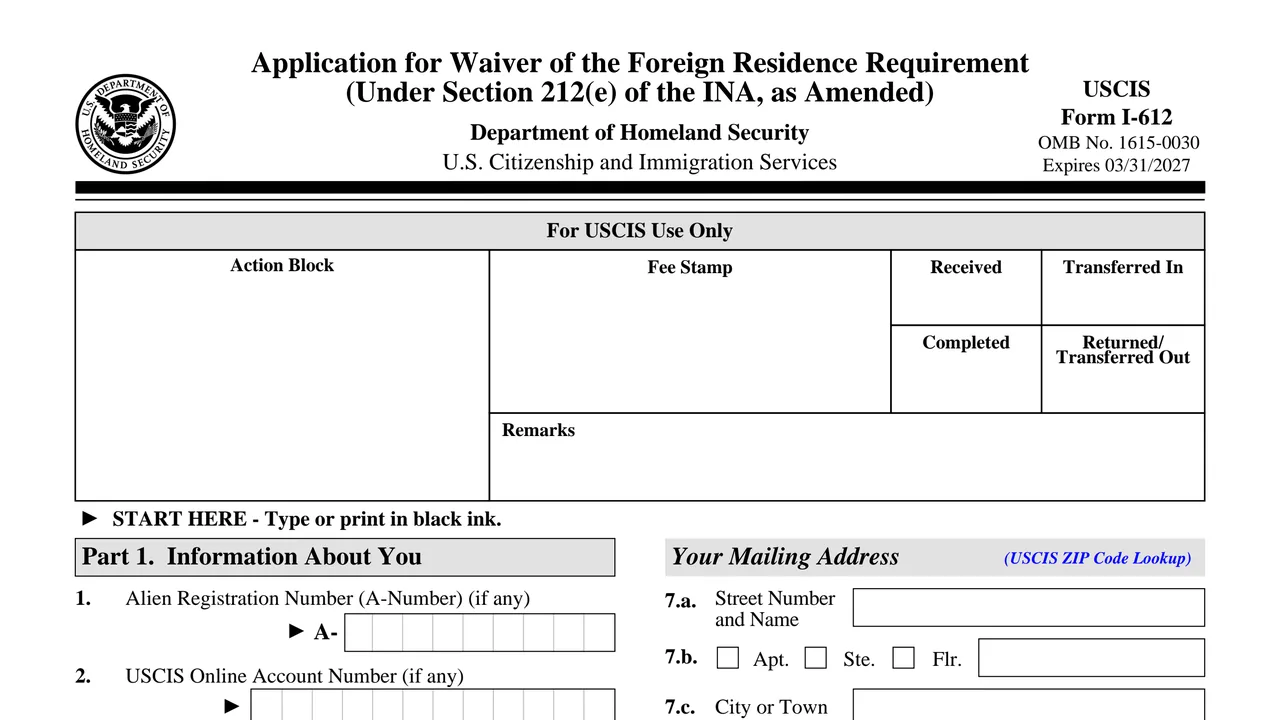
A-Number, USCIS online account number, Social Security number, names, mailing address, your last U.S. address if you live abroad, marital status, birth details, citizenship and country of last foreign residence.
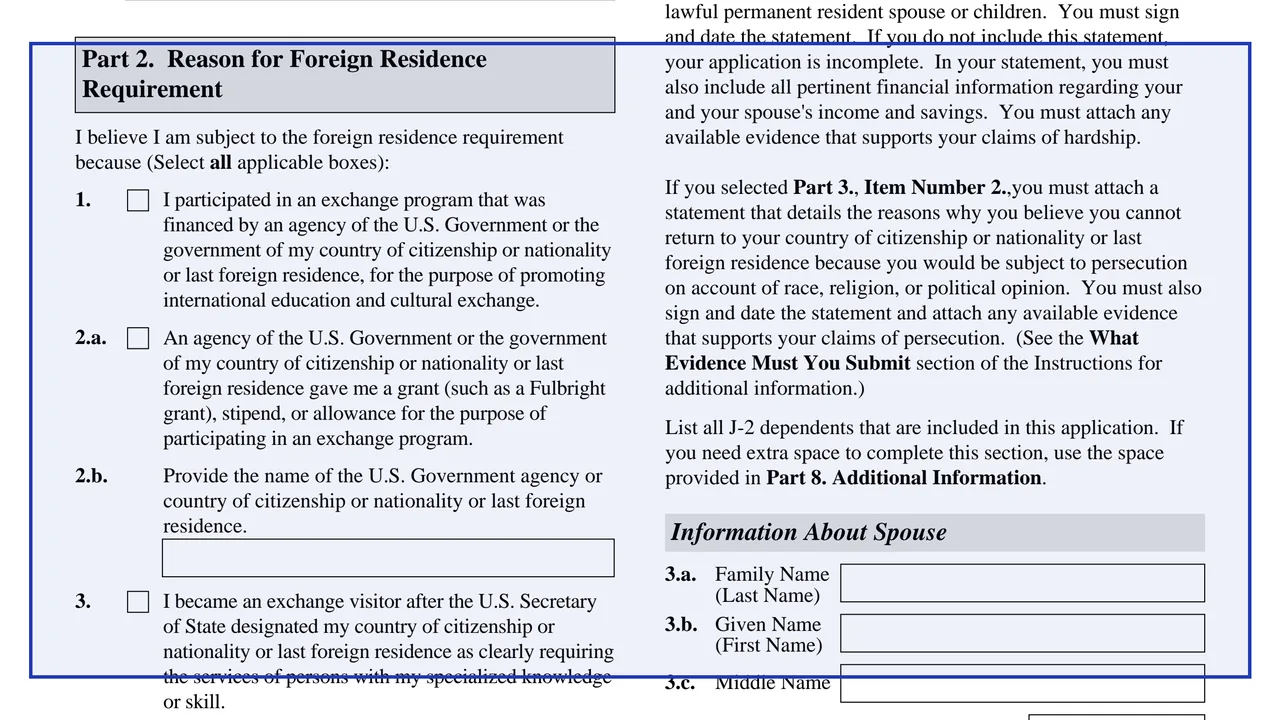
Select all that apply: a government-financed program, a grant such as a Fulbright grant, a country that designated your specialized skill, or graduate medical education on or after January 10, 1977.
One box for exceptional hardship or persecution, then the name, birth date, citizenship and country of last foreign residence of each J-2 spouse and child included.
Exchange program numbers and sponsors, major field of activity, occupation, last J-1 entry date and port of entry, and details of the U.S. citizen or permanent resident spouse or children claimed for hardship.
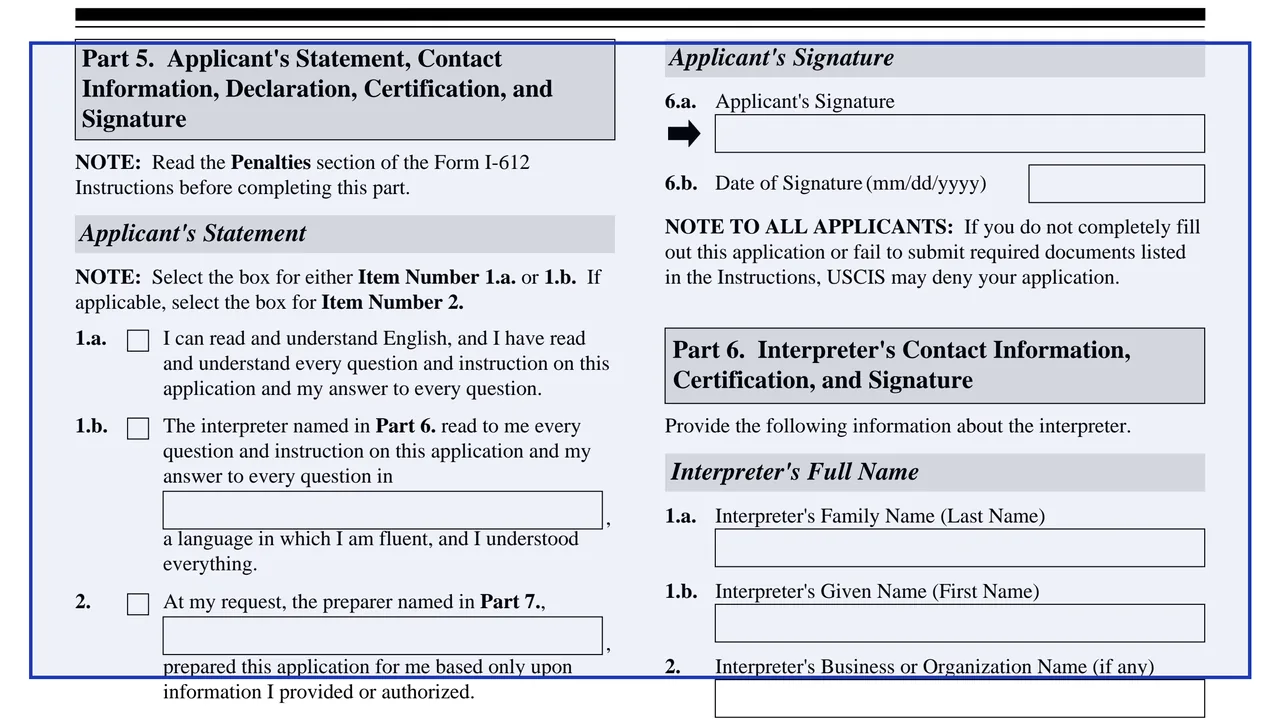
Whether you read the form yourself or used an interpreter, whether a preparer helped, your contact details, the declaration and certification, and your signature.
The interpreter's and preparer's details and certifications, including whether a preparer is an attorney or accredited representative, plus additional information space.
The USCIS page says the edition date and page numbers should be visible on every printed page, all from the same edition. Type or print in black ink. Write N/A where a question does not apply and None for a zero.
The instructions list the conditions that make an exchange visitor subject to the requirement. For questions about that, they suggest contacting the responsible program officer or a U.S. Embassy or Consulate.
The form says a hardship claim needs a signed, dated statement with financial details on your and your spouse's income and savings, or the application is incomplete. A persecution claim needs its own signed statement.
Enter each J-2 spouse and child in Part 3, using Part 8 for more space. The instructions say J-2 dependents not listed will not receive waivers with you.
For a hardship claim, give how the spouse or child obtained U.S. citizenship, with naturalization or certificate details, or their permanent resident details such as the A-Number and preference category.
The instructions say a stamped or typewritten name is not accepted, and a parent or legal guardian may sign for an applicant under 14. This page lets you fill the form online free, then print it for signature.
You get the real form, filled in a browser tab, with nothing standing between you and the finished PDF.
For a hardship or persecution waiver, the USCIS page says to mail the form to the USCIS Elgin Lockbox or Phoenix Lockbox, depending on where you live, and lists separate USPS and courier addresses.
For an Interested U.S. Government Agency request, a No Objection statement or the Conrad Waiver Program, the USCIS page says to follow the process on the Department of State website.
The fee is on the USCIS Fee Schedule page, and the instructions point to Form G-1055. Fees can change, so check it on the day you file. The instructions say USCIS rejects a form sent without the correct fee or a signature.
Your statement on the hardship or persecution, copies of all Forms DS-2019 or IAP-66 for every exchange program you or your spouse joined, and a copy of your Form I-94. The instructions say not to send an original passport.
Proof of the spouse's or child's U.S. citizenship or permanent resident status, proof of the relationship, the marriage certificate, proof all prior marriages ended, and the child's birth certificate if the claim is based on a child.
The instructions say a paper copy of an electronic Form I-94 can be obtained on the CBP website, and if that is not possible, by filing Form I-102 with USCIS.
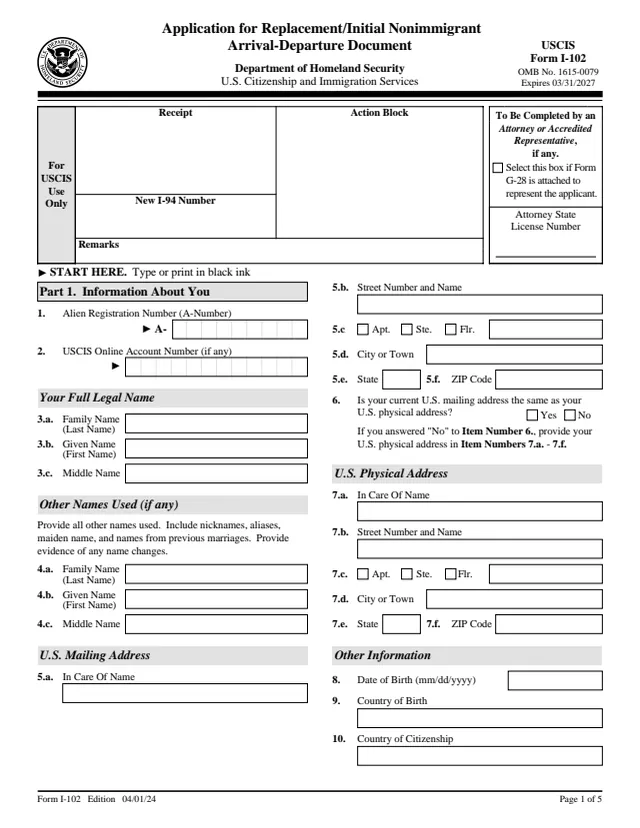
I-102
115 fields, 5 pages
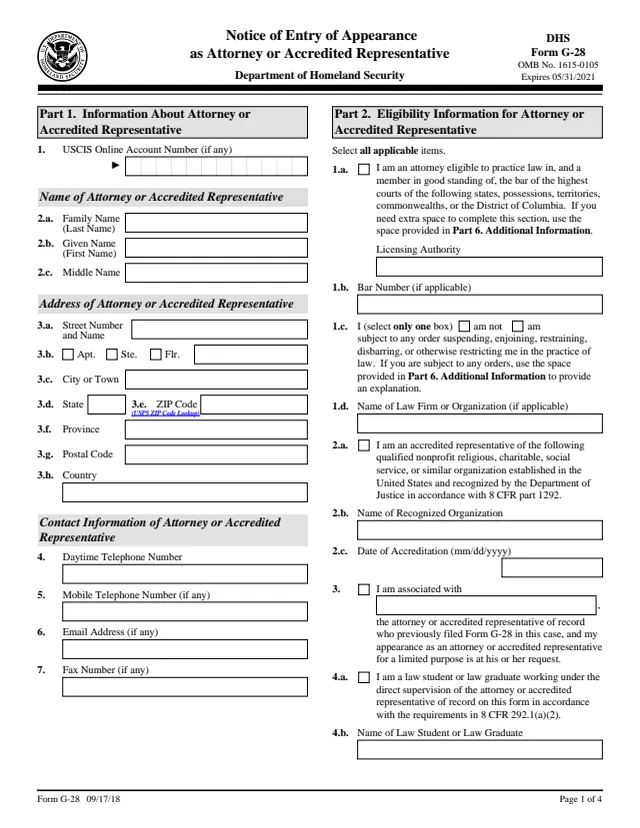
G-28
101 fields, 4 pages
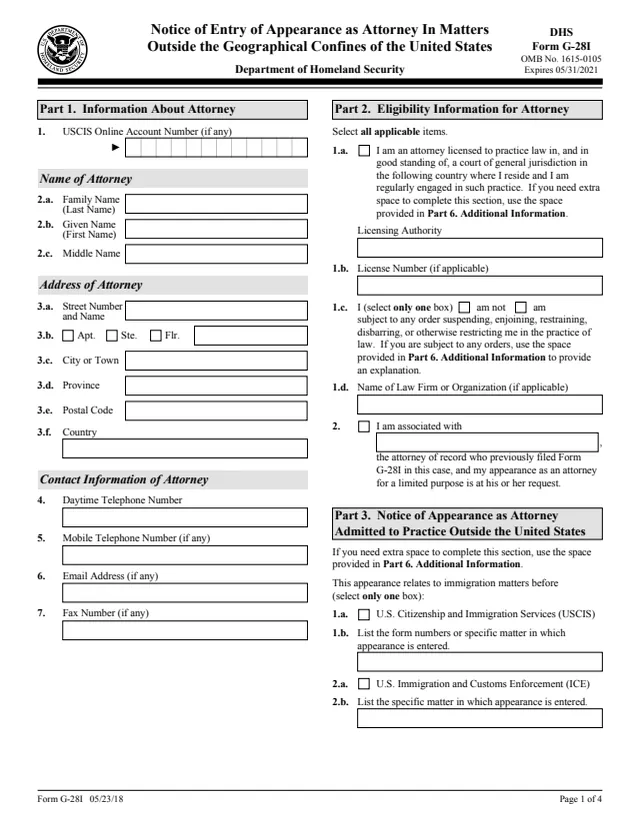
G-28I
83 fields, 4 pages
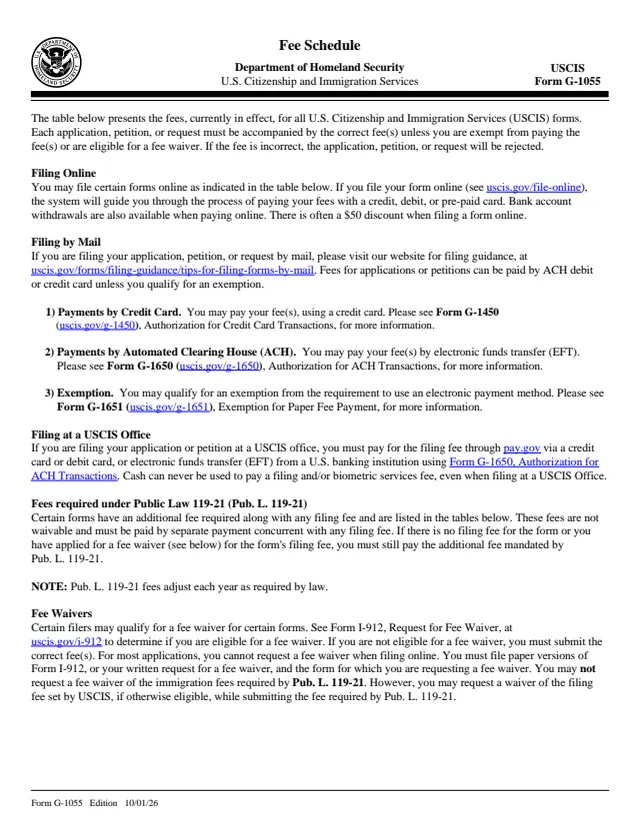
G-1055
64 fields, 58 pages
No tool matches that search.
The instructions say INA section 212(e) requires certain J-1 and J-2 exchange visitors to return to their home country or country of last foreign residence for at least two years before applying for an immigrant visa, adjustment or a change of status.
The instructions say J-2 spouses still married to the J-1 and unmarried children under 21 may not file on their own behalf. They are listed on the J-1's application instead.
No. The instructions say those, and waivers requested by an Interested U.S. Government Agency, are not filed with USCIS. The Department of State website describes the process.
The instructions say the requirement cannot be waived unless the Department of State's Waiver Review Division makes a favorable recommendation to the Secretary of Homeland Security. USCIS notifies the applicant of the decision in writing.
The instructions list three conditions, such as program funding by a government or graduate medical education. They suggest asking the responsible program officer or a U.S. Embassy or Consulate.
USCIS fees change, so this page does not list one. The I-612 page points to the USCIS Fee Schedule, and the instructions point to Form G-1055.