Part 1: Information about attorney
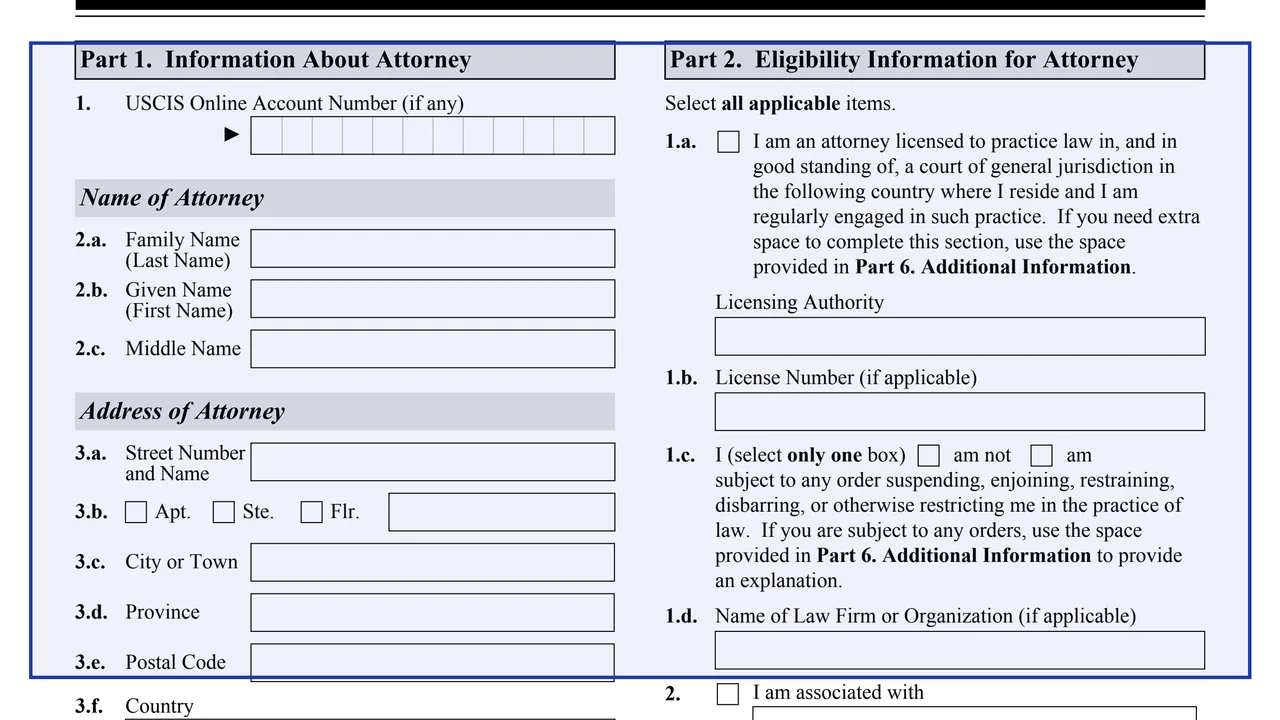
The attorney's USCIS online account number if any, full name, mailing address with province and country, and daytime phone, mobile phone, email and fax.
G-28I
Notice of Entry of Appearance as Attorney in Matters Outside the Geographical Confines of the United States
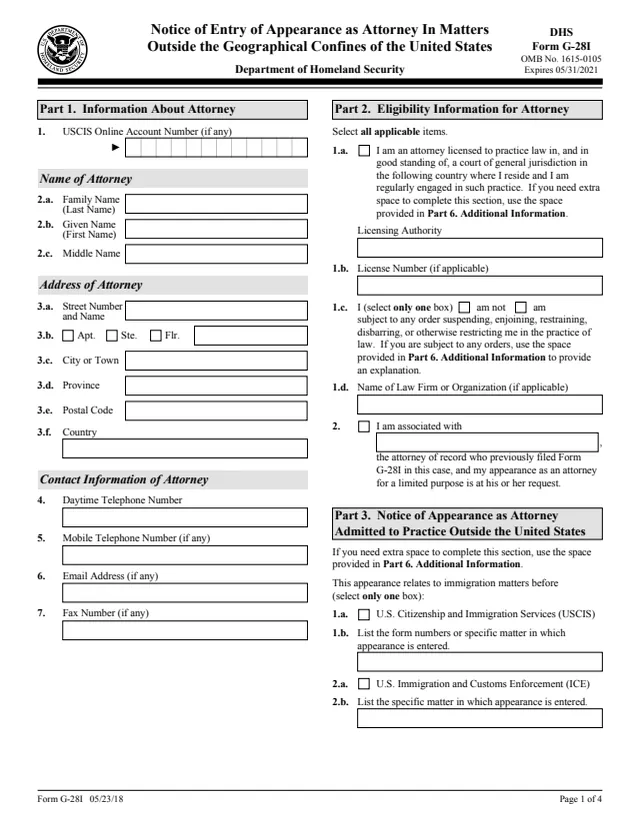
Form G-28I, Notice of Entry of Appearance as Attorney in Matters Outside the Geographical Confines of the United States, is how an attorney admitted to practice law in another country gives notice that they seek to appear before the Department of Homeland Security (DHS) in a matter outside the United States.
The instructions say USCIS, U.S. Customs and Border Protection (CBP) and U.S. Immigration and Customs Enforcement (ICE) only recognize a properly completed Form G-28I signed by both the attorney and the client, and recognize it until the matter ends unless otherwise notified.
Accepting the form is not the same as permission to represent. The instructions say the DHS official before whom the attorney seeks to appear also has to give permission and has the discretion to decide whether the attorney may appear.
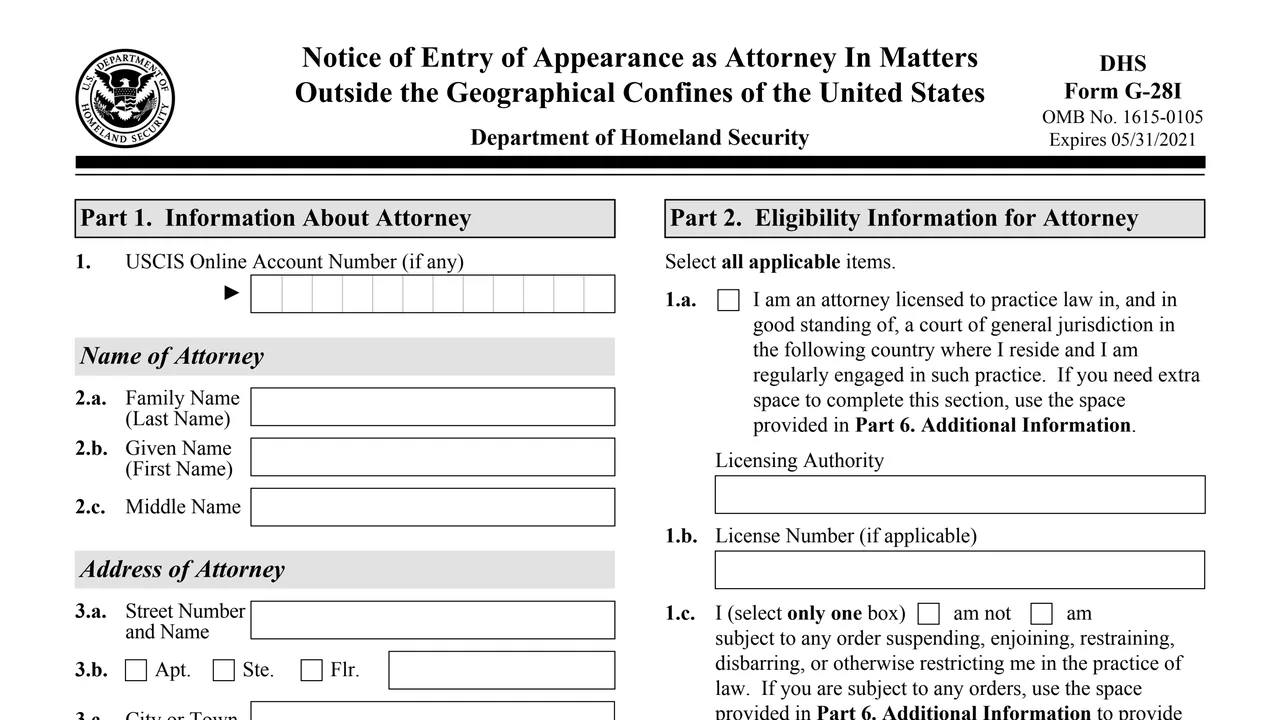
The attorney's USCIS online account number if any, full name, mailing address with province and country, and daytime phone, mobile phone, email and fax.
The country and licensing authority where the attorney practices, the license number if any, whether the attorney is subject to any order restricting their practice, and the law firm name. Item 2 covers a limited purpose appearance.
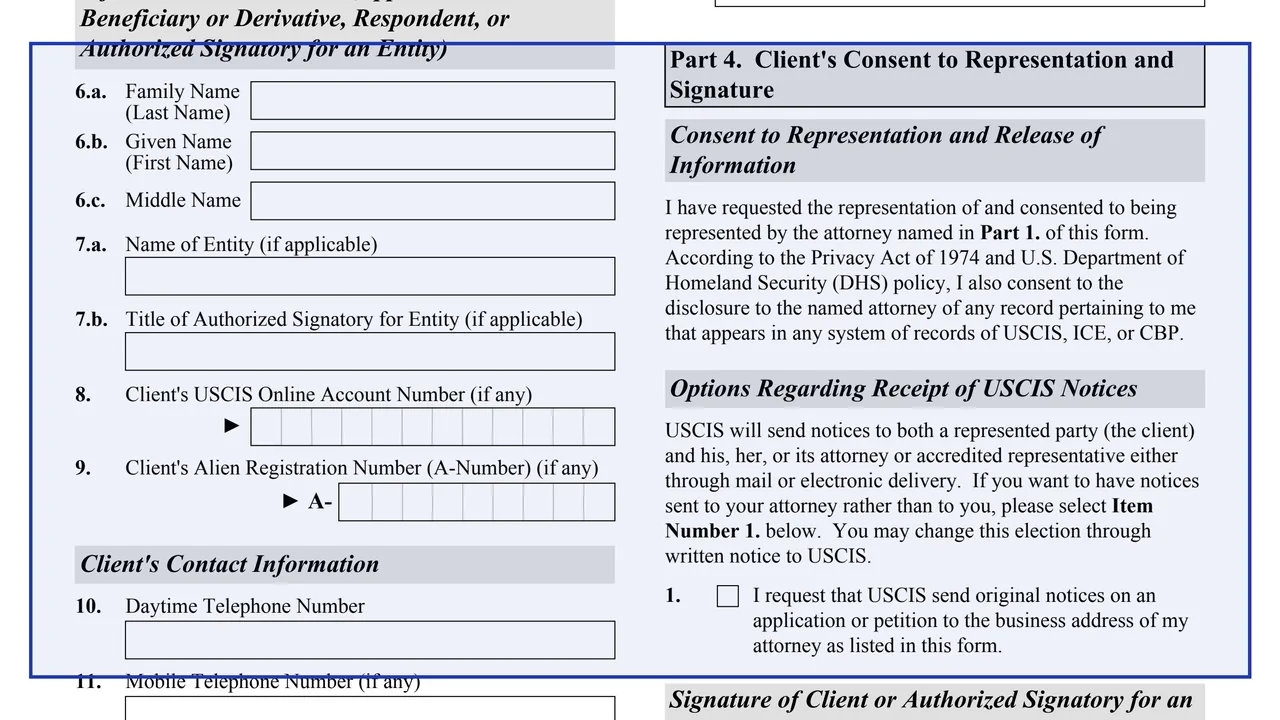
Which agency the matter is before (USCIS, ICE or CBP, one box only), the form numbers or matter, the receipt number if any, the client type, and the client's name, account number, A-Number, contact details and mailing address.
The client consents to representation and to the release of records to the attorney, may ask USCIS to send original notices to the attorney's business address, and signs and dates.
The attorney declares they have read 8 CFR 103.2 and 292 and signs under penalty of perjury. Part 6 gives space for longer answers with page, part and item numbers.
Type or print legibly in black ink and answer all questions fully. The USCIS page says to keep the edition date and page numbers visible on every page of a printed copy, with all pages from the same edition.
Enter the licensing authority and license number. The instructions say an attorney subject to any order restricting their practice selects that box in Item 1.c. and explains it in Part 6.
For USCIS, list the form numbers filed with Form G-28I or the matter. For CBP or ICE, list the matter. Enter the client's name exactly as it appears on the related immigration form, as the USCIS page asks.
The instructions say not to use the attorney's business address unless it is the safe mailing address on the application or petition. USCIS mails notices to a foreign address; a U.S. business address goes in Part 6.
The client signs Part 4 and the attorney signs Part 5. A stamped or typed name is not accepted, but a photocopied, faxed or scanned copy of the original ink signature is. This page lets you fill the form online free, then print it for signature.
You get the real form, filled in a browser tab, with nothing standing between you and the finished PDF.
The USCIS page says to file Form G-28I with the application or petition submitted to a DHS office outside the geographical confines of the United States. It may not be filed with matters in offices within the United States.
The USCIS page lists edition 05/23/18 and says a new edition will be published soon. In the meantime, it says the 05/23/18 edition may still be used despite the expiration date printed on the form.
USCIS points to its Fee Schedule page for any Form G-28I fee. Fees can change, so check that page and the USCIS Fee Schedule (Form G-1055) on the day you file.
The USCIS page says the most common mistake is a missing signature. An improperly completed form is not accepted, and USCIS then processes the benefit request as if no Form G-28I was sent.
When completing it by hand, the USCIS page says to use a black pen inside the spaces, and never use highlighters, correction fluid or gray out any part of the form.
The instructions say individuals appearing as attorneys are subject to the rules of professional conduct in 8 CFR 292.3, and attorneys are required to notify DHS of convictions or discipline under that rule.
No tool matches that search.
No. The USCIS page says this form may not be filed with matters in offices within the United States. It is filed with an application or petition submitted to a DHS office outside the country.
Not by itself. The instructions say acceptance of the form does not itself constitute permission, and the DHS official has the discretion to decide whether the attorney may appear.
Both the client and the attorney. If the client is under 14, the instructions say a parent or legal guardian may sign, and a legal guardian may also sign for a mentally incompetent person.
The USCIS page says yes. A new edition will be published soon, and until then the 05/23/18 edition may be used despite its expiration date.
The form says USCIS sends notices to both the client and the attorney. If the client selects Part 4, Item 1, originals go to the attorney's business address and copies to the client.
The instructions say USCIS, CBP and ICE recognize it until the conclusion of the matter for which it was entered, unless otherwise notified.