Part 1: Information about you
A-Number, USCIS online account number, names, addresses, Social Security number and birth details, plus your consular case number, Form I-485 or Form I-821 receipt number, and any Form I-212 filing.
I-601
Application for Waiver of Grounds of Inadmissibility
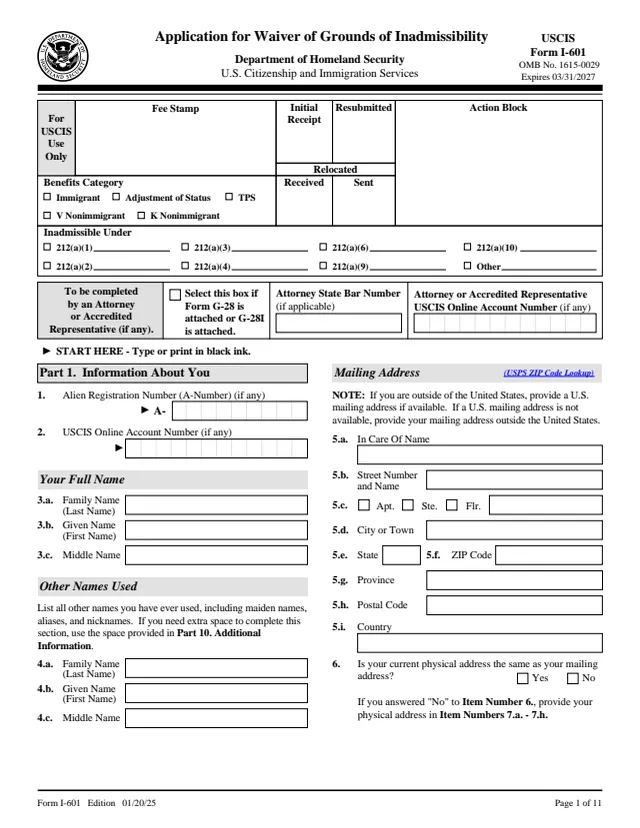
Form I-601, Application for Waiver of Grounds of Inadmissibility, is how a person who is inadmissible to the United States asks for a waiver of certain grounds of inadmissibility. USCIS says it is used by people seeking an immigrant visa, adjustment of status, certain nonimmigrant statuses or certain other immigration benefits.
Which grounds can be waived, and whether a qualifying relative is needed, depends on the benefit sought and the reason for inadmissibility. The instructions list the categories: immigrant, K and V visa applicants, adjustment of status applicants, Temporary Protected Status (TPS) applicants, NACARA and HRIFA applicants, VAWA self-petitioners, T nonimmigrants and Special Immigrant Juveniles.
The instructions say a provisional unlawful presence waiver is requested on Form I-601A, not on Form I-601. The USCIS page says all 11 pages of Form I-601 are submitted.
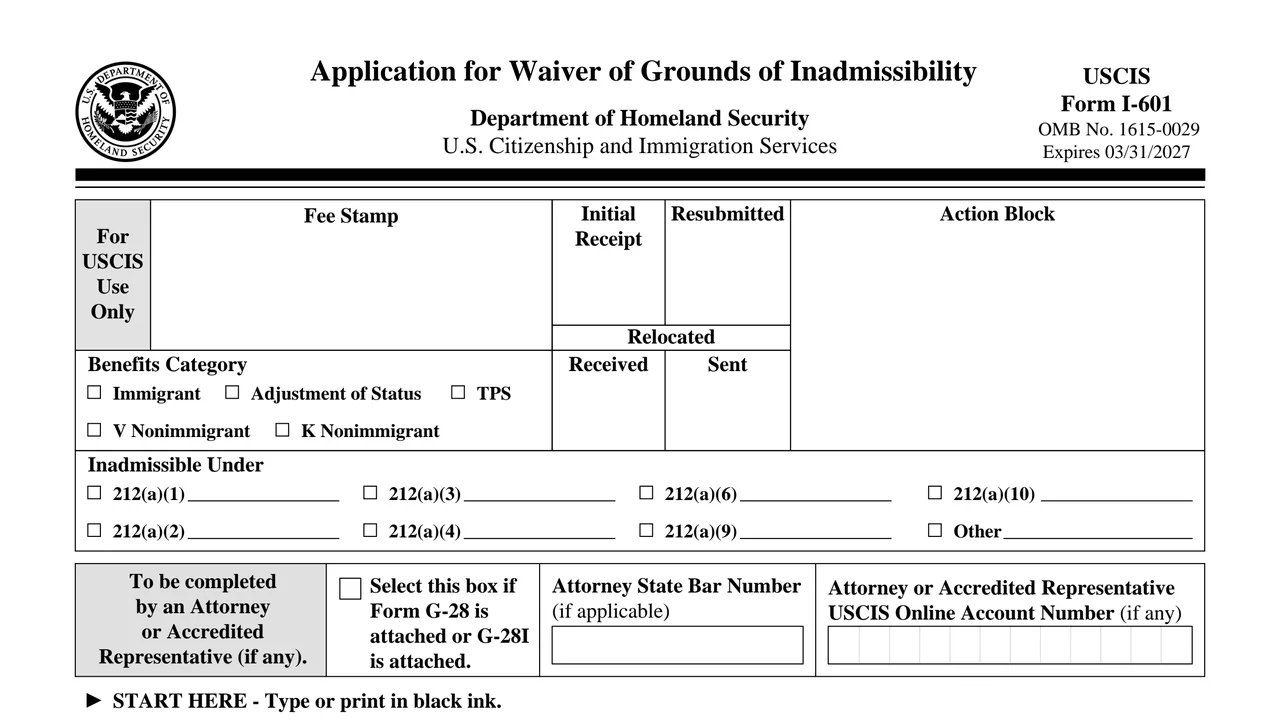
A-Number, USCIS online account number, names, addresses, Social Security number and birth details, plus your consular case number, Form I-485 or Form I-821 receipt number, and any Form I-212 filing.
Your periods of stay in the United States, starting with the most recent arrival, then ethnicity, race, height, weight, eye and hair color for USCIS applicants.
Section A for visa, adjustment, K and V applicants (Items 1 to 18), Section B for T and SIJ adjustment (Item 19), Section C for TPS (Items 20 to 39), and the inadmissibility statement in Item 40.
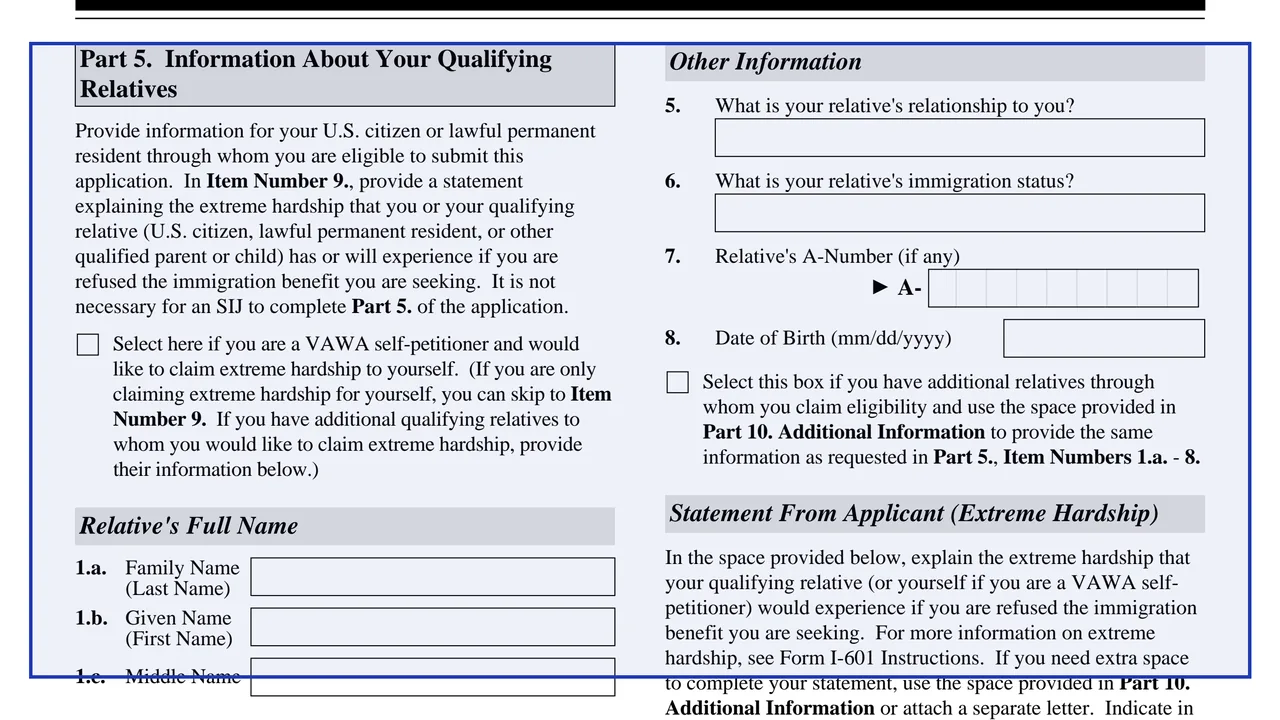
The U.S. citizen or permanent resident relative through whom you claim eligibility, a box for a VAWA self-petitioner claiming hardship to themselves, and the extreme hardship statement in Item 9.
Other family members you would like considered, and the Item 9 statement on why the application should be approved as a matter of discretion.
Your signature (Part 7), interpreter (Part 8), preparer (Part 9), additional information (Part 10), and Part 11 for applicants with a Class A tuberculosis condition, signed with local and state health officials.
The USCIS page says all 11 pages are submitted, with the edition date and page numbers visible and every page from the same edition. Type or print in black ink, and write N/A or None where it fits.
The USCIS page says the form is rejected if the Part 1 family name, mailing address or date of birth is missing, and that unsigned forms are rejected.
The form says to select only the grounds listed under the benefit you are seeking. The instructions say an approved waiver covers only the grounds and events included, so they ask applicants to list all of them.
Explain the acts, convictions or medical conditions with their dates. The instructions say records of convictions are certified court documents and an uncertified copy is not sufficient.
Part 5, Item 9 is for extreme hardship and Part 6, Item 9 for discretion. If a separate letter is used, the instructions say to note it in Item 9 and send the letter with the application.
The instructions say a stamped or typewritten name is not accepted, and a parent or legal guardian may sign for an applicant under 14. This page lets you fill the form online free, then print it for signature.
You get the real form, filled in a browser tab, with nothing standing between you and the finished PDF.
The USCIS page says the filing location depends on the benefit sought and lists addresses on its Direct Filing Addresses for Form I-601 page. It changed the location on Oct. 7, 2026, and accepts forms postmarked on or before Nov. 9, 2026, sent to a prior location.
The fee is on the USCIS Fee Schedule page, and the instructions point to Form G-1055. Fees can change, so check it on the day you file. The instructions say no biometric services fee is sent at filing with USCIS.
The USCIS page says it accepts a fee waiver request from a VAWA self-petitioner, a T visa applicant, a battered spouse or child of a permanent resident or U.S. citizen, a TPS applicant, a Special Immigrant Juvenile, and certain others.
The instructions list examples such as affidavits, police reports, complete court records, evidence of rehabilitation and medical reports. Where extreme hardship applies, they ask for proof of the family relationship and of the hardship.
The instructions name health, financial considerations, education, personal considerations and special factors, and say mere assertions will not suffice. Medical claims are supported by a medical professional's statement.
For an email or text when a lockbox accepts the form, clip Form G-1145 to the first page. Foreign-language documents need a full English translation with the translator's certification.
I-601A
257 fields, 9 pages
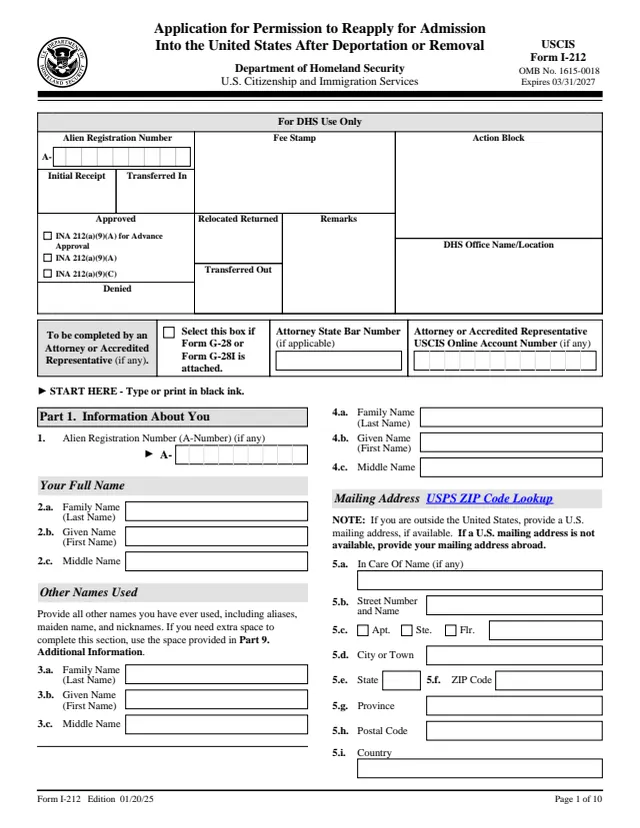
I-212
298 fields, 10 pages
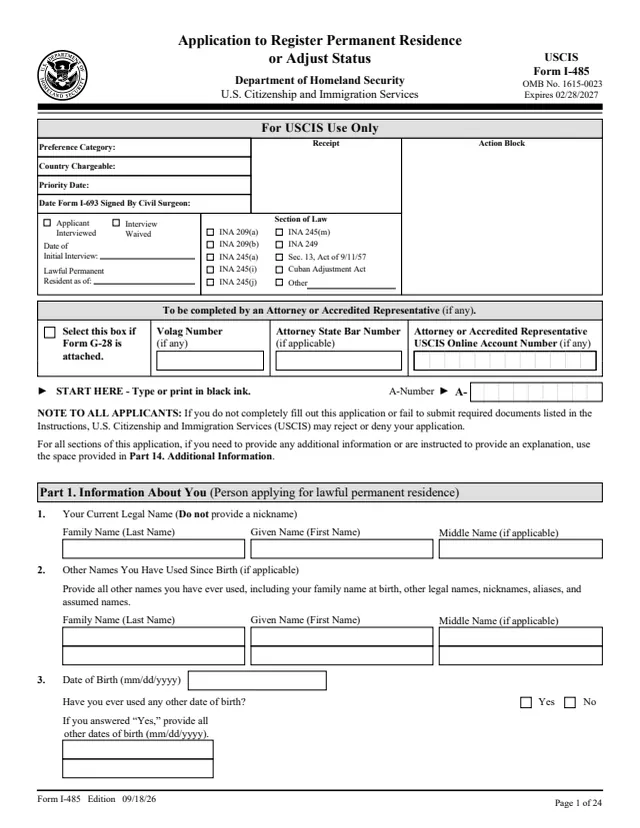
I-485
730 fields, 24 pages
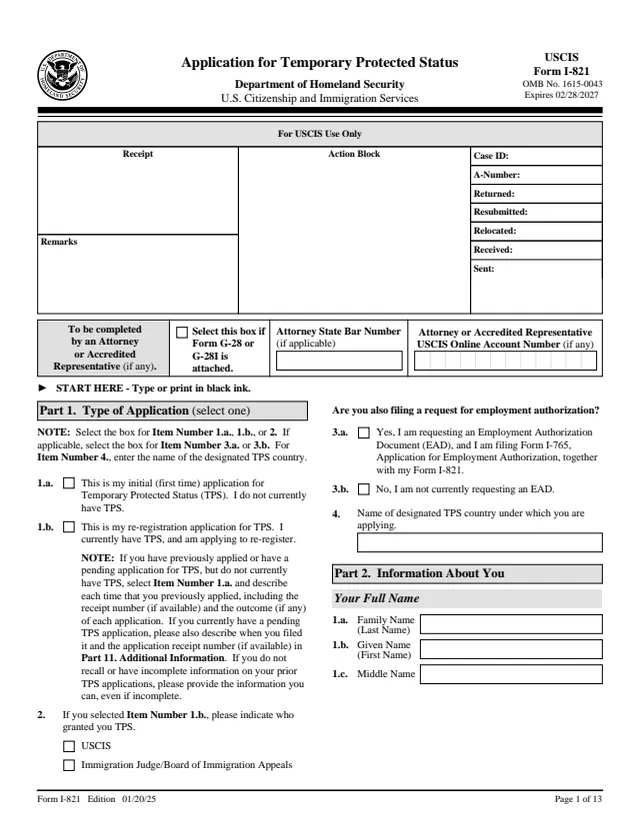
I-821
478 fields, 13 pages
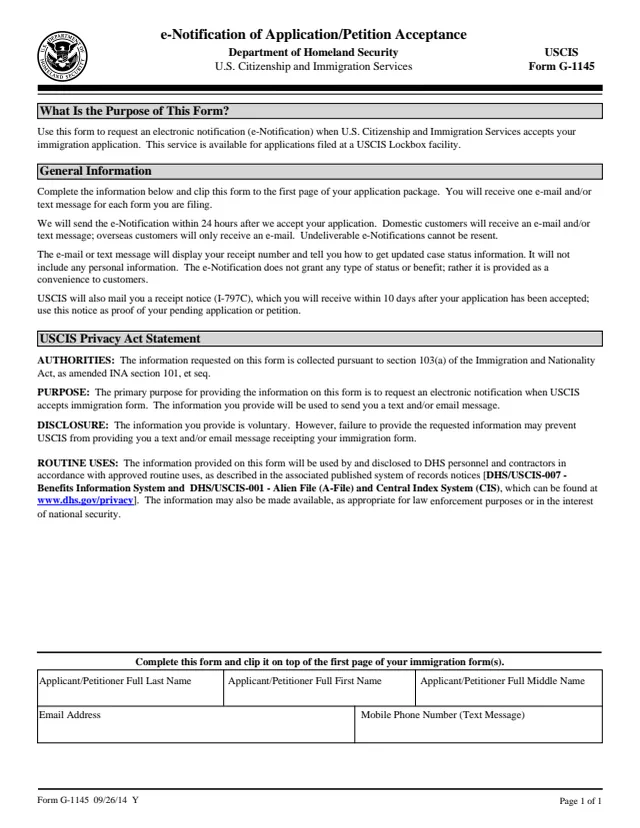
G-1145
6 fields, 1 page
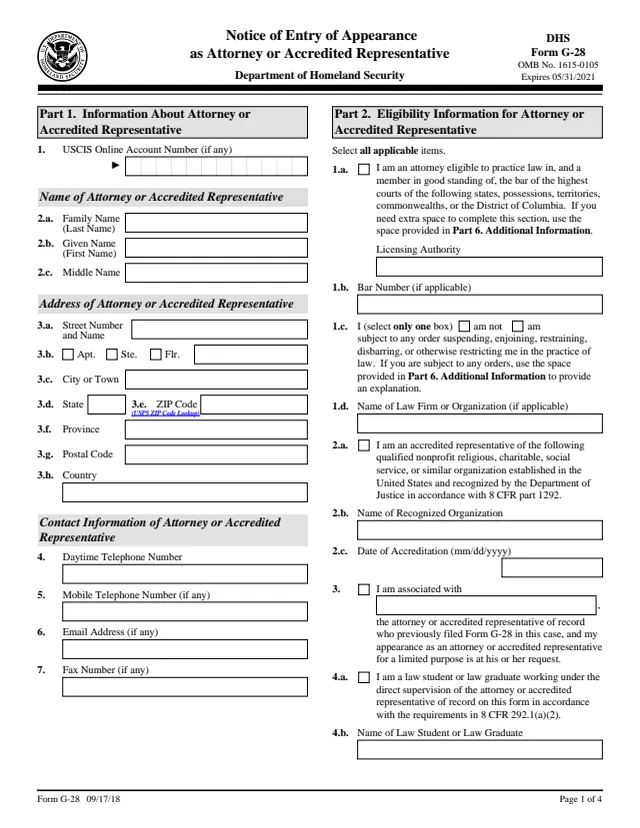
G-28
101 fields, 4 pages
No tool matches that search.
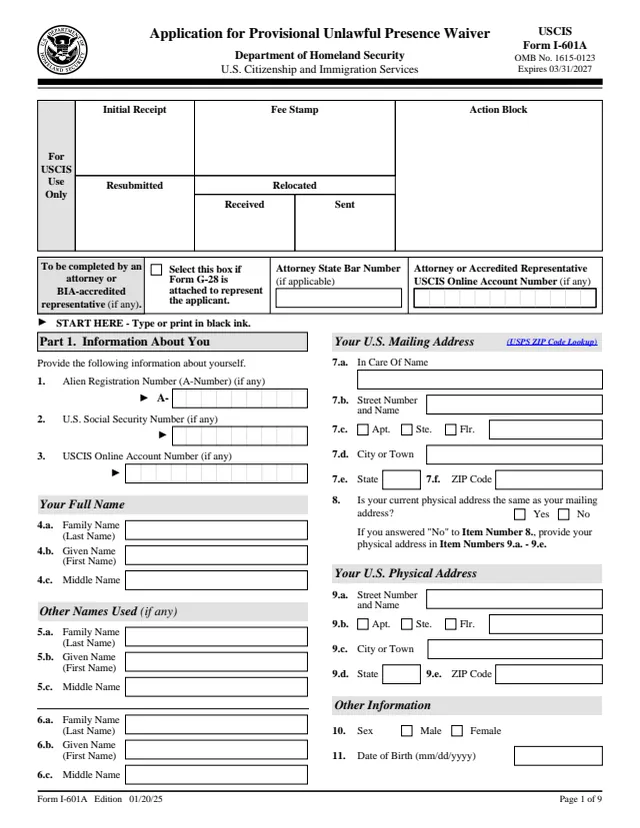
The instructions say Form I-601A is for a provisional waiver of the unlawful presence ground under INA section 212(a)(9)(B) only, and that Form I-601 is not used for that request.
The instructions say a waiver granted with an immigrant visa or adjustment application is generally valid indefinitely. Waivers tied to a Convention adoptee, a K visa, conditional residence or TPS are conditional or limited.
It depends on the ground. The instructions say the waivers require different qualifying relationships. A Special Immigrant Juvenile waiver under INA section 245(h) needs no qualifying relative and no extreme hardship.
The USCIS page says the address depends on the benefit sought, listed on the Direct Filing Addresses for Form I-601 page. The location changed on Oct. 7, 2026, with a grace period to Nov. 9, 2026.
The instructions say to enter the U.S. citizen petitioner in Items 1.a. to 8. and write Prospective Spouse in Item 5. USCIS conditionally approves the waiver, with the marriage as the condition.
The USCIS page lists the groups it accepts a fee waiver request from, including VAWA self-petitioners, T visa applicants, TPS applicants and Special Immigrant Juveniles, and points to its Fee Waiver page.
USCIS fees change, so this page does not list one. The I-601 page points to the USCIS Fee Schedule, and the instructions point to Form G-1055.