I-363

Request to Enforce Affidavit of Financial Support and Intent to Petition for Legal Custody for Public Law 97-359 Amerasian

Agency
USCIS
Revision
Edition 04/01/24
Fillable fields
198
Pages
7
Official source
USCIS form page
Checked
October 20, 2026
Fill I-363 online
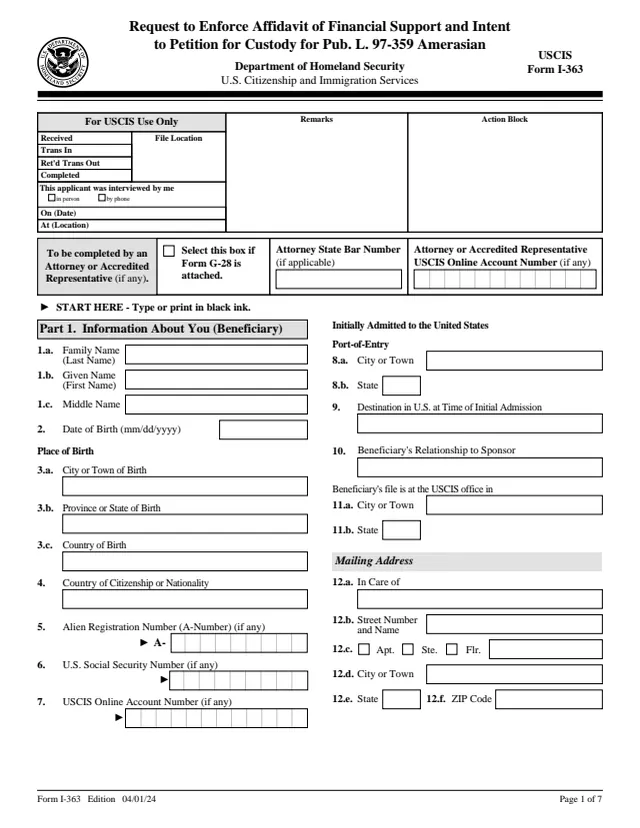
Page 1 of form I-363

Form I-363: Request to Enforce Affidavit of Financial Support for an Amerasian

Form I-363, Request to Enforce Affidavit of Financial Support and Intent to Petition for Legal Custody for Public Law 97-359 Amerasian, is how the guarantee a sponsor made on Form I-361 is brought to USCIS for enforcement. USCIS says that if, after admission to the United States, the beneficiary of a petition for a Public Law 97-359 Amerasian requires enforcement of the guarantee of financial support and intent to petition for legal custody executed by the sponsor, the beneficiary may file this form.

The instructions say the guarantee may be enforced against the sponsor in a civil suit brought by the Attorney General in the U.S. district court for the district where the sponsor resides. The sponsor's estate is not liable if the sponsor dies or is determined to be bankrupt under Title 11, United States Code.

The privacy statement in the instructions says the information is used to decide whether Form I-361 requires enforcement and may be furnished to the U.S. Attorney for an enforcement action.

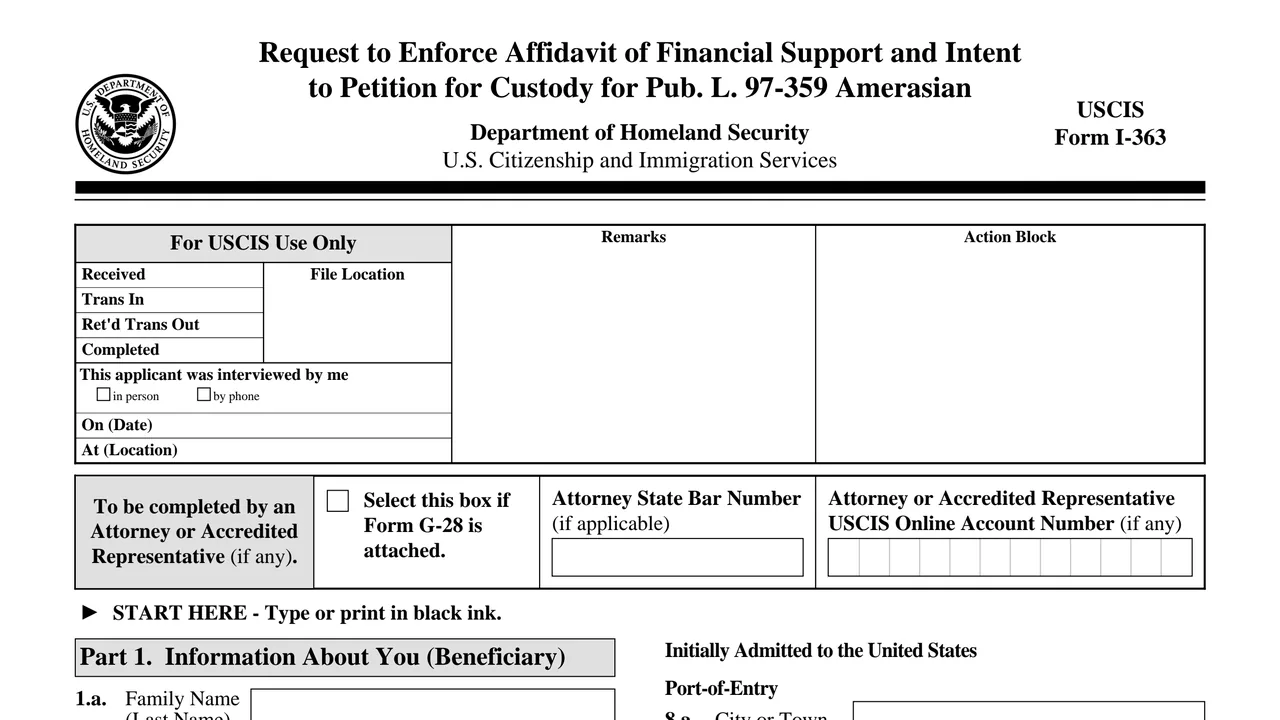
Top of page 1 of Form I-363: Request to Enforce Affidavit of Financial Support for an Amerasian, as printed by USCIS

What's on Form I-363

Part 1: Information about you (beneficiary)

Name, date and place of birth, citizenship, A-Number, Social Security and USCIS online account numbers, the port of entry and destination at initial admission, relationship to the sponsor, the USCIS office holding your file, mailing address and employer or school.
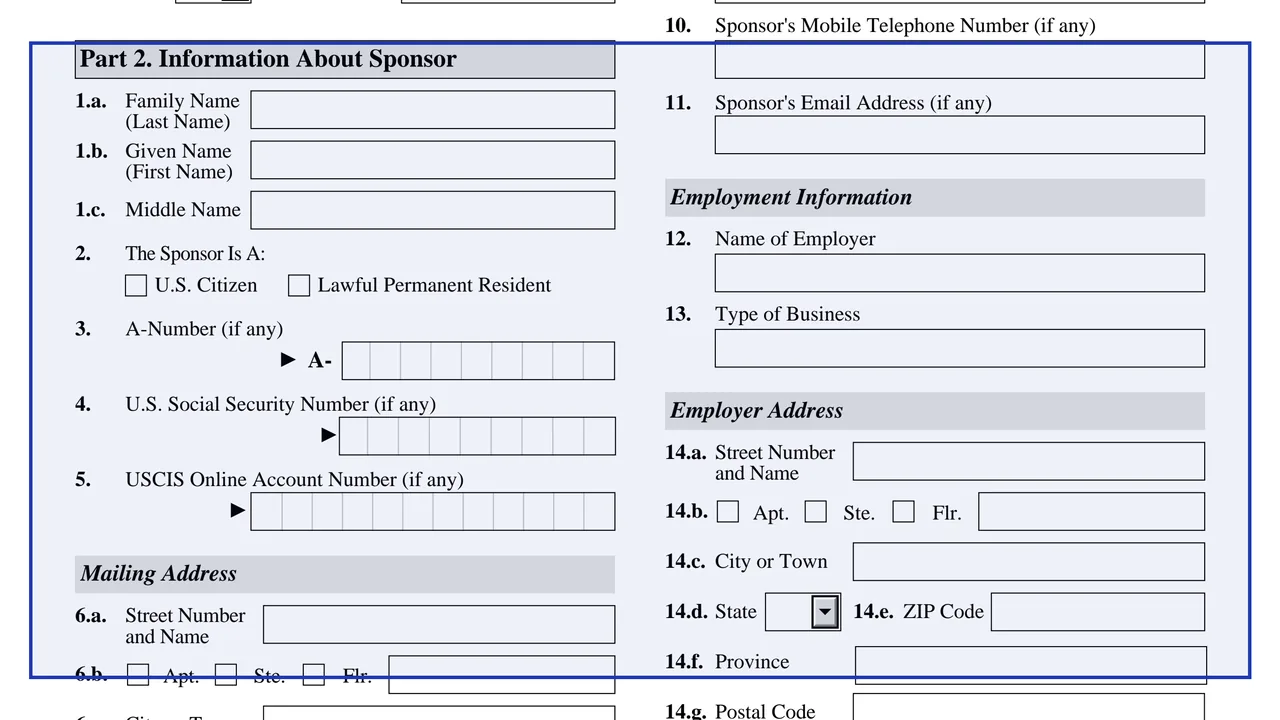
Part 2: Information about sponsor

Name, whether the sponsor is a U.S. citizen or lawful permanent resident, A-Number, Social Security and online account numbers, mailing and physical address, phone and email, and employer.

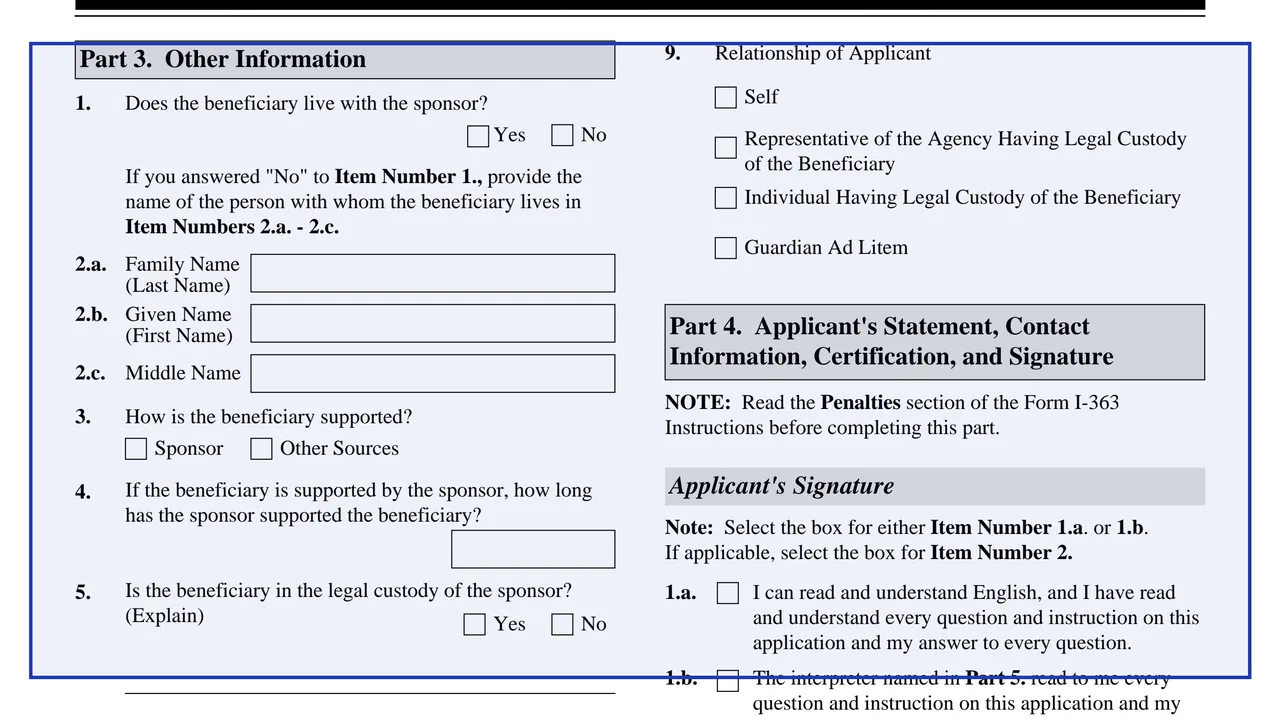
Part 3: Other information

Whether the beneficiary lives with the sponsor, how the beneficiary is supported and for how long, legal custody, whether and when support stopped, any reason the sponsor gave, and the applicant's relationship to the beneficiary.

Part 4: Applicant's statement and signature

Whether you read the request yourself or through an interpreter, whether a preparer helped, contact details, the certification under penalty of perjury and your signature.

Parts 5 to 7: Interpreter, preparer and additional information

Contact details, certifications and signatures for anyone who interpreted or prepared the request, and extra space for longer answers. The last page of the form is for USCIS use only.

How to fill out Form I-363

  1. 1

    Use the 04/01/24 edition and write clearly

    Type or print in black ink. Answer every question, writing N/A where a question does not apply and None for a zero. On a printed copy, keep the edition date and page numbers visible, with all pages from the same edition.

  2. 2

    Fill in Part 1 and Part 2

    Give your own details, including where you were initially admitted, then the sponsor's. The instructions say a USCIS online account number exists only if you previously filed a form with a receipt number that begins with IOE.

  3. 3

    Describe the support in Part 3

    Answer whether the sponsor stopped all support, the date it stopped, and any reason the sponsor gave. Longer explanations go in Part 7 with the page, part and item number.

  4. 4

    Attach Form I-361 if available

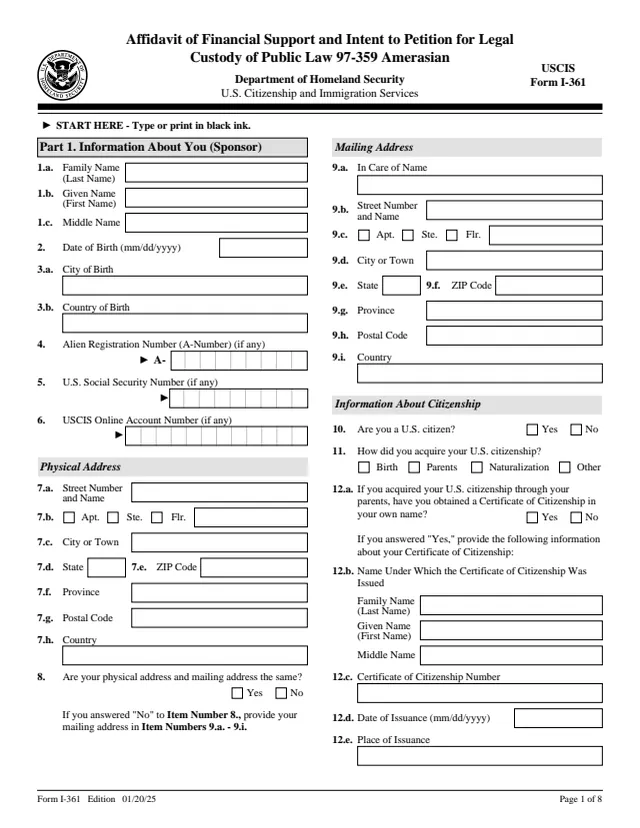
    A note in Part 3 asks for a copy of Form I-361, Affidavit of Financial Support and Intent to Petition for Legal Custody for P.L. 97-359 Amerasian, if one is available.

  5. 5

    Sign Part 4 in ink

    The instructions say a stamped or typewritten name is not accepted and an unsigned Form I-363 is rejected. This page lets you fill the form online free, then print it for signature.

Why fill Form I-363 on indox

You get the real form, filled in a browser tab, with nothing standing between you and the finished PDF.

  • Fill the form right in your browser, no software to install
  • Free to fill and free to download, with no account
  • The official blank straight from the USCIS, not a copy someone retyped
  • Works on a phone, tablet or computer

Where to file, processing and fees

Where to file

The USCIS page says the form should be filed with the USCIS district office having jurisdiction over the beneficiary's residence in the United States, which the Field Office Locator finds.

Fee

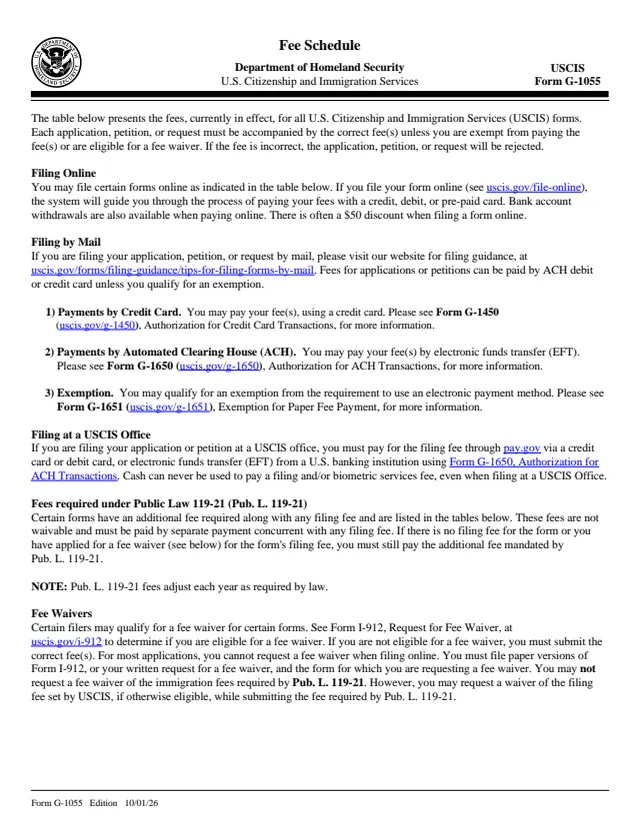
The USCIS page points to its Fee Schedule page, and the instructions point to Form G-1055. Fees can change, so check them on the day you file.

Unsigned requests

The instructions say an unsigned Form I-363 is rejected with a notice that it is deficient. The deficiency can be corrected and the form resubmitted, and it is not properly filed until USCIS accepts it.

Copies and translations

Send legible photocopies unless an original is requested. A foreign-language document goes with a full English translation and the translator's certification, signature, printed name, date and contact information.

What USCIS does next

The instructions say USCIS may ask for more information or evidence, or for an interview that can include biometrics. The form's USCIS-only page records whether an investigation was needed and whether enforcement is recommended to the U.S. Attorney.

Attorneys and representatives

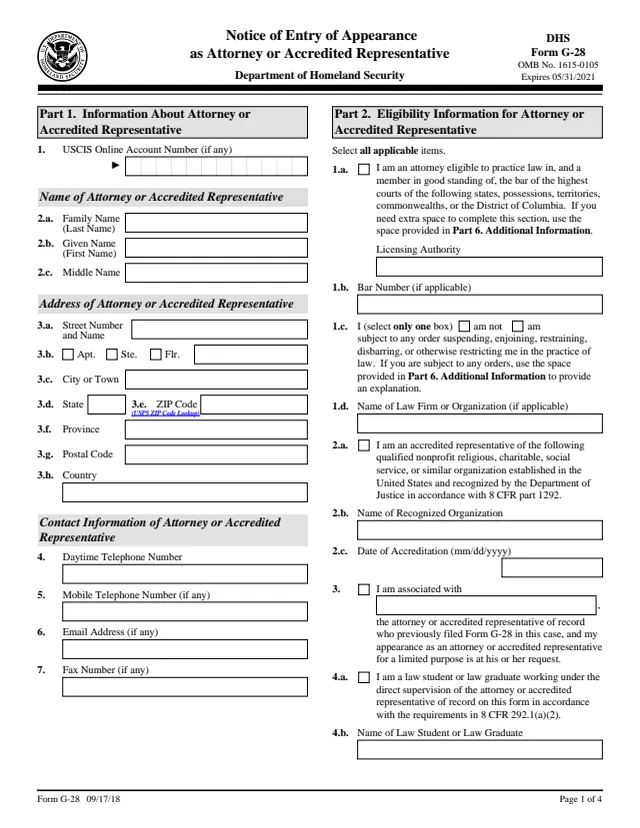
The instructions say an attorney or accredited representative who helped prepare the request may be obliged to also submit Form G-28, Notice of Entry of Appearance as Attorney or Accredited Representative.

Who files Form I-363?

  • The Amerasian beneficiary

    The instructions say the beneficiary of a petition for a Public Law 97-359 Amerasian may file after admission to the United States when the sponsor's guarantee requires enforcement.

  • Custodians of a beneficiary under 18

    If the beneficiary is under 18 years of age, the instructions say any agency or individual, other than the sponsor, having legal custody of the applicant may file Form I-363.

  • The applicant's relationship

    Part 3, Item 9 lists four relationships for the applicant: self, a representative of the agency having legal custody, an individual having legal custody, or a guardian ad litem.

  • Who signs

    The applicant signs Part 4 in ink. The instructions say a parent or legal guardian may sign for an applicant under 14, and a legal guardian may sign for a mentally incompetent person.

Official sources and the blank

Do it all with indox

View all 94 tools

Questions about Form I-363

Who can file Form I-363?

The instructions say the Amerasian beneficiary may file after admission to the United States. For a beneficiary under 18, any agency or individual other than the sponsor having legal custody may file.

Where is Form I-363 filed?

The USCIS page says with the USCIS district office having jurisdiction over the beneficiary's residence in the United States. The Field Office Locator finds that office.

Is a copy of Form I-361 needed?

The form asks for a copy of Form I-361 to be attached if one is available.

What if the sponsor has died or gone bankrupt?

The instructions say the sponsor's estate is not liable under the guarantee if the sponsor dies or is determined to be bankrupt under Title 11, United States Code.

What is the Form I-363 fee?

USCIS fees change, so this page does not list one. The I-363 page links to the USCIS Fee Schedule, and the instructions point to Form G-1055.